It is curious how a small email, a simple “hello,” or a genuine ask can sometimes catapult a curious conversation, and sporadically even a new camaraderie. Voilà, such is life!
This happened to me recently.
I was recently working on my PhD chapter dealing with the interwar copyright discourse, and one name kept popping up: Dr Julius Kopsch. Naturally, I found myself wondering: who, pray, is this copyright curiou? Only later did I discover that Kopsch was a prominent figure in German copyright during the interwar years—and, dare I say, no stranger to controversy! (More on those controversies anon…)
Inquisitive (or perhaps simply procrastinating from my main task of actually writing the chapter?), I began ferreting out the name and happened upon the wonderful website of Tobias Broeker, a collector and preserver of manuscripts and scores, particularly from the twentieth century.
And then came the little surprise.
Tobias, as it turns out, holds part of Kopsch’s estate. Not merely musical manuscripts, but a rather curious collection of letters and documents covering Kopsch’s activities throughout his life. Id est, his concert programmes, his work as a conductor, documents relating to his copyright activities at the Genossenschaft Deutscher Tonsetzer and beyond, his work with the Ärzte- und Juristenorchester, and the Richard Strauss Gesellschaft. If intrigued, here’s the full finding aid to see other Kopsch’s niceties it entails.
Well … if you know, you know. For someone interested in the history of copyright—or simply in the strange joy of leafing through dusty documents, dying papers, and hazy handwritten notes—this was an invitation too tempting to resist!
So, curiosity piqued and hope duly mustered, I wrote to Tobias and asked if I might see the copyright-related material.
Lo and behold! Not only was his response prompt and positive, but Tobias digitised the materials almost immediately. The very next day, he shared the digitised archive with me.
May his tribe increase! Tobias has made the copyright-related documents available here.
Though I am yet to pore over the file in its entirety, I have already fed it into NotebookLM (a very useful tool created by Google that can come in handy for such research). For the documents are in German, and, alas, this blogger is yet to acquire that particular linguistic superpower.
NotebookLM described the documents as follows. But do have a look through the archive yourself, should it pique your interest:
“A significant portion of the material examines the advocacy for extending copyright protection from 30 to 50 years, highlighted by the writings and activism of Wenzel Goldbaum. The archive includes various legal articles, correspondence, and manuscripts that track the evolution of intellectual property rights through the Nazi era and into the post-war reconstruction of German law. These sources emphasise the vital role of the Genossenschaft Deutsche Tonsetzer (GDT) in protecting the economic and moral interests of composers like Richard Strauss. Additionally, the texts provide a comparative analysis between German and Italian copyright reforms, reflecting a broader European shift toward systematic legal protection for creators. Together, the collection serves as a historical record of the struggle to secure fair compensation and artistic freedom for intellectual workers.“
If you like to transcend copyright contours ….
If you have an interest in the arts, music, cultural history, or enjoy savouring the sheer serendipity of archives, Tobias’s website is well worth a wander. There are some wonderful things tucked away there.
For instance, Tobias has a long-term objective of “helping to bring unknown or forgotten compositions on stage.” In keeping with that mission, his website has a rather delightful page titled “Research Effects,” where he lists “the most prominent effects I had on the creation or performance of compositions.”
’Tis a good reminder that we can quietly shape the afterlife of forgotten works—perhaps before we forget that there was something to be forgotten in the first place.
I have already thanked Tobias, and can only wish him the very best in his endeavours. His generosity has certainly made this little archival detour all the more rewarding.
And a final word for those willing or wishing to tread a similar path, I’d say: sometimes the most productive research tool is simply asking. Of course, this presupposes that you have done your homework first!
(This post was first published at IPRMENTLAW – another blog I have been associated with for the last few years.)
Bonjour,
Comment ça va? (Well … my French exhausts itself almost immediately after this … Alas)
But speaking of things unmistakably French, here’s something I wanted to share and briefly talk about: the 1852 French decree…
‘Twas a decree that would go on to undergird the path of international copyright law and, in many ways, foreshadow the beginnings of the Berne Convention for the Protection of Literary and Artistic Works, 1886 (the first international copyright treaty). Yet it offered nothing new, 19th-century scholars argued.
You may ask: why do I wake a sleeping decree?
Well … so it happened that a few weeks ago, I was leafing through some literature appertaining to early phases of international copyright discourse and noticed that the famed French Decree of 1852 survives in a rather inaccessible form.
The PSCO website’s scanned pages proved the easiest portal to it, though it may require the patience of a legal archaeologist. (A huge shout-out to the projectPrimary Sources on Copyright (PSOC) 1450-1900for making a lot of primary recipes available with required context and commentary)
Another way to find it here on pages 259–260 of J. B. Duvergier’s 1852 published Collectioncomplètedeslois,décrets,ordonnances,règlements,etavisduConseil d’État:publiéesurleséditionsofficiellesduLouvre;del’Imprimerienationale,parBaudouin;etduBulletindeslois,de1788à1824inclusivement,parordrechronologique… :suivied’unetablealphabétiqueetraisonnéedesmatières. Tis available on the Gallica BnF website.
As I could not find an easily readable text version anywhere, I thought it worthwhile to reproduce the decree here in full both in the original French and in an English translation (using DeepSeek). But whilst dusting off the archival record, I realise that contrary to the exalted status with which this decree is anointed in mainstream discourse, some nineteenth-century commentators greeted it with a more nuanced, and even sceptical, eye. They praised it for its moral might, but they also problematized its much-bandied novelty and moral authority.
‘Twas this forgotten, or perhaps the under-discussed debate, rather than the decree alone, that I wish to discuss in this post. In what follows below, before reproducing the decree verbatim, I share a few reflections on these neglected debates, which seldom find a place in the mainstream telling of international copyright history.
What Nineteenth-Century Scholars Made of It
Long before the age of harmonisation, diplomacy and TRIPS-era sermonizing trade sanctions, France pulled off something rather audacious in 1852 — a decree extending copyright protection to foreign authors without demanding reciprocity in return.
As the accompanying report by Minister of Justice Jacques-Pierre Abbatucci noted, it was an inconsistency and “contrary to universal justice” to protect a foreigner’s physical property in France while leaving their intellectual creations vulnerable to piracy.
At first glance, one may call this move typical of universalist-civilisation logic of the time. But beneath this generosity lay a pragmatic altruism, as some scholars said. By unilaterally protecting foreign works, France positioned itself advantageously in the emerging landscape of bilateral copyright negotiations, securing both cultural prestige and diplomatic leverage.
Alcide Darras, in his commentary, Études théoriques et pratiques de droit international privé. Des droits intellectuels (1887), (page 83), characterised it as marking a shift from mercantilism to universal justice. Reflecting on the decree’s impact, he remarked, in his commentary, that after the Decree of 28 March 1852, the international legal landscape changed entirely. Through this unilateral act of generosity, Darras declared (which I translated),
“France was then able to negotiate not merely as an industrial nation haggling over a tariff with trading nations, but as the sovereign of a moral empire, inviting — and, so to speak, compelling — Europe to sign with her a second declaration of the rights of the intellect.”
And the original French text reads: “Immédiatement après le décret du 28 mars, tout changea de face. Cela devait être; car la France put négocier alors non plus comme nation industrielle marchandant un tarif à des peuples marchands, mais comme souveraine d’un empire moral, conviant, forçant pour ainsi dire, l’Europe à signer avec elle une seconde déclaration des droits de l’intelligence.”
Darras adduced evidence to prove his point (page 83). He noted that while France had managed to secure only four copyright conventions between 1841 and 1852 (when it relied on commercial reciprocity), the moral authority gained from the 1852 Decree allowed it to obtain fifty-seven treaties by 1865. Another 1890 commentary by Lucien Bastide named L’Union internationale pour la protection des œuvres littéraires et artistiques noted that between 1852 and 1857, twenty agreements were entered into (see footnote at page 53).
While often celebrated as the first decree of its kind and the harbinger of modern international copyright law, these scholars have cast doubt on both its novelty and its significance. As Darras, for instance, notes in a footnote (p. 83)
“Even before the 1852 decree came to satisfy the notion of justice in France, its beneficial effects had already been foreseen. Mr Gochut had already remarked in 1839: ‘In matters that must be dealt with in full view of the people, generosity sometimes becomes a matter of tact. A fine example might perhaps have inspired all nations, even those that profit from abuse, whereas a strictly negotiated reciprocity will be accepted only by those states that stand to gain from it’ (Revue des deux-Mondes, Vol. I, (1839), p. 393) During the deliberations preceding the vote on the Franco-Portuguese convention, Mr Barthélémy Samt-Hilaire also said: ‘Once we have begun by declaring that counterfeiting in our country is an offence punishable by law, I believe we shall find it much easier to persuade governments to abolish it in their own countries’ (Moniteur, 30 June–1 July 1851, p. 1852.)”
The Decree that ‘Innovated Nothing’??
More arresting, Lucien Bastide, in his 1890 study of the Berne Convention, offers a characteristic claim that underscores the double-visioned account of the French decree of 28 March 1852. While he acknowledged it as a “monument of law” and a marking of a “new era” in French legal history, he also argued that, from a strictly theoretical lens, it was not a true innovation.
Bastide famously argued that the decree “innovated nothing in reality” and contended that the principle of protecting authors regardless of nationality or place of publication was already legally present in the revolutionary decrees of 1791 and 1793. The 1852 decree merely “sanctioned a situation already legally existing for more than half a century”. (see page 15)
The case of the Law of 19–24 July 1793—often called the “Declaration of the Rights of Genius” and hailed as the “Code of the Rights of Intelligence”—is notable here. The law conferred upon authors, composers, painters, and designers the exclusive right to sell, assign, and exploit their works throughout their lifetime.
Though it said nothing explicitly about foreign authors, to Bastide and Darras, this silence was eloquent… They rather insisted that the 1793 law spoke in a particular universal logic and revolutionary France recognised only frères de l’esprit (“brothers of the mind”).
This meaning, nationality was thus beyond the question. The Revolution had, after all, abolished the droit d’aubaine, the feudal doctrine that allowed the Crown to confiscate a foreigner’s property upon death. In this way, denying protection to foreign authors would amount to a kind of revival of that repudiated injustice, a form of legal spoliation dressed in different clothes.
From this logic, Darras deduced the “true principle” that copyright flowed from the sole fact of creation. As he said, “As soon as the work is born and has appeared to the day, the right to protection is born for the author”.
He believed that the 19th-century courts had “misunderstood” the original breadth of the revolutionary laws, making the 1852 decree necessary to restore those “true principles”. It is in this context that Bastide argued that the 1852 Decree “innovated nothing” but merely restored the spirit of old laws.
The decree found another prominent proponent in the publisher Louis Hachette, one of the principal architects behind the campaign for perpetual literary property. In a letter later cited by Philip Bertocci’s puissant piece, Hachette celebrated the decree’s recognition, “for the benefit of foreigners, in an absolute manner, without condition, of the right of literary property,” because it elevated the issue “to the level of all the great principles of natural law and human rights, instead of reducing it to the petty proportions of a commercial treaty.” In other words, copyright was no longer to be treated as a grubby bargain between trading nations (i.e., through the picnic pole of reciprocity), but as a matter of civilizational principle.
Concluding Thoughts: A French Kiss with Conditions?
It ought not be lost on readers that this French decree came simply out of universal justice. It coincides with France’s growing cultural and publishing dominance. And therein lies the rub: that international copyright was more than a matter of moral enlightenment (which apparently lent it the logic and language). It very much resulted from economic self-interest dominating publishing economies of Europe.
‘Twas a combustible mixture of both (and many other factors I’d say).
It merits mention that the 1858 Brussels Congress on Literary and Artistic Property (arguably, the first international congresses that officially inaugurated the project for international copyright), an assembly of more than 300 delegates, “saluted with respect” the 1852 decree, proclaiming it the “expression of a fundamental truth” and the “living manifestation of a principle of justice too long stifled”. From thereon, it remained a crucial citation in other formative gatherings, especially the 1861 Antwerp Congress and the 1877 Antwerp Congress.
Enough commentary. Let the decree have the last word …
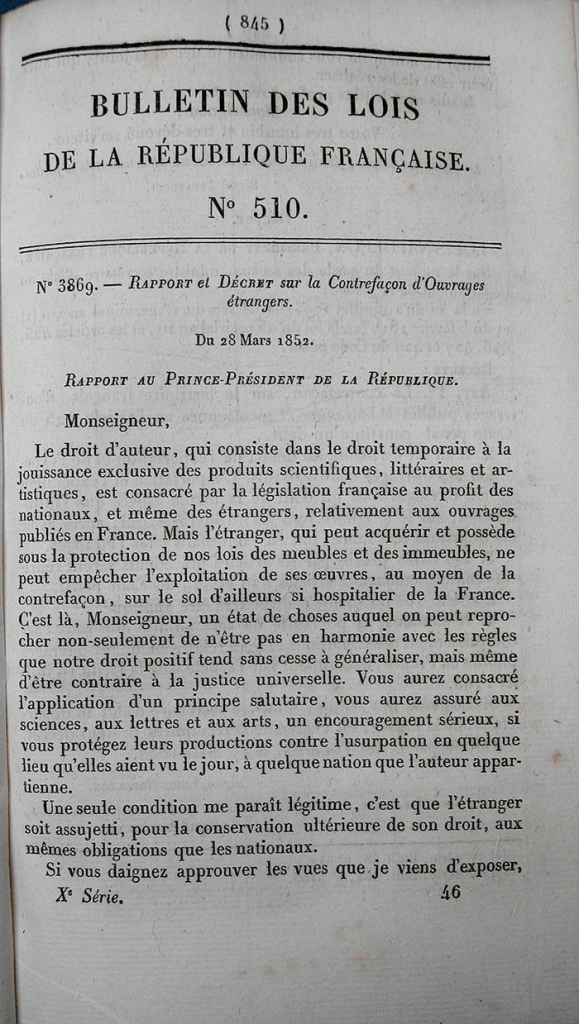
Report and decree on the counterfeiting of foreign works. (X, Bull. DX, n. 3869.)
Report to the Prince-President of the Republic.
Monseigneur, copyright, which consists of the temporary right to exclusive enjoyment of scientific, literary and artistic products, is enshrined in French legislation for the benefit of nationals, and even of foreigners, with respect to works published in France. But the foreigner, who can acquire and possess movable and immovable property under the protection of our laws, cannot prevent the exploitation of his works through counterfeiting on the otherwise so hospitable soil of France. This, Monseigneur, is a state of affairs which one may criticise not only for not being in harmony with the rules that our positive law constantly seeks to generalise, but even for being contrary to universal justice. You will have consecrated the application of a salutary principle, you will have assured the sciences, letters and arts a serious encouragement, if you protect their productions against usurpation wherever they may have seen the light of day, to whatever nation the author belongs. Only one condition seems legitimate to me: that the foreigner be subject, for the subsequent preservation of his right, to the same obligations as nationals. If you deign to approve the views I have just set forth, I will have the honour to submit to you the attached decree, which will have the effect of realising them. I am with the most profound respect, Monseigneur, your very humble and very devoted servant, the Keeper of the Seals, Minister Secretary of State for the Department of Justice, signed ABBATUCCI.
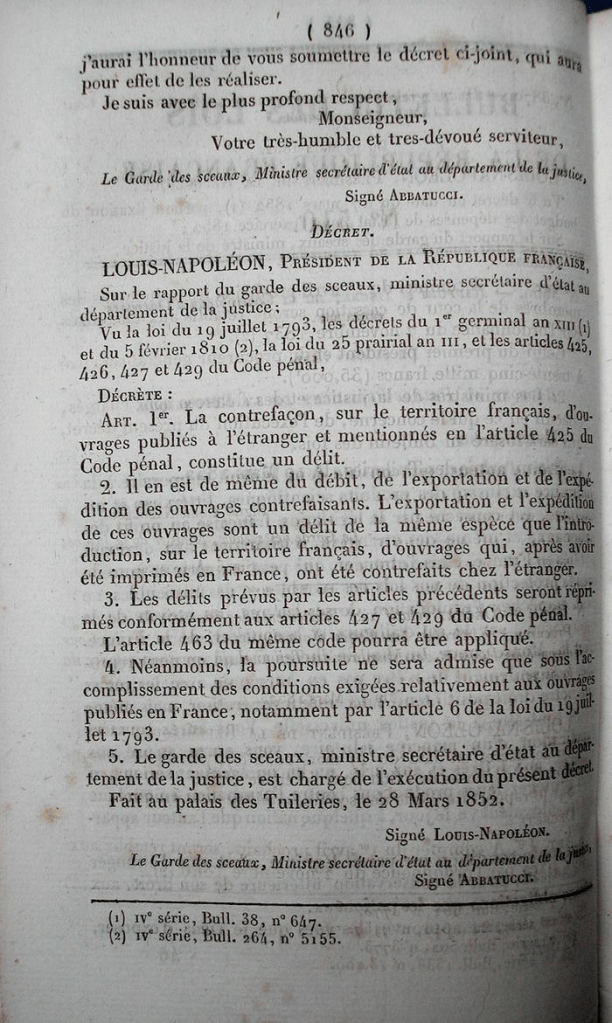
Decree.
Louis-Napoléon, President of the French Republic, on the report of the Keeper of the Seals, Minister Secretary of State for the Department of Justice; having seen the law of July 19, 1793, the decrees of 1 Germinal year 13 and February 5, 1810, the law of 25 Prairial year 3, and Articles 425, 426, 427 and 429 of the Penal Code, decrees:
Art. 1. Counterfeiting, on French territory, of works published abroad and mentioned in Article 425 of the Penal Code, constitutes an offence.
Art. 2. The same applies to the sale, export and dispatch of counterfeit works. The export and dispatch of such works is an offence of the same kind as the introduction onto French territory of works which, after having been printed in France, have been counterfeited abroad.
Art. 3. The offences provided for in the preceding articles shall be punished in accordance with Articles 427 and 429 of the Penal Code. Article 463 of the same Code may be applied.
Art. 4. Nevertheless, prosecution shall only be admitted subject to the fulfilment of the conditions required with respect to works published in France, notably by Article 6 of the law of July 19, 1793.
Art. 5. The Minister of Justice (Mr Abbatucci) is charged, etc.
I write this as I return from a whirlwind week in Geneva—a city I had long longed to visit. Partly because of my PhD work, partly because of its place in the history of international (IP) law, and partly because some cities acquire an almost mythical quality when you spend years reading about them before ever setting foot in them. Geneva was one such city.
Thankfully, SciencesPo generously provided the funding that made this long-standing wish a reality.
Much like I did after my archival adventures at the British Library in London, I thought I’d set down a few practical notes for those interested in conducting research at the World Intellectual Property Organisation (WIPO).
As I have noted before, archival research can often feel intimidating, especially when the institution in question happens to be one of the most influential international organisations in the IP universe. Throw in layers of bewildering bureaucracy, security protocols, institutional formalities, and dare I say …. enough acronyms to populate a small dictionary, and things can appear rather daunting.
If that’s what you’re thinking, I hear you, dost. I do, yes, I do.
But here’s the good news: WIPO is far more accessible than one might imagine. Like many large institutions, it becomes significantly less intimidating once you find the right person to guide you through its labyrinthine corridors—both literal and metaphorical.
In my case, that person was Dr Edward Kwakwa, whom I had the pleasure of meeting at a conference in Finland last year, organised by a dear friend and mentor, Dr Daniel Acquah. An honest ask, a sincere follow-up and voila — an archival aspiration suddenly became a practical possibility.
For those uninitiated, WIPO is the United Nations specialised agency for intellectual property, established in 1967. Depending on where one positions oneself politically, WIPO is either a champion of global innovation, a sophisticated vehicle for the internationalisation of Western IP norms, or—as is often the case—a fascinating olio of all of the above.
Whatever your ideological inclinations, if your interests lie in the history of IP, international law, development, technology governance, or the broader politics of knowledge production, WIPO’s archives are a treasure trove. Buried within those boxes and files are stories of negotiations and norm-making, diplomatic dramas and developmental debates, institutional anxieties and geopolitical ambitions, and competing visions of the global knowledge order—some forgotten, some flourishing, and some still fighting for relevance today.
So if any of that sounds remotely interesting, make the trip.
First Things First: Thanks to Sahana and Colin!
Before I get to the practicalities, two people deserve special mention.
The first is my dear friend and colleague, Sahana Simha, currently a fellow at WIPO. Sahana not only hosted me but also shepherded me through the peculiar puzzles of a new city and a new institution! Every researcher needs a friendly local guide; I had the good fortune of finding one. She is the reason my first day—and indeed my entire stay—was considerably less chaotic than it might otherwise have been. May all travelling researchers be blessed with a Sahana-esque host.
The second is Colin Wells, Archives Management Officer at WIPO. I can’t emphasise this enough that archivists and librarians are the unsung heroes of historical research. We academics may eventually get our names etched onto articles and books, but archivists and librarians are the people who rescue order from chaos, retrieve forgotten files, and, of course, save us from ourselves.
Colin did all of this with praiseworthy patience and precision. He arranged materials in advance, answered (or perhaps endured) my endless questions, and ensured that my limited time in Geneva was spent reading documents rather than chasing them.
I am deeply grateful to both of them. May their tribe increase!!!
Now … comes the Practical Bit
A small caveat at the outset: WIPO’s archival programme is still something of a work in progress. Unlike older institutions whose archival systems have been polished over decades, WIPO’s Archives department is still in its salad days—growing, evolving, and finding its feet. But do not mistake juvenescence for inefficiency. The team is helpful and even enthusiastic about facilitating research.
The key is simple: plan early and coordinate carefully.
The first step is to identify relevant files from WIPO’s archival catalogue, which can be obtained by contacting <wipoarchives@wipo.int>. Alternatively, you can simply send a general query and seek their advice. Once you have a sense (or at least an inkling?) of what you need, contact the archives team with your specific request. Subsequently, they will review the materials, determine accessibility, and guide you through the process.
As you might imagine, WIPO is not the sort of place where one simply saunters in with a notebook, a laptop, and an oozing optimism. Security is taken rather seriously. Dates have to be coordinated well in advance, and once your visit is approved, the archives team will alert security and ask for your identification details beforehand. You will then be issued a visitor badge, which must be faithfully collected each morning and surrendered at the end of the day (no, this is not negotiable). The library is open from 9 a.m. to 5 p.m. And they are, in the nicest possible way, quite strict about those hours.
Once all that is done… voilà… You have successfully navigated Geneva’s gentlest gauntlet of bureaucracy. You will then be allowed in the WIPO Library within the main complex. This became my temporary habitat from Monday through Friday, where I sifted through files and scanned a potpourri of pages.
One of the curious joys of archival research is that you may arrive with one question and leave with twenty more. The WIPO archives, which I am only beginning to pore over carefully, will be no exception. Given my limited time, I confined myself largely to materials relevant to my immediate interests—the discourse surrounding international copyright law between roughly 1900 and 1950.
Even then, the archive kept tempting me down new paths. I will share some stories in the coming days here at this site, at SpicyIP, or IPRMENT. Keep an eye on the space.
In sum, if you are considering archival research at WIPO, my advice is simple: plan ahead, contact the archives team early through the above-mentioned email ID, be patient with the process, and leave ample room for serendipity. Well … the archives may be carefully catalogued, but the most delightful discoveries seldom are.
Such is (archival!) life.
I hope these notes prove useful to anyone contemplating a research trip to Geneva. If you have questions about the process, do leave them in the comments, and I’ll do my best to answer.
Happy hunting.
LV
P.S. An unexpected yield of the visit was a rapid introduction to Bangalorean English. By week’s end, I was emboldened enough to confidently tell Sahana, “Macha, put off one scene, no!” Quite what I meant by this—and whether I used it in the correct context—remains shrouded in uncertainty (just like unexcavated archives). But it is, without question, a linguistic achievement that may ultimately outlast anything I unearthed in the archives.
So the other day …. I fell, most unwillingly but quite happily, down a rather curious piece (though I confess I only truly read it now, as one does with the more tempting of intellectual distractions! Alas, life is such).
It was a piece from 1967 in the Duke Law Journal, a slender sixteen-page text … dressed in all the full regalia of the American law review tradition. I mean … the dense, deliberate, and detailedly footnoted text, as though the citations are contesting for attention with the text they adorn.
But there is something else as well that ignites my interest in this piece. For one, there is, I find, something rather beguiling about writing on Soviet copyright discourse. It remains strangely under-visited in English scholarship, or at least, not easily sighted in the usual mainstream historical scholarship. Perhaps it is hiding in some archives acloves, carrying the digital dust … awaiting more patient, more persistent pursuers. At times, I suspect I ought to search more earnestly; there is likely an entire cartography of thought yet unmapped.
Secondly, as I suggested above, I liked the citations of this piece, which detour into forgotten corners, pause for brief historical asides, and occasionally seem to breathe with a life of their own. One begins to feel (at least I did) that the author took greater pleasure in the footnotes than in the main text itself.
(Well … if one were ever inclined toward an IP trivia night, this is the sort of piece one would chip in, quietly and watch the room slowly realise that copyright discourse is far more entertaining than it had dared to assume.)
But I shall not linger in preamble any longer. Below follows the citation of the piece, and thereafter a fragment of its introduction
THE COPYRIGHT laws of a country have no extraterritorial application. Nevertheless, practically every nation in the world, by adherence to either bilateral or multilateral treaties or conventions, protects copyrights of foreign nationals. The Soviet Union alone among the major world powers has refused to recognise international copyright and does not adhere to any treaty or convention for the protection of copyrights. As a result, that country’s state-controlled publishing firms have, generally without seeking permission or paying royalties, printed whatever foreign works they felt were suitable for Soviet minds. During the period from 1917-1950, it has been estimated that one billion copies of books protected by foreign copyright were published in the Soviet Union. Among these were more than seventy-seven million copies of 2700 books by some 200 United States authors, including Jack London, Mark Twain, Theodore Dreiser, Upton Sinclair, Erskine Caldwell, Sin-clair Lewis, John Steinbeck and Ernest Hemingway.” Numerous foreign scientific and technical publications, short stories, plays10 and miscellaneous articles¹¹ have also been published in the U.S.S.R. Thus, that country has been characterized as “the world’s most active literary pirate.”This article will consider various reasons for the Soviet Union’s position concerning international copyright. In addition, it will outline some attempts which have been made to change the Soviet view and evaluate future prospects for the solution of the problem.
(This post continues a series where I share readings that I’ve found useful or, at the very least, intellectually stimulating. See here and here.)
Salam/Namaskar
The nineteenth century was somewhat a moment for international law. It was marked by a distinctive, I’d say, thought style in which organising international congresses to address perceived “social problems” became almost a thing. Intellectual property (IP) treaties were no exception. The late nineteenth century, as Bentley and Sherman claim, was a period of consolidation of IP laws and the beginnings of IP expertise as a specialised legal field. (Its a must-read book for IP history enthusiasts!)
I recently chanced upon two pieces that speak nicely to this broader historical moment, and I think our readers here may find them both useful and intriguing. Before pasting their abstracts below, let me briefly flag what they offer.
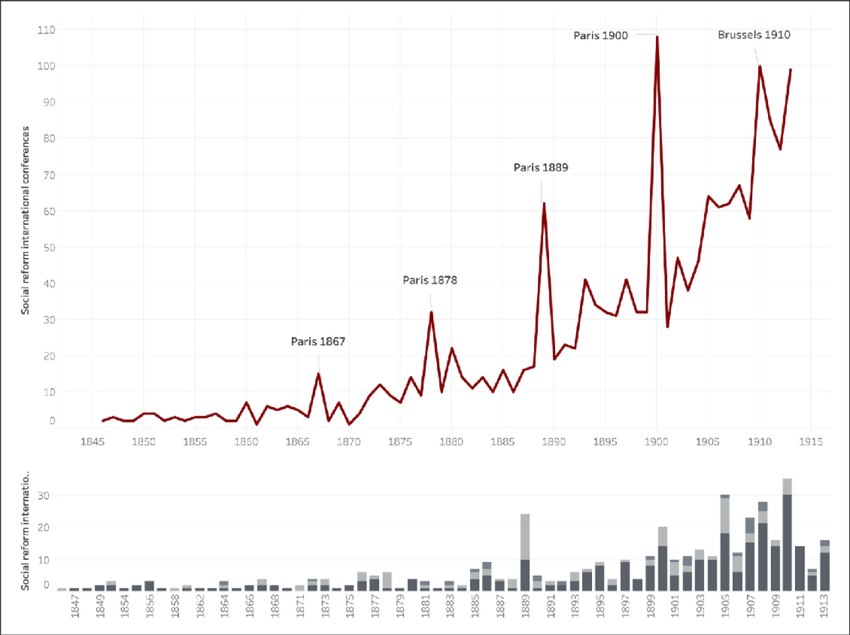
The first piece looks at the international congresses held between 1846 and 1914. ‘Tis a short yet sharp account of the early conference culture of internationalism—mapping not only the sheer proliferation of such meetings, but also the kinds of ideas, aspirations, and even anxieties that circulated within them. It can be a useful piece for someone willing to dig deeper into this topic. For those interested in IP like me, this can turn useful in tracing the genealogy of international copyright law.
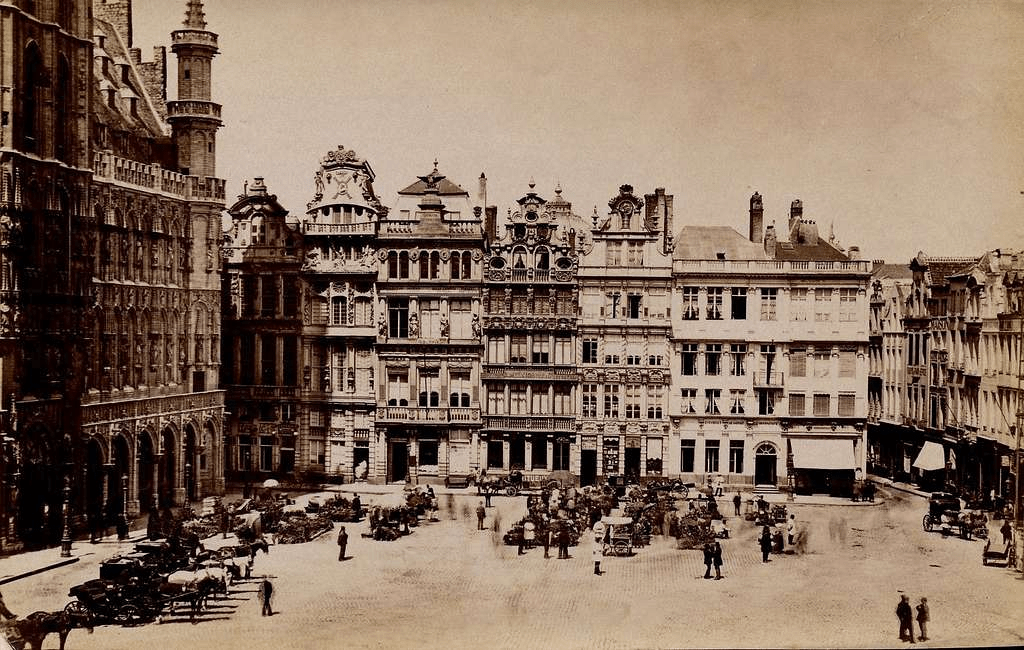
Belgium, as is well known, emerges as a key site in this history. Brussels hosted a remarkable number of international copyright meetings, most notably the 1858 Congress, arguably the first serious attempt to forge the foundation of international copyright law, which would later become the Berne Convention. The second piece offers why Belgium came to organise so many international congresses in the first place. These congresses functioned as a form of soft power.
Read together, these pieces help situate international copyright law not merely as a doctrinal or treaty-based development, but as part of a wider nineteenth-century culture of conferencing, expertise-building, and international problem-solving—one where law, politics, and power were deeply intertwined.
Okay, here are the readings:
Christophe Verbruggen et al, Social Reform International Congresses and Organizations (1846–1914): From Sources to Data, Journal of Open Humanities Data (2022)
TIC-Collaborative was a collaborative digital humanities project that focused on transnational intellectual cooperation (TIC) in the long nineteenth century, in particular on transnational connections in the field of social reform. The dataset contains information on over 1650 international congresses and 450 organizations and conference series related to the social question. The project focussed on the Low Countries and a selection of reform areas.
The piece also provides a gripping graph showing how the congresses escalated after 1845, see page 4
“Social reform international congresses and organizations, 1846–1914”
DAVID AUBIN, Congress Mania in Brussels, 1846—1856: Soft Power, Transnational Experts, and Diplomatic Practices, 50(4) Historical Studies in the Natural Sciences (2020) pp. 340-363 (24 pages)
In 1853, the director of the Belgium Royal Observatory, Adolphe Quetelet, welcomed delegates from several countries to two consecutive meetings that have acquired considerable reputation as the first international congresses of, respectively, mete- orology and statistics. This paper examines the local context where several similar international congresses (on free trade, universal peace, prison reform, public hygiene, etc.) were organized in the same decade. It argues that the new Belgian state developed this new form of international conference in order to bolster its soft power in the Concert of Nations. It also discusses tensions between national interests and global beliefs in the efficiency of science, which arose from these congresses.
On a tangential (but highly recommended) note, do check out this beautifully penned piece by my dearest friend Shivam Kaushik, How India Learnt to Stop Complaining and Love Copyright. It pairs rather well with the themes discussed here.
Okay, that’s it for this post! See you in the next post.