A Curious Copyright Footnote of 1938 Proceedings of the American Society of International Law at Its Annual Meeting

Image from here

Bonjour,

I found something today, not that dazzling or dramatic (like I found before), but perhaps a useful little footnote at the very least.

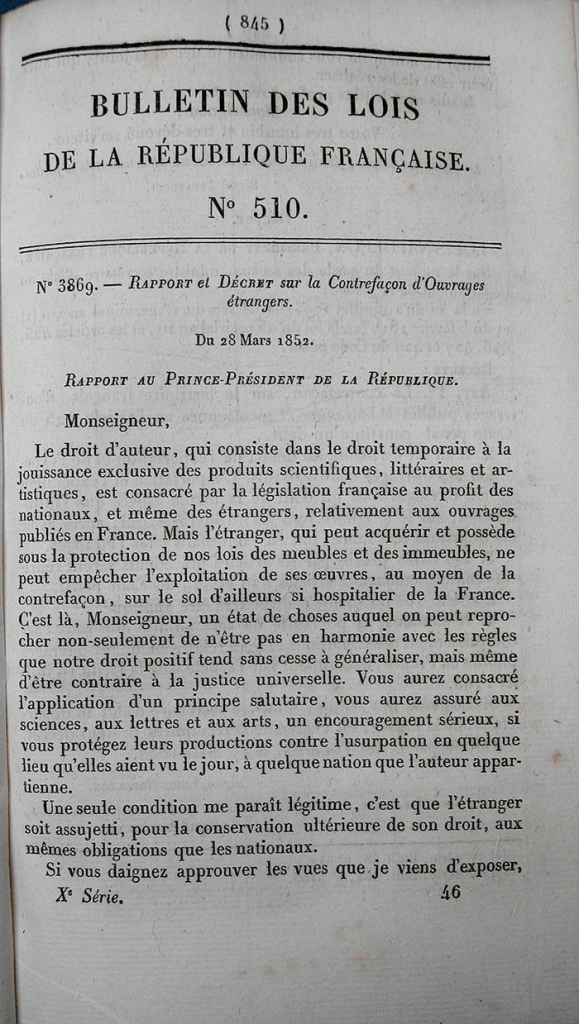
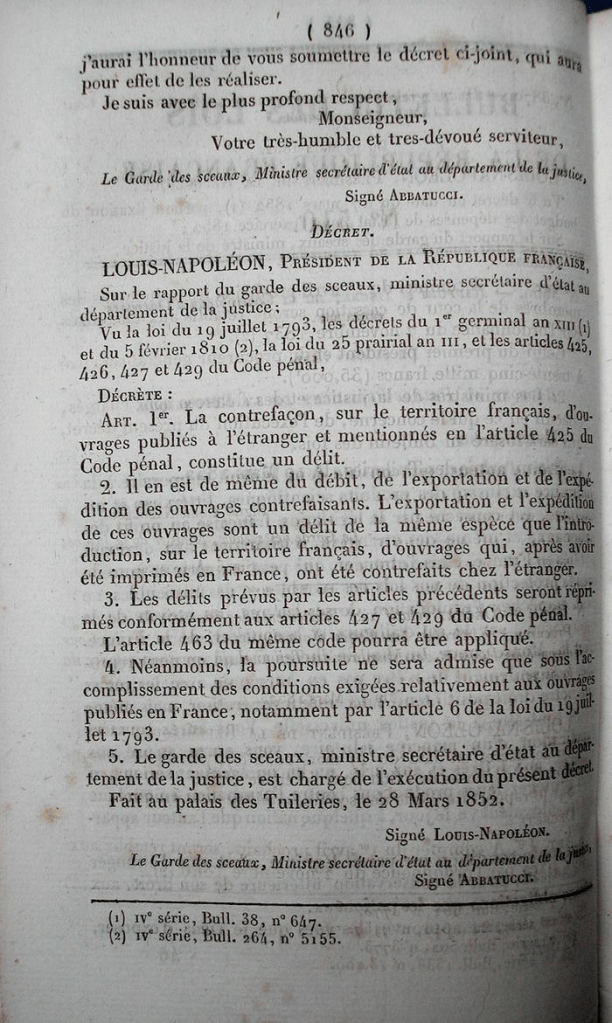
While the postwar shift in U.S. copyright policy—from pirate nation to IP policeman—is hardly news, it is still striking to see it stated so plainly on record by Richard C. De Wolf, then Law Officer of the U.S. Copyright Office. There are, of course, other sources that point in the same direction, but having lit upon this one, I thought it worth flagging for further scrutiny. I came across the remark while leafing through the 1938 Proceedings of the American Society of International Law. There is nothing revolutionary here … but only the sort of archival soupçon that lends a scholarly piece a sharper, more serviceable footnote.

Source: Wallace McClure & Clement L. Bouvé, International Law of Copyright, 32 Proceedings of the American Society of International Law at Its Annual Meeting 44–62 (Apr. 28–30, 1938). https://www.jstor.org/stable/25656973 

At page 56, De Wolf remarks:

The question is always coining up: Why is it that the United States, which has long been a party to other conventions for the protection of intellec tual and industrial property, should have so long remained outside the Con vention for the Protection of Literary Property.

I think a little reflection answers that question. We have been, in regard to inventions, a creating or producing nation. Our inventions have gone abroad and our interest has been to see to it that an American inventor was protected in foreign countries without too much difficulty. On the other hand, until quite recently the United States has been a consuming country with regard to the creations of the mind in the narrower sense, that is, works of literature and art. Therefore, the interests of the exploiters of literary property have prevailed in this country over those of the producers. But now the shoe is going onto the other foot. Since the advent of American motion pictures and a certain type of popular music, Europe has come to be much more largely a consumer of American products of these kinds than it was in earlier times. Consequently we are beginning to think of the interests of our own creators of literature and art in foreign countries and we are asking the question why should we have to go to thirty or forty different foreign countries and perform formalities in those different countries in order to be sure that these works of ours are protected there. 

Something seems inherently wrong and repugnant to logical thinking in the idea that a man, having written a book?and I presume among all of this audience there is no one who has not done it or has not thought of doing it? should have to go through a lot of burdensome formalities in order to have that work copyrighted in every different foreign country. Of course this was the aspect of the thing that was present in the minds of the people who for mulated the International Copyright Convention. Each country, of course, preferred to legislate for itself; each country had a certain national policy with regard to what should be done to protect copyrights and, of course, wanted to adhere to that with regard to the works of foreign authors. 

But after a while the system broke down. An Englishman writing a book had to attend to formalities in twenty-five or thirty foreign countries, and a Frenchman likewise. The formalities became so burdensome that every body got together and said, “Here, we will all make some sacrifices. We will sacrifice our national inclinations so far as the citizens of other countries are concerned and, in return, they will sacrifice their inclinations so far as we are concerned, and we will all get together and wipe out the formalities. And the fact of the matter is that the system has worked, and I am sure they would not think of abandoning it. Yet, as Colonel Bouve has pointed out, each country is left with a wide latitude with respect to its own citizens and also with respect to the assertion of protection in the courts of the country. 

It seems to me that the time has now come when the United States must take up this question seriously. In fact, it has been taken up seriously for some time past. When I first came to the Copyright Office thirty years ago I met Thorvald Solberg, who then and for many years afterwards was Register of Copyrights and whom you know as a persistent advocate of the adherence of the United States to the Copyright Convention. I am frank to say that I imbibed these views from him, and I hold them now. I think that really will be the next and greatest advance in the field of copyright law which is now open to the United States.

Okay. That’s it from my end today. See you in the next post.

Thanks

A Quick Note on Archival Research at the British Library

Image from here

Salam/Namaskar,

A few months ago, while working at the British Library in the UK for my PhD research, Akshat suggested that I put together a short note, a quick guide, of sorts, on conducting archival research there. I must note at the outset that I remain a novice in this space, learning as I go, and understanding the rhythms of the British Library’s reading rooms. What follows, therefore, is not a definitive directive but a modest, even meandering reflection on my own experience.

1. Registration and Access: Access to the British Library begins with getting a Reader Pass. To do this, you must: Provide a valid identification document with proof of address. Importantly, anyone from anywhere in the world can register, provided they have a valid address and the required documentation. See here for more information.

2. Choosing the Reading Room: Once registered, the next step is to determine which Reading Room is most relevant to your work. The Library has several rooms, including Manuscripts, Newspapers, Rare Books, and the South Asian reading rooms, etcetera. Please note that materials related to your field may not always be limited to a single room. For example, even if you are working on copyright law, you may find useful material in the Newspaper section, Manuscripts, or South Asian collections. You can search them here.  Personally, I usually begin with the South Asian collections, as much of my research relates to colonial and Indian copyright history.

3. Using the Online Catalogue and Requesting Materials: The British Library website and catalogue are central to the research process. You can find all the catalogues in our collection https://www.bl.uk/collection, which holds over 170 million items–something that grows bigger every day. Speaking of my my, here’s how I do it. I begin with broad search terms (for example: “British copyright law,” “Indian copyright,” or “international copyright”) on this Archives and Manuscripts Catalogue, but you can also check the Main Catalogue.

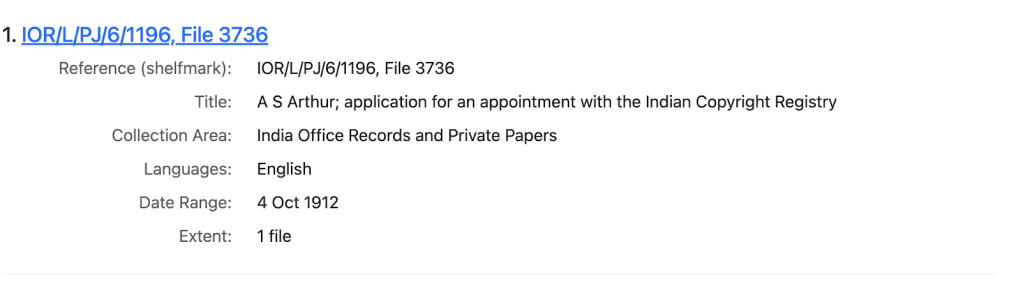
Once you see a relevant document, you can either submit a request online using your account (you have to create one) or, in most cases, you can use this Request form to access the material. Accuracy is crucial when filling out the request form — particularly when selecting the correct “collection area” or designated reading room. See the image below for what I mean by the collection area. If this is entered incorrectly, the request may be rejected. 

It takes around an hour to receive your requested material, so you must submit the request on time. For example, if you request it in the late evening around 3 PM, you may receive it by 4, but you cannot finish reading it, as you will need to return the material by 4.40 PM, as many reading rooms close at 5 PM. 

Of course, you cannot make unlimited requests. As I was informed, you can make up to 10 requests per day. At any given time, you cannot have more than 30 items requested or in circulation. (But do confirm this …) If it’s your first time, don’t worry. The librarians are extremely helpful, especially if you know: the relevant years, the names of individuals, or the type of document you are searching for. Please know that while photography is generally permitted, in some cases, you may obtain permission from the reference staff, but this is not guaranteed.

Final words

Archival work itself can be demanding. Locating relevant sources is surely difficult, confusing, and even taxing. What I typically do is treat each document as a lead: once I see a name, a reference, a date, or a piece of correspondence, I follow it further. One file points to another, and gradually a network of connections and a story begin to emerge.

To give a concrete example: While researching the history of the Indian Copyright Act of 1847, I encountered references to Lord Hardinge, who was the Governor-General of India at the time. While I have yet to investigate this trail fully, a search of the catalogue for correspondence from 1846 to 1849 reveals that files containing his letters do exist. On my next visit, I plan to check the specific letters mentioned in the copyright file discussions. In doing so, I hope to trace the exchanges more closely and see the history(ies) surrounding the drafting of the Act.

In sum, the key is simply to begin ‘somewhere’ — with a topic, a name, a year, or a letter — and then follow the trail with care.

Okay, that’s from my end for now.

À bientôt, de vous revoir.

An Interesting 1965 Piece: International Copyright and the Soviet Union by Allan P. Cramer

Image from here

Namaskar/Salam

So the other day …. I fell, most unwillingly but quite happily, down a rather curious piece (though I confess I only truly read it now, as one does with the more tempting of intellectual distractions! Alas, life is such).

It was a piece from 1967 in the Duke Law Journal, a slender sixteen-page text … dressed in all the full regalia of the American law review tradition. I mean … the dense, deliberate, and detailedly footnoted text, as though the citations are contesting for attention with the text they adorn.

But there is something else as well that ignites my interest in this piece. For one, there is, I find, something rather beguiling about writing on Soviet copyright discourse. It remains strangely under-visited in English scholarship, or at least, not easily sighted in the usual mainstream historical scholarship. Perhaps it is hiding in some archives acloves, carrying the digital dust … awaiting more patient, more persistent pursuers. At times, I suspect I ought to search more earnestly; there is likely an entire cartography of thought yet unmapped.

Secondly, as I suggested above, I liked the citations of this piece, which detour into forgotten corners, pause for brief historical asides, and occasionally seem to breathe with a life of their own. One begins to feel (at least I did) that the author took greater pleasure in the footnotes than in the main text itself.

(Well … if one were ever inclined toward an IP trivia night, this is the sort of piece one would chip in, quietly and watch the room slowly realise that copyright discourse is far more entertaining than it had dared to assume.)

But I shall not linger in preamble any longer. Below follows the citation of the piece, and thereafter a fragment of its introduction

Citation: Allan P. Cramer, International Copyright and the Soviet Union, 1965 Duke Law Journal 531-545 (1965). Available at: https://scholarship.law.duke.edu/dlj/vol14/iss3/3

INTRODUCTION (footnotes omitted)

THE COPYRIGHT laws of a country have no extraterritorial application. Nevertheless, practically every nation in the world, by adherence to either bilateral or multilateral treaties or conventions, protects copyrights of foreign nationals. The Soviet Union alone among the major world powers has refused to recognise international copyright and does not adhere to any treaty or convention for the protection of copyrights. As a result, that country’s state-controlled publishing firms have, generally without seeking permission or paying royalties, printed whatever foreign works they felt were suitable for Soviet minds. During the period from 1917-1950, it has been estimated that one billion copies of books protected by foreign copyright were published in the Soviet Union. Among these were more than seventy-seven million copies of 2700 books by some 200 United States authors, including Jack London, Mark Twain, Theodore Dreiser, Upton Sinclair, Erskine Caldwell, Sin-clair Lewis, John Steinbeck and Ernest Hemingway.” Numerous foreign scientific and technical publications, short stories, plays10 and miscellaneous articles¹¹ have also been published in the U.S.S.R. Thus, that country has been characterized as “the world’s most active literary pirate.”This article will consider various reasons for the Soviet Union’s position concerning international copyright. In addition, it will outline some attempts which have been made to change the Soviet view and evaluate future prospects for the solution of the problem.

Do take a look at the piece. Happy reading …

See you in the next post.

A bientôt.

Interesting Reading: 19th Century’s Conference Culture and Belgium’s Soft Power

Image from here


(This post continues a series where I share readings that I’ve found useful or, at the very least, intellectually stimulating. See here and here.)

Salam/Namaskar

The nineteenth century was somewhat a moment for international law. It was marked by a distinctive, I’d say, thought style in which organising international congresses to address perceived “social problems” became almost a thing. Intellectual property (IP) treaties were no exception. The late nineteenth century, as Bentley and Sherman claim, was a period of consolidation of IP laws and the beginnings of IP expertise as a specialised legal field. (Its a must-read book for IP history enthusiasts!)

I recently chanced upon two pieces that speak nicely to this broader historical moment, and I think our readers here may find them both useful and intriguing. Before pasting their abstracts below, let me briefly flag what they offer.

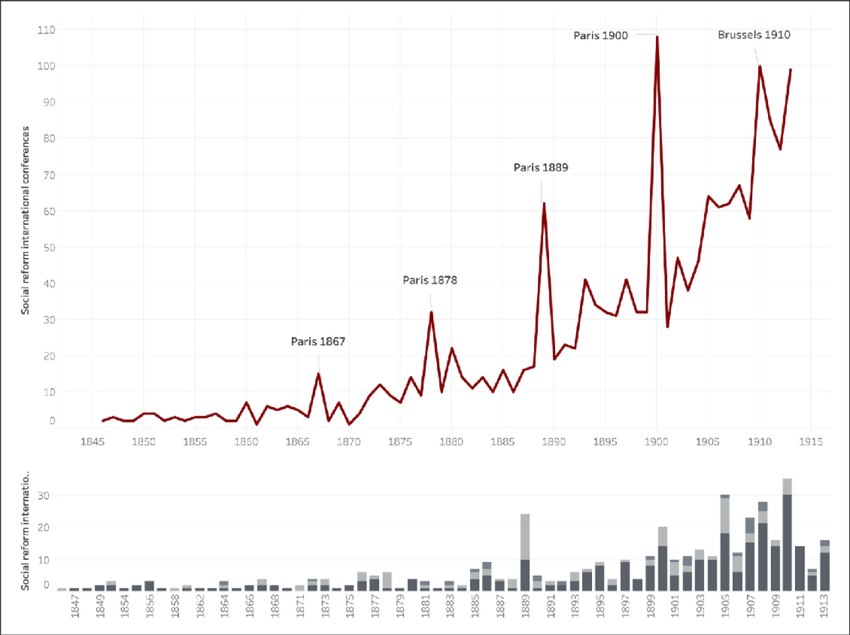
The first piece looks at the international congresses held between 1846 and 1914. ‘Tis a short yet sharp account of the early conference culture of internationalism—mapping not only the sheer proliferation of such meetings, but also the kinds of ideas, aspirations, and even anxieties that circulated within them. It can be a useful piece for someone willing to dig deeper into this topic. For those interested in IP like me, this can turn useful in tracing the genealogy of international copyright law.

Belgium, as is well known, emerges as a key site in this history. Brussels hosted a remarkable number of international copyright meetings, most notably the 1858 Congress, arguably the first serious attempt to forge the foundation of international copyright law, which would later become the Berne Convention. The second piece offers why Belgium came to organise so many international congresses in the first place. These congresses functioned as a form of soft power.

Read together, these pieces help situate international copyright law not merely as a doctrinal or treaty-based development, but as part of a wider nineteenth-century culture of conferencing, expertise-building, and international problem-solving—one where law, politics, and power were deeply intertwined.

Okay, here are the readings:

Christophe Verbruggen et al, Social Reform International Congresses and Organizations (1846–1914): From Sources to Data, Journal of Open Humanities Data (2022)

TIC-Collaborative was a collaborative digital humanities project that focused on transnational intellectual cooperation (TIC) in the long nineteenth century, in particular on transnational connections in the field of social reform. The dataset contains information on over 1650 international congresses and 450 organizations and conference series related to the social question. The project focussed on the Low Countries and a selection of reform areas.

The piece also provides a gripping graph showing how the congresses escalated after 1845, see page 4

“Social reform international congresses and organizations, 1846–1914”

DAVID AUBIN, Congress Mania in Brussels, 1846—1856: Soft Power, Transnational Experts, and Diplomatic Practices, 50(4) Historical Studies in the Natural Sciences (2020) pp. 340-363 (24 pages)

In 1853, the director of the Belgium Royal Observatory, Adolphe Quetelet, welcomed delegates from several countries to two consecutive meetings that have acquired considerable reputation as the first international congresses of, respectively, mete- orology and statistics. This paper examines the local context where several similar international congresses (on free trade, universal peace, prison reform, public hygiene, etc.) were organized in the same decade. It argues that the new Belgian state developed this new form of international conference in order to bolster its soft power in the Concert of Nations. It also discusses tensions between national interests and global beliefs in the efficiency of science, which arose from these congresses.

On a tangential (but highly recommended) note, do check out this beautifully penned piece by my dearest friend Shivam Kaushik, How India Learnt to Stop Complaining and Love Copyright. It pairs rather well with the themes discussed here.

Okay, that’s it for this post! See you in the next post.

New Paper: Indian Copyright Law in the Age of GenAI: Knowledge/Power, Patchwork, and Peril

Image from here

Bonjour,

Happy New Year! Hope you had a nice beginning of the year!

I recently published an article in the Indian Journal of Law and Technology, co-authored with my good friend Luca Schirru. Apart from being a brilliant human being and an exceptionally kind soul (!), Luca is a Post-Doctoral Researcher at the Brazilian Institute of Citizen Science (INCC), Research Coordinator at the Centre on Knowledge Governance, and a Research Fellow at CiTiP, KU Leuven

Though I must note here that given the rapid pace of AI developments, parts of the piece may already feel dated, and my own understanding of discourse has evolved since we wrote it a few months ago. Nonetheless, the article can provide useful insight into the limitations of contemporary copyright thinking and open up a broader inquiry into what limits our thinking.

Below is the abstract of our piece. Those interested in the piece can check the full piece here. Full Citation: Vyas, Lokesh and Schirru, Luca (2024) “Indian Copyright Law in the Age of GenAI: Knowledge/Power, Patchwork, and Peril,” Indian Journal of Law and Technology: Vol. 20: Iss. 2, Article 2.
DOI: 10.55496/ZGDS8505

Abstract

Isn’t copyright law an analog relic, striving to stay relevant in a digital world and hoping to survive an AI-driven and quantum-coded future? We argue it is. It is a law, born in a world of paper and print, now finding itself (again) patching its foundations to keep pace with generative AI (‘GenAI’). This unruly, still-developing technology not only redefines creative processes but also challenges the very assumptions of authorship, creativity, and copying. While discussions on this technology and copyright law abound, amid all the noise, one question simmers beneath the surface: ‘Is the very way we approach GenAI and copyright already shaped—if not confined—by the limits of discourse, where the language of law now struggles to think beyond itself?’. This question matters because, by the time the AI/copyright debate reached Indian courts, the terrain of legal arguments, policy proposals, and ideological fault lines appears to have been already drawn.

From U.S. lawsuits to European policies, the discourse around GenAI and copyright had crystallised into a vocabulary of ‘fair dealing’, ‘licensing’, and ‘exceptions’, leaving little space to rethink beyond the oft-claimed solutions. We argue this is not merely about finding the correct legal answers anymore. It is about the discourse—the invisible architecture of thought that shapes (and saps) what can be said, imagined, or reformed. In India, one can sense the gravitational pull. Our legal debates echo the voices of distant courtrooms and Brussels backrooms. While the facts may differ, the footnotes may change, the lingo may be localised, the skeleton of arguments remains eerily familiar. There is little space, it appears, left to ask the most fundamental question: ‘What do we want copyright to do for us now?’.

Drawing on Foucault’s ideas of knowledge/power, this paper offers a discourse analysis of the current AI/copyright conversation. We do not aim to critique GenAI reforms per se, but to underscore the discursive boundaries within which such reforms are conceived, debated, and defended. If employing copyright law as the primary tool to deal with Gen-AI-related issues is a trap, the more profound question becomes: ‘Who built it, who benefits from it, and who remains stuck?’. Far from being a jurisprudential vacuum (as the first hearing in ANI v. OpenAI suggested), India’s GenAI debates are already saturated—saturated with inherited ideas, imported frameworks, and invisible hierarchies of thought. This paper is an attempt to lift that lid and let a little fresh air in. After all, it is through the cracks (or perhaps, diagnosing the gap) where the light comes in.

The post is incomplete without acknowledging the many minds that shaped it. We owe a big thank-you to Bharathwaj Ramakrishnan and Aditya Gupta for their thoughtful comments on earlier drafts! We are also grateful to Professor Sean Flynn, Director of PIJIP, where both of us have worked (and continue to work) in different capacities. Many of the ideas in the piece were forged, consciously or otherwise, in there. And, as is often the case, several strands of thought in this piece owe their origin to my long conversations with Swaraj Barooah and other members of the SpicyIP family. And of course, a big shout-out to the IJLT team for their useful feedback and much-needed patience! The usual disclaimer applies: any errors, infelicities, or excesses of enthusiasm are entirely ours. After all, as some wise soul once said, mistakes are what make us human.)

Cool. À bientôt!

A very Interesting 1992 piece called “Critical Perspectives on the History and Philosophy of Copyright” by RONALD V. BETTIG

Image from here

I recently came across a fascinating work on the history and theory of copyright law titled Critical Perspectives on the History and Philosophy of Copyright by Ronald V. Bettig, published in 1992. It references some compelling historical studies related to copyright law and, more broadly, knowledge production. I will be discussing some of these in my upcoming post. In this post, I want to introduce readers to Bettig’s work and briefly outline its content. I would encourage readers to check it out—it is relatively short, spanning only 26 pages.

Full citation:

Ronald V. Bettig (1992), Critical perspectives on the history and philosophy of copyright, Critical Studies in Mass Communication, 9:2, 131–155. (Unfortunately paywalled, but feel free to reach out if you need a copy.)

The abstract of Bettig’s piece explains:

“The philosophy of intellectual property reifies economic rationalism as a natural human trait and assumes that, without mechanisms such as copyrights and patents, human beings would cease to be intellectually and artistically creative. To discover the roots of this assumption, this article employs a theoretical combination of political economy and the cultural history of communications to locate the origins of the concept of literary property. With attention directed toward the modes and relations of production and communication, this study reveals that the rise of capitalism and the development of the printing press are the keys to understanding the emergence of intellectual property law and how it serves as the basis for the “enclosure” of the intellectual and cultural “commons.”

Betty begins the piece by noting that

“Critical research on intellectual property is still pioneering work, including the relatively unexplored history of copyright. The traditional histories of copyright (see Bugbee, 1967; Patterson, 1968; Putnam, 1896/1962; Whale, 1971) provide adequate descriptions of the origins and evolution of copyright but lack any real explanation for its emergence and function. These histories are also teleological; they treat the evolution of the concept of literary property as a reflection of the natural progressiveness of human beings. The history of copyright developed in this article is based on an analytical framework that stresses the modes and relations of production and communications as the key explanatory variables in accounting for the origin and development of a concept of literary property. Accordingly, this history of copyright suggests that there is an essential connection between the rise of capitalism, the extension of commodity relations into literary and artistic domains, and the emergence of the printing press.

The first section of this article looks for evidence of intellectual property rights in ancient and medieval times. In a second section, an analysis of the dawn of capitalism and the development of the printing press is linked to the emergence of copyright, a crucial connection that is generally neglected in the traditional histories. The evolution of copyright in England and the United States is the central focus of the third section, which includes a significant revision and expansion of previous copyright histories on the connection between John Locke and the articulation of literary property rights. Patterson (1968) argues that a historical analysis of copyright “removes obstacles—long-continued acceptance of certain ideas, self- interest, and the pressing need to resolve immediate problems—which may be present when analysis occurs in a wholly contemporary context” (p. 223). It also provides the occasion, in the last section of this work, to compare the earliest ideas concerning copyright to current copyright practices. Here special attention also is paid to patterns of ownership and control of intellectual and artistic creativity.”

Okay, I leave this here. Bettig structures this piece into 6 parts, but I’ll leave the details for readers to explore further. Bettig’s piece, I reiterate, can be a useful piece for understanding the historical and theoretical underpinnings of copyright and knowledge production.

See you in the next post.

Epistemic Privilege: Handle With Care (Side Effects May Include Overthinking) (?)

Image from here

This post is co-authored with Aditya Gupta, an enterprising IP scholar and a dear friend! Aditya is studying LLM at the American University Washington College of Law and is a recipient of the Arcadia Fellowship for 2025-26. He completed his law degree from NUSRL, Ranchi, in 2020.

Salam Readers,

We have recently been working on a short piece titled “Academic Anxieties and Visa Woes.” The piece is our experiment with a duo-ethnographic methodology, through which we explore how visa delays and denials contour the academic trajectories of Global South scholars, including our own. The piece extends many of our long-running conversations and contestations—as friends, collaborators, young scholars, and constant academic sparring partners who share (to some extent) overlapping positionalities and relationalities.

We began with two simple threads. First, the anxieties we carry into academic spaces—where they come from, why they cling to us, and how they shape our movement. Second, how these anxieties contour our place within knowledge production: how we read, participate, and create; how some claims are invited into the room while others are kept waiting at the door. But when we actually sat down to put the proverbial pen to paper, yet another disagreement surfaced. We call it, for want of a better phrase, the paradox of privilege.

This short post offers a glimpse into the thought process behind the essay. We try to sketch out some ideas around epistemic privilege (especially how they occurred to us). This is, of course, not to settle them, but to mark them as questions worth lingering with. Discussing this epistemic privilege, we sense an inherent paradox that continues to trouble us, that we suspect needs collective reflection, critique, and conversation.

Thanks, Geertz, for “Thick Description”

First things first, we asked ourselves a simple but unsettling question: what are we really doing here, other than intellectualising our undesirable experience? And is there anything wrong with intellectualising it—after all, isn’t that what academics are meant to do? Clifford Geertz (an American anthropologist), and particularly his idea of thick description, came to our rescue. Though it’s worth noting that the notion of thick description was first introduced by the British philosopher Gilbert Ryle in 1968 in “The Thinking of Thoughts: What is ‘Le Penseur’ Doing?” and “Thinking and Reflecting“. Here, thin refers to surface-level observations of behaviour, whereas thick emphasises adding context to such behaviour.

This notion helped us see that experiences—no matter how mundane or routine, one may call them—carry peculiar cultural meanings that deserve to be understood, interpreted, and investigated. Geertz allowed us to shift both the frame and focus of our analysis, encouraging us to stop chasing or chagring generality through the rigours of social-scientific theorisation and instead embrace humanistic interpretation.

For those unfamiliar with the distinction: a thin description might state, “He closed one eye,” recording the bare movement. A thick description would situate the same act within the shared meanings that make it intelligible. For example, “He winked eye in a crowded café while catching his coworker’s gaze; among the staff, this well-known signal marks a private joke about the manager, recognizable because of their earlier banter and the café’s playful culture, distinguishing it from a nervous twitch or a flirtatious cue.”

Thick description, thus, interprets actions by placing them in the local webs of significance, showing not just what happened (physically), but how participants know what it means and why that meaning holds in that setting. We take this idea to underscore the importance and relevance of distinct and unique experiences (i.e., visa denials and delays in our case), without an innate pressure or requirement to theorise and situate them in a larger, more identifiable mould.

But as we began to brood these ideas—articulating our experiences and reading how others have written about similar moments—we encountered an unexpected sense of isolation. Stories of visa denials and delays, scholars missing conferences, being unable to attend crucial courses or deliver keynotes, or even being turned away at airports, are all over the place on social media platforms. (see here). As per this CNN news report, Africans lost nearly $70M to denied visa applications to Europe in 2024. Many visa denial or delay accounts sound uncannily alike, with many of these voices sharing certain identities: they hold not-very-privileged passports that do not guarantee easy mobility.

This pattern initially struck us as surprising—or rather, it was the absence of surprise, the sense of normalisation, that became the most surprising element of all. Based on our ongoing research, we found this issue as one of the very few areas of academic scholarship where voices from the Global North were noticeably absent. Even the few voices that could be traced to the Global North had some degree of identifiable similarity and relationality with the larger set of voices and articulations within the discourse. Say, a professor from Columbia University, who holds an Indian passport, or a French professor with a Ghanaian passport. It felt almost as if this issue was only being articulated from a very discrete echo chamber. 

The Complexity of Epistemic Privilege

Neither of us understood this. We have written about and talked about how citation politics work and how scholars who belong to certain epistemic traditions are given more weight and influence than others, but this time, the game seemed a bit different. To understand this, we read standpoint theory/epistemology and, more specifically, epistemic privilege. The concept of epistemic privilege remains broad and oft contested. However, the term generally refers to the forms of privilege that accrue from one’s social position. For standpoint theorists, these positions in a social circle provide them access to evidence, group knowledge, sui generis ways of knowing, or some other distinctive epistemic good. It argues that members of certain marginalised, oppressed and excluded groups can have superior insights into the workings of society, especially hidden biases, injustices, and exclusionary practices, thus affording an epistemic advantage in understanding how knowledge and power interlock. 

This idea, to some extent, assuaged our anxiety that our concern was not unwarranted. There was, indeed, a privilege in being an outsider, in being outside the reward network of systems. This privilege allowed us to think, theorise and articulate in a certain manner. It extended unto us an audience. In terms of network theory, it created an in-group of subjects who were outside the network of privilege.

However, it is worth pausing to recognise that even this in-group privilege—the ability to engage with issues like visa delays or denials—comes with its own layers and hierarchies. Well … realistically speaking, having a passport is itself a privilege in India. As per this Times of India report, in 2022, 7.2% of Indians own passports, a number set to cross 10 crore soon. And per this The MapsDaily report, only 8.71% of Indians hold a Valid Passport in 2025.

Image from here

Coming back to the point of epistemic privilege, it allows us to turn our lived experiences into knowledge: to translate uncertainty, anxiety, and bureaucratic precarity into insights that become legible within academic discourse. But there is something more subtle at play. Not everyone within the group shares this privilege equally—there are meta-privileges embedded within it. The way I can interpret my visa denials and evangelise it into an academic issue is something that our other friend will be able to do.

This makes us believe that there exist two overlapping privileges underlying epistemic privilege. First, the privilege of being an outsider and being privy to a thought process and knowledge framework that often remains unnoticed and overlooked. This is a privilege that we inherit by way of experiencing an event which brings within it a pre-defined audience that can engage with, comprehend and even empathise with the positions we articulate. Second, the second form of privilege shares something with what Bourdieu might call cultural capital (e.g. education) and social capital (family associations, networking, etc.). Meaning, it is our educational backgrounds, intertwined with the institutional support around us, that furnish the material, institutional, and cognitive tools which ultimately reinforce our epistemic privilege.

Conclusion: Knowing is never neutral!

Herein lies a hitch, however. Recognising this privilege also introduces a sense of responsibility. That is, once you begin to notice and interrogate how these systems function—how visas operate as technologies of control, how borders govern intellectual mobility, how academic structures simultaneously generate opportunity and precarity—you lose the comfort of innocence. You become acutely aware of your own position within these arrangements. So, if Stan Lee could say, “With great power comes great responsibility,” perhaps we might add: with greater knowing comes greater responsibility (and anxiety?). 

Knowing is never neutral. Knowing alters us; it asks something of us. It produces a form of responsibility to see, to name, to stay with the discomfort rather than look away on the pretext of being mundane, commonsensical, routine, etc. Although epistemic and standpoint privilege—along with the overlapping layers of advantage identified above—may enable us to articulate these issues and situate them within broader structures, they also leave us wondering: to what extent, and toward what ends, does this very privilege carry our articulated concerns? What capacities does it open, and what limits does it quietly reproduce? This is where the paradox of privilege becomes palpable: even when we possess epistemic advantage to see, sense and sensitise certain issues, we remain uncertain about where it ultimately leads us and what our articulated concerns can, in fact, accomplish.

What do you think of this paradox? Let us know.

Note: As always, we owe a debt of gratitude to those who nudged this work along. A big thanks to two very kind and supportive professors, Suresh Canagarajah and Bryan Khan, for their thoughts/comments on the essay. If you’d like to read it, we’re happy to share a working copy and would appreciate any thoughts you might have—we’re currently working through the suggestions we’ve received. Thank you!

See you in the next post.

Oh, Time, Whither You?

Image from here.

A few months—or perhaps years—ago, I heard a story of a monk, perhaps in one of Osho’s talks, who had recently returned to my mind, making me wonder once again what time truly is, and how deeply it shapes our legal imagination. So the story goes like that:

A Zen monk was working in the garden, digging the earth.

A visitor asked, “What are you doing?”

The monk replied, “I am digging.”

The visitor pressed further, “I can see that you’re digging, but who is digging?”

The monk paused, smiled, and said:

“There is no one digging—there is only digging.”

Or, as another version puts it:

“I am the very act of digging.”

Lately, I’ve been tussling with this idea of time. An endlessly exciting concept, as it is. Its meanings and non-meanings spill across disciplines: science, philosophy, psychology, and religion. And yet, my own small mind keeps returning to it through what I know better—intellectual property law.

People often speak of those rare moments when time seems to cease. Yes, those moments of immersion, of pure flow. As Professor Shamnad Basheer once wrote, in a very creative piece where I first encountered this idea of “flow,” creation arguably happens in such a state. Put simply, when we write, paint, compose, or lose ourselves in love, time seems to stop. The past and future fall away. Only the act remains. As this twitter/X user named Keshavchan defined it so nicely, “flow state. that scene in f1 when Brad was flying. in whiplash, when miles teller was one with drums. when time slows down and you are operating at a frequency beyond thought. You are no longer making something, you are simply the conduit through which it comes into being”

Put otherwise, one can understand flow as a psychological and even a phenomenological state: a becoming in which the self dissolves into the act, where the actor and the act become one, just as the monk in the story became the digging. As G. N. Devy beautifully writes in A Crisis Within, reflecting on Buddhist thought:

“Abhinavagupta postulated that ‘the knowledge of Truth is just another name for the knowledge of the Self’. For him, all experience and all dramatic sentiments were justified in their ability to evoke the experience of that which is ‘permanent nature’, the ‘sthayibhava’ of ‘moksha’. Knowledge for him was, thus, ‘realizing’ and not a (or the) ‘realization’.”

Devy offers several examples suggesting that systems of knowledge production and governance in ancient India rested on epistemic foundations quite distinct from those we take for granted today—particularly from the proprietary logic that underpins modern notions of copyright.

Returning to the idea of flow, one could say that it unfolds in a space outside measurable time. Something that mystics and metaphysicians might call kairos (qualitative, lived time) rather than chronos (quantitative, historical time). It is in this moment that the “I” which owns, measures, or names wonderfully withers away, leaving only the act itself.

But once the work is produced, fixed, and transformed into “information”—or a fount of information—it re-enters chronos. It becomes subject to laws, such as copyright laws, data laws, and other systems of record and recognition, which can be seen, exchanged, owned, copied, and thus legislated. Here, copyright becomes a technology of knowledge governance, through which the timeless flow of creation is arrested and put back into a temporal, property-bearing form. And here, dear reader, in this very domain of time, the work becomes an event: authored and evenutated by someone, made at a particular moment, and protected for a ‘duration’. After all, this, this very realm of time makes governance possible. Doesn’t it?

And hither I wonder, and only wonder (with no critique of law or anything like that) … how do we reconcile or even re-imagine these two experiences of time? On one side, creation ‘arguably’ arises from a space (?) where time does not exist. This is a personal experience. On the other hand, it must exist in time to be seen, shared, or even acknowledged. What does this passage look like? I, for sure, don’t know. And perhaps I may even be wrong to speak of space while questioning the boundaries of time. What thou says?

As Kant would have it, time, along with space, is an a priori condition of experience. We cannot think or feel without it. Love, grief, or joy, all actions unfold in duration. Every action/doing occurs across time, beginning somewhere and ending somewhere. Or, should I believe what Shri Krisha in the Bagavad Gita said, “अंतः अस्ति प्रारंभः/Antah Asti Prarambh”, i.e., meaning “The End is the Beginning”. I am tempted to second him.

And yet, I would say, the act of creation, like meditation, or perhaps love, if it may, momentarily frees us from time. The two are inseparable: we need time to recognise what it means to be timeless. No? Or, creation is not an escape from time, but a play with it. A tango between the eternal and the temporal, between pure becoming and fixed being, if you will.

Maybe.

Okay, time to be back in the realm of time… See you again 😉

Thanks to Sahana Simha for her comments on the draft.

Mr PATAILLE’s Response to Victor Hugo’s “Domaine public payant” at the 1878 Paris Congress

Image from here

Salam,

In the previous posts, I shared the three speeches delivered by Victor Hugo at the 1878 Paris Conference. (See here: Speech one, two and three) However, there was also a cogent counterpoint to Hugo by Mr Pataille, an author and member of the Société des gens de lettres and its judicial council. As the source document states (mentioned below, page 27), his arguments were presented in a letter addressed to members of Congress, but could not be printed in time for distribution before the vote.

While he remains loyal to the idea of authors’ rights as a form of property, he pushes back hard against Hugo’s more idealistic vision. At one point, he asserts, defiantly so: 

“… Let us remain realistic. – The author is everything, and the public domain is nothing! – Whether the author has released his work to the public or kept it in his desk, he remains the sole and unique owner. — If he can no longer recapture the ideas he has put into circulation, he nevertheless retains exclusive ownership of his name and the material form he has given to those ideas.” 

Well … that sounds spicy! Doesn’t it? And yet, Pataille isn’t blind to solidarity. He also applauds Hugo’s “the grand and beautiful idea of establishing a common fund for men of letters.” but picks holes for two reasons “first, because imposed charity is not charity, it is a tax; second, and above all, because a fund established and financed with public funds for the benefit of an entire category of unnamed individuals would be nothing more than disguised alms, whereas I want any relief fund to be based on the principles of mutuality and solidarity.”

Okay, without much mediation, below is an English translation of Pataille’s letter (via DeepL). For the French original, see pages 27-33, Pataille, J., ed. Annales de la Propriété Industrielle, Artistique et Littéraire, Vol. 25 (Paris, 1880), available through Gallica—the fantastic(!!!) digital archive of the Bibliothèque nationale de France. Needless to say, if you can’t find it there, let me know. I’ll share a copy.

To the members of the International Literary Congress.

Gentlemen and honoured colleagues,

Ever since the issue of authors’ and artists’ rights to their works has been raised and debated, both in times of privilege and since the recognition of equality for all before the law, in publications by interested parties and in the work of legal experts, in congresses and legislative assemblies and, let us say, in the

texts of the laws themselves, there has always been antagonism between those who support authors and those who support the public domain.

There was a time when the struggle was so fierce that the system known as the paid public domain appeared to many good minds as a happy compromise between the two extreme parties; so I was not surprised to hear our great poet and honourable president defend the interests of the public domain with the generosity of sentiment and magnificence of language for which he is known.

But after the incessant conquests of the authors’ party, when there is hardly any discussion left except about the word and we have the thing itself, when almost all modern legislations recognise, under different names, the legitimacy of their rights and are ready to extend their duration and increase their guarantees, I was strangely surprised to to see friends from our ranks and authors ready to accept, as progress and as the law of the future, a system which, in law, is a denial of the property for which I have been fighting, along with so many others , for more than forty years, and which, in fact, constitutes a veritable expropriation of the rights of heirs , with the aggravating circumstance that, place of prior compensation, they are granted only an arbitrary and problematic royalty that is as difficult to collect as it is to determine and guarantee. This is what prompted me to speak at the last session of the Congress and what prompts me to take up my pen today, at the risk of arriving too late.

From a theoretical point of view, the system of paid public domain is based on what I believe to be the erroneous opinion that, once published, a work belongs to everyone or, at the very least, that there are two co-owners with equal rights: the author and the public. Let us examine this as quickly as possible.

In the interest of the public domain, it is always said that authors and artists work on a common fund and that by delivering their work to the public, they are only giving back what they have taken from it. This has been said, and very seriously, in legislative assemblies.

In the interest of the public domain, it is always said that authors and artists work on a common fund and that by delivering their works to the public, they are merely giving back what they have taken . This has been said , and very seriously, in legislative assemblies . I do not think I need to refute the objection in a literary congress. This is obviously confusing the idea, the thought, with the work that is its expression. Proclaiming ownership of the work does not mean seeking authorship of the ideas it may contain, and even if it were true that they were inspired by earlier works, the new form given to the same subject, to the same thought, is enough to make it a unique and personal work. ” Who would dare, as we have written elsewhere, to ask La Fontaine to account for the borrowings he made from his predecessors? Did he not appropriate all the subjects through the charm of his style and the profusion of details and philosophical ideas with which he enriched them? Did this appropriation diminish the public domain? No! The Fables of Aesop and Phaedrus have lost none of their originality, and if there has been imitation, that imitation is in itself a masterpiece, and therefore a new work constituting property. 

“Even though an author has only compiled a work, he has engaged in an intellectual process of appropriation that serves as the basis for a private right, while allowing everyone else to do the same, on the sole condition that they do not take away what is personal in that work . “

Even the most ardent defenders of the public domain are willing to recognise that as long as the work is unpublished, it is the sacred, exclusive property of the author, who remains free to communicate it to the public or to destroy it. – So far, therefore, there is no primary ownership of the public domain, nor even co-ownership. The public remains in possession of everything it previously possessed; it therefore has no claim to assert.

It’s a fact! – But is it right? No! This is the perpetual confusion between, on the one hand, the idea which, once expressed, escapes me and becomes the property of anyone who wants to appropriate it, and on the other hand, my name and the form given to this idea, the book, which remains my property because it is the fruit of my intelligence and my work.

It is said that the author can no longer destroy his work, nor modify it!

But that is the question within the question; it is very certain that once he has entrusted his work to the public and sold copies of it, he will, in fact, find it all the more difficult to buy them all back, as the people who have acquired them will be entitled to reply that they own them by virtue of a regular contract and his own consent.

However, does it follow that, on the one hand, the author will not be able to modify or disavow his original work and, on the other hand, that each of these owners of old copies will be able to reproduce them to his detriment and against his will?

Of course not! – The author’s right of ownership, which derives from the very nature of his creation, is not limited to a simple right to publish or not to publish, to choose his publisher and the method of publication; it necessarily includes the right to prohibit any subsequent publication, either to complete, modify or transform their original work, or even, if they so wish, to keep it silent, as far as it depends on them.  

It is understood that he retains these rights only insofar as he has not voluntarily transferred them to a publisher or a third party. However, as for the public, and especially purchasers, they have acquired and paid for only copies of which they are the undisputed owners with the jus utendi et abutendi, that is to say, the right to use and dispose of them and even to destroy them, but not to reproduce them by printing or other means. Why? Because this is the spirit of the contract that has been entered into between the seller and the purchaser, and which must be interpreted and executed as if each purchaser had signed a deed whereby, acknowledging that they have only purchased and paid for the copy, they undertake not to reproduce it.

If this is true for each individual purchaser, it will be true for all and for the public domain, which is nobody precisely because it is everybody. Once again, no one disputes that the public has the right to profit from the ideas expressed, but that it claim ownership of the work itself , that it claims to have acquired the right not only to draw inspiration from it, but to alter and mutilate it or to make copies or reproductions of it , in order to derive commercial profit to the detriment of the author or his successors, is something that we will never accept. In reality, he has only a right of use.

If we argue that it is in the public interest for certain works to fall into the public domain as soon as possible, so much the better! Civil law is there for that purpose. In its omnipotence, it can decree the expropriation of a literary work, as of any other property, for reasons of public utility, but it must pay for its value. It can even, in exchange for the special protection it grants, limit its duration, just as it limits the duration of ownership of a mine or a railway. This has been accepted by all modern legislation, even by those, like ours, that recognise the principle of authorship.

However, when life annuities and variable rights are gradually being replaced by fixed and certain rights that eliminate uncertainty and make it possible to plan for the future; when the duration of the rights of heirs and concessionaires, which was only ten years not long ago, is now fifty years in France, Russia, Denmark and Norway; when we see so many other legislations ready to follow this path of increasing duration, with Spain, in particular, bringing it to eighty years, I do not understand why we are thinking of going backwards and making the public domain the owner of the work from the death of the author!

Nevertheless, we are willing to reserve a royalty for the direct heirs, to be paid by each publisher. I will not dwell on the difficulty, not to say impossibility, of setting this royalty in a way that is both remunerative and equitable. Any determination made without the cooperation and outside the parties concerned (the heirs and future publishers) will necessarily be arbitrary and, in most cases, unfair, whether a uniform royalty is adopted for all literary works without distinction or whether classes and categories are established.

As I told you at the last meeting, Horace was able to write, in a burst of legitimate pride:

Exegi monumentum ære perennius,

because no one knows what became of his bust and there is not one of us who does not have his works in their library; but it is not given to many to impose themselves on all generations and there are many degrees even among the greatest and most illustrious! Moreover, it is not always the name or talent of the author, nor even the merit of the work itself, that makes a book successful.

Habent sua fata libelli,

says the poet! Some books, indeed, shine and disappear like meteors; others take ten, twenty, thirty years to make their way and are often only appreciated at their true value after the death of the author. If this is true for the works themselves and from the point of view of their intrinsic merit, how much more true is it from a commercial point of view! A novel, even a bad book, will find thousands of readers and make the publisher’s fortune, while a scientific work that has cost its author thirty years of labour and has its place in all the major libraries will find, with great difficulty, only a few hundred buyers. Is it not clear that such a work, even if unpublished, will not find a publisher if, in exchange for the royalties to be paid to the heirs, the publisher does not obtain exclusive rights for at least a few years, and if, by undertaking a costly edition worthy of the work, he finds himself exposed to being overtaken and perhaps ruined by cheap editions!

I am well aware that these objections and many others, which will strike anyone with some practical knowledge of bookshops, can be levelled at the system of paid public domain adopted by the first section, of which I was a member. But you will note that the resolution it proposes to you only allows this after the expiry of the heirs’ absolute property rights. For several members of the section, this was only a compromise and a step towards the declaration of perpetuity, and in any case it did not affect acquired rights, whereas the proposal for a paid public domain applied at the very moment of the author’s death is a step backwards and a real denial of the author’s absolute right. I am well aware that inheritance law is a civil law institution. But it is so in tune with the family spirit and the aspirations of all that it is one of those rights which, if they did not exist, would have to be created. There is no one among us who, when working, does not think about the future and the fate of their children and their property, and if one has the right to leave one’s fortune to one’s children and to bequeath to one’s parents or friends the jewellery or objects one has been most fond of, it is difficult to understand why the law would deprive an author of the right to pass on all or part of their literary works to their spouse, children or even strangers of their choice. What is the point of proclaiming loudly that it is the most personal and sacred of all property, only to immediately deny the author of a literary work a right that is granted to the manufacturer and even to the mere purchaser of a table or a snuffbox?

Our honourable and illustrious president, whose door is besieged by publishers and who has nevertheless made himself an ardent defender of the public domain, has anticipated the objection by proposing an exception for the benefit of publishers who have acquired a work during the author’s lifetime and who, by  derogation from the principle of paid public domain, will continue to enjoy their exclusive right for a period of fifty years . But if it is true that the author loses all his rights upon his death, that his heirs are nothing and that the public domain is the true owner, it is difficult to understand this distinction between transfers made during the author’s lifetime and those that only take effect after his death. In the future, we would have two categories of authors and literary properties, depending on whether or not there was a transfer before death, and we would be exposed to seeing authors, on their deathbeds, calling a notary, not to make a will that would be invalid from the outset, but to try to make a more or less sincere sale to a publisher called in extremis!

No! Let us remain realistic. – The author is everything, and the public domain is nothing! – Whether the author has released his work to the public or kept it in his desk, he remains the sole and unique owner. — If he can no longer recapture the ideas he has put into circulation, he nevertheless retains exclusive ownership of his name and the material form he has given to those ideas. – He alone has the right to revise and modify his work , to judge and assess what kind of publicity suits it, whether it is worthy of a deluxe edition or suitable for a popular edition, and what he has the right to do during his lifetime, he must be able to do after his death, by choosing himself the person or persons he deems most worthy of safeguarding his glory, either by publishing new editions or by preventing truncated and flawed editions that would dishonour his work .

It should not be forgotten that, for an author who is convinced and jealous of his fame, this absolute right to watch over or have his work watched over is far more precious and sacred than that of receiving the proceeds. But even from this latter point of view, I repeat, I do not understand why anyone would want to diminish the author’s estate and disinherit his heirs and legatees for the benefit of the public domain, which has no rights whatsoever as long as those of the author or his heirs exist.

On the other hand, when this property perishes either because there are no heirs or because the period determined by civil law in its omnipotence has expired, I do not understand why the public domain should be obliged to pay a perpetual fee to the benefit of what has been called “the literary family”. Like all of you, I applauded the generous words of our illustrious president, insofar as they expressed the grand and beautiful idea of establishing a common fund for men of letters. But I reject the means – first, because imposed charity is not charity, it is a tax; second, and above all, because a fund established and financed with public funds for the benefit of an entire category of unnamed individuals would be nothing more than disguised alms, whereas I want any relief fund to be based on the principles of mutuality and solidarity. Let everyone contribute their mite in order to be entitled, if necessary, to a share in the distribution of the common fund; let the rich be generous and even give up their copyright in favour of this common fund; nothing could be better! Those who see their share increase accordingly will know to whom they owe it and will bless them. But no taxes! There is fraternity only where there is spontaneity.

Recevez, etc.

J. PATAILLE,

Avocat à la cour d’appel , membre du conseil judiciaire

de la Société des gens de lettres .

Speech three: Victor Hugo’s Speech of June 25 1878 at Paris Congress

Image from

This is the third and final speech where Hugo advocates for the “paying public domain”. Speech no. 1 is here, and speech no.2 is here. Two points are particularly interesting in this speech.

One, Hugo interestingly mentions two kinds of heirs to an author—one heir to blood, meaning the author’s immediate family, and the other to spiritual heirs, representing society at large. Hugo believes the latter should be promoted. He also proposes creating a fund financed by public contributions – specifically to support authors and young writers- since there are no longer authors in the traditional sense. 

Disclaimer – The following text is an English translation of a French original. The translation was done using DeepL. Although I have made the best of my efforts to maintain the accuracy of the source material. I would suggest you check the original source in Pataille, J., ed. Annales de la Propriété Industrielle, Artistique et Littéraire. Vol. 25. Paris, 1880. Available through Gallica, the digital archive of the Bibliothèque nationale de France. If you don’t find the document, let me know. I will share a copy with you.

Third speech by Mr Victor Hugo, President of the Congress. Session of 25 June.

(Paying public domain / Domaine public payant.)

Gentlemen, allow me to enter freely into the discussion. I do not understand the declaration of war being made on the public domain.

What! Are the works of Corneille, La Fontaine, Racine and Molière not being published? Does the public domain not exist? Where are these works today?

What! Are the works of Corneille, La Fontaine,

Racine and Molière not being published? Does the public domain not exist? Where are, in the present, these disadvantages, these dangers, everything that the Book Trade Circle has been kind enough to announce to us for the future?

All these objections can be levelled at the public domain as it exists today.

The public domain is detestable, they say, upon the death of the author, but excellent as soon as the expiry arrives… of what? Of the strangest fantasy that legislators have ever applied to a mode of property,  the deadline set for the expiry of a book.

Here you are entering into the thoughtless fantasy of people who do not know what they are talking about. I have the right to speak somewhat freely about legislators. The men who make laws sometimes know what they are talking about; they do not know what they are talking about when it comes to literature.

Do they at least agree among themselves? No. The term of protection they grant is ten years here, twenty years there, fifty years elsewhere; they even go as far as eighty years. Why? They have no idea. I challenge them to give a reason.

And it is on this absolute ignorance of legislators that you, who know what you are talking about, want to base legislation! You who are competent will accept the ruling handed down by incompetents!

Who will explain the reasons why, in all civilised countries, legislation grants the heir, after the death of the author, a variable period of time during which the heir, as absolute master of the work, may publish it or not? Who will explain the gap that various legislations have placed between the death of the author and the entry into the public domain?

This capricious and bizarre invention of ignorant legislators must be destroyed.  It is up to you, indirect but competent legislators, to accomplish this task. 

In reality, what did those legislators who, with incomprehensible levity, legislated on these matters consider? What did they think? They believed that the heir of the blood was the heir of the mind. They believed that the heir of the blood must have knowledge of the property he was inheriting, and that, consequently, by giving him the right to dispose of it, they were making a just and intelligent law.

This is where they were greatly mistaken. The heir of the blood is the heir of the blood. The writer, as a writer, has only one heir, and that is the heir of the spirit, the human spirit, the public domain. That is the absolute truth.

Legislators have granted the heir of the blood a power that is full of disadvantages, that of administering property that he does not know. The heir of the blood is most often at the discretion of his publisher. Let the blood heir retain his right, and let the heir of the spirit be given what belongs to him, by establishing the public domain as payable, immediate . 

What! Immediately? Here comes an objection, which is not really an objection. Those who raised it had not heard my words. I am asked: What! Will the public domain immediately seize the work? But if the author has sold it for ten years, for twenty years, will the person who bought it be dispossessed? No publisher will want to buy a work anymore.

I said precisely the opposite, the text is there. I said: “Except for concessions made by the author during his lifetime, and contracts he has signed.” 

The result is that if you have sold the ownership of one of your works to a publisher for a specified period of time, the public domain will not take possession of that work until after the period you have set.

But can this period be unlimited? You know, gentlemen, that property, sacred as it is, nevertheless has its limits. I am telling you something basic when I say that one does not own a house in the same way that one owns a mine, a forest, a coastline, a river, or a field. Property, as legal experts understand, is limited according to the extent to which the object belongs to the public interest. Literary property belongs more than any other to the public interest, and must therefore also be subject to limitations. The law may very well prohibit the sale by the author of the perpetual property of his work; this is a simple restriction. The law may prohibit absolute sale and grant the author, for example, fifty years. I believe that there is no author who would not be satisfied with a possession of fifty years.

This argument therefore collapses entirely and should not have been put forward. Immediate paid public domain does not remove the author’s ability to sell their book for a fixed period; the author retains all their rights.

Second argument: Immediate public domain, by creating enormous competition, will harm both authors and publishers.

Books will no longer find serious publishers.

I am surprised that the honourable representatives of the book trade who are here support a similar thesis and act “as if they did not know”. I will teach them what they know very well, what happens I will teach them what they know very well, what happens every day. During their lifetime, authors sell the rights to exploit a book, in a given form, in a given number of copies, for a given period of time, and stipulate the format and sometimes even the selling price of the book. At the same time, he sells another format to another publisher, under different conditions; to another, a different mode of publication; for example, a cheap illustrated edition . There is someone here talking to you who has seven publishers.

So, when I hear men whom I know to be competent, men whom I honour and esteem, when I hear them say, “We will not find publishers, in the face of competition and unlimited freedom of publication, to buy and publish a book,” I am astonished. I have proposed nothing new; every day, we have seen, we see, during the author’s lifetime and with his consent, several publishers, without harming each other, and even by helping each other, publish the same work. I have proposed nothing new; every day, we have seen, we see, during the author’s lifetime and with his consent, several publishers, without harming each other, and even by helping each other, publish the same work. I have proposed nothing new; every day, we have seen, and continue to see, during the author’s lifetime and with his consent, several publishers, without harming each other, and even helping each other, publish the same book. And this competition benefits everyone, the public, the writers, the booksellers!

Do you see any interruption in the publication of the great works of the great French writers? Is this not the most exploited area of the book trade? (Signs of approval.)

Now that it is well understood that entry into the public domain does not hinder the author and leaves him the right to sell the property of his work; now that it also seems to me to have been demonstrated that competition can be usefully established on books, after the death of the autor as well as during his lifetime, let us return to the matter at hand.

Let us suppose that the public domain is remunerative, immediate, and established.

If there is a direct heir, he pays the royalty to that direct heir; for note that we stipulate only for the direct heir, and that all the arguments put forward concerning collateral heirs and the difficulty of discovering them vanish.

But when there are no direct heirs, what happens?

One of two things: either the public domain continues to exploit the work without paying royalties, since there are no longer any direct heirs, or it continues to exploit the work by paying royalties.

To whom?

It is here, gentlemen, more than ever, that I affirm the usefulness of perpetual rent. You all know that nothing would be more useful than a sort of common fund, a considerable capital, solid revenues, applied to the needs of literature, which is constantly evolving. There are many young writers, young minds, young authors who are full of talent and promise, and who encounter immense difficulties at the outset. Some do not make it; they lacked encouragement, they lacked bread. Governments, as I explained Governments, as I explained in my first public remarks, have created the pension system, a system that is sterile for writers. But suppose that French literature, through its own strength, through this tithe levied on the immense product of the public domain, possesses a vast literary fund administered by a writers’ union, by this Society of Men of Letters which represents the great intellectual movement of Europe. Suppose that your committee has this very important function of administering what I would call “the civil list of literature”. Can you imagine anything more beautiful than this: all works that no longer have direct heirs fall into the public domain and the proceeds are used to encourage, invigorate and fertilise young minds? (Unanimous agreement.)

Could there be anything greater than this admirable aid, this august legacy bequeathed by illustrious writers who have died to young writers still living?

Do you not believe that instead of sadly and meekly receiving a kind of royal alms, young writers starting out on their careers would feel uplifted to see their work supported by such almighty geniuses as Corneille and Molière? (Prolonged applause.)

This is your independence, your fortune. The emancipation, the liberation of writers lies in the creation of this glorious heritage.

We are all one family; the dead belong to the living, and the living must be protected by the dead. What better protection could you wish for? (Explosion of bravos.)

I urge you to create the paid public domain under the conditions I have outlined. There is no reason to delay the taking possession of the human spirit for even an hour. (Long burst of applause .)


See you in the next post.