
Salam/Namaskar,
A few months ago, while working at the British Library in the UK for my PhD research, Akshat suggested that I put together a short note, a quick guide, of sorts, on conducting archival research there. I must note at the outset that I remain a novice in this space, learning as I go, and understanding the rhythms of the British Library’s reading rooms. What follows, therefore, is not a definitive directive but a modest, even meandering reflection on my own experience.
1. Registration and Access: Access to the British Library begins with getting a Reader Pass. To do this, you must: Provide a valid identification document with proof of address. Importantly, anyone from anywhere in the world can register, provided they have a valid address and the required documentation. See here for more information.
2. Choosing the Reading Room: Once registered, the next step is to determine which Reading Room is most relevant to your work. The Library has several rooms, including Manuscripts, Newspapers, Rare Books, and the South Asian reading rooms, etcetera. Please note that materials related to your field may not always be limited to a single room. For example, even if you are working on copyright law, you may find useful material in the Newspaper section, Manuscripts, or South Asian collections. You can search them here. Personally, I usually begin with the South Asian collections, as much of my research relates to colonial and Indian copyright history.
3. Using the Online Catalogue and Requesting Materials: The British Library website and catalogue are central to the research process. You can find all the catalogues in our collection https://www.bl.uk/collection, which holds over 170 million items–something that grows bigger every day. Speaking of my my, here’s how I do it. I begin with broad search terms (for example: “British copyright law,” “Indian copyright,” or “international copyright”) on this Archives and Manuscripts Catalogue, but you can also check the Main Catalogue.
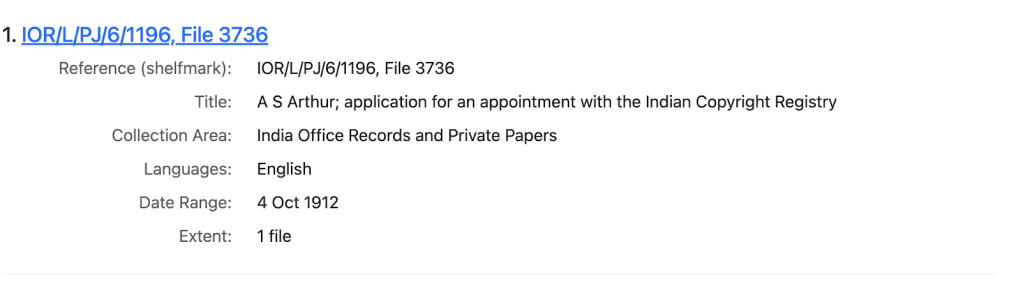
Once you see a relevant document, you can either submit a request online using your account (you have to create one) or, in most cases, you can use this Request form to access the material. Accuracy is crucial when filling out the request form — particularly when selecting the correct “collection area” or designated reading room. See the image below for what I mean by the collection area. If this is entered incorrectly, the request may be rejected.
It takes around an hour to receive your requested material, so you must submit the request on time. For example, if you request it in the late evening around 3 PM, you may receive it by 4, but you cannot finish reading it, as you will need to return the material by 4.40 PM, as many reading rooms close at 5 PM.
Of course, you cannot make unlimited requests. As I was informed, you can make up to 10 requests per day. At any given time, you cannot have more than 30 items requested or in circulation. (But do confirm this …) If it’s your first time, don’t worry. The librarians are extremely helpful, especially if you know: the relevant years, the names of individuals, or the type of document you are searching for. Please know that while photography is generally permitted, in some cases, you may obtain permission from the reference staff, but this is not guaranteed.
Final words
Archival work itself can be demanding. Locating relevant sources is surely difficult, confusing, and even taxing. What I typically do is treat each document as a lead: once I see a name, a reference, a date, or a piece of correspondence, I follow it further. One file points to another, and gradually a network of connections and a story begin to emerge.
To give a concrete example: While researching the history of the Indian Copyright Act of 1847, I encountered references to Lord Hardinge, who was the Governor-General of India at the time. While I have yet to investigate this trail fully, a search of the catalogue for correspondence from 1846 to 1849 reveals that files containing his letters do exist. On my next visit, I plan to check the specific letters mentioned in the copyright file discussions. In doing so, I hope to trace the exchanges more closely and see the history(ies) surrounding the drafting of the Act.
In sum, the key is simply to begin ‘somewhere’ — with a topic, a name, a year, or a letter — and then follow the trail with care.
Okay, that’s from my end for now.
À bientôt, de vous revoir.


