
Salam/Namaskar,
This post is not from me but from Niharika Salar, a PhD candidate at Queen’s University Belfast, working on questions around identity and geographical indication law in the traditional craft space under the supervision of Professor Giancarlo Frosio and Dr Pratyush Nath Upreti. Niharika, besides being a sagacious scholar with teaching and research experience across India and abroad, is also a dear friend and a generous source of guidance and goodwill. Some of her perspicacious pieces can be found on SpicyIP here, here and here.
In this post, she reflects on her recent experience at the Jaipur Literature Festival in Belfast and nudges towards a possible connection between such cultural crossings and the complex, evolving—and dare I say consternating—jurisprudence of personality rights in India. Here’s her LinkedIn profile if you wish to connect with her. Here goes Niharika …
Dr Tharoor at JLF Belfast left me Problematising Indian Personality Rights Jurisprudence
Niharika Salar
A few years ago, I wrote something about personality rights in IJLT and recently found myself revisiting those thoughts, albeit with a different focus.
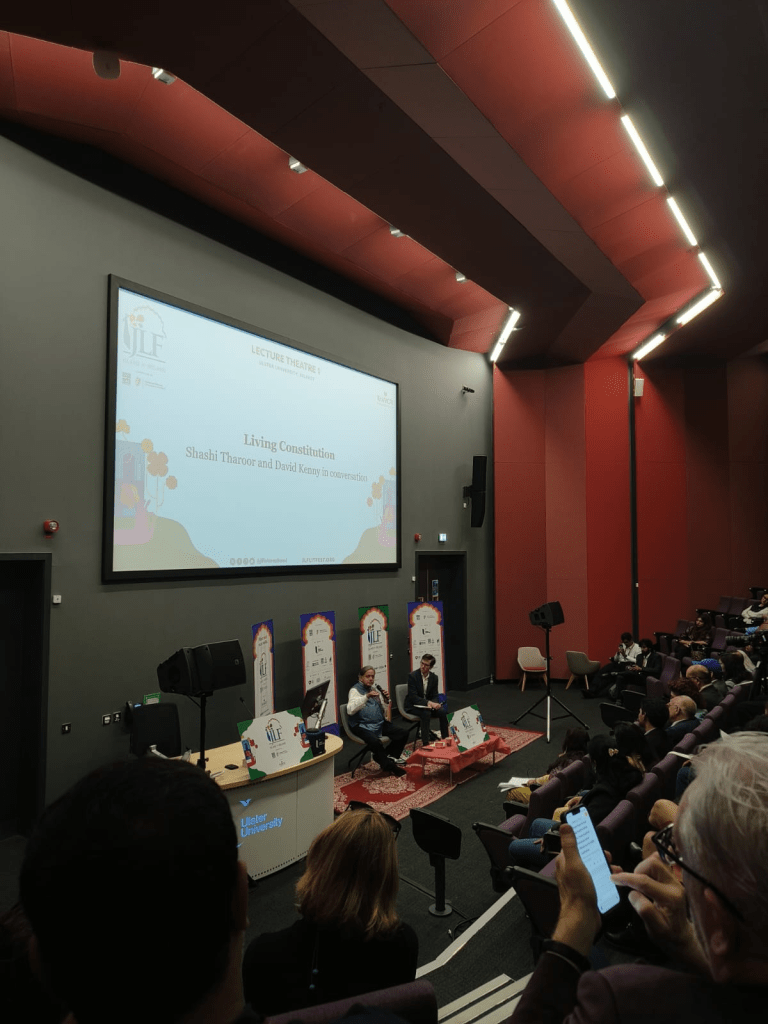
So, last week, the famous Jaipur Literature Festival was travelling to the island of Ireland, where Dr Shashi Tharoor was speaking on the theme “Living Constitution.” I was looking forward to it for 2 reasons. One, the intellectual kind, because the themes were interesting to me. Two, the cultural kind, because social media and meme culture had long sold me on Tharoor as the articulate, witty, quotable Indian public intellectual. A fellow Indian-origin PhD student I mentioned this to was unmoved. “He says nothing of value,” they said, “just in a well-articulated manner; when was the last time you heard him speak of the interests of the people of his constituency?” My excitement remained unhinged.
Nevertheless, the lecture theatre was packed, largely with the Indian diaspora. The talk was good. Even substantive for that matter. But everything else happening in that lecture theatre made me observe things I didn’t usually before.
This was not about Dr Tharoor himself but about what celebrity and public intellectualism seem to mean in the Indian social imagination, irrespective of the border. And that, in turn, prodded me to ponder whether there might be a deeper connection between the (egregiously) evolving jurisprudence of personality rights in India and the need to deploy more robust socio-legal research tools—tools capable not only of finding answers, but of reframing the very questions we ask in the first place.
During open Q&A, I noticed that almost every person who stood up to ask a question was of Indian origin. And almost every one of them stood up, physically rose from their seat, which is, in my limited experience of international academic and literary events, not the default. Was it respect? Reverence? Something harder to name? Whatever it was, it was selective because this did not happen in other sessions at the same festival.
When the session ended, a young boy wanted a selfie with him, and Dr Tharoor said, “Yes, let’s do it outside.” As if he almost knew and was prepared for what came next. After stepping out of the lecture theatre, I watched the chaos around him. People were excited to interact with him and be in the same frame as him. Then I heard someone call out, half-amused, half-exasperated: “We’re in Northern Ireland, we can at least queue up!” Before I had fully processed that sentence, two women were arguing loudly because one had taken too long in her selfie and encroached on the other’s time with him.
This was anything but new to me, as I am well aware of the celebrity-worshipping culture back home, sometimes even a party to it. The intensity of parasocial attachment to public figures, like politicians, film stars, cricketers, and now intellectual-celebrities, is a well-documented feature of Indian social life. What was new to me, or rather what I experienced for the first time, was that it does not disappear when Indians move abroad; if anything, displacement can intensify it, turning familiar public figures into anchors of cultural identity.
But I found myself thinking about a different, more specific question: could this same cultural substrate help explain why personality rights jurisprudence in India is developing the way it is? While I don’t delve into ‘how it can do that’, I posit it can.
So, what does this have to do with Personality Rights?
Personality rights or the right of publicity, depending on which jurisdiction you are in, is the legal protection of a person’s name, likeness, voice, and persona from unauthorised commercial exploitation and is not a new concept globally. But in India, the jurisprudence has been developing with a particular urgency but mixed flavours. Indian courts have granted injunctions protecting the personas of film stars, cricketers, and politicians with a scope that sometimes outpaces comparable jurisdictions. The underlying legal architecture borrows from passing off, privacy, and publicity rights, but the intensity of the protection and the categories of people seeking it reflect something beyond doctrinal logic alone.
If celebrity status in India is not simply a form of fame but something closer to a social institution, then the relationship between public figures and their audiences carries deep emotional and cultural meaning. Fans often see celebrities as symbols of identity, community, and even devotion. In that context, the commercial value of a celebrity persona is rather shaped by powerful social attachment. As a result, an unauthorised deepfake of a Bollywood actor or a false AI-generated endorsement by a cricketer does not merely mislead consumers. For many people, it feels closer to a form of violation or desecration. Courts operating within this cultural environment, even unconsciously, may be responding to that deeper social significance when deciding such cases.
I am not saying that the law is merely validating mass feeling. But law does not operate in a social vacuum, and personality rights, more than most areas of IP (as they are increasingly becoming), sit at the intersection of identity, cultural meaning, and commercial exploitation. Understanding why Indian courts have been expansive, why certain claimants get robust protection, and why the remedies are often immediate and sweeping requires you to understand what celebrity means and what persona has to do with the social fabric that law is trying to govern.
This is, at its core, an argument for socio-legal research in IP law, which is a field that often prides itself on technical precision and resists the messiness of social context. The assumption, sometimes implicit and sometimes explicit, is that IP doctrine can be adequately understood on its own terms: through precedent, economic rationale, and comparative analysis with other jurisdictions. Socio-legal inquiry can seem soft by comparison, even indulgent.
But the JLF Belfast afternoon suggested something different to me. The question I never got to ask Dr Tharoor – whether dowry-related crimes (I was aghast at the recent developments in the Twisha Sharma case) in educated, upper-middle-class families are evidence that certain practices are so deeply embedded in the social fabric that legal prohibition alone cannot contain them – is in some ways the same question I am broaching here, just in a different register. Can law, whether constitutional or intellectual property, fully govern a social phenomenon that it does not also completely understand? And do we, as researchers, produce more accurate legal analysis when we pay attention to the world in which the law is actually operating?
I think the answer is yes.
Perhaps… the selfie argument in Belfast, in its small way, is a data point about what public figures mean to people, about how that meaning travels across borders, and about why a legal system shaped by the same culture might extend protections that look, from the outside, disproportionate. Perhaps this is not even a new phenomenon.
But maybe revisiting the criteria through which we frame these questions can help us understand the problem differently. What are the social, cultural, and even epistemic conditions that make celebrity worship make sense in the first place? (see generally, “Conditions of Possibility”) While Indian courts have been increasingly willing to hand out personality rights injunctions, there lies a more fundamental question underneath that willingness: what (not who) is a celebrity? Who gets to have access to become one? Does celebrity change with the medium through which it is produced? Was television really the decisive turning point for persona-based fame, or has social media fundamentally altered the scale, intimacy and velocity of it? And in an era of algorithms, influencers and carefully curated online selves, how much of a celebrity persona is “real” nd how much of it is manufactured performance packaged as authenticity?
Law is in many ways constantly responding to shifts in social and cultural values. I do not think that is necessarily a flaw to be corrected, but a phenomenon interesting enough to be studied on its own terms. The seemingly simple questions posed in the preceding paragraphs merit closer examination than they have thus far received.
P.S.: Sorry, Dr Tharoor, for invoking your likeness to pen these thoughts; hopefully, your May 2026 Delhi High Court order does not extend this far.


