Happy New Year! Hope you had a nice beginning of the year!
I recently published an article in the Indian Journal of Law and Technology, co-authored with my good friend Luca Schirru. Apart from being a brilliant human being and an exceptionally kind soul (!), Luca is a Post-Doctoral Researcher at the Brazilian Institute of Citizen Science (INCC), Research Coordinator at the Centre on Knowledge Governance, and a Research Fellow at CiTiP, KU Leuven
Though I must note here that given the rapid pace of AI developments, parts of the piece may already feel dated, and my own understanding of discourse has evolved since we wrote it a few months ago. Nonetheless, the article can provide useful insight into the limitations of contemporary copyright thinking and open up a broader inquiry into what limits our thinking.
Below is the abstract of our piece. Those interested in the piece can check the full piece here. Full Citation: Vyas, Lokesh and Schirru, Luca (2024) “Indian Copyright Law in the Age of GenAI: Knowledge/Power, Patchwork, and Peril,” Indian Journal of Law and Technology: Vol. 20: Iss. 2, Article 2. DOI: 10.55496/ZGDS8505
Abstract
Isn’t copyright law an analog relic, striving to stay relevant in a digital world and hoping to survive an AI-driven and quantum-coded future? We argue it is. It is a law, born in a world of paper and print, now finding itself (again) patching its foundations to keep pace with generative AI (‘GenAI’). This unruly, still-developing technology not only redefines creative processes but also challenges the very assumptions of authorship, creativity, and copying. While discussions on this technology and copyright law abound, amid all the noise, one question simmers beneath the surface: ‘Is the very way we approach GenAI and copyright already shaped—if not confined—by the limits of discourse, where the language of law now struggles to think beyond itself?’. This question matters because, by the time the AI/copyright debate reached Indian courts, the terrain of legal arguments, policy proposals, and ideological fault lines appears to have been already drawn.
From U.S. lawsuits to European policies, the discourse around GenAI and copyright had crystallised into a vocabulary of ‘fair dealing’, ‘licensing’, and ‘exceptions’, leaving little space to rethink beyond the oft-claimed solutions. We argue this is not merely about finding the correct legal answers anymore. It is about the discourse—the invisible architecture of thought that shapes (and saps) what can be said, imagined, or reformed. In India, one can sense the gravitational pull. Our legal debates echo the voices of distant courtrooms and Brussels backrooms. While the facts may differ, the footnotes may change, the lingo may be localised, the skeleton of arguments remains eerily familiar. There is little space, it appears, left to ask the most fundamental question: ‘What do we want copyright to do for us now?’.
Drawing on Foucault’s ideas of knowledge/power, this paper offers a discourse analysis of the current AI/copyright conversation. We do not aim to critique GenAI reforms per se, but to underscore the discursive boundaries within which such reforms are conceived, debated, and defended. If employing copyright law as the primary tool to deal with Gen-AI-related issues is a trap, the more profound question becomes: ‘Who built it, who benefits from it, and who remains stuck?’. Far from being a jurisprudential vacuum (as the first hearing in ANI v. OpenAI suggested), India’s GenAI debates are already saturated—saturated with inherited ideas, imported frameworks, and invisible hierarchies of thought. This paper is an attempt to lift that lid and let a little fresh air in. After all, it is through the cracks (or perhaps, diagnosing the gap) where the light comes in.
The post is incomplete without acknowledging the many minds that shaped it. We owe a big thank-you to Bharathwaj Ramakrishnan and Aditya Gupta for their thoughtful comments on earlier drafts! We are also grateful to Professor Sean Flynn, Director of PIJIP, where both of us have worked (and continue to work) in different capacities. Many of the ideas in the piece were forged, consciously or otherwise, in there. And, as is often the case, several strands of thought in this piece owe their origin to my long conversations with Swaraj Barooah and other members of the SpicyIP family. And of course, a big shout-out to the IJLT team for their useful feedback and much-needed patience! The usual disclaimer applies: any errors, infelicities, or excesses of enthusiasm are entirely ours. After all, as some wise soul once said, mistakes are what make us human.)
I recently came across a fascinating work on the history and theory of copyright law titled Critical Perspectives on the History and Philosophy of Copyright by Ronald V. Bettig, published in 1992. It references some compelling historical studies related to copyright law and, more broadly, knowledge production. I will be discussing some of these in my upcoming post. In this post, I want to introduce readers to Bettig’s work and briefly outline its content. I would encourage readers to check it out—it is relatively short, spanning only 26 pages.
“The philosophy of intellectual property reifies economic rationalism as a natural human trait and assumes that, without mechanisms such as copyrights and patents, human beings would cease to be intellectually and artistically creative. To discover the roots of this assumption, this article employs a theoretical combination of political economy and the cultural history of communications to locate the origins of the concept of literary property. With attention directed toward the modes and relations of production and communication, this study reveals that the rise of capitalism and the development of the printing press are the keys to understanding the emergence of intellectual property law and how it serves as the basis for the “enclosure” of the intellectual and cultural “commons.”
Betty begins the piece by noting that
“Critical research on intellectual property is still pioneering work, including the relatively unexplored history of copyright. The traditional histories of copyright (see Bugbee, 1967; Patterson, 1968; Putnam, 1896/1962; Whale, 1971) provide adequate descriptions of the origins and evolution of copyright but lack any real explanation for its emergence and function. These histories are also teleological; they treat the evolution of the concept of literary property as a reflection of the natural progressiveness of human beings. The history of copyright developed in this article is based on an analytical framework that stresses the modes and relations of production and communications as the key explanatory variables in accounting for the origin and development of a concept of literary property. Accordingly, this history of copyright suggests that there is an essential connection between the rise of capitalism, the extension of commodity relations into literary and artistic domains, and the emergence of the printing press.
The first section of this article looks for evidence of intellectual property rights in ancient and medieval times. In a second section, an analysis of the dawn of capitalism and the development of the printing press is linked to the emergence of copyright, a crucial connection that is generally neglected in the traditional histories. The evolution of copyright in England and the United States is the central focus of the third section, which includes a significant revision and expansion of previous copyright histories on the connection between John Locke and the articulation of literary property rights. Patterson (1968) argues that a historical analysis of copyright “removes obstacles—long-continued acceptance of certain ideas, self- interest, and the pressing need to resolve immediate problems—which may be present when analysis occurs in a wholly contemporary context” (p. 223). It also provides the occasion, in the last section of this work, to compare the earliest ideas concerning copyright to current copyright practices. Here special attention also is paid to patterns of ownership and control of intellectual and artistic creativity.”
Okay, I leave this here. Bettig structures this piece into 6 parts, but I’ll leave the details for readers to explore further. Bettig’s piece, I reiterate, can be a useful piece for understanding the historical and theoretical underpinnings of copyright and knowledge production.
This post is co-authored with Aditya Gupta, an enterprising IP scholar and a dear friend! Aditya is studying LLM at the American University Washington College of Law and is a recipient of the Arcadia Fellowship for 2025-26. He completed his law degree from NUSRL, Ranchi, in 2020.
Salam Readers,
We have recently been working on a short piece titled “Academic Anxieties and Visa Woes.” The piece is our experiment with a duo-ethnographic methodology, through which we explore how visa delays and denials contour the academic trajectories of Global South scholars, including our own. The piece extends many of our long-running conversations and contestations—as friends, collaborators, young scholars, and constant academic sparring partners who share (to some extent) overlapping positionalities and relationalities.
We began with two simple threads. First, the anxieties we carry into academic spaces—where they come from, why they cling to us, and how they shape our movement. Second, how these anxieties contour our place within knowledge production: how we read, participate, and create; how some claims are invited into the room while others are kept waiting at the door. But when we actually sat down to put the proverbial pen to paper, yet another disagreement surfaced. We call it, for want of a better phrase, the paradox of privilege.
This short post offers a glimpse into the thought process behind the essay. We try to sketch out some ideas around epistemic privilege (especially how they occurred to us). This is, of course, not to settle them, but to mark them as questions worth lingering with. Discussing this epistemic privilege, we sense an inherent paradox that continues to trouble us, that we suspect needs collective reflection, critique, and conversation.
Thanks, Geertz, for “Thick Description”
First things first, we asked ourselves a simple but unsettling question: what are we really doing here, other than intellectualising our undesirable experience? And is there anything wrong with intellectualising it—after all, isn’t that what academics are meant to do? Clifford Geertz (an American anthropologist), and particularly his idea of thick description, came to our rescue. Though it’s worth noting that the notion of thick description was first introduced by the British philosopher Gilbert Ryle in 1968 in “The Thinking of Thoughts: What is ‘Le Penseur’ Doing?” and “Thinking and Reflecting“. Here, thin refers to surface-level observations of behaviour, whereas thick emphasises adding context to such behaviour.
This notion helped us see that experiences—no matter how mundane or routine, one may call them—carry peculiar cultural meanings that deserve to be understood, interpreted, and investigated. Geertz allowed us to shift both the frame and focus of our analysis, encouraging us to stop chasing or chagring generality through the rigours of social-scientific theorisation and instead embrace humanistic interpretation.
For those unfamiliar with the distinction: a thin description might state, “He closed one eye,” recording the bare movement. A thick description would situate the same act within the shared meanings that make it intelligible. For example, “He winked eye in a crowded café while catching his coworker’s gaze; among the staff, this well-known signal marks a private joke about the manager, recognizable because of their earlier banter and the café’s playful culture, distinguishing it from a nervous twitch or a flirtatious cue.”
Thick description, thus, interprets actions by placing them in the local webs of significance, showing not just what happened (physically), but how participants know what it means and why that meaning holds in that setting. We take this idea to underscore the importance and relevance of distinct and unique experiences (i.e., visa denials and delays in our case), without an innate pressure or requirement to theorise and situate them in a larger, more identifiable mould.
But as we began to brood these ideas—articulating our experiences and reading how others have written about similar moments—we encountered an unexpected sense of isolation. Stories of visa denials and delays, scholars missing conferences, being unable to attend crucial courses or deliver keynotes, or even being turned away at airports, are all over the place on social media platforms. (see here). As per this CNN news report, Africans lost nearly $70M to denied visa applications to Europe in 2024. Many visa denial or delay accounts sound uncannily alike, with many of these voices sharing certain identities: they hold not-very-privileged passports that do not guarantee easy mobility.
This pattern initially struck us as surprising—or rather, it was the absence of surprise, the sense of normalisation, that became the most surprising element of all. Based on our ongoing research, we found this issue as one of the very few areas of academic scholarship where voices from the Global North were noticeably absent. Even the few voices that could be traced to the Global North had some degree of identifiable similarity and relationality with the larger set of voices and articulations within the discourse. Say, a professor from Columbia University, who holds an Indian passport, or a French professor with a Ghanaian passport. It felt almost as if this issue was only being articulated from a very discrete echo chamber.
The Complexity of Epistemic Privilege
Neither of us understood this. We have written about and talked about how citation politics work and how scholars who belong to certain epistemic traditions are given more weight and influence than others, but this time, the game seemed a bit different. To understand this, we read standpoint theory/epistemology and, more specifically, epistemic privilege. The concept of epistemic privilege remains broad and oft contested. However, the term generally refers to the forms of privilege that accrue from one’s social position. For standpoint theorists, these positions in a social circle provide them access to evidence, group knowledge,sui generis ways of knowing, or some other distinctive epistemic good. It argues that members of certain marginalised, oppressed and excluded groups can have superior insights into the workings of society, especially hidden biases, injustices, and exclusionary practices, thus affording an epistemic advantage in understanding how knowledge and power interlock.
This idea, to some extent, assuaged our anxiety that our concern was not unwarranted. There was, indeed, a privilege in being an outsider, in being outside the reward network of systems. This privilege allowed us to think, theorise and articulate in a certain manner. It extended unto us an audience. In terms of network theory, it created an in-group of subjects who were outside the network of privilege.
However, it is worth pausing to recognise that even this in-group privilege—the ability to engage with issues like visa delays or denials—comes with its own layers and hierarchies. Well … realistically speaking, having a passport is itself a privilege in India. As per this Times of India report, in 2022, 7.2% of Indians own passports, a number set to cross 10 crore soon. And per this The MapsDaily report, only 8.71% of Indians hold a Valid Passport in 2025.
Coming back to the point of epistemic privilege, it allows us to turn our lived experiences into knowledge: to translate uncertainty, anxiety, and bureaucratic precarity into insights that become legible within academic discourse. But there is something more subtle at play. Not everyone within the group shares this privilege equally—there are meta-privileges embedded within it. The way I can interpret my visa denials and evangelise it into an academic issue is something that our other friend will be able to do.
This makes us believe that there exist two overlapping privileges underlying epistemic privilege. First, the privilege of being an outsider and being privy to a thought process and knowledge framework that often remains unnoticed and overlooked. This is a privilege that we inherit by way of experiencing an event which brings within it a pre-defined audience that can engage with, comprehend and even empathise with the positions we articulate. Second, the second form of privilege shares something with what Bourdieu might call cultural capital (e.g. education) and social capital (family associations, networking, etc.). Meaning, it is our educational backgrounds, intertwined with the institutional support around us, that furnish the material, institutional, and cognitive tools which ultimately reinforce our epistemic privilege.
Conclusion: Knowing is never neutral!
Herein lies a hitch, however. Recognising this privilege also introduces a sense of responsibility. That is, once you begin to notice and interrogate how these systems function—how visas operate as technologies of control, how borders govern intellectual mobility, how academic structures simultaneously generate opportunity and precarity—you lose the comfort of innocence. You become acutely aware of your own position within these arrangements. So, if Stan Lee could say, “With great power comes great responsibility,” perhaps we might add: with greater knowing comes greater responsibility (and anxiety?).
Knowing is never neutral. Knowing alters us; it asks something of us. It produces a form of responsibility to see, to name, to stay with the discomfort rather than look away on the pretext of being mundane, commonsensical, routine, etc. Although epistemic and standpoint privilege—along with the overlapping layers of advantage identified above—may enable us to articulate these issues and situate them within broader structures, they also leave us wondering: to what extent, and toward what ends, does this very privilege carry our articulated concerns? What capacities does it open, and what limits does it quietly reproduce? This is where the paradox of privilege becomes palpable: even when we possess epistemic advantage to see, sense and sensitise certain issues, we remain uncertain about where it ultimately leads us and what our articulated concerns can, in fact, accomplish.
What do you think of this paradox? Let us know.
Note: As always, we owe a debt of gratitude to those who nudged this work along. A big thanks to two very kind and supportive professors, Suresh Canagarajah and Bryan Khan, for their thoughts/comments on the essay. If you’d like to read it, we’re happy to share a working copy and would appreciate any thoughts you might have—we’re currently working through the suggestions we’ve received. Thank you!
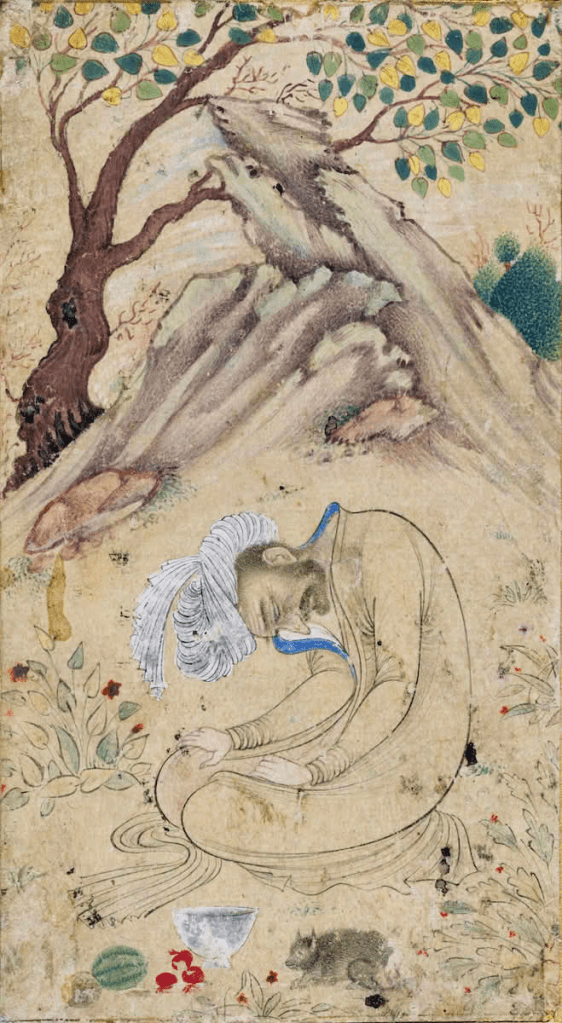
A few months—or perhaps years—ago, I heard a story of a monk, perhaps in one of Osho’s talks, who had recently returned to my mind, making me wonder once again what time truly is, and how deeply it shapes our legal imagination. So the story goes like that:
A Zen monk was working in the garden, digging the earth.
A visitor asked, “What are you doing?”
The monk replied, “I am digging.”
The visitor pressed further, “I can see that you’re digging, but who is digging?”
The monk paused, smiled, and said:
“There is no one digging—there is only digging.”
Or, as another version puts it:
“I am the very act of digging.”
Lately, I’ve been tussling with this idea of time. An endlessly exciting concept, as it is. Its meanings and non-meanings spill across disciplines: science, philosophy, psychology, and religion. And yet, my own small mind keeps returning to it through what I know better—intellectual property law.
People often speak of those rare moments when time seems to cease. Yes, those moments of immersion, of pure flow. As Professor Shamnad Basheer once wrote, in a very creative piece where I first encountered this idea of “flow,” creation arguably happens in such a state. Put simply, when we write, paint, compose, or lose ourselves in love, time seems to stop. The past and future fall away. Only the act remains. As this twitter/X user named Keshavchan defined it so nicely, “flow state. that scene in f1 when Brad was flying. in whiplash, when miles teller was one with drums. when time slows down and you are operating at a frequency beyond thought. You are no longer making something, you are simply the conduit through which it comes into being”
Put otherwise, one can understand flow as a psychological and even a phenomenological state: a becoming in which the self dissolves into the act, where the actor and the act become one, just as the monk in the story became the digging. As G. N. Devy beautifully writes in A Crisis Within, reflecting on Buddhist thought:
“Abhinavagupta postulated that ‘the knowledge of Truth is just another name for the knowledge of the Self’. For him, all experience and all dramatic sentiments were justified in their ability to evoke the experience of that which is ‘permanent nature’, the ‘sthayibhava’ of ‘moksha’. Knowledge for him was, thus, ‘realizing’ and not a (or the) ‘realization’.”
Devy offers several examples suggesting that systems of knowledge production and governance in ancient India rested on epistemic foundations quite distinct from those we take for granted today—particularly from the proprietary logic that underpins modern notions of copyright.
Returning to the idea of flow, one could say that it unfolds in a space outside measurable time. Something that mystics and metaphysicians might callkairos (qualitative, lived time) rather than chronos (quantitative, historical time). It is in this moment that the “I” which owns, measures, or names wonderfully withers away, leaving only the act itself.
But once the work is produced, fixed, and transformed into “information”—or a fount of information—it re-enters chronos. It becomes subject to laws, such as copyright laws, data laws, and other systems of record and recognition, which can be seen, exchanged, owned, copied, and thus legislated. Here, copyright becomes a technology of knowledge governance, through which the timeless flow of creation is arrested and put back into a temporal, property-bearing form. And here, dear reader, in this very domain of time, the work becomes an event: authored and evenutated by someone, made at a particular moment, and protected for a ‘duration’. After all, this, this very realm of time makes governance possible. Doesn’t it?
And hither I wonder, and only wonder (with no critique of law or anything like that) … how do we reconcile or even re-imagine these two experiences of time? On one side, creation ‘arguably’ arises from a space (?) where time does not exist. This is a personal experience. On the other hand, it must exist in time to be seen, shared, or even acknowledged. What does this passage look like? I, for sure, don’t know. And perhaps I may even be wrong to speak of space while questioning the boundaries of time. What thou says?
As Kant would have it, time, along with space, is an a priori condition of experience. We cannot think or feel without it. Love, grief, or joy, all actions unfold in duration. Every action/doing occurs across time, beginning somewhere and ending somewhere. Or, should I believe what Shri Krisha in the Bagavad Gita said, “अंतः अस्ति प्रारंभः/Antah Asti Prarambh”, i.e., meaning “The End is the Beginning”. I am tempted to second him.
And yet, I would say, the act of creation, like meditation, or perhaps love, if it may, momentarily frees us from time. The two are inseparable: we need time to recognise what it means to be timeless. No? Or, creation is not an escape from time, but a play with it. A tango between the eternal and the temporal, between pure becoming and fixed being, if you will.
Maybe.
Okay, time to be back in the realm of time… See you again 😉
Thanks to Sahana Simha for her comments on the draft.
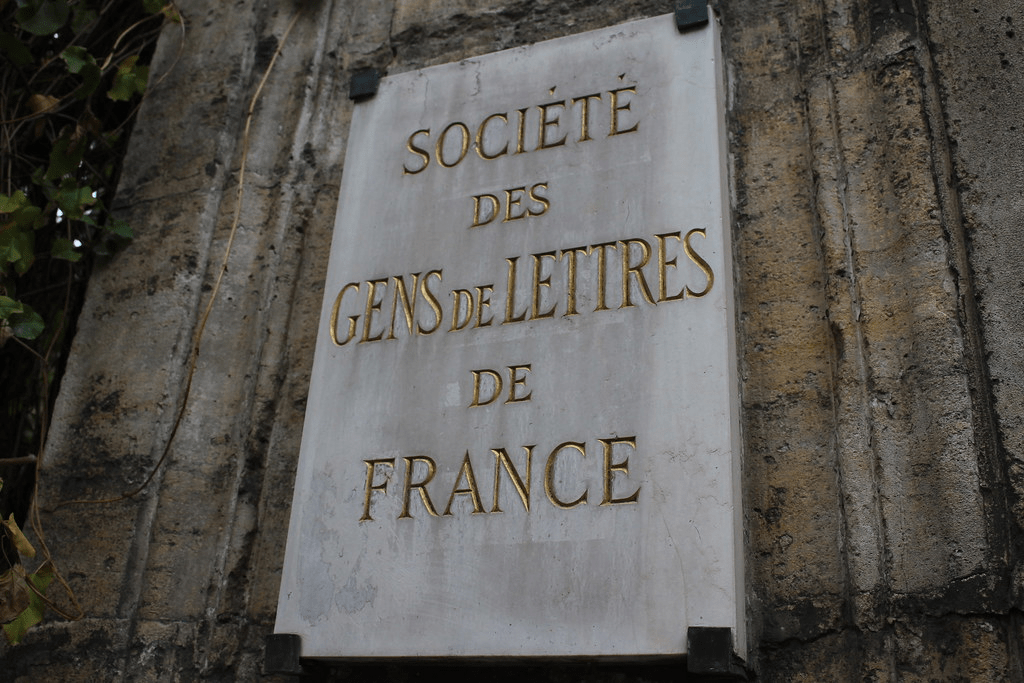
In the previous posts, I shared the three speeches delivered by Victor Hugo at the 1878 Paris Conference. (See here: Speech one, two and three) However, there was also a cogent counterpoint to Hugo by Mr Pataille, an author and member of the Société des gens de lettres and its judicial council. As the source document states (mentioned below, page 27), his arguments were presented in a letter addressed to members of Congress, but could not be printed in time for distribution before the vote.
While he remains loyal to the idea of authors’ rights as a form of property, he pushes back hard against Hugo’s more idealistic vision. At one point, he asserts, defiantly so:
“… Let us remain realistic. – The author is everything, and the public domain is nothing! – Whether the author has released his work to the public or kept it in his desk, he remains the sole and unique owner. — If he can no longer recapture the ideas he has put into circulation, he nevertheless retains exclusive ownership of his name and the material form he has given to those ideas.”
Well … that sounds spicy! Doesn’t it? And yet, Pataille isn’t blind to solidarity. He also applauds Hugo’s “the grand and beautiful idea of establishing a common fund for men of letters.” but picks holes for two reasons “first, because imposed charity is not charity, it is a tax; second, and above all, because a fund established and financed with public funds for the benefit of an entire category of unnamed individuals would be nothing more than disguised alms, whereas I want any relief fund to be based on the principles of mutuality and solidarity.”
Okay, without much mediation, below is an English translation of Pataille’s letter (via DeepL). For the French original, see pages 27-33, Pataille, J., ed. Annales de la Propriété Industrielle, Artistique et Littéraire, Vol. 25 (Paris, 1880), available through Gallica—the fantastic(!!!) digital archive of the Bibliothèque nationale de France. Needless to say, if you can’t find it there, let me know. I’ll share a copy.
To the members of the International Literary Congress.
Gentlemen and honoured colleagues,
Ever since the issue of authors’ and artists’ rights to their works has been raised and debated, both in times of privilege and since the recognition of equality for all before the law, in publications by interested parties and in the work of legal experts, in congresses and legislative assemblies and, let us say, in the
texts of the laws themselves, there has always been antagonism between those who support authors and those who support the public domain.
There was a time when the struggle was so fierce that the system known as the paid public domain appeared to many good minds as a happy compromise between the two extreme parties; so I was not surprised to hear our great poet and honourable president defend the interests of the public domain with the generosity of sentiment and magnificence of language for which he is known.
But after the incessant conquests of the authors’ party, when there is hardly any discussion left except about the word and we have the thing itself, when almost all modern legislations recognise, under different names, the legitimacy of their rights and are ready to extend their duration and increase their guarantees, I was strangely surprised to to see friends from our ranks and authors ready to accept, as progress and as the law of the future, a system which, in law, is a denial of the property for which I have been fighting, along with so many others , for more than forty years, and which, in fact, constitutes a veritable expropriation of the rights of heirs , with the aggravating circumstance that, place of prior compensation, they are granted only an arbitrary and problematic royalty that is as difficult to collect as it is to determine and guarantee. This is what prompted me to speak at the last session of the Congress and what prompts me to take up my pen today, at the risk of arriving too late.
From a theoretical point of view, the system of paid public domain is based on what I believe to be the erroneous opinion that, once published, a work belongs to everyone or, at the very least, that there are two co-owners with equal rights: the author and the public. Let us examine this as quickly as possible.
In the interest of the public domain, it is always said that authors and artists work on a common fund and that by delivering their work to the public, they are only giving back what they have taken from it. This has been said, and very seriously, in legislative assemblies.
In the interest of the public domain, it is always said that authors and artists work on a common fund and that by delivering their works to the public, they are merely giving back what they have taken . This has been said , and very seriously, in legislative assemblies . I do not think I need to refute the objection in a literary congress. This is obviously confusing the idea, the thought, with the work that is its expression. Proclaiming ownership of the work does not mean seeking authorship of the ideas it may contain, and even if it were true that they were inspired by earlier works, the new form given to the same subject, to the same thought, is enough to make it a unique and personal work. ” Who would dare, as we have written elsewhere, to ask La Fontaine to account for the borrowings he made from his predecessors? Did he not appropriate all the subjects through the charm of his style and the profusion of details and philosophical ideas with which he enriched them? Did this appropriation diminish the public domain? No! The Fables of Aesop and Phaedrus have lost none of their originality, and if there has been imitation, that imitation is in itself a masterpiece, and therefore a new work constituting property.
“Even though an author has only compiled a work, he has engaged in an intellectual process of appropriation that serves as the basis for a private right, while allowing everyone else to do the same, on the sole condition that they do not take away what is personal in that work . “
Even the most ardent defenders of the public domain are willing to recognise that as long as the work is unpublished, it is the sacred, exclusive property of the author, who remains free to communicate it to the public or to destroy it. – So far, therefore, there is no primary ownership of the public domain, nor even co-ownership. The public remains in possession of everything it previously possessed; it therefore has no claim to assert.
It’s a fact! – But is it right? No! This is the perpetual confusion between, on the one hand, the idea which, once expressed, escapes me and becomes the property of anyone who wants to appropriate it, and on the other hand, my name and the form given to this idea, the book, which remains my property because it is the fruit of my intelligence and my work.
It is said that the author can no longer destroy his work, nor modify it!
But that is the question within the question; it is very certain that once he has entrusted his work to the public and sold copies of it, he will, in fact, find it all the more difficult to buy them all back, as the people who have acquired them will be entitled to reply that they own them by virtue of a regular contract and his own consent.
However, does it follow that, on the one hand, the author will not be able to modify or disavow his original work and, on the other hand, that each of these owners of old copies will be able to reproduce them to his detriment and against his will?
Of course not! – The author’s right of ownership, which derives from the very nature of his creation, is not limited to a simple right to publish or not to publish, to choose his publisher and the method of publication; it necessarily includes the right to prohibit any subsequent publication, either to complete, modify or transform their original work, or even, if they so wish, to keep it silent, as far as it depends on them.
It is understood that he retains these rights only insofar as he has not voluntarily transferred them to a publisher or a third party. However, as for the public, and especially purchasers, they have acquired and paid for only copies of which they are the undisputed owners with the jus utendi et abutendi, that is to say, the right to use and dispose of them and even to destroy them, but not to reproduce them by printing or other means. Why? Because this is the spirit of the contract that has been entered into between the seller and the purchaser, and which must be interpreted and executed as if each purchaser had signed a deed whereby, acknowledging that they have only purchased and paid for the copy, they undertake not to reproduce it.
If this is true for each individual purchaser, it will be true for all and for the public domain, which is nobody precisely because it is everybody. Once again, no one disputes that the public has the right to profit from the ideas expressed, but that it claim ownership of the work itself , that it claims to have acquired the right not only to draw inspiration from it, but to alter and mutilate it or to make copies or reproductions of it , in order to derive commercial profit to the detriment of the author or his successors, is something that we will never accept. In reality, he has only a right of use.
If we argue that it is in the public interest for certain works to fall into the public domain as soon as possible, so much the better! Civil law is there for that purpose. In its omnipotence, it can decree the expropriation of a literary work, as of any other property, for reasons of public utility, but it must pay for its value. It can even, in exchange for the special protection it grants, limit its duration, just as it limits the duration of ownership of a mine or a railway. This has been accepted by all modern legislation, even by those, like ours, that recognise the principle of authorship.
However, when life annuities and variable rights are gradually being replaced by fixed and certain rights that eliminate uncertainty and make it possible to plan for the future; when the duration of the rights of heirs and concessionaires, which was only ten years not long ago, is now fifty years in France, Russia, Denmark and Norway; when we see so many other legislations ready to follow this path of increasing duration, with Spain, in particular, bringing it to eighty years, I do not understand why we are thinking of going backwards and making the public domain the owner of the work from the death of the author!
Nevertheless, we are willing to reserve a royalty for the direct heirs, to be paid by each publisher. I will not dwell on the difficulty, not to say impossibility, of setting this royalty in a way that is both remunerative and equitable. Any determination made without the cooperation and outside the parties concerned (the heirs and future publishers) will necessarily be arbitrary and, in most cases, unfair, whether a uniform royalty is adopted for all literary works without distinction or whether classes and categories are established.
As I told you at the last meeting, Horace was able to write, in a burst of legitimate pride:
Exegi monumentum ære perennius,
because no one knows what became of his bust and there is not one of us who does not have his works in their library; but it is not given to many to impose themselves on all generations and there are many degrees even among the greatest and most illustrious! Moreover, it is not always the name or talent of the author, nor even the merit of the work itself, that makes a book successful.
Habent sua fata libelli,
says the poet! Some books, indeed, shine and disappear like meteors; others take ten, twenty, thirty years to make their way and are often only appreciated at their true value after the death of the author. If this is true for the works themselves and from the point of view of their intrinsic merit, how much more true is it from a commercial point of view! A novel, even a bad book, will find thousands of readers and make the publisher’s fortune, while a scientific work that has cost its author thirty years of labour and has its place in all the major libraries will find, with great difficulty, only a few hundred buyers. Is it not clear that such a work, even if unpublished, will not find a publisher if, in exchange for the royalties to be paid to the heirs, the publisher does not obtain exclusive rights for at least a few years, and if, by undertaking a costly edition worthy of the work, he finds himself exposed to being overtaken and perhaps ruined by cheap editions!
I am well aware that these objections and many others, which will strike anyone with some practical knowledge of bookshops, can be levelled at the system of paid public domain adopted by the first section, of which I was a member. But you will note that the resolution it proposes to you only allows this after the expiry of the heirs’ absolute property rights. For several members of the section, this was only a compromise and a step towards the declaration of perpetuity, and in any case it did not affect acquired rights, whereas the proposal for a paid public domain applied at the very moment of the author’s death is a step backwards and a real denial of the author’s absolute right. I am well aware that inheritance law is a civil law institution. But it is so in tune with the family spirit and the aspirations of all that it is one of those rights which, if they did not exist, would have to be created. There is no one among us who, when working, does not think about the future and the fate of their children and their property, and if one has the right to leave one’s fortune to one’s children and to bequeath to one’s parents or friends the jewellery or objects one has been most fond of, it is difficult to understand why the law would deprive an author of the right to pass on all or part of their literary works to their spouse, children or even strangers of their choice. What is the point of proclaiming loudly that it is the most personal and sacred of all property, only to immediately deny the author of a literary work a right that is granted to the manufacturer and even to the mere purchaser of a table or a snuffbox?
Our honourable and illustrious president, whose door is besieged by publishers and who has nevertheless made himself an ardent defender of the public domain, has anticipated the objection by proposing an exception for the benefit of publishers who have acquired a work during the author’s lifetime and who, by derogation from the principle of paid public domain, will continue to enjoy their exclusive right for a period of fifty years . But if it is true that the author loses all his rights upon his death, that his heirs are nothing and that the public domain is the true owner, it is difficult to understand this distinction between transfers made during the author’s lifetime and those that only take effect after his death. In the future, we would have two categories of authors and literary properties, depending on whether or not there was a transfer before death, and we would be exposed to seeing authors, on their deathbeds, calling a notary, not to make a will that would be invalid from the outset, but to try to make a more or less sincere sale to a publisher called in extremis!
No! Let us remain realistic. – The author is everything, and the public domain is nothing! – Whether the author has released his work to the public or kept it in his desk, he remains the sole and unique owner. — If he can no longer recapture the ideas he has put into circulation, he nevertheless retains exclusive ownership of his name and the material form he has given to those ideas. – He alone has the right to revise and modify his work , to judge and assess what kind of publicity suits it, whether it is worthy of a deluxe edition or suitable for a popular edition, and what he has the right to do during his lifetime, he must be able to do after his death, by choosing himself the person or persons he deems most worthy of safeguarding his glory, either by publishing new editions or by preventing truncated and flawed editions that would dishonour his work .
It should not be forgotten that, for an author who is convinced and jealous of his fame, this absolute right to watch over or have his work watched over is far more precious and sacred than that of receiving the proceeds. But even from this latter point of view, I repeat, I do not understand why anyone would want to diminish the author’s estate and disinherit his heirs and legatees for the benefit of the public domain, which has no rights whatsoever as long as those of the author or his heirs exist.
On the other hand, when this property perishes either because there are no heirs or because the period determined by civil law in its omnipotence has expired, I do not understand why the public domain should be obliged to pay a perpetual fee to the benefit of what has been called “the literary family”. Like all of you, I applauded the generous words of our illustrious president, insofar as they expressed the grand and beautiful idea of establishing a common fund for men of letters. But I reject the means – first, because imposed charity is not charity, it is a tax; second, and above all, because a fund established and financed with public funds for the benefit of an entire category of unnamed individuals would be nothing more than disguised alms, whereas I want any relief fund to be based on the principles of mutuality and solidarity. Let everyone contribute their mite in order to be entitled, if necessary, to a share in the distribution of the common fund; let the rich be generous and even give up their copyright in favour of this common fund; nothing could be better! Those who see their share increase accordingly will know to whom they owe it and will bless them. But no taxes! There is fraternity only where there is spontaneity.
Recevez, etc.
J. PATAILLE,
Avocat à la cour d’appel , membre du conseil judiciaire
This is the third and final speech where Hugo advocates for the “paying public domain”. Speech no. 1 is here, and speech no.2 is here. Two points are particularly interesting in this speech.
One, Hugo interestingly mentions two kinds of heirs to an author—one heir to blood, meaning the author’s immediate family, and the other to spiritual heirs, representing society at large. Hugo believes the latter should be promoted. He also proposes creating a fund financed by public contributions – specifically to support authors and young writers- since there are no longer authors in the traditional sense.
Disclaimer – The following text is an English translation of a French original. The translation was done using DeepL. Although I have made the best of my efforts to maintain the accuracy of the source material. I would suggest you check the original source in Pataille, J., ed. Annales de la Propriété Industrielle, Artistique et Littéraire. Vol. 25. Paris, 1880. Available through Gallica, the digital archive of the Bibliothèque nationale de France. If you don’t find the document, let me know. I will share a copy with you.
Third speech by Mr Victor Hugo, President of the Congress. Session of 25 June.
(Paying public domain / Domaine public payant.)
Gentlemen, allow me to enter freely into the discussion. I do not understand the declaration of war being made on the public domain.
What! Are the works of Corneille, La Fontaine, Racine and Molière not being published? Does the public domain not exist? Where are these works today?
What! Are the works of Corneille, La Fontaine,
Racine and Molière not being published? Does the public domain not exist? Where are, in the present, these disadvantages, these dangers, everything that the Book Trade Circle has been kind enough to announce to us for the future?
All these objections can be levelled at the public domain as it exists today.
The public domain is detestable, they say, upon the death of the author, but excellent as soon as the expiry arrives… of what? Of the strangest fantasy that legislators have ever applied to a mode of property, the deadline set for the expiry of a book.
Here you are entering into the thoughtless fantasy of people who do not know what they are talking about. I have the right to speak somewhat freely about legislators. The men who make laws sometimes know what they are talking about; they do not know what they are talking about when it comes to literature.
Do they at least agree among themselves? No. The term of protection they grant is ten years here, twenty years there, fifty years elsewhere; they even go as far as eighty years. Why? They have no idea. I challenge them to give a reason.
And it is on this absolute ignorance of legislators that you, who know what you are talking about, want to base legislation! You who are competent will accept the ruling handed down by incompetents!
Who will explain the reasons why, in all civilised countries, legislation grants the heir, after the death of the author, a variable period of time during which the heir, as absolute master of the work, may publish it or not? Who will explain the gap that various legislations have placed between the death of the author and the entry into the public domain?
This capricious and bizarre invention of ignorant legislators must be destroyed. It is up to you, indirect but competent legislators, to accomplish this task.
In reality, what did those legislators who, with incomprehensible levity, legislated on these matters consider? What did they think? They believed that the heir of the blood was the heir of the mind. They believed that the heir of the blood must have knowledge of the property he was inheriting, and that, consequently, by giving him the right to dispose of it, they were making a just and intelligent law.
This is where they were greatly mistaken. The heir of the blood is the heir of the blood. The writer, as a writer, has only one heir, and that is the heir of the spirit, the human spirit, the public domain. That is the absolute truth.
Legislators have granted the heir of the blood a power that is full of disadvantages, that of administering property that he does not know. The heir of the blood is most often at the discretion of his publisher. Let the blood heir retain his right, and let the heir of the spirit be given what belongs to him, by establishing the public domain as payable, immediate .
What! Immediately? Here comes an objection, which is not really an objection. Those who raised it had not heard my words. I am asked: What! Will the public domain immediately seize the work? But if the author has sold it for ten years, for twenty years, will the person who bought it be dispossessed? No publisher will want to buy a work anymore.
I said precisely the opposite, the text is there. I said: “Except for concessions made by the author during his lifetime, and contracts he has signed.”
The result is that if you have sold the ownership of one of your works to a publisher for a specified period of time, the public domain will not take possession of that work until after the period you have set.
But can this period be unlimited? You know, gentlemen, that property, sacred as it is, nevertheless has its limits. I am telling you something basic when I say that one does not own a house in the same way that one owns a mine, a forest, a coastline, a river, or a field. Property, as legal experts understand, is limited according to the extent to which the object belongs to the public interest. Literary property belongs more than any other to the public interest, and must therefore also be subject to limitations. The law may very well prohibit the sale by the author of the perpetual property of his work; this is a simple restriction. The law may prohibit absolute sale and grant the author, for example, fifty years. I believe that there is no author who would not be satisfied with a possession of fifty years.
This argument therefore collapses entirely and should not have been put forward. Immediate paid public domain does not remove the author’s ability to sell their book for a fixed period; the author retains all their rights.
Second argument: Immediate public domain, by creating enormous competition, will harm both authors and publishers.
Books will no longer find serious publishers.
I am surprised that the honourable representatives of the book trade who are here support a similar thesis and act “as if they did not know”. I will teach them what they know very well, what happens I will teach them what they know very well, what happens every day. During their lifetime, authors sell the rights to exploit a book, in a given form, in a given number of copies, for a given period of time, and stipulate the format and sometimes even the selling price of the book. At the same time, he sells another format to another publisher, under different conditions; to another, a different mode of publication; for example, a cheap illustrated edition . There is someone here talking to you who has seven publishers.
So, when I hear men whom I know to be competent, men whom I honour and esteem, when I hear them say, “We will not find publishers, in the face of competition and unlimited freedom of publication, to buy and publish a book,” I am astonished. I have proposed nothing new; every day, we have seen, we see, during the author’s lifetime and with his consent, several publishers, without harming each other, and even by helping each other, publish the same work. I have proposed nothing new; every day, we have seen, we see, during the author’s lifetime and with his consent, several publishers, without harming each other, and even by helping each other, publish the same work. I have proposed nothing new; every day, we have seen, and continue to see, during the author’s lifetime and with his consent, several publishers, without harming each other, and even helping each other, publish the same book. And this competition benefits everyone, the public, the writers, the booksellers!
Do you see any interruption in the publication of the great works of the great French writers? Is this not the most exploited area of the book trade? (Signs of approval.)
Now that it is well understood that entry into the public domain does not hinder the author and leaves him the right to sell the property of his work; now that it also seems to me to have been demonstrated that competition can be usefully established on books, after the death of the autor as well as during his lifetime, let us return to the matter at hand.
Let us suppose that the public domain is remunerative, immediate, and established.
If there is a direct heir, he pays the royalty to that direct heir; for note that we stipulate only for the direct heir, and that all the arguments put forward concerning collateral heirs and the difficulty of discovering them vanish.
But when there are no direct heirs, what happens?
One of two things: either the public domain continues to exploit the work without paying royalties, since there are no longer any direct heirs, or it continues to exploit the work by paying royalties.
To whom?
It is here, gentlemen, more than ever, that I affirm the usefulness of perpetual rent. You all know that nothing would be more useful than a sort of common fund, a considerable capital, solid revenues, applied to the needs of literature, which is constantly evolving. There are many young writers, young minds, young authors who are full of talent and promise, and who encounter immense difficulties at the outset. Some do not make it; they lacked encouragement, they lacked bread. Governments, as I explained Governments, as I explained in my first public remarks, have created the pension system, a system that is sterile for writers. But suppose that French literature, through its own strength, through this tithe levied on the immense product of the public domain, possesses a vast literary fund administered by a writers’ union, by this Society of Men of Letters which represents the great intellectual movement of Europe. Suppose that your committee has this very important function of administering what I would call “the civil list of literature”. Can you imagine anything more beautiful than this: all works that no longer have direct heirs fall into the public domain and the proceeds are used to encourage, invigorate and fertilise young minds? (Unanimous agreement.)
Could there be anything greater than this admirable aid, this august legacy bequeathed by illustrious writers who have died to young writers still living?
Do you not believe that instead of sadly and meekly receiving a kind of royal alms, young writers starting out on their careers would feel uplifted to see their work supported by such almighty geniuses as Corneille and Molière? (Prolonged applause.)
This is your independence, your fortune. The emancipation, the liberation of writers lies in the creation of this glorious heritage.
We are all one family; the dead belong to the living, and the living must be protected by the dead. What better protection could you wish for? (Explosion of bravos.)
I urge you to create the paid public domain under the conditions I have outlined. There is no reason to delay the taking possession of the human spirit for even an hour. (Long burst of applause .)
This is the second speech delivered on 21st June 1878, in which Hugo explains his case for a system that focuses more on society and less on the heirs of authors. Though he finds the interest of heirs just as respectable and worth keeping in mind.
Disclaimer – The following text is an English translation of a French original. The translation was performed using DeepL. Although I have made the best of my efforts to maintain the accuracy of the source material. I would suggest you check the original source in Pataille, J., ed. Annales de la Propriété Industrielle, Artistique et Littéraire. Vol. 25. Paris, 1880. Available through Gallica, the digital archive of the Bibliothèque nationale de France. If you don’t find the document, let me know. I will share a copy with you.
Here we go:
Discours de M. Victor Hugo , président du Congrés .(Séance solennelle d’ouverture du 17 juin.)
Since you wish to know my opinion, gentlemen, I shall tell you.
This, moreover, is merely a conversation.
Gentlemen, in this serious matter of literary property, there are two entities involved: the author and society. I use the word entity for brevity; they are like two distinct persons. These two persons, these two entities, know what they are doing and what they want; only they know this.
In a moment, we will address the question of a third party, the heir.
As for me, I have no hesitation in saying that the most absolute, the most complete right belongs to these two entities: the author, who is the first entity, and society, which is the second.
The author knows what he is doing.
Society knows what it wants.
The author gives the book, society accepts it or does not accept it. The fate of the book is decided by society.
The heir does not make the book; he cannot have the rights of the author.
The heir does not create success; he cannot have the rights of society.
I would find it difficult to see Congress recognising any value in the will of the heir.
Let us not take false starting points.
The author knows what he is doing; society knows what it is doing; the heir does not. He is neutral and passive.
Let us first examine the conflicting rights of these two entities: the author who creates the book, and the company that accepts or rejects this creation.
The author obviously has an absolute right over his work; this right is complete. It goes very far, because it extends to destruction . But let us be clear about this destruction . Before publication, the author has an indisputable and unlimited right. Imagine a man like Dante, Molière, Shakespeare. Imagine him at the
moment when he has just finished a great work. His manuscript is there, in front of him; imagine that he has the whim to throw it into the fire, no one can stop him. Shakespeare can destroy Hamlet; Molière, Tartuffe; Dante, Inferno.
But as soon as the work is published, the author is no longer its master. It is then that the other character takes hold of it, call it what you will: the human mind, the public domain, society. It is this character who says: I am here, I take this work, I do with it what I believe I should do, I, the human spirit; I possess it, it is mine from now on. And may my honourable friend Mr. de Molinari allow me to say this to him, the work no longer belongs to the author himself. He can no longer remove anything from it; or else, upon his death, everything reappears. His will can do nothing about it. Voltaire, from the depths of his grave, would like to suppress La Pucelle; Mr. Dupanloup would publish it.
The man who is speaking to you at this moment began as a Catholic and a monarchist. He suffered the consequences of an aristocratic and clerical education. Was he refused permission to republish
works from his childhood? No. (Bravo! Bravo!)
I wanted to mark my starting point. I wanted to be able to say: This is where I started and this is where I ended up.
I said this in exile: I started from a happy position and rose to the misfortune that is the consequence of duty fulfilled, of conscience obeyed. (Applause.) I do not want to erase the early years of my life.
But I go much further, I say: It is not up to the author to make a deletion in his work once he has published it. He can make a correction of style, he cannot make a deletion of conscience. Why? Because the other character, the public, has taken possession of his work.
I have sometimes written harsh words, which I later I would have liked, out of a feeling of leniency, to erase . It happened to me one day… I can tell you this, to condemn the name of a very guilty man; and I certainly did well to condemn that name. This man had a son. That son met a heroic end, he died for his country . So I exercised my right and forbade that name from being spoken in the theatres of Paris, where the plays I have just mentioned were read publicly. But it was not in my power to erase the disgraced name from the work; the heroism of the son could not erase the fault of the father. (Bravo.)
I would like to do so, but I cannot. If I could, I would have done so.
You see, then, how much the public, human conscience, human intelligence, the human spirit, that other character who is present alongside the author, has an absolute right that cannot be infringed upon.
All the author can do is write faithfully. As for me, I have peace and serenity of conscience. That is enough for me. (Applause.)
All that the author can do is write faithfully. As for me, I have All the author can do is write honestly. As for me, I have peace and serenity of conscience. That is enough for me. (Applause.)
Let us do our duty and leave it to the future to judge. Once the author dead, the author gone, his work belongs only to his memory, which will either wither or glorify it. (That’s very true! Very good!)
I declare that if I had to choose between the writer’s right and the right of the public domain, I would choose the right of the public domain. Above all, we are men of devotion and sacrifice. We
must work for everyone before working for ourselves.
That said, there is a third character, a third entity in which I take the deepest interest: the heir, the child. This raises the very delicate, very curious, very interesting question of heredity and the form it should take.
I ask your permission to quickly submit to you, from this new point of view, the ideas that seem to me to result from my careful examination of this question.
What is a book?
The author knows. He wrote it.
Society knows. It reads it.
The heir does not know. It is none of his business.
Joseph de Maistre, Voltaire’s heir, would not have the right to say: I know about it.
The heir has no right to make a deletion, to remove a line. He has no right to delay for a minute or to diminish by one copy the publication of his ancestor’s work. (Bravo! Bravo! Very good!)
He has only one right: to live off the inheritance that his ancestor has bequeathed to him.
Gentlemen, I say this quite clearly. I consider all forms of current legislation that constitute the right of the heir for a limited period of time to be detestable. They grant him complete authority that they have no right to give him, and they grant him the right of publication for a limited time, which is a useless part. They grant him complete authority that they have no right to give him, and they grant him the right of publication for a limited time, which is a useless part. The law is very easily circumvented.
The heir, in my opinion, has only one right, I repeat: to live off the work of his ascendant; this right is sacred, and it would certainly not be easy to make me disinherit our children and grandchildren . We work first for all men, then for our children .
But what we firmly want is for the right of publication to remain absolute and entirely in the public domain. It is the right of human intelligence
That is why, many years ago – I am one of those who sadly have to go back a long way in their memories – I proposed a very simple mechanism which seemed to me, and still seems to me, to have the advantage of reconciling all the rights of the three parties involved: the author, the public domain and the heir. Here is the system: when the author dies, their book belongs to the public domain; anyone can publish it immediately, with complete freedom, because I am in favour of freedom. Under what conditions? I will tell you.
There is an article in our laws that has no penalty, which means it has been violated very often. It is an article that requires all publishers, before publishing a work, to make a declaration to the bookshop management, at the Ministry of the Interior, covering the following points:
1st point: What is the book that he is going to publish?
2nd point: Who is the printer?
3rd point: What will be the format?
4th point: What is the name of the author?
This is where the declaration required by law ends. I would like to see two other pieces of information added, which I will tell you about.
The publisher would be required to declare the cost price for each copy of the book he intends to publish and the price at which he intends to sell it. Between these two prices, in this interval, is included the publisher’s profit.
That being the case, you have certain data: the number of copies, the cost price and the selling price, and you can, in the simplest way possible, assess the profit.
Here, I will be told: You are establishing the publisher’s profit on the basis of a simple declaration and without knowing whether he will sell his edition. No, I want the law to be absolutely fair. I even want it to lean more towards the public domain than towards the heirs. So I say to you: the publisher will only be required to account for the profit he has made when he comes to file a new declaration. Then we say to him: You have sold the first edition, and since you want to publish a second one, you owe the heirs their royalties. This right, gentlemen , do not forget, must be very moderate, for the heir’s right must never be an obstacle to the right of the public domain, an obstacle to the distribution of books. I would ask for only a royalty of five or ten per cent on the profit made .
No objection possible. The publisher cannot find onerous a condition that applies to profits already earned and is so moderate; for if he has earned a thousand pounds, he is only asked for a hundred pounds and is left with nine hundred pounds. You can see how advantageous to him is the law that I propose and that I would like to see passed.
I repeat that this is simply a conversation. We are all seeking to enlighten one another. I have studied this question extensively in the interests of enlightenment and freedom. I look for objections and I confess that I cannot find any. I see all objections to the old system crumbling; everything that has been said about the good or bad will of an heir, about a bishop confiscating Voltaire, has been excellently said, it was true in the old system, but in mine it vanishes.
The heir exists only as a stakeholder, levying a very small royalty on the proceeds of his ancestor’s work. Except for the concessions made and stipulated by the author during his lifetime, contracts that are binding, except for these reservations, the publisher may publish the work in as many copies as he sees fit, in the format he pleases; he makes his declaration, he pays the royalty and that is all there is to it.
Here, one objection is that our law has a loophole. There are legal experts in this assembly; they know that there is no statute of limitations without penalty; however, the statute of limitations relating to the declaration has no penalty. The publisher makes the declaration required of him by law, if he wishes to do so. This leads to a great deal of fraud, the perpetrators of which are now victims. The law should attach a penalty to this obligation .
I would like the legal experts to indicate this themselves. It seems to me that a false declaration made by a publisher could be likened to forgery of a public or private document. A penalty is therefore necessary; in my opinion, it is only on this condition that we will be able to use the system that I have the honour of explaining to you, and which I proposed many years ago.
This system has been taken up with great loyalty and competence by a distinguished publisher whom I regret not seeing here, Mr Hetzel; he has published an excellent paper on this subject.
In my opinion, such a law would be useful. I certainly do not have the opinion of the very distinguished writers who are listening to me, but it would be very useful if, in their resolutions, they would take into account what I have had the honour of telling them:
1º There are only two parties with a genuine interest: the writer and society;
2º The interests of the heir, although very respectable, must come second.
The interests of the heir must be safeguarded, but under conditions so moderate that, in no case, do these interests take precedence over the interests of society.
You have seen all the objections collapse. You have heard my words. I do not wish to influence your decision, and I do not want to know to what extent you will agree with the advice I am giving you.
I believe that your decision will be a good one.
I am sure that the future belongs to the solution I have proposed to you.
If you do not accept it, the future is patient, it has time, it will wait.
(Prolonged applause. – The assembly votes unanimously to have this speech printed.)
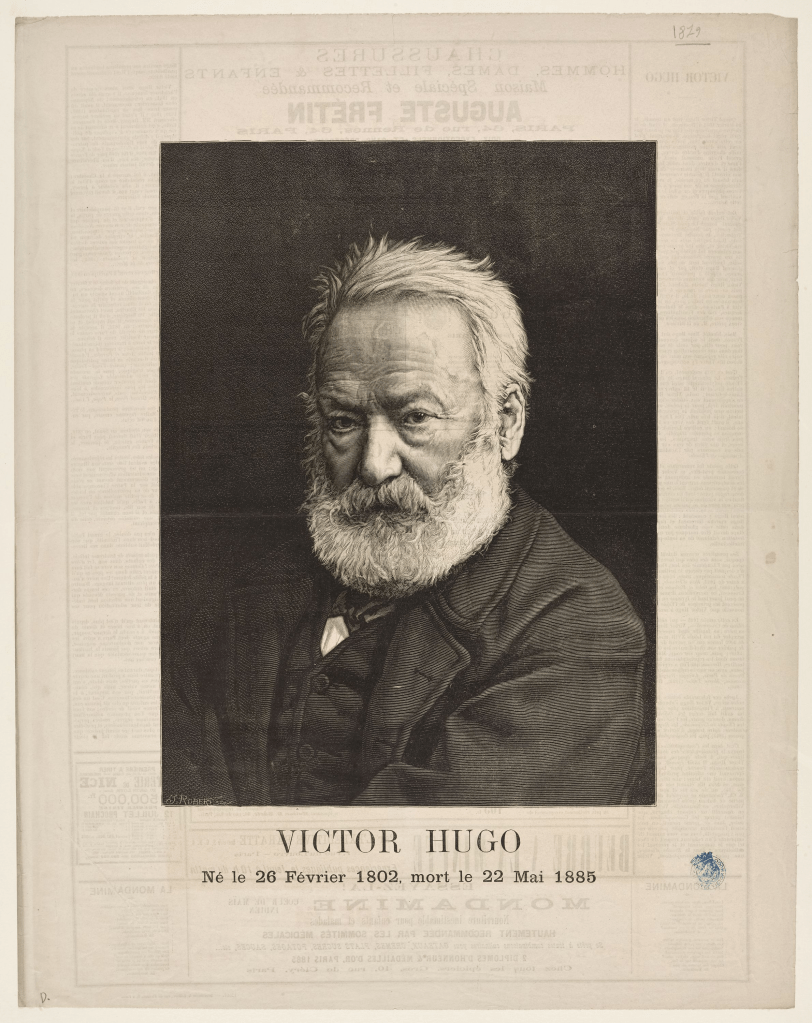
So, I was poring over the minutes of the 1878 Paris conference—the one that set the stage for the Berne Convention of 1886. And I chanced upon Victor Hugo’s first speech on 17th June 1878. He gave three speeches in total, contrary to what some believe to be two. Although I have seen some of these snippets floating around in the scholarship on the notion of public domain and public interest, etc., this time, when I read the whole thing, every word. And voilà… it hit differently. And I think it’s worth quoting in full. This post is limited to the first speech delivered on 17th June. Speech 2 is here, and Speech 3 is here.
Disclaimer – The following text is an English translation of a French original. The translation was performed using DeepL. Although I have made the best of my efforts to maintain the accuracy of the source material. I would suggest you check the original source in Pataille, J., ed. Annales de la Propriété Industrielle, Artistique et Littéraire. Vol. 25. Paris, 1880. Available through Gallica, the digital archive of the Bibliothèque nationale de France. If you don’t find the document, let me know. I will share a copy with you.
Okay, here are a few things that caught my interest –
First, I liked how Hugo defines the book and emphasises its importance to progress, using highly compelling rhetoric to make his point clear. While he discusses the public domain, it is a different kind of course—one which keeps the author’s rights perpetual, but not in a simple black-and-white manner. He says,(emphasis placed by me)
“Gentlemen, let us return to principle: respect for property. Let us affirm literary property, but at the same time, let us found the public domain. Let us go further: let us enlarge it. Let the law grant to all publishers the right to print all books after the author’s death, on the sole condition of paying to the direct heirs a very modest royalty, not exceeding in any case five or ten percent of the net profit. This very simple system, reconciling the incontestable property of the writer with the no less incontestable right of the public domain, was indicated in the commission of 1836 by the one who now addresses you; and this solution, with all its developments, may be found in the minutes of that commission, then published by the Ministry of the Interior.”
And he adds something which I found even more intriguing, given my work on the genealogy of balance discourse in international copyright law:
“Let us not forget: the principle is double. The book, as book, belongs to the author; but as thought, it belongs—to use no word too vast—to humanity. All minds have right to it. And if one of the two rights, the right of the writer or the right of the human spirit, had to be sacrificed, it would surely be the writer’s right, for the public interest is our sole preoccupation, and all, I declare, must take precedence over us. (Numerous marks of approval.)”
But mind it, it is not to be confused with the idea of balance that is thrown everywhere these days—it’s more about reconciling interest with a clear instrumental relationship with authors, right alongside that of human spirituality. In the event of a conflict, the latter would prevail.
Yes, you read him right …. if one of the two rights, that of the writer or that of the ‘human spirit’ (which seems vaguer than the notions of public interest mainly linked to limiations and exceptions these days), were to be sacrificed, it must surely be the writer’s, for the public interest is, he insists, our only true concern, and all else must yield before it. And then comes something that, to me, feels like a rhetorical sleight of hand. Hugo adds:
“But, as I have said, such a sacrifice is unnecessary. Ah, light! Light always! Light everywhere! The universal need is light. The light is in the book. Open the book wide. Let it shine, let it act. Whoever you are that would cultivate, vivify, edify, soften, appease—put books everywhere; teach, show, demonstrate; multiply schools; schools are the luminous points of civilization.”
It’s also interesting how the rhetoric of civilisation is played out here and the way the idea of literature or text is described, going to the extent of claiming that text is civilisation, underscoring a particular epistemic stand on knowledge production, which, in no way, was universal yet was enclosed like it was. (I will discuss this idea in detail in the coming days.)
Alright, that’s what piqued my curiosity the most. Below is his entire speech; see what excites or irritates you:
“Speech of Victor Hugo, President of the Congress (Solemn opening session, 17 June)
Gentlemen,
What makes this memorable year so great is that, supremely, above the rumors and clamor, imposing a majestic interruption to the astonished hostilities , it gives voice to civilization. We can say of it: it is a year that is obeyed. What it has set out to do, it is doing. It is replacing the old agenda, war, with a new agenda, progress. It is overcoming resistance. Threats are rumbling, but the union of peoples smiles. The work of the year 1878 will be indestructible and complete. Nothing is temporary. One senses in everything that is being done something definitive. This glorious year proclaims, through the Paris Exposition, the alliance of industries; through the centenary of Voltaire, the alliance of philosophies; through the congress gathered here, the alliance of literatures (Applause); a vast federation of labor in all its forms, an august edifice of human fraternity based on peasants and workers and crowned by intellectuals. (Bravo.)
Industry seeks utility, philosophy seeks truth, literature seeks beauty. Utility, truth, beauty: these are the threefold goals of all human endeavor; and the triumph of this sublime endeavor, gentlemen, is civilization among peoples and peace among men. It is to witness this triumph that you have come here from all corners of the civilized world. You are the great minds that nations love and revere, you are the famous talents, the generous voices that are listened to, the souls working for progress. You are the peacemakers. You bring here the radiance of renown. You are the ambassadors of the human spirit in this great city of Paris. Welcome. Writers, orators, poets, philosophers, thinkers, fighters, France salutes you. (Prolonged applause.)
You and we are fellow citizens of the universal city. All of us, hand in hand, affirm our unity and our alliance. Let us enter, all together, into the serene homeland, into the absolute, which is justice, into the ideal, which is truth.
It is not for personal or limited interests that you are gathered here; it is for the universal interest. What is literature? It is the setting in motion of the human spirit. What is civilization? It is the perpetual discovery made at every step by the human spirit in motion; hence the word Progress. One might say that literature and civilization are identical.
Peoples are measured by their literature. An army of two million men passes, an Iliad remains; Xerxes has the army, but lacks the epic: Xerxes fades away. Greece is small in territory but great in Aeschylus. (Movement.) Rome is but a city; but through Tacitus, Lucretius, Virgil, Horace, and Juvenal, this city fills the world. If you mention Spain, Cervantes springs to mind; if you speak of Italy, Dante rises; if you name England, Shakespeare appears. At certain moments, France can be summed up in one genius, and the splendor of Paris merges with the brilliance of Voltaire. (Repeated applause.)
Gentlemen, your mission is a lofty one. You are a kind of constituent assembly of literature. You have the authority, if not to vote on laws, at least to dictate them. Say the right things, express true ideas, and if, by some chance, you are not listened to, well, you will prove the legislation wrong.
You are going to establish a foundation, literary property. It is within the law, and you are going to introduce it into the code. For I affirm that your resolutions and your advice will be taken into account.
You are going to make it clear to legislators who would like to reduce.
You will make it clear to legislators who would like to reduce literature to a local phenomenon that literature is a universal phenomenon. Literature is the government of the human race by the human spirit. (Bravo!)
Literary property is of general utility. All old monarchical laws have denied and still deny literary property. To what end? To the end of enslavement. The writer who owns his property is The writer who owns his work is the free writer. To take away his property is to take away his independence. At least, that is the hope. Hence this singular sophism, which would be childish if it were not treacherous: thought belongs to everyone, therefore it cannot be property, so literary property does not exist. First, there is a strange confusion between the faculty of thinking, which is general, and thought, which is individual; thought is the self. Then there is confusion between thought, which is abstract, and the book, which is material. The writer’s thought, as thought, escapes any hand that would seize it; it flies from soul to soul; it has this gift and this power, virum volitare per ora; but the book is distinct from thought; as a book, it is graspable, so graspable that it is sometimes seized. ( Laughter. ) The book, a product of the printing press, belongs to industry and determines, in all its forms, a vast commercial movement; it is sold and bought; it is property, value created and not acquired, wealth added by the writer to the national wealth, and certainly, from all points of view, the most indisputable of properties. This inviolable property is violated by despotic governments ; they confiscate the book , hoping thus to confiscate the writer . Hence the system of royal pensions . Take everything and give back a little . Spoliation and subjugation of the writer . He is robbed , then bought . A futile effort, moreover . The writer escapes. He is made poor, but he remains free. (Applause.) Who could buy these superb consciences, Rabelais, Molière, Pascal? But the attempt is nonetheless made, and the result is grim. The monarchy is some kind of terrible suction of the vital forces of a nation; historiographers give kings the titles of fathers of the nation and fathers of letters; everything is held together in the disastrous monarchical whole; Dangeau, flatterer, notes this on one side; Vauban, stern, notes it on the other; and, for example, in what is called “the great century,” the way in which kings are fathers of the nation and fathers of letters leads to these two grim facts: the people without bread, Corneille without shoes. (Long applause.)
A dark stain on the great reign!
This is where the confiscation of property born of labor leads, whether this confiscation weighs on the people or on the writer.
Gentlemen, let us return to the principle: respect for property. Let us recognize literary property, but at the same time, let us establish the public domain. Let us go further. Let us expand it. Let the law give all publishers the right to publish all books after the death of the authors, on the sole condition of paying the direct heirs a very small royalty, which in no case exceeds five or ten percent of the net profit. This very simple system, which reconciles the writer’s indisputable property rights with the equally indisputable right of the public domain, was proposed in the 1836 commission by the person speaking to you at this moment; and this solution, with all its details, can be found in the minutes of the commission, published at the time by the Department of the Interior.
Let us not forget that there are two principles at work here. The book, as a book, belongs to the author, but as a thought, it belongs—and the word is not too broad— to humankind. All minds have a right to it. If one of the two rights, the right of the writer and the right of the human mind, were to be sacrificed, it would certainly be the right of the writer, for the public interest is our sole concern, and all, I declare, must come before us. (Numerous signs of approval.)
But, as I just said, this sacrifice is not necessary.
Ah! Light! Light always! Light everywhere! The need for everything is light. Light is in the book. Open the book wide. Let it shine, let it do its work. Whoever you are who wants to cultivate, enliven, edify, soften, appease, put books everywhere; teach, show, demonstrate; multiply schools; schools are the bright spots of civilization.
You take care of your cities, you want to be safe in your homes, you are concerned about this danger, leaving the streets dark; consider this even greater danger, leaving the human mind dark. Intelligence is like open roads; it has comings and goings, it has visitors, with good or bad intentions, it can have unfortunate passersby; a bad thought is like a thief in the night, the soul has criminals; bring light everywhere; do not leave human intelligence of those dark corners where superstition can nestle, where error can hide , where lies can lie in wait. Ignorance is twilight; evil lurks there. Think about lighting the streets, yes; but think also, think above all, about lighting the minds. (Prolonged applause.)
This requires, of course, a prodigious expenditure of light. It is to this expenditure of light that France has been devoted for three centuries. Gentlemen, allow me to say a filial word, which is in your hearts as well as in mine: nothing will prevail against France. France is of public interest. France rises above the horizon of all peoples. France rises on the horizon of all peoples. Ah! they say, it is daybreak, France is here! (Yes! Yes! Repeated bravos.)
That there may be objections to France is surprising; yet there are some; France has enemies. They are the very enemies of civilization, the enemies of books, the enemies of free thought, the enemies of emancipation, of examination, of deliverance; those who see in dogma an eternal master and in the human spirit an eternal minor. But they are wasting their efforts; the past is past, nations do not return to their vomit, blindness has an end, the dimensions of ignorance and error are limited. Accept this, men of the past, we do not fear you! Go ahead, do it, we are watching you with curiosity! Try your strength, insult ’89, depose Paris, condemn freedom of conscience, freedom of the press, freedom of the tribune, condemn civil law, condemn the revolution, condemn tolerance, condemn science, condemn progress! Do not tire! Dream, while you’re at it, of a Syllabus big enough for France and a snuffer big enough for the sun! (Unanimous acclamation. Triple round of applause.)
I do not want to end on a bitter note. Let us rise above and remain in the unchanging serenity of thought. We have begun to affirm harmony and peace; let us continue this proud and tranquil affirmation.
I have said elsewhere, and I repeat, all human wisdom can be summed up in these two words: conciliation and reconciliation; conciliation for ideas, reconciliation for men.
Gentlemen, we are here among philosophers; let us take advantage of the occasion; let us not be shy; let us speak the truth. (Smiles and signs of approval.) Here is one, a terrible one: the human race has a disease, hatred. Hatred is the mother of war; the mother is infamous, the daughter is awful.
Let us strike back at them blow for blow. Hatred for hatred! War for war! (Sensation.)
Do you know what Christ meant when he said, “Love one another”? It means universal disarmament. It means healing the human race. That is true redemption. Love one another. It is better disarms his enemy by extending his hand than by showing him his fist. This advice from Jesus is a command from God. It is good. We accept it. We are with Christ, we ourselves! The writer is with the apostle; the thinker is with the lover. (Applause.)
Ah! Let us raise the cry of civilization! No! No! No! We want neither barbarians who wage war nor savages who murder! We want neither war between peoples nor war between men. All killing is not only ferocious, but senseless. The sword is absurd and the dagger is foolish. We are the warriors of the spirit, and it is our duty to prevent the war of the flesh; our role is to always throw ourselves between the two armies. The right to life is inviolable. We do not see the crowns, if there are any, we see only the heads. To grant mercy is to make peace. When the fateful hour strikes, we ask kings to spare the lives of their people, we ask republics to spare the lives of emperors. (Applause.)
It is a beautiful day for the outcast when he begs a people for a prince, and when he tries to use, in favor of an emperor, that great right of mercy which is the right of exile.
Yes, to conciliate and reconcile. Such is our mission, we philosophers. O my brothers of science, poetry, and art, let us recognize the civilizing power of thought. With every step that humankind takes toward peace, let us feel the deep joy of truth grow within us. Let us take pride in useful work. Let us take pride in useful work. Truth is one and has no divergent rays; it has only one synonym, justice. There are not two lights, there is only one, reason. There are not two ways of being honest, sensible, and true. The ray that is in the Iliad is identical to the clarity that is in the Philosophical Dictionary. This incorruptible ray traverses the centuries with the straightness of an arrow and the purity of dawn. This ray will triumph over the night, that is to say, over antagonism and hatred. This is the great literary miracle. There is none more beautiful. Strength bewildered and stunned before justice, the arrest of war by the spirit, this, O Voltaire, is violence tamed by wisdom; this, O Homer, is Achilles seized by the hair by Minerva! (Long applause.)
And now that I am about to finish, allow me to make a wish, a wish that is not addressed to any party, but to all hearts.
Gentlemen, there is a Roman who is famous for his obsession; he said: Let us destroy Carthage! I, too, have a thought that obsesses me, and it is this: Let us destroy hatred. If the humanities have a purpose, it is this: Humaniores litteræ. Gentlemen, the best way to destroy hatred is through forgiveness. Ah! May this great year not end Ah! May this great year not end without definitive pacification, may it end in wisdom and cordiality, and after extinguishing foreign war, may it extinguish civil war. This is the deep wish of our souls. France at this hour shows the world its hospitality; may it also show its clemency. Clemency! Let us place this crown on the head of France! Every celebration is fraternal; a celebration that does not forgive someone is not a celebration. (Loud emotion. – Repeated bravos.) The logic of public joy is amnesty. Let this be the conclusion of this admirable solemnity, the World’s Fair. Reconciliation! Reconciliation! Certainly, this gathering of all the common efforts of humankind, this rendezvous of the wonders of industry and labor, this salutation of masterpieces among themselves, confronting and comparing themselves, is an august spectacle; but there is an even more august spectacle, that of the exile standing on the horizon and the homeland opening its arms! (Long acclamation; the French and foreign members of Congress surrounding the speaker on the platform come to congratulate him and shake his hand, amid repeated applause from the entire hall.)
In my reading of the Second Treatise‘s property chapter, I do not find desert absent – that would overreach. Rather, I find desert claims functioning as morally appealing packaging for arguments with instrumental aims. These aims operate at two levels: (i) individual self-preservation in an emerging market society where social relations of production are driven by creation of exchange value for survival in an ever competitive environment, and (ii) social improvement to expand the overall propensity for creating exchange value – what Locke frames as God commanding labor to “improve” land “for the benefit of life,” giving it to “the Industrious and Rational,” and increasing “the common stock of mankind.” Locke writes at a moment when feudal relations are dissolving, and market dependencies are emerging as the structure governing access to subsistence. His move is articulating a theory to enclose commons in favour of someone who is expending labour or sacrifice or effort and being productive – through property rules – while packaging them in the intuitive and morally appealing language of deserving for individual desert, divine command, and natural right – “subduing or cultivating the earth, and having dominion, we see are joined together”; “God by commanding to subdue, gave authority to appropriate”.
The chain runs: God commands self-preservation → self-preservation requires continuous production → production requires continuous labour → therefore labour deserves rights → these rights are enclosures (which provide access to means of self-preservation as a matter of transaction capacity) and hence, property rights. The weight, thus, rests on self-preservation and its consequences (including “preservation of mankind” through increasing the common stock), not on effort or exertion as possessing intrinsic moral value. How self-preservation got linked to continuous production, which got linked to labour, and ultimately provided a connection to “property” which is the bounty to ensure self preservation, is not appropriately explained by Locke or Lockeans.
As the previous piece explained, self-preservation got linked to a need for continuous and self-expanding notion of production (resulting in accumulation) only in a particular epoch where through a period of transition, humans were dis-embedded from their means of subsistence, and were forced to labour and be productive for self-preservation. Productive labour is deemed “valuable” (which I shall explore in the next piece) solely because of the prevalence of this epoch, and not for any intrinsic worth that it embodies. Touting it as god’s command ignores this factual-historical reality. Moreover, Locke, no where explains, why property or enclosure is the rightly “deserved” reward for the “labour” extended, and intuitively assumes it.
When Locke writes that someone who takes “the benefit of another’s pains, which he had no right to” [§34] commits a wrong, this is a desert formulation. But what and why are these “pains”? Notice the grounding: “the penury of his condition required it of him” [§32]; “God commanded, his wants forced him to labour” [§35]. These pains are efforts compelled by preservation necessity in prevalent social relations, where such preservation (remember “safety first”?) increasingly requires productive appropriation creating exchange value. The wrong isn’t purely about respecting individual effort as such – it’s about taking what someone’s survival needs forced them to produce and they need for their own preservation. Desert is real in Locke, but it’s an instrument towards preservation as against a moral reward for effort (for any simpliciter non instrumental moral reason, as a justification with any intrinsic reasoning for itself). One deserves the fruits not because exertion is intrinsically morally worthy, but because one needs them to survive in a market society, and one’s condition (hence god’s command) forced one to produce them, apart from it adding social value to the world (to whatever extent that is). Labor matters because it produces survival-necessary mechanisms in the relevant epoch, not because mixing one’s efforts with objects carries intrinsic moral significance which is de hors any explanation.
Further. §28 states: “The Grass my Horse has bit; the Turfs my Servant has cut; and the Ore I have digg’d in any place where I have a right to them in common with others, become my Property, without the assignation or consent of any body. The labour that was mine, removing them out of that common state they were in, hath fixed my Property in them.” The servant performs the physical labor of cutting turfs. The servant’s preservation needs drove the effort. Yet the master owns the product as initial entitlement, without any contract or transfer. If property followed from personal desert, the servant should own. Locke could save appearances by invoking contractual transfer, but he doesn’t. He simply asserts master’s ownership. This makes sense if property follows from organizing productive appropriation – the master owns because he directs the productive deployment of labor (his own, his servant’s, his horse’s) toward creating exchange value. In my reading, Locke uses “one’s labor” to mean the labor one owns, not the labor one performs. Some argue this to be the naturalized reminiscent of feudalism still prevalent to an extent when Locke was writing, and not a foundation for employment relations that came much more subsequently. However, I believe, Locke assumes production relations similar to employment from the outset, embedding them in the state of nature itself. The framework concerns productive deployment, not rewarding individual exertion, simplicter. Also, I don’t think this is about slavery or coercion. Chapter IV explicitly distinguishes slavery and clarifies that men sold themselves “only to drudgery, not to slavery” [§24], with masters lacking arbitrary power. The servant relationship represents voluntary employment, yet master still owns as initial entitlement without requiring contractual transfer.
I see a functional role of labor in passages where Locke says labor “puts the difference of value on everything” [§40], “makes the far greatest part of the value of things, we enjoy in this World” [§42], and “puts the greatest part of value upon Land” [§43]. The language is consistently descriptive of function rather than prescriptive of entitlement based on effort, per se.
Locke measures this value through market exchange rather than use-value or subsistence. §43 is “the benefit mankind receives from the one in a year” measured by what it “is worth” versus what “an Indian received from it were to be valued, and sold here; at least, I may truly say, not one thousandth”. This completely orients toward creating exchange value. Even §50’s discussion of money supports this: gold and silver have value “only from the consent of Men,” yet “Labour yet makes in great part the measure” of value [§50].
Locke also says that Americans are “rich in Land, and poor in all the Comforts of Life” [§41] despite laboring, because they lack “improving it by labour.” An American “King of a large and fruitful Territory there, feeds, lodges, and is clad worse than a day Labourer in England” [§41]. Native Americans perform labor through hunting, gathering, and cultivation. They certainly exert effort. Their preservation needs certainly force labor. Yet Locke says they lack “improving” labor and therefore remain poor despite working. Americans labor and remain poor while English day-laborers – who don’t own land and work for wages – enjoy superior material conditions. In my reading then, what matters isn’t effort but productive value-creation organized within specific social relations. In this process he seems to naturalize a conception of “value” that is prevalent and relevant to his time (to the social relations constituting his mindset) as against anything else. What counts as “valuable” labor is determined by whether it’s organized within the market structures emerging in his historical moment, not by effort or productivity in any abstract sense. This is a value theory of labour: desert seems intuitive because labor creates “value,” but what constitutes “value” is itself determined by social relations preceding and constituting “value”.
This connects to a deeper problem with claiming market valuations, through rights to exclude (which are then transacted through licenses or assignments) measure what workers deserve, simpliciter. There are several problems with this approach. First, whether someone develops valuable marketable skills depends largely on morally random factors like their genetic makeup and the family and social circumstances they were born into – things they didn’t choose. Second, what the market values at any given moment reflects social factors that have little to do with moral merit, such as current consumer preferences and what labor or skills happen to be available from other workers. Third, the price something commands in the market isn’t just about a person’s abilities and what society wants; it’s also heavily influenced by various legal and institutional structures that determine how much bargaining power different people have in the marketplace – factors that have nothing to do with what someone morally deserves.
Property rights, in Locke’s text, seem instrumental to me because he says that without appropriation, resources “could be of no use, or at all beneficial to any particular Man” [§26]. “He who appropriates land to himself by his labour, does not lessen but increase the common stock of mankind… he, that incloses Land and has a greater plenty of the conveniences of life from ten acres, than he could have from an hundred left to Nature, may truly be said, to give ninety acres to Mankind” [§37]. This appeals to social consequences: increased “common stock,” “plenty,” more “conveniences of life.” He further links “subduing or cultivating the Earth” with “having Dominion” [§35], showing that he values productive improvement rather than effort per se. The “enough and as good” proviso [§§27, 33] preserves others’ productive opportunities. The common stock principle [§37] makes appropriation legitimate only when it increases general benefit.
Moreover, the spoilage limitation [§§31, 46] grounds property in actual sustenance (self-preservation needs rather than unlimited accumulation. These are preservation-based constraints.
I don’t think desert or reward or deservingness is the justification itself. I think it’s a consequence of social relations that make it compulsory, and hence convincing, to link effort or labour to some kind of reward through conferment of something valuable that can provide a link to click to access resources for needs of sustenance/ self-preservation (be it exchange value through some determined form of fair compensation that is socially provided, or self-expanding market determinant property rights (which have been more so criticized for being a circular justification)). It comes across as convincing rhetorical packaging. Just as “God commanded” or “natural reason” provides intuitive force, labor-mixing language, in a social situation where access to basics are stripped off, and labour is a way of getting access to sustenance, provides intuitive force for property rules which aim towards expanding overall production of exchange value – both for individual self-preservation in market relations and for social improvement through increasing the common stock – without doing genuine desert work in the foundational sense.
And there’s an internal tension: for Locke, the liberty that an individual possesses in his person is inalienable [§23], while the argument from self-dominion is often used to justify conceptions of legal ownership that include the right to alienate. Locke immediately uses self-ownership to create transactable property rights. Self-ownership, in my reading, thus seems to be functional – it explains the technical process by which appropriation occurs in Locke’s theory to create value that fulfills preservation needs and conveniences of life, as against having any intrinsic moral value in itself.
By framing property as arising from isolated acts of individual productive labor-mixing with nature, Locke obscures that what makes labor “productive” or “valuable” is determined by a comprehensive system of social relations – the market dependencies, competitive imperatives, employment structures that capitalism creates. The framework presents isolated individuals mixing labor with unowned nature [§§26-28], when what’s actually happening is systemic transformation of social relations that creates certain behaviors as necessary for survival. What appears as individual choice – to labor productively, to improve land, to enter employment – is actually compulsion generated by transformed property relations that render access to means of subsistence market-dependent, and hence creation of maximum exchange value imperative for survival. Locke is just theorizing a further bait – through enclosures – to make sure labour is performed as it would increase overall common stock that generates value (meaning exchange value).
Thus, the preceding post showed that labor became “valuable” and “productivity” became meaningful only because of specific historical transformation – when market-dependence made labor-for-exchange-value a survival imperative – meaning “value” itself was constituted by these new social relations, not discovered as a natural property or derived from any intrinsic moral worth related to effort or industriousness. It is relevant only because it is labour that is “productive”, and not anything else, that now helps (or is useful to) realize access to conveniences of life (as access to means of subsistence is linked to it), and the more productive one is, the better they sustain in a competitive society. This means desert claims based on labor or productivity only seem intuitively compelling because we’re already embedded in social relations where productive labour equals access to means of survival; the moral force of “labor deserves reward” derives from social conditions where not-rewarding-productive labour with value would undermine the social relations of production as source of access to basics (which feudal lords competing for now “free” peasants conceptualized by dispossessing and claiming absolute control of land (through leasehold arrangements), as explained in the preceding part).
Locke and Lockeans present the causal chain as: Labor (intrinsically valuable and morally worth) → Desert → Property rights. But the actual order, revealed by historical analysis, runs: Transformed property relations → Labor becomes “valuable” (survival-necessary) → Desert claims become intuitively appealing → Used to justify property rules and enclosures (as bounty for labour). Desert presupposes what it claims to ground. Labor doesn’t possess intrinsic value that naturally generates property rights; rather, labor became “valuable” in the relevant sense – only because the transformation explained in the preceding post made it so. When Locke argues that labor-mixing creates property rights, he’s not articulating transhistorical truth but naturalizing historically specific compulsions – theorizing as eternal what the preceding post showed was created – showing that now that productive labour is a compulsion one can make it the subject of enclosure by adverting it some “value” for purposes of exchange enabling it to be a source of realizing the means of subsistence and subsequently, conveniences of life. Are enclosures that are then transactable through exchange the only source of sustenance though?
To conclude, the moral link between labor and desert may be more historically contingent than we typically assume. In pre-capitalist contexts, labor wasn’t primarily understood through desert frameworks at all – people worked the land as embedded participants in households and communities, where “return” meant participation in a shared form of life rather than individually deserved compensation for discrete labor inputs. The desert-for-labor intuition intensifies precisely under specific conditions: when labor becomes alienated and commodified, when survival depends on selling labor time, when work is experienced as sacrifice rather than embedded activity, and when there’s constant anxiety about whether one is receiving “fair” compensation (and whether enclosure/property is the best mode of providing “fair” compensation). In other words, the moral urgency of “I deserve X for my labor” emerges from the very conditions where labor is separated from life and becomes something one must do for others who control resources. The desert framework, rather than being an intrinsic moral truth about productive activity, appears to be ideology generated by the material circumstances of capitalism itself – we must believe labor deserves return because under market dependence, that transactional logic and imputing such “value” to productive labour, is the only mechanism through which we can claim access to subsistence.
Capitalism ¹ Liberty : Notes from Wood and Brenner
The conventional narrative posits that capitalism arose naturally from expanding trade, urban development, wealth accumulation, or technological advancement – elements supposedly present throughout history, requiring only liberation from feudal constraints which had stumbled their pre-presence. Ellen Wood’s The Origin of Capitalism and Robert Brenner’s Agrarian Class Structure and Economic Development and Property and Progress: Where Adam Smith Went Wrong, reveal a dramatically different story: capitalism emerged from a specific transformation of social property relations in the English countryside, creating for the first time markets operating not as opportunities but as imperatives – mechanisms compelling certain behaviors on pain of elimination. This distinction explains why capitalism emerged specifically in the English countryside rather than in societies with more extensive commerce, and illuminates why capitalism represents not natural liberation of economic behavior but creation of novel compulsions operating through apparently impersonal (and hence, “un-free” contrary to libertarian narrative) market forces.
The Concept
No quantity of accumulation – from theft, imperialism, commercial profit, or even labor exploitation – by itself constitutes capital or produces capitalism. Roman senators, Venetian merchants, Spanish conquistadors accumulated vast wealth without creating capitalism. What transforms wealth into capital is not quantity but social form: property relations generating capitalist “laws of motion” – imperatives of competition and profit-maximization, compulsion to reinvest surpluses, systematic requirement to improve labor productivity and develop productive forces for subsistence. It is when “safety first” gets linked to constant production, fundamentally reinventing social relations of production.
This means capitalism cannot be defined by the presence of markets simpliciter (which have existed for millennia), nor by trade (connecting distant civilizations in antiquity), nor even by profit-seeking behavior (motivating merchants throughout recorded history to “buy cheap and sell dear”). Rather, capitalism is defined by specific social relations that create systemic imperatives for continuous accumulation and productivity improvement
Marx identified the critical transformation in English countryside. In Marx’s account, the critical transformation occurred in the English countryside through the expropriation of direct producers (Wood, p.40). Landlords derived rents from capitalist tenants’ commercial profits. These tenants were actually leaseholders: after absolute ownership was expropriated in lords’ favor, rents were levied competitively upon lease transfers, exchanged for freedom from serfdom and common law rights in King’s Courts. Meanwhile, numerous small producers underwent dispossession and became wage laborers. Marx regards this rural transformation as the authentic “primitive accumulation” not because it created a critical mass of wealth – numerous societies had accumulated substantial wealth through conquest and trade – but because these social property relations generated novel economic imperatives, particularly the compulsions of competition and a systematic requirement to develop productive forces, producing new laws of motion unprecedented in human history. (Wood, p.40).
Polanyi recognized that only in “market society” do economic institutions separate from social relations, with society becoming market’s “adjunct” rather than economy embedded in society (Wood, p.26). Without “protective countermoves,” “human society would have been annihilated.” According to Wood, however, Polanyi’s explanation contained technological determinism – arguing complex machinery necessitated commodifying labor. This, according to Wood, inverts reality. She argues that radical social relations transformation preceded industrialization (Wood, p.29) – Capitalist imperatives drove machinery development, not the reverse.
What transpired in the English Countryside?
Through competitive political accumulation, particularly responding to the emerging French monarchy, Anglo-Norman lords created a more centralized feudal state than existed elsewhere in Europe at that time. By organizing through a national monarchical state that could discipline the aristocracy, English lords achieved unusually high cooperation in operating their decentralized surplus extraction system and in military ventures (Brenner, p.20-21).
A critical institutional innovation was imposing a national common law system binding the lords themselves. This system granted all free persons, including legally free peasants, access to royal courts while excluding unfree peasants and relegating them to manorial jurisdiction. The resulting enhancement of lordly power enabled English lords to experience an economic golden age from the late twelfth through early fourteenth centuries – precisely when French lords faced declining feudal revenues due to peasant gains. English lords imposed tighter serfdom with state assistance, maintaining extraction levels right until the Black Plague (Brenner, p.21).
The catastrophic post-plague population collapse undermined coercive extraction. The drastically altered man-land ratio caused lordly cooperation to collapse under competitive pressures for scarce tenants (Brenner, p.21). The 1381 revolt proved watershed – peasants streamed away, lords competed offering better terms and legal freedom through written manor roll copies (contracts between legal equals). By the fifteenth century’s second quarter, most English peasants had won freedom and paid reduced rents.
This was the social condition that created lords’ existential threat. Unable to reimpose feudal levies, they deployed their “trump card”: the powerful monarchical state they could now repurpose (Brenner, p.22). With Tudor state assistance, lords asserted that customary land remained subject to arbitrary, variable rents upon transfer – transforming it into commercial leasehold, effectively lords’ own property, as against peasant proprietorship that was prevalent in France. State power suppressed sixteenth-century peasant revolts vindicating customary rights in the land, separating the peasants from their means of subsistence. Lords cut short peasants’ push to win not just freedom but fixed payments and inheritance rights, thereby establishing their own property rights, while severing tenants from full means of subsistence, rendering them market-dependent, as the cost of freedom (Brenner, p.22). This is why it is sometimes referred to as “freedom in the double sense”.
Critically, English lords understood themselves as acting within established feudal tradition, merely reaffirming their customary prerogative to impose arbitrary levies on customary tenants. Their objective was not creating a new system but preventing peasants from consolidating possessory rights – fixed dues and inheritance rights – that would eliminate lords’ ability to obtain economic returns from customary land. Given population growth’s inflationary pressures, consolidation of such peasant rights threatened lords’ capacity to extract any meaningful rent whatsoever (Brenner, p.22).
The epochal yet unintended consequence was – subjecting tenants to competitive lease bidding, imposing necessity to abandon subsistence production and adopt capitalist reproduction rules (Brenner, p.22-23). Once rendered market-dependent, emerging farmers had no alternative but to alter their “safety first” strategy – Production and maximal accumulation to win rent-competition was initiated as that was the only way of being safe from being famished. This transformation was fundamentally political – lords inadvertently created capitalism while preserving feudal privileges.
This transformed into what Robert Brenner identifies as a classical landlord-capitalist tenant-wage labor structure (Brenner, p.35). Landholding in England was unusually concentrated. Large landowners controlled an unusually substantial proportion of land under conditions enabling them to deploy property in novel ways (Wood, p.102-103). An unusually large proportion of land was cultivated not by peasant-proprietors but by tenants – a pattern reflected linguistically in the fact that the word “farmer” originally and literally signified “tenant,” as the phrase “farming out” continues to indicate.
What English landlords lacked in “extra-economic” powers – juridical, military, political powers continental lords employed – they compensated for through increasing “economic” powers from controlling land and structuring tenant relationships (Wood, p.102-103). Their income depended on tenants’ capacity to produce profitably and remit rent from that profit. Both landlords and tenants came to depend on the market in historically unprecedented ways merely to secure conditions of their own social reproduction (Wood, p.56).
“Rules for reproduction” captures how property relations determine logic by which actors must operate to survive and reproduce themselves – they constitute individual action. Reduced to market dependence, commercial tenants had no alternative but to adopt “production for exchange,” maximizing profits through specializing, accumulating, innovating (Brenner, p.29). They abandoned peasant rules: producing numerous children for insurance, subdividing holdings. Customary leases ultimately transformed into economic leases, and property itself became an instrument of economic exchange as against ownership by conquest.
The consequence was a highly productive agrarian sector in which landlords and tenants alike became preoccupied with “improvement” – the enhancement of land’s productivity for profit (Wood, p.109). This dynamic initiated an entirely novel historical process: an unprecedented rupture with old Malthusian cycles, a process of self-sustaining development, new competitive pressures that generated their own effects upon the requirement to increase productivity, further concentration of landholding (Wood, p.56). Where other European societies remained trapped within cycles of expansion and crisis, England achieved breakthrough to sustained growth – not through technological superiority or greater commercial development but through transformed social relations imposing systematic imperatives for productivity improvement.
This makes clear that capitalism does not simply liberate pre–existing entrepreneurial tendencies or rational economic behavior. Rather, it creates entirely new compulsions that reshape behavior across multiple domains, production, investment, family formation, demographic patterns. Understanding these transformed rules for reproduction illuminates why the absence of such transformation in other contexts, most notably France, failed to generate capitalist dynamics.
French Contrast
French peasants enjoyed land at fixed rents. Where English landlords obtained rent increases through cooperation in improvements increasing output, French lords extracted larger shares of declining output. The paradox: customary property rights meant poverty and backwardness. In England, absence of secure peasant rights facilitated development (Brenner, p.47). Self-preservation became linked to production and commodifying labor.
The peasant proprietor faced relatively little pressure to operate his plot as profitably or efficiently as potential competitors in order to survive, because no direct mechanism existed through which such competitors could “defeat” him (Brenner, p.44-45). Unlike a tenant, the peasant proprietor need not provide a level of rent equal to what a landlord might obtain from any alternative tenant or face eviction. Unlike the independent artisan within a competitive urban environment, he need not produce cheaply enough to sell goods profitably at market price or face business failure and thus famine, as acquisition of means of subsistence was dependent on the market and not through basic proprietorship or general ability (but specialization). All that survival required for the peasant proprietor (assuming food production) was sufficient output to provide for family subsistence and to meet tax obligations and generally fixed customary rents, which could often be supplemented through wage labor (Brenner, p.45).
The peasant proprietor could resist market pressures simply by maintaining possession, by producing sufficient for subsistence, by supplementing farm income with wage labor as necessary. He need not maximize profit or improve productivity competitively. He could survive through satisficing rather than optimizing. Surplus could be reinvested for luxury, but adopting specialization and more productive mechanisms meant divorcing from means of subsistence, which was antithetical to the “safety first” approach. A market for basics necessarily came with the burden of risk.
Possessing means of subsistence shielded peasants from competition (Brenner, p.66). But why not pursue the gains from trade anyway, as rational homo economicus theory predicts? Here, Brenner identifies “the fatal flaw of Smithian trans-historical micro-economics”: Smith specified gains from specialization but “failed to consider and investigate the other side of the coin – potential costs” (Brenner, p.67). The primary constraint: “safety first.” Bad harvests were unpredictable, leading to subsistence crises. Peasants specializing in non-food crops faced incalculable danger of being squeezed between high food costs and low output returns – risking famine (Brenner, p.68). Given starvation as business failure’s cost, peasants adopted “safety first.” Large families provided insurance but reduced surplus, creating intolerable competitive disadvantage if specializing. No incentive is needed to not be willing to starve – it is an imperative.
Contrarily, In Adam Smith’s explanation, as merchants offer lords irresistible luxuries previously unavailable, lords, at an individual level dismiss retainers, expel peasants, offer commercial leases – producing capitalism. But Smith accomplishes this only by ignoring feudal social-property relations as constraints (Brenner, p.70-71). Smith’s lord acts rationally only if capitalism already exists – he presupposes its existence, reflecting lack of understanding the socially curated and constitutive nature of humans. This is methodological individualism failing to grasp how social structures constrain action.
Opportunity to Imperative
Throughout history, direct land access – through ownership, customary rights (common pool use rights Wood specifically recounts, before “improvement” led to “enclosures”), or traditional arrangements – was given for agricultural producers. In England, access became market-mediated, contingent on competitive success. The emergence of “economic rents” – determined by market conditions, not custom – exemplifies this transformation (Wood, p.103-104). Surveyors calculated “unearned increment” accruing to customary tenants paying below market-determined value – early capitalist rationality reducing social relationships to abstract monetary calculations.
The triad of landlord, capitalist tenant, wage laborer emerged. With wage labor growth, the same process created highly productive agriculture but also increasing propertyless mass constituting both wage-labor force and domestic market for cheap consumer goods – “a type of market unprecedented in history” (Wood, p.106). This mass market of the poor became central to industrial capitalism.
Improvement, Enclosure, and Locke’s Labour Producer Theory
The concept of “improvement” encapsulates the transformation in economic mentality and practice that accompanied agrarian capitalism. The word itself, in its original signification, denoted not merely “making better” in a general sense but specifically meant to render something productive of monetary profit, especially to cultivate land for profit – derived from the old French for “into” (en) and “profit” (pros) (Wood, p.109).
By the seventeenth century, the word “improver” designated someone who rendered land productive and profitable, especially through enclosure or waste reclamation. In the eighteenth century, “improvement” in both word and deed achieved its full articulation. The concept reveals how capitalism transforms the very criteria by which we evaluate resource utilization – from serving human needs or community welfare to generating profit.
An extensive new body of literature emerged in the seventeenth century elaborating techniques and benefits of improvement (Wood, p.109). This literature operated not merely at the technical level but functioned profoundly ideologically, disseminating a novel conception of humanity’s relationship to land and nature. Improvement became a major preoccupation of the Royal Society, which assembled England’s most prominent scientists – including Newton and Boyle – with members of ruling classes such as the first Earl of Shaftesbury and his protégé John Locke, who himself was a follower of Pierre Nicole (Wood, p.109-110).
Improvement did not depend primarily upon significant technological innovations. Generally, it involved new developments in farming techniques or refinements of established ones: convertible husbandry, crop rotation, drainage (Wood, p.110). The agricultural revolution that preceded industrialization was not primarily a technological revolution but a social one. The same techniques had often been known previously; what changed was the systematic compulsion to apply them.
However, improvement signified something more fundamental than novel techniques: it signified new forms and conceptions of property (Wood, p.110). “Improved” farming entailed enlarged and concentrated landholdings. It necessitated the elimination of customary practices that interfered with the most productive use of land – “productive” now defined strictly in terms of marketable output and profit. This was the first showcase of classical liberalism: a curb on regulation (through customary rights) or interference in the “market” to make it pure competition.
Peasants had employed various means of regulating land use in the interests of village communities since time immemorial (Wood, p.110-111). They restricted certain practices and granted certain rights not to enhance landlord wealth but to preserve the peasant community itself, perhaps to conserve land or distribute its fruits more equitably, often providing for the community’s less fortunate members. Distributive thinking was present but would be replaced. These practices reflected an entirely different rationality than capitalist improvement – one oriented toward community reproduction, equity, and sustainability rather than profit maximization.
Even private ownership had typically been conditioned by such customary practices, granting non-owners certain use rights to property owned by others, making it a means of subsistence for most. In England: common lands with grazing rights or rights to collect firewood; various use rights on private land, such as rights to collect harvest leavings during specified periods; traditional arrangements for crop rotation requiring coordination among landholders (Wood, p.110-111). Commons were common.
From the standpoint of improving landlords and capitalist farmers, land required liberation from any such obstructions to their productive and profitable property deployment. Between the sixteenth and eighteenth centuries, increasing pressure developed to extinguish customary rights that interfered with capitalist accumulation (Wood, p.111). This could entail disputing communal rights to common lands by claiming exclusive private ownership; eliminating use rights on private land; or eliminating customary rights of smallholders’ possession without unambiguous legal title.
This reflected a transformation in the understanding of property – from means of subsistence (access to means of subsistence) to means of maximal production to generate maximum profit, for maximum accumulation, to secure subsistence in a competitive environment. In all these cases, traditional conceptions of property required replacement by new, capitalist conceptions – not merely as “private” but as exclusive (Wood, p.111). This represents a first hint of the concept of allocative efficiency. Other individuals and the community required exclusion through elimination of village regulation and restrictions on land use, especially through extinguishing customary use rights. Property had to become absolute, exclusive, and alienable – a bundle of rights deployable solely according to owner’s calculation of profit, unencumbered by social obligations or community claims. This points toward a transformed meaning of property rights. What about the emergence of “intellectual property rights” around this time?
Enclosure is often understood simply as the physical fencing of common land or open fields. However, enclosure signified not merely physical demarcation but the extinction of common and customary use rights upon which numerous people depended for their livelihood (Wood, p.111).
The first major wave of socially disruptive enclosure occurred in the sixteenth century, when larger landowners sought to expel commoners from lands that could be profitably deployed as pasture for increasingly lucrative sheep farming. Contemporary commentators attributed to enclosure, more than any other single factor, responsibility for the growing phenomenon of vagabondage – those dispossessed “masterless men” who wandered the countryside and threatened social order.
A novel form of enclosure movement emerged in the eighteenth century: Parliamentary enclosures (Wood, p.112). The extinction of troublesome property rights that interfered with landlord accumulation now transpired through acts of Parliament. Nothing testifies more clearly to the triumph of agrarian capitalism. The state itself became the instrument for dispossessing commoners and transforming property relations. Is this neo-liberalism? So much so for law being constitutive, as against social relations being constitutive of the law.
Pressures to transform property manifested themselves in court cases, in conflicts over specific property rights (Wood, p.112). In such cases, customary practices and claims often confronted directly the principles of “improvement,” and judges increasingly recognized reasons of improvement as legitimate claims against customary rights that had existed for as long as anyone could recall. Where custom, tradition, and community need had once justified certain rights and practices, profit and productivity now became the standard.
Locke’s property theory, batting for enclosure, hinges on “improvement” (Wood, p.113-114). Locke commences with the proposition that God “hath given the world to men in common” (II.26), but proceeds to demonstrate how individuals came to possess property in particular things (Wood, p.113). Such private, individual property constitutes a God-given natural right. Men own their own persons, and the labor they perform is therefore their property. A natural right of property is established when a man “mixes his labor” with something, thereby removing it from its natural state or altering its natural condition. The theme permeating his discussion was that the earth exists to be rendered productive and profitable, and this is why private property, which emanates from labor, supersedes common possession (Wood, p.113-114).
This was the first articulation of any value – later to be revealed as exchange value – emerging out of production, in an environment where increased production and improvement was the only means of subsistence. Locke calculated “99/100” should be attributed to labour rather than nature. Crucially, Locke considers exchange value, not use value (Wood, p.114). Something particularly revealing emerges upon careful examination of Locke’s argument (Wood, p.114-115). There exists something initially appealing about the proposition that labor constitutes the source of value and the basis of property – it appears to ground property in actual productive activity rather than arbitrary power. However, something profoundly problematic becomes evident. No direct correspondence exists between labor and property because one man can appropriate another’s labor. The transferability notion becomes crucial. He can acquire a property right in something by “mixing” with it not his own labor but the labor of someone else whom he employs.
It appears the issue for Locke concerns less the activity of labor as such than its profitable deployment or its link with production/productivity. In calculating the value of the acre in America, he addresses not the Indian’s expenditure of effort but the Indian’s failure to realize profit. The issue is not the labor of a human being but the productivity, rendering exchange value, and its application in commercial profit (Wood, p.114-115), increasing common stock. (More on Locke in the next post).
What then is Capitalism?
Only in capitalism are legally free direct producers completely dispossessed, surplus labor appropriated through purely “economic” means (Wood, p.99). Workers have common law rights enforceable in King’s Courts yet must sell labor power because separated from means of production. Markets existed throughout history, but capitalism’s market possesses unprecedented function: the principal determinant and regulator of social reproduction (Wood, p.100). Once food production became subject to market imperatives, once land access became market-dependent, foundation was established for generalizing market dependence throughout society. Coercion is hidden and is the real invisible hand.
This unique system of market dependence possesses specific systemic requirements and compulsions shared by no other mode of production: the imperatives of competition, accumulation, and profit-maximization, and consequently a constant systemic requirement to develop productive forces (Wood, p.100). These imperatives signify that capitalism can and must constantly expand in ways unlike any other social form. It can and must constantly accumulate, constantly seek new markets, constantly impose its imperatives upon new territories and new spheres of life.
Crucially, agrarian capitalism rendered industrialization possible, not the reverse (Wood, p.146). English agriculture’s transformation was primarily social revolution – transformed property relations and productive imperatives, not technological. Techniques like convertible husbandry, drainage, crop rotation weren’t radically novel but systematic applications of known methods. What changed was social imperatives compelling their systematic application. Technology didn’t create capitalism; capitalism created the imperative for technological improvement. And this does not mean technology would not have developed but for capitalism, but just that it would have developed over a longer period of time de hors forces of compulsion.
In pre-capitalist societies with markets, the market was opportunity to invest surplus. But it didn’t determine social reproduction or impose systematic compulsions. Only when property relations transformed such that access to means of production and subsistence became market-dependent did the market become imperative– a force commanding behaviors under threat, generating capitalism’s distinctive dynamics: relentless productivity improvement, systematic accumulation, continuous revolutionizing of production, constant expansion, at the costs of whatever comes in it way – subsistence of those who are unable to win this competition, environmental impact, impact on human development, etc.
If capitalism arose from particular historical transformations rather than inevitable progress, it can potentially be transformed through creating different social relations. Capitalism is not history’s endpoint but a specific mode of production with a specific origin that may have a specific end.