Speech One: Victor Hugo’s on 17 June 1878 at the Paris Conference

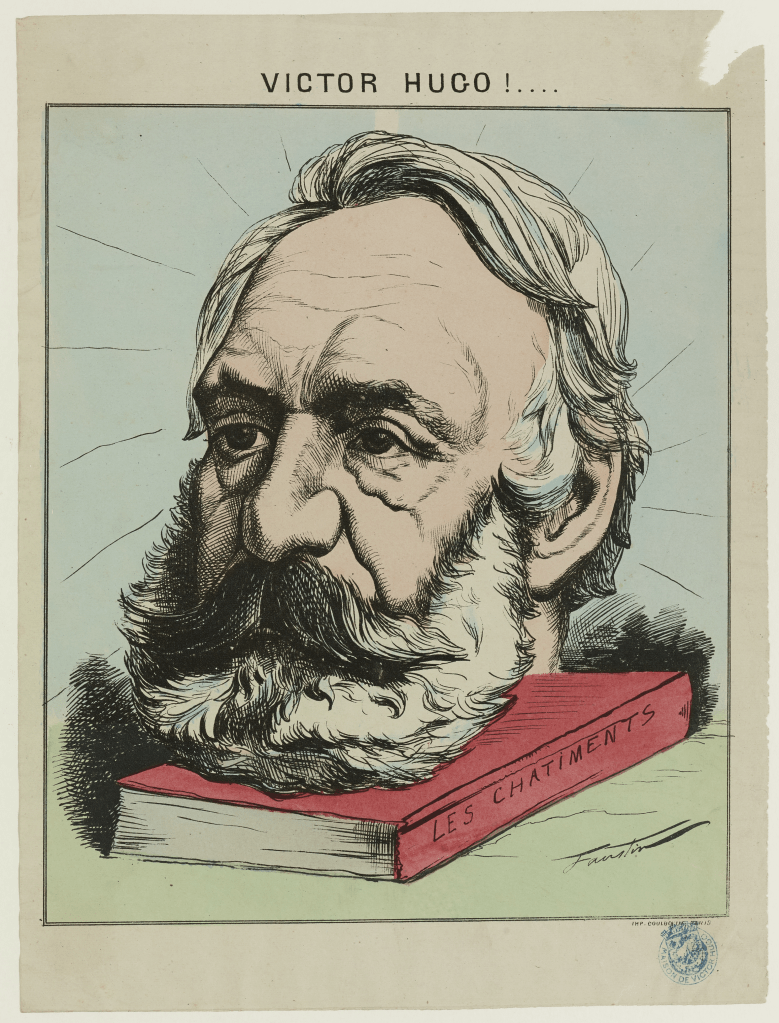
Image from here

Bonjour,

So, I was poring over the minutes of the 1878 Paris conference—the one that set the stage for the Berne Convention of 1886. And I chanced upon Victor Hugo’s first speech on 17th June 1878. He gave three speeches in total, contrary to what some believe to be two. Although I have seen some of these snippets floating around in the scholarship on the notion of public domain and public interest, etc., this time, when I read the whole thing, every word. And voilà… it hit differently. And I think it’s worth quoting in full. This post is limited to the first speech delivered on 17th June. Speech 2 is here, and Speech 3 is here.

Disclaimer – The following text is an English translation of a French original. The translation was performed using DeepL. Although I have made the best of my efforts to maintain the accuracy of the source material. I would suggest you check the original source in Pataille, J., ed. Annales de la Propriété Industrielle, Artistique et Littéraire. Vol. 25. Paris, 1880. Available through Gallica, the digital archive of the Bibliothèque nationale de France. If you don’t find the document, let me know. I will share a copy with you.

Okay, here are a few things that caught my interest –

First, I liked how Hugo defines the book and emphasises its importance to progress, using highly compelling rhetoric to make his point clear. While he discusses the public domain, it is a different kind of course—one which keeps the author’s rights perpetual, but not in a simple black-and-white manner. He says,(emphasis placed by me)

“Gentlemen, let us return to principle: respect for property. Let us affirm literary property, but at the same time, let us found the public domain. Let us go further: let us enlarge it. Let the law grant to all publishers the right to print all books after the author’s death, on the sole condition of paying to the direct heirs a very modest royalty, not exceeding in any case five or ten percent of the net profit. This very simple system, reconciling the incontestable property of the writer with the no less incontestable right of the public domain, was indicated in the commission of 1836 by the one who now addresses you; and this solution, with all its developments, may be found in the minutes of that commission, then published by the Ministry of the Interior.”

And he adds something which I found even more intriguing, given my work on the genealogy of balance discourse in international copyright law:

“Let us not forget: the principle is double. The book, as book, belongs to the author; but as thought, it belongs—to use no word too vast—to humanity. All minds have right to it. And if one of the two rights, the right of the writer or the right of the human spirit, had to be sacrificed, it would surely be the writer’s right, for the public interest is our sole preoccupation, and all, I declare, must take precedence over us. (Numerous marks of approval.)”

But mind it, it is not to be confused with the idea of balance that is thrown everywhere these days—it’s more about reconciling interest with a clear instrumental relationship with authors, right alongside that of human spirituality. In the event of a conflict, the latter would prevail.

Yes, you read him right …. if one of the two rights, that of the writer or that of the ‘human spirit’ (which seems vaguer than the notions of public interest mainly linked to limiations and exceptions these days), were to be sacrificed, it must surely be the writer’s, for the public interest is, he insists, our only true concern, and all else must yield before it. And then comes something that, to me, feels like a rhetorical sleight of hand. Hugo adds:

“But, as I have said, such a sacrifice is unnecessary. Ah, light! Light always! Light everywhere! The universal need is light. The light is in the book. Open the book wide. Let it shine, let it act. Whoever you are that would cultivate, vivify, edify, soften, appease—put books everywhere; teach, show, demonstrate; multiply schools; schools are the luminous points of civilization.”

It’s also interesting how the rhetoric of civilisation is played out here and the way the idea of literature or text is described, going to the extent of claiming that text is civilisation, underscoring a particular epistemic stand on knowledge production, which, in no way, was universal yet was enclosed like it was. (I will discuss this idea in detail in the coming days.)

Alright, that’s what piqued my curiosity the most. Below is his entire speech; see what excites or irritates you:

“Speech of Victor Hugo, President of the Congress (Solemn opening session, 17 June)

Gentlemen,

What makes this memorable year so great is that, supremely, above the rumors and clamor, imposing a majestic interruption to the astonished hostilities , it gives voice to civilization. We can say of it: it is a year that is obeyed. What it has set out to do, it is doing. It is replacing the old agenda, war, with a new agenda, progress. It is overcoming resistance. Threats are rumbling, but the union of peoples smiles. The work of the year 1878 will be indestructible and complete. Nothing is temporary. One senses in everything that is being done something definitive. This glorious year proclaims, through the Paris Exposition, the alliance of industries; through the centenary of Voltaire, the alliance of philosophies; through the congress gathered here, the alliance of literatures (Applause); a vast federation of labor in all its forms, an august edifice of human fraternity based on peasants and workers and crowned by intellectuals. (Bravo.) 

Industry seeks utility, philosophy seeks truth, literature seeks beauty. Utility, truth, beauty: these are the threefold goals of all human endeavor; and the triumph of this sublime endeavor, gentlemen, is civilization among peoples and peace among men. It is to witness this triumph that you have come here from all corners of the civilized world. You are the great minds that nations love and revere, you are the famous talents, the generous voices that are listened to, the souls working for progress. You are the peacemakers. You bring here the radiance of renown. You are the ambassadors of the human spirit in this great city of Paris. Welcome. Writers, orators, poets, philosophers, thinkers, fighters, France salutes you. (Prolonged applause.) 

You and we are fellow citizens of the universal city. All of us, hand in hand, affirm our unity and our alliance. Let us enter, all together, into the serene homeland, into the absolute, which is justice, into the ideal, which is truth.

It is not for personal or limited interests that you are gathered here; it is for the universal interest. What is literature? It is the setting in motion of the human spirit. What is civilization? It is the perpetual discovery made at every step by the human spirit in motion; hence the word Progress. One might say that literature and civilization are identical. 

Peoples are measured by their literature. An army of two million men passes, an Iliad remains; Xerxes has the army, but lacks the epic: Xerxes fades away. Greece is small in territory but great in Aeschylus. (Movement.) Rome is but a city; but through Tacitus, Lucretius, Virgil, Horace, and Juvenal, this city fills the world. If you mention Spain, Cervantes springs to mind; if you speak of Italy, Dante rises; if you name England, Shakespeare appears. At certain moments, France can be summed up in one genius, and the splendor of Paris merges with the brilliance of Voltaire. (Repeated applause.) 

Gentlemen, your mission is a lofty one. You are a kind of constituent assembly of literature. You have the authority, if not to vote on laws, at least to dictate them. Say the right things, express true ideas,  and if, by some chance, you are not listened to, well, you will prove the legislation wrong.

You are going to establish a foundation, literary property. It is within the law, and you are going to introduce it into the code. For I affirm that your resolutions and your advice will be taken into account.

You are going to make it clear to legislators who would like to reduce.

You will make it clear to legislators who would like to reduce literature to a local phenomenon that literature is a universal phenomenon. Literature is the government of the human race by the human spirit. (Bravo!)

Literary property is of general utility. All old monarchical laws have denied and still deny literary property. To what end? To the end of enslavement. The writer who owns his property is The writer who owns his work is the free writer. To take away his property is to take away his independence. At least, that is the hope. Hence this singular sophism, which would be childish if it were not treacherous: thought belongs to everyone, therefore it cannot be property, so literary property does not exist. First, there is a strange confusion between the faculty of thinking, which is general, and thought, which is individual; thought is the self. Then there is confusion between thought, which is abstract, and the book, which is material. The writer’s thought, as thought, escapes any hand that would seize it; it flies from soul to soul; it has this gift and this power, virum volitare per ora; but the book is distinct from thought; as a book, it is graspable, so graspable that it is sometimes seized. ( Laughter. ) The book, a product of the printing press, belongs to industry and determines, in all its forms, a vast commercial movement; it is sold and bought; it is property, value created and not acquired, wealth added by the writer to the national wealth, and certainly, from all points of view, the most indisputable of properties. This inviolable property is violated by despotic governments ; they confiscate the book , hoping thus to confiscate the writer . Hence the system of royal pensions . Take everything and give back a little . Spoliation and subjugation of the writer . He is robbed , then bought . A futile effort, moreover . The writer escapes. He is made poor, but he remains free. (Applause.) Who could buy these superb consciences, Rabelais, Molière, Pascal? But the attempt is nonetheless made, and the result is grim. The monarchy is some kind of terrible suction of the vital forces of a nation; historiographers give kings the titles of fathers of the nation and fathers of letters; everything is held together in the disastrous monarchical whole; Dangeau, flatterer, notes this on one side; Vauban, stern, notes it on the other; and, for example, in what is called “the great century,” the way in which kings are fathers of the nation and fathers of letters leads to these two grim facts: the people without bread, Corneille without shoes. (Long applause.)

A dark stain on the great reign!

This is where the confiscation of property born of labor leads, whether this confiscation weighs on the people or on the writer.

Gentlemen, let us return to the principle: respect for property. Let us recognize literary property, but at the same time, let us establish the public domain. Let us go further. Let us expand it. Let the law give all publishers the right to publish all books after the death of the authors, on the sole condition of paying the direct heirs a very small royalty, which in no case exceeds five or ten percent of the net profit. This very simple system, which reconciles the writer’s indisputable property rights with the equally indisputable right of the public domain, was proposed in the 1836 commission by the person speaking to you at this moment; and this solution, with all its details, can be found in the minutes of the commission, published at the time by the Department of the Interior.

Let us not forget that there are two principles at work here. The book, as a book, belongs to the author, but as a thought, it belongs—and the word is not too broad— to humankind. All minds have a right to it. If one of the two rights, the right of the writer and the right of the human mind, were to be sacrificed, it would certainly be the right of the writer, for the public interest is our sole concern, and all, I declare, must come before us. (Numerous signs of approval.)

But, as I just said, this sacrifice is not necessary.

Ah! Light! Light always! Light everywhere! The need for everything is light. Light is in the book. Open the book wide. Let it shine, let it do its work. Whoever you are who wants to cultivate, enliven, edify, soften, appease, put books everywhere; teach, show, demonstrate; multiply schools; schools are the bright spots of civilization. 

You take care of your cities, you want to be safe in your homes, you are concerned about this danger, leaving the streets dark; consider this even greater danger, leaving the human mind dark. Intelligence is like open roads; it has comings and goings, it has visitors, with good or bad intentions, it can have unfortunate passersby; a bad thought is like a thief in the night, the soul has criminals; bring light everywhere; do not leave human intelligence of those dark corners where superstition can nestle, where error can hide , where lies can lie in wait. Ignorance is twilight; evil lurks there. Think about lighting the streets, yes; but think also, think above all, about lighting the minds. (Prolonged applause.)

This requires, of course, a prodigious expenditure of light. It is to this expenditure of light that France has been devoted for three centuries. Gentlemen, allow me to say a filial word, which is in your hearts as well as in mine: nothing will prevail against France. France is of public interest. France rises above the horizon of all peoples. France rises on the horizon of all peoples. Ah! they say, it is daybreak, France is here! (Yes! Yes! Repeated bravos.) 

That there may be objections to France is surprising; yet there are some; France has enemies. They are the very enemies of civilization, the enemies of books, the enemies of free thought, the enemies of emancipation, of examination, of deliverance; those who see in dogma an eternal master and in the human spirit an eternal minor. But they are wasting their efforts; the past is past, nations do not return to their vomit, blindness has an end, the dimensions of ignorance and error are limited. Accept this, men of the past, we do not fear you! Go ahead, do it, we are watching you with curiosity! Try your strength, insult ’89, depose Paris, condemn freedom of conscience, freedom of the press, freedom of the tribune, condemn civil law, condemn the revolution, condemn tolerance, condemn science, condemn progress! Do not tire! Dream, while you’re at it, of a Syllabus big enough for France and a snuffer big enough for the sun! (Unanimous acclamation. Triple round of applause.)

I do not want to end on a bitter note. Let us rise above and remain in the unchanging serenity of thought. We have begun to affirm harmony and peace; let us continue this proud and tranquil affirmation. 

I have said elsewhere, and I repeat, all human wisdom can be summed up in these two words: conciliation and reconciliation; conciliation for ideas, reconciliation for men.

Gentlemen, we are here among philosophers; let us take advantage of the occasion; let us not be shy; let us speak the truth. (Smiles and signs of approval.) Here is one, a terrible one: the human race has a disease, hatred. Hatred is the mother of war; the mother is infamous, the daughter is awful.

Let us strike back at them blow for blow. Hatred for hatred! War for war! (Sensation.)

Do you know what Christ meant when he said, “Love one another”? It means universal disarmament. It means healing the human race. That is true redemption. Love one another. It is better disarms his enemy by extending his hand than by showing him his fist. This advice from Jesus is a command from God. It is good. We accept it. We are with Christ, we ourselves! The writer is with the apostle; the thinker is with the lover. (Applause.)

Ah! Let us raise the cry of civilization! No! No! No! We want neither barbarians who wage war nor savages who murder! We want neither war between peoples nor war between men. All killing is not only ferocious, but senseless. The sword is absurd and the dagger is foolish. We are the warriors of the spirit, and it is our duty to prevent the war of the flesh; our role is to always throw ourselves between the two armies. The right to life is inviolable. We do not see the crowns, if there are any, we see only the heads. To grant mercy is to make peace. When the fateful hour strikes, we ask kings to spare the lives of their people, we ask republics to spare the lives of emperors. (Applause.)

It is a beautiful day for the outcast when he begs a people for a prince, and when he tries to use, in favor of an emperor, that great right of mercy which is the right of exile.

Yes, to conciliate and reconcile. Such is our mission, we philosophers. O my brothers of science, poetry, and art, let us recognize the civilizing power of thought. With every step that humankind takes toward peace, let us feel the deep joy of truth grow within us. Let us take pride in useful work. Let us take pride in useful work. Truth is one and has no divergent rays; it has only one synonym, justice. There are not two lights, there is only one, reason. There are not two ways of being honest, sensible, and true. The ray that is in the Iliad is identical to the clarity that is in the Philosophical Dictionary. This incorruptible ray traverses the centuries with the straightness of an arrow and the purity of dawn. This ray will triumph over the night, that is to say, over antagonism and hatred. This is the great literary miracle. There is none more beautiful. Strength bewildered and stunned before justice, the arrest of war by the spirit, this, O Voltaire, is violence tamed by wisdom; this, O Homer, is Achilles seized by the hair by Minerva! (Long applause.)

And now that I am about to finish, allow me to make a wish, a wish that is not addressed to any party, but to all hearts.

Gentlemen, there is a Roman who is famous for his obsession; he said: Let us destroy Carthage! I, too, have a thought that obsesses me, and it is this: Let us destroy hatred. If the humanities have a purpose, it is this: Humaniores litteræ. Gentlemen, the best way to destroy hatred is through forgiveness. Ah! May this great year not end Ah! May this great year not end without definitive pacification, may it end in wisdom and cordiality, and after extinguishing foreign war, may it extinguish civil war. This is the deep wish of our souls. France at this hour shows the world its hospitality; may it also show its clemency. Clemency! Let us place this crown on the head of France! Every celebration is fraternal; a celebration that does not forgive someone is not a celebration. (Loud emotion. – Repeated bravos.) The logic of public joy is amnesty. Let this be the conclusion of this admirable solemnity, the World’s Fair. Reconciliation! Reconciliation! Certainly, this gathering of all the common efforts of humankind, this rendezvous of the wonders of industry and labor, this salutation of masterpieces among themselves, confronting and comparing themselves, is an august spectacle; but there is an even more august spectacle, that of the exile standing on the horizon and the homeland opening its arms! (Long acclamation; the French and foreign members of Congress surrounding the speaker on the platform come to congratulate him and shake his hand, amid repeated applause from the entire hall.)


Okay, that’s it. See you in the next post.

Ranjhana’s Re-release and Director’s Doubts: India Copyright Law Gives No Rights to Director?

Image from here

Recently, there has been some news about the re-release of the film Raanjhanaa, starring Dhanush and Sonam Kapoor. The director, however, has objected to the release of this version. Tejaswini, a very enterprising scholar, has written a detailed post on SpicyIP unpacking the issue. During a conversation with her, I shared a text offering my two cents on the matter. I’m reproducing that text below—with a few edits to make it a more readable version. I must say that I’ve been interested in this issue for quite some time, and had even written about it for the first edition of SpicyIP‘s Shamnad Basheer Essay Competition, where my entry on this very topic was awarded first place. See also here and here.

Okay. Here’s what I wrote to her…

“In this case, I think the director’s moral rights claim is weak—perhaps even a non-issue, both legally and conceptually.

Why?

The director wants to dissociate from the film because the producer is changing its ending, allegedly altering its meaning. But there’s no specific claim of reputational harm. Nor is there a dispute over attribution. So, which moral right is actually being invoked here?

Under Indian copyright law, Section 57 gives two main moral rights:

  1. The Right of Attribution – which the director isn’t asserting.
  2. The Right of Integrity – which protects against distortion, mutilation, or modification that harms the author’s honour or reputation.

But here, the director’s objection rests on something vaguer: discomfort over a perceived shift in the film’s meaning. That alone doesn’t amount to reputational harm. There’s no apparent injury to honour or dignity—just disapproval of an interpretive direction.

To me, ’tis a philosophical objection, reminding me of Roland Barthes‘s famous article called the Death of the Author, where he argues that the meaning isn’t in the author. Once a work is public, its meaning/interpretation is no longer controlled by its creator.

This also brings to mind Abhay Deol’s reading of the film, where he expressed discontent with the movie’s message. Yes, people often speak of “meanings” in art and cinema, but I wonder what they mean by “meaning.” No single review score or Rotten Tomatoes rating can convey the meaning of a film. It’s because there is no singular meaning built into the movie. Viewers extract different meanings, often contradictory ones, and yet respond similarly.

The myth of a singular, stable meaning must be busted.

And even if the ending is altered, that’s not per se wrongful. Gestalt theory is also an interesting way to look at it, which the Delhi High Court in MRF tires also reinforced, that the whole is greater than the sum of its parts—a new ending simply reorganises meaning.

Maybe viewers will now see a one-sided lover who “gets the girl” who once tried to kill him. Is it a happy ending? Maybe for you. Not for me, necessarily.

If not moral rights, what’s the actual issue here? Perhaps … it’s the question of control: Can a contributor—who may not even be the author—prevent the rights-holder from altering the work’s meaning?

That’s where things get interesting.

Under Indian copyright law, moral rights don’t go that far. Economic rights might, if the director is a co-author with a say over derivative works. But most likely, he isn’t.

But herein lies a hitch: Section 2(d) of the Copyright Act, 1957 doesn’t define “author” as such—it instead merely assigns the title and tells us who the author is. Put otherwise, it does not say what makes someone an author.

This matters.

If authorship were based on creativity or contribution, directors might qualify. But Indian law prioritises control and investment. Especially for the producers who are the authors of the cinematography work, the law concern isn’t creativity—it’s capital. It recognises the one who pays, not necessarily the one who creates.

So, if the director has no authorship/ownership stake and contractual arrangement, he’s out of luck.


If you’re interested in exploring this topic further, you may want to look into Auteur theory. Historically, the question of the director’s creative authority has surfaced at least twice—once during the 1967 Revision Conference of the Berne Convention, and later in the context of the 2010 Amendment Bill in India. I have explored the issue in depth here in this piece. Director’s Authorship under Indian Copyright Law: An (Un)Indian Approach? (January 18, 2021). Journal of IP Studies, NLU Jodhpur, Available at SSRN: https://ssrn.com/abstract=3768248

Whither Global South’s Copyright Scholar(ship) …

Image from here

A few months ago, my winning entry in the ATRIP Essay Competition 2023, titled “Whither Global South’s Copyright Scholar(ship): Lost in the ‘Citation Game’?” was published in IIC – International Review of Intellectual Property and Competition Law. Below is the abstract of the piece. The original entry can be found on my SSRN page, and a short post discussing the essay is available at SpicyIP.

Abstract

Are some scholars more equal than others? Surely not. But some are more visible than others. What gives them this extra visibility? Of course, some (get to) write more and “better” than others. But why? Location is a significant factor, with scholars from the Global North often receiving more attention in terms of citations and reliance on their copyright-related research. This over-visibility cuts deep, invisibilizing scholars from other parts of the world and, more problematically, creating an epistemic framework. This framework knits an ideation/thinking pattern that supports certain ideas/reforms/arguments while suppressing, resisting, or discouraging others. While there are many known and unknown causes and effects of this phenomenon, this essay focuses on the history of IP teaching and research in the Global South, which, coupled with citation practices – or the “Citation Game”, as I call it –shape copyright discourses. To illustrate my claims, I problematize Art. 17 of the Berne Convention, which is typically interpreted as authorizing censorship. Using rules of interpretation, especially the provision’s history, I challenge the prevailing interpretation, which affirms the dominant “balance” discourse, and propose an alternative interpretation that empowers states to permit the dissemination of copyrighted work during emergencies such as pandemics. Grounded in Critical Legal Studies and TWAIL, this essay will help re-evaluate the history of copyright history and challenge the status quo of modern (international) legal thought.

The PDF is available here – https://link.springer.com/content/pdf/10.1007/s40319-025-01572-x.pdf

Dramatics of the Indian AI/Copyright Discourse?

Image from here

A Few days ago, Akshat wrote a piquing post problematising the MEITY report, which concludes that training Large Language Models infringes and isn’t protected under Section 52(1)(a)(i) of the Copyright Act. 

In his casually complex style, he noted:

“What’s missing from the current debate is a crucial understanding: copyright protects against unauthorized sharing of my work with others, potentially depriving me of credit or economic compensation that I could have gotten by sharing it with them myself. In simpler terms, while I cannot express your original expression without your permission, I can certainly consume your publicly available original expression without the same (maybe (or not?), barring paywall circumvention, which isn’t part of this current debate). The law focuses on unauthorized expression of original publicly available content—not its unauthorized consumption, as making content public already waives that claim.”

I agree with Akshat that the MEITY report is “missing” something and have made similar arguments in several of my previous works since 2023. E.g., see this article ​​called Taking Copyright’s “Balance” Too Seriously and this recent one named Faith-Based Fair Dealing: Beware, New Exceptions Ahead (?). Indeed, many scholars have argued that the training of AI is non-infringing work and, therefore, a non-issue for international copyright law. If you haven’t seen it, check out this fantastic piece by Oren Bracha, titled “The Work of Copyright in the Age of Machine Production.” Anyway.

Reading Akshat’s piece and reflecting on my previous works, I don’t think there’s any angle that is innocently missed. The people who wrote the MEITY report very likely knew (and should have known!) that AI training can involve a different kind of “use” compared to the type of usage the Copyright Act authorises owners to exclude. Not every use constitutes infringement—only expressive ones, as Aksaht aptly pointed out. Not every act of storing a work is problematic, either. If no human involvement or communication occurs, why apply the fair use doctrine? Fair dealing, I repeat, is a tricky terrain, and sometimes it’s best not to tread there.

But I sense something more at play here, something beyond what we consider good or bad arguments, or what makes for a desirable or undesirable policy. From my limited readings, I’ve observed the AI and copyright discourse, and it feels like a loop—repackaged arguments, recycled citations, well-worn tropes of author vs. public, incentive vs. access, and innovation vs. regulation. While there are some shifts in interpretation—debates now incorporating the technicalities and workings of AI, discussing whether a use qualifies as fair, its alignment with copyright’s purpose, or invoking the balance trope—few changes reshape the discourse in any meaningful way.

This makes me wonder: Has the discourse around AI-Copyright, the way we think about the issue, been set, controlled and regulated? As Foucault says, “In every society the production of discourse is at once controlled, selected, organised and redistributed by a certain number of procedures whose role is to ward off its powers and dangers, to gain mastery over its chance events, to evade its ponderous, formidable materiality.”

Who knows and how: whether we remain caught in the act of defending or extending our current positions? I attempted to address this question in my upcoming piece for the Journal of the Copyright Society of the USA, where I argue that a “balance” discourse is grounded in a utilitarian episteme—the general system of thought—that shapes the current approach to the issue. However, I feel I have left the issue incomplete.  There is a deeper layer here that extends beyond the existence of a discourse. 

It is also a question of agency: who controls the discourse itself, how the boundaries of discourse are defined, and who has the authority to do so. There are “epistemic forces” at play which shape not just what is said, but how it’s said and by whom. The questions we ask, the terms we use, and even the arguments we entertain are all filtered through an underlying power/struggle. What I’ve missed, and what I believe Akshat also missed in his post, is that this discourse delimitation is not passive or neutral. It is actively shaped by those who have the power to define the terms of the debate—and by those who have the power to exclude alternative narratives or conceptions from entering the conversation.

So, why assume that an argument or conceptual angle is absent simply because people are unaware of it or fail to appreciate its significance? It could be a deliberate omission. The way copyright and AI discourse is unfolding—especially in the Global North, and now in India and China—isn’t simply a matter of organic, unregulated exchange. The way courts and policymakers approach the issue, and how it’s shaped by the agendas of those in positions of power, is far from incidental. This discourse is actively moulded, steered, and controlled by the dominant players in the field. It’s not a free-flowing debate where the most compelling and convincing claims naturally prevail. No, it’s carefully shaped and restricted by the agents involved—not just by the substance of what’s being said, but by who gets to speak, and more crucially, by the language in which those arguments are framed.

Akshat has highlighted Big Tech’s influence through ChatGPT’s Opt-Out mechanism at SpicyIP, another blog for which both of us write. Similarly,  we also know that tech companies are lobbying for easier access to copyrighted works. Meanwhile, authors and rights holders are pushing for licensing or remuneration. The Standing Committee on Copyright and Related Rights of WIPO is drafting a proposal on author remuneration, a key agenda item at the upcoming March 2025 meeting. Civil society groups and scholars are advocating for new research exceptions. Even those who argue that AI training doesn’t constitute infringement still (need to) frame their analysis in terms of fair dealing as a safeguard because that’s how legal arguments are structured in courtrooms and policy debates. The field is structured to work in this way. 

On top of this, since the 1980s, we’ve arguably gestated a faith in fair dealing as the default response to every new technology. It has become a kind of conceptual messiah—the go-to solution, regardless of context. At the same time, authors and copyright holders know that some uses of their works are inevitable. They can’t stop them, so they focus on monetisation—hence the push for licensing as a practical compromise.

The real issue isn’t just what arguments are being made, but who is making them, where, and why. This is a symbolic struggle for power, with different groups competing to define the world order and how copyright law fits into it. In turn, there is an effort to define how knowledge governance will happen in the coming years.

That’s all from my end for now. I’ve explored these questions in greater depth in an upcoming piece for the Indian Journal of Law and Technology, co-authored with Luca Schirru, a brilliant scholar from Brazil and a dear friend. I will share that piece once it is published.

Until then,

Thank you for reading. À bientôt

-LV

AI and Copyright- MEITY Sub-Committee Report

In India, there has been significant discourse lately surrounding copyright concerns in the development of Generative AI models, the most recent contribution being MEITY subcommittee’s Report on AI Governance in India, which declares that storing and copying works to create datasets for training foundation models constitutes infringement. Moreover, it isn’t protected under Section 52(1)(a)(i) of the Copyright Act.

While I have written extensively about these issues elsewhere, this piece focuses on what I believe is a fundamental misdirection in this debate—from both sides—whether it’s those claiming training-purpose usage is infringement or those arguing it constitutes “fair use.” Let us not even touch fair use. Training models using copyright works (including storing or making copies of them for training a model) is not infringement of any exclusionary right provided under Section 14, period.

The MEITY Sub-Committee’s broad conclusion that models infringe copyright holders’ exclusive rights simply by storing and making training copies of publicly available copyrighted works is deeply problematic. This stance, if accepted, would fundamentally overturn our understanding of copyright law. Here’s why:

Consider the implications of this statement. If the mere act of making and storing a copy constitutes copyright infringement, wouldn’t you be liable for printing or saving an article from my blog to read later? Could I legitimately sue you for that? If you showed it to someone else or uploaded oit n a public drive, then maybe, but otherwise could I?

The essence of copyright—whether it is reproduction, distribution, performance, or other rights—lies in the exclusive ability to express one’s original expression, translating to an ability/ or a right, to stop someone else from expressing one’s original expression. It is crucial to understand that to express is fundamentally a relative concept involving two human beings– the human “expresso” and the human “consumer” of that expression. Copyright claims, in respect of publicly available works, are only available, under law if one has substituted the position of the expressor (by becoming the expressor of someone else’s original expression)- not if someone is a mere consumer of the expression.  This relative relation does not exist in AI training. It merely involves consumption of the expression of the original creation by the model to learn and train itself.

What’s missing from the current debate is a crucial understanding: copyright protects against unauthorized sharing of my work with others, potentially depriving me of credit or economic compensation that I could have gotten by sharing it with them myself. In simpler terms, while I cannot express your original expression without your permission, I can certainly consume your publicly available original expression without the same (maybe (or not?) barring paywall circumvention, which isn’t part of this current debate). The law focuses on unauthorized expression of original publicly available content—not its unauthorized consumption, as making content public already waives that claim.

This is why I struggle to understand how storing or copying for purposes that don’t involve sharing/expressing the original expression, or a substantial part thereof with third parties (what academics often call non-expressive, consumptive copying) could be considered infringement at all. This question needs to be addressed before we even enter the fair use debate, which only becomes relevant after establishing prima facie infringement. If such copying were illegal, simply printing publicly available web pages for one’s learning/consumption would constitute copyright infringement. If I store content for learning, which I might use to produce a potentially competing article, is that infringement? By this logic, academia (a commercial enterprise), which more often than not requires storing and printing publicly available articles for learning the ideas embedded within them, would equal to an enterprise built on infringement of copyright. Fortunately (and thank god for that!) that is not the case.

Developers of models aren’t exposing any humans to the expression of the inputted works—they’re creating an alternate expression. If this alternate expression substantially resembles the original expression used for learning, that will indeed constitute infringement, but that’s fundamentally different from claiming that storing and copying for model training purposes is inherently infringing.

In short – (i) no, copyright is not the answer for your existential crises, and (ii) it is a “scope of rights” issue, not concerning itself with a backend defense of fair use.

The sooner we understand this and get over copyright, the sooner we will look for other arenas that actually resolve the existential concerns.

I welcome your thoughts on this perspective.

Indian Copyright Law and Generative AI: Part 4:

Who is liable for infringing outputs?

In Part 3 of the Series, we explored the output side of things – showing how if the output generated by the Generative AI model is substantially similar or a trivial alteration, or an adaptation in a different format of a work, it may infringe the rights of the copyright owner. However, who will be liable? The user or the Model developer? or both? or neither? These questions are essential to consider given the Model itself lacks legal personhood for imputing any intent, liability, or damages – and responsibility for infringement has to be attributed to a human/corporation.

There are three distinct situations that arise here:

  • Would liability be on the model developer/service provider for direct infringement, as direct copyright infringement is a strict liability offence?
  • Would liability for direct infringement be on the user of the model, for imputing certain prompts which yield infringing outputs, and liability for indirect infringement be on the model developer/service provider?
  • Would both the model developer and the user be jointly liable for direct infringement?

The answer to each of the queries rests on a host of factual considerations, some of which are as follows:

  • A situation where the developer of the model has taken all objectively plausible, practically feasible, and technologically available steps to ensure that the model does not regurgitate memorizations or output that is substantially similar to any of its input training data.
  • A situation where the user/prompter has used prompt injections or the model as a copy-machine, to provoke prohibited regurgitations, exploiting the inherent vulnerabilities/fallibilities of LLM Systems, at the current state of technology,[i] and in violation of the user terms and conditions.
  • A situation where even upon normal/generic prompts, the model generates regurgitations of its memorized training data set, narrowing down possible outputs.
  • A situation where a model is specifically built to produce the inputted work in a different medium/format of expression (for instance a literary work to a dramatic work) and allows attachments to be uploaded by prompters who can upload a copyrighted script or work.
  1. When Developer may be liable for Direct Infringement

Section 51(a)(i) provides for direct copyright infringement where copyright is deemed to be infringed if any person does anything, without a license from the copyright owner, the exclusive right to do which is, by the Copyright Act, conferred upon the copyright owner. The provision, which is a strict liability provision, however, like other strict liability provisions requires “causation”, i.e., a “but-for” cause pointing towards volition.[ii] Even around the world, volitional conduct has been deemed to be an essential component of direct copyright infringement, as compared to indirect – for instance, a copy shop that lets customers operate photocopiers is not a direct infringer, but a copy shop that makes infringing photocopies is.[iii] Thus, direct infringement, would imply a degree of “authorization” or “control” over the output produced in the hands of the developer.

In respect of the various factual situations considered above, as Generative AI is a self-evolving tool[iv], which continues to learn and expand its training data set through user prompts, beyond the control of the developer who merely trains it to understand “how to learn”, a volitional requirement is unlikely to be met especially when the developer has taken all objectively plausible, practically feasible, and technologically available steps to ensure that the model does not regurgitate memorizations or output that is substantially similar to any of its input training data. However, if the model is specifically trained to produce adaptations of inputted content (where often copyrighted content is allowed to be attached), or produces memorized regurgitations even on generic prompts, a volitional requirement may more probably be deemed to be fulfilled to attract direct liability.

A contrary view, however, could be that the inherent vulnerability associated with LLMs where they may be manipulated to produce infringing content, makes them an inherently dangerous avenue for copyrighted works. Hence, all responsibility ought to be on the developer choosing to run the platform to ensure no infringing content spurs out of its usage. However, in light of the lack of direct causation, or loss of life and limb, the strength of this argument is arguably thin.

  • When Developer may be liable for Indirect Infringement

When direct infringement claims fail due to lack of causation/volition, the focus often shifts to the indirect infringement standard. Section 51(a)(ii) of the Copyright Act provides that permitting for profit, any place for communications that infringe copyright would constitute indirect infringement, unless the operator was unaware or had no reasonable ground for believing such communication to be infringing.

“Reasonable ground for believing” has been interpreted by Indian Courts, in the context of the Copyright Act, to mean “consciousness or awareness and not mere possibility or suspicion of something likely.”[v] Moreover, in respect of automated platforms, it has been held that authorization/approval from a person or authority is essential to connote knowledge.[vi] In other contexts as well, the mere possibility of harm, without the existence of facts that show knowledge, has been held to be insufficient to connote knowledge for the purposes of imputing liability.[vii] Moreover, in an analogous context of banking, it has been held that for determining reasonable belief, officers of banks are not required to be amateur detectives, albeit they can be attributed the degree of intelligence ordinarily required from a person in their position while evaluating cheques for violation of the Negotiable Instruments Act.[viii]

Applying this in the context of Gen AI developers, in factual situations (i) and (ii) above, where the developer has taken reasonably possible steps to eradicate the regurgitation of substantially similar output and disallowed prompts that exploit the inevitable and inherent vulnerability associated with LLM technology at its current state, it is improbable that developers would be held liable for infringing outputs. In other words, the mere possibility of generating substantially similar outputs, due to the inherent vulnerability of LLMs in spite of the developer taking reasonable care in designing the product, would not connote knowledge or reasonable belief for indirect infringement.

To determine “reasonableness”, the classic “risk-utility” test in product-design liability could be adopted – weighing whether the burden on the product developer to eradicate the harm outweighs/is outweighed, by the gravity and the possibility of harm as well as the utility of the alternative design available that reduces the harm. The factors considered in such weighing include – (i) usefulness and desirability of the product; (ii) utility to the public as a whole; (iii) gravity of danger posed; (iv) scientific and mechanical as well as economic feasibility of an alternate design that is safer; (v) user’s ability to avoid harm by exercising care in use of the product including effect of instructions or warnings; (vi) developers ability to eliminate the danger without impairing the usefulness of the product or it being unduly expensive; and (vii) feasibility of alternate design.[ix]

Thus, so long as the developer has taken care to ensure that infringing outputs are not produced in the reasonable course of the model’s use and are only produced when the inherent vulnerabilities of the model are exploited by the user, on the basis of the risk-utility test above, it cannot reasonably be expected that the product developer is to eradicate harms driven by such uses – shifting the focus of liability to the user. In other words, so long as the Model/Product is not built willfully blind to its inherent fallibilities and an attempt to remedy the possibility of copyright infringement at the output stage to the extent technologically and economically feasible/possible is evident, it is unlikely that the developer of the Model would be held liable.

  • When User may be liable for Direct Infringement

It is the user’s specific interaction with the model that leads to the output generated. The user’s instructions add a filter that steers the model towards the output. Without the user’s specific directives, the potential of the model to generate infringing content remains just that – a potential.[x] The questions leading to the answer become as important as the answer itself. This is particularly relevant in a time where prompt engineering has been considered equivalent to a form of creative practice that deserves copyright protection due to its potential to specifically induce the model to create certain outputs.[xi] Therefore, in case of infringing outputs that are a result of very specific prompts, or even prompt injections (that is manipulating the model to answer certain questions it initially is refusing to answer by prompt engineering, thus capitalizing on the inherent fallibility of LLM Systems in contravention of the user terms and conditions of these products), the liability for direct infringement most probably would shift towards the user. Thus, it is important to account for the user’s actions on the product when imputing liability, especially because of the lack of ability of the developer to control the outputs produced by the self-evolving tools of Generative AI, as well as the inherent fallibilities associated with such tools at this stage of technological development.

Part 5 of this series shall look at issues concerning Moral Rights, and Digital Rights Management provisions under the Copyright Act.


[i] Ido Kilovaty, “Hacking Generative AI”,  58 LOY. L.A. L. REV __ (forthcoming), available at < https://papers.ssrn.com/sol3/papers.cfm?abstract_id=4788909&gt;.

[ii] Municipal Corporation of Delhi v. Uphaar Tragedy Victims Association and Ors., (2011) 14 SCC 481.

[iii] CoStar Grp., Inc. v. LoopNet, Inc., 373 F.3d 544 (4th Cir. 2004); Religious Technology Center v. Netcom On-Line Communication Services, Inc., 907 F. Supp. 1361 (N.D. Cal. 1995) at 1370; Cartoon Network LP, LLLP v. CSC Holdings, Inc., 536 F (3d) 121 (2d Cir. 2008) at 131.   Perfect 10, Inc. v. Giganews, Inc., 847 F.3d 657 (9th Cir 2017); Basic Books, Inc. v. Kinko’s Graphics Corp., 758 F.Supp. 1522 (S.D.N.Y. 1991); Princeton

   Univ. Press v. Mich. Document, 99 F.3d 1381 (6th Cir. 1996).

[iv] <https://medium.com/@jitu028/the-evolution-of-ai-navigating-the-future-of-self-evolving-systems-ef0ca84b838a&gt;

[v] MySpace Inc. v. Super Cassettes 2016 SCC OnLine Del 6382.

[vi] Ibid  at para 38 and 39.

[vii] India Telecomp Limited v. Adino Telecom Limited, 1993 SCC OnLine Del 127; Collector Of Customs, New Delhi v. Ahmadelieva Nodira, (2004) 3 SCC 549.

[viii] Pradeep Kumar and Anr. v. Postmaster General and Ors., (2022) 6 SCC 351.

[ix] Barker v. Lull Engineering Co., 20 Cal. 3d 413, 143 Cal. Rptr. 225, 573 P.2d 443, 96 A.L.R.3d 1 (1978), Knitz v. Minster Mach. Co., 69 Ohio St. 2d 460, 23 Ohio Op. 3d 403, 432N.E.2d 814 (1982).

[x] Giancarlo Frosio, Generative AI in Court, in Nikol Koitras and Niloufer Selvadurai (eds)., Recreating Creativity, Reinventing Inventiveness- International Perspectives on AI and IP Governance. (Routledge, 2023).

[xi] Mark Lemley, How Generative AI Turns Copyright upside down, 25 Columbia Science and Technology Review 190 (2024).

Indian Copyright Law and Generative AI: Part 3- The Output Stage:

Co-authored with Sneha Jain

In the first two posts in this series, we addressed Copyright concerns raised by Generative AI, primarily at the stage of training the LLM as well as using certain datasets. In the first post, we considered whether storing copyrightable works for training purposes is an infringing reproduction. In the second post, we analyzed whether extracting meta-information or using meta-information embedded within copyrighted works for the purposes of training the model would be infringing of any of the exclusive rights of the copyright holder, including when such content is scraped out of paywalls. We also briefly evaluated the impact of the codified exceptions and limitations under Indian Copyright law and their implications at the training stage.

In this third post, we are finally moving to the Output stage- or the downstream side of things. We address two questions here:

  • Would the output generated by the AI Model, basis a query from the user, infringe the Reproduction Right of a copyright owner, whose work was inputted at the training stage?
  • Would the output generated by the AI Model, basis a query from the user, infringe the Adaptation Right of a copyright owner, whose work was inputted at the training stage?

Similarity in Output and the Reproduction Right

The Reproduction Right under Section 14 of the Copyright Act protects the primary market of the original work [for derivative works like sound recordings and cinematograph films, a distinct right to exclude the making of a copy of the said work is provided. We are currently not concerned with that]. While analyzing the contours of this Reproduction Right, courts use the test of substantial similarity, to conclude whether the Defendant’s work, overall, is substituting the primary market of the owner of the Plaintiff’s work. In the seminal decision of R.G. Anand v. Deluxe Films [AIR 1978 SC 1613 [52]], the Supreme Court held that “One of the surest and the safest test to determine whether or not there has been a violation of copyright is to see if the reader, spectator or the viewer after having read or seen both the works is clearly of the opinion and gets an unmistakable impression that the subsequent work appears to be a copy of the original.” This test clarifies that unless the output generated by the model is substantially similar, i.e., unmistakably similar or a literal imitation of a previous work/ a work that is a member of the dataset, it would not infringe on the Reproduction Right of the Plaintiff.

As many have argued [see here and here], the possibility of an LLM model trained on a dataset to produce an output that is unmistakably similar or a literal imitation to any one of the inputs of the dataset, is considerably low, although it cannot be ruled out due to inherent fallibilities of LLMs as well as the potential mindset of the developer.[i] Even if the prompts inputted as queries are very specific, yet the possibility of output, that so closely resembles a single individual input that the model is trained on, is low, unless the model is specifically trained to produce regurgitations from its memorizations. Prompt injections, however, change this. Prompt injections mean inputting certain carefully designed prompts to trick the model of manipulated Gen AI into disregarding its content generation restrictions.[ii] These are often in violation of user terms and conditions. Susceptibility to such manipulation is an inherent fallibility of Generative AI and here to stay, however it requires carefully and wickedly engineered prompts, often in violation of user terms, to exploit this vulnerability of the model.

In any case, if the output produced by the model is a literal/substantial imitation of any of its training inputs, of course there would be a claim of violation of the exclusive Reproduction Right i.e., Section 14(a)(i) / (c)(i) r/w Section 51(a)(i) and Section 51 (a)(ii) of the Copyright Act. However, who will be liable for this is a different question that we shall explore in Part 4 of this series.

What we, although, need to be mindful of is that liability may only arise for violating the reproduction right if the output is substantially similar to the input. The Reproduction Right only protects against substantial similarity, which as the Supreme Court in R.G. Anand (supra) holds means similarity of the nature that will result in a situation where a person when looking at the two works as a “whole” would conclude unfair appropriation. The similarity may be in respect of certain fragments or hook parts of the original work, however, if- when looked as a “whole”, a lay person does not think it to be literal imitation or thinks of it to be a different work, the same would not be infringing. [Para 53 and 71]. In simpler terms, “substantial” has been held to mean a part of the original work which is qualitatively or quantitatively so significant that inspite of merely being a part, it makes the whole of the two works seem similar, thus reducing the differences to plain noise, and giving an impression of it being a colorable imitation.

As per a couple of interim orders of the Bombay High Court in Ram Sampath v. Rajesh Roshan and ors. [2008 SCC OnLine Bom 1722] and Twentieth Century Fox Film Corporation v. Sohail Maklai Entertainment Pvt. Ltd. and Anr. [2010 SCC OnLine Bom 1577], copying of even fragments of works, which may be “hooks” would be infringing, terming the test to be where an illiterate person thinks that “Hay! I have heard this tune before”, i.e., is reminded of the former tune.

The correctness of the legal position of these interim orders, when analyzed in context of the binding judgment in R.G. Anand (supra) is doubtful. For instance, I may think of so many songs to have sequence of notes that are similar to the basic hook note sequence of “Hey Jude” by The Beatles, embedded within their work. However, that would not mean that the analysis of similarity would have to be divorced of the context  of the work looked at/compared as a “whole”. Such a test ignores the material context surrounding the fragment, and its contribution to the originality of the whole work over which copyright rests in the first place. Such an inward fragmentation approach to the Reproduction Right, expanding exclusivity to include even fragments or elements of the work divorced from its context, is arguably outside the scope and purport of the right. In other words, the “substantially similar” test mandates a holistic comparison of the works, as against comparison of certain elements (which may be qualitatively significant) of the work, divorced from its overall context.

In any case, for our purposes, it is noteworthy that Courts may hold reproduction of notable or qualitatively essential fragments of works at the output stage to be infringing relying upon the aforementioned interim orders.

Importantly, however, the Reproduction Right does not extend to the the basic themes of the work, style of the author, or the generic storyline of the work, but only the expression as a whole. The former constitute ideas and are not protectable.

The Adaptation Right

When a claim under the Reproduction Right fails, the focus shifts towards the “Adaptation Right” which, due to its literal phrasing, has a seemingly larger scope, encompassing uses of works which even alter or re-arrange the original so long that it retains the core of the primary expression. The connotation, as commonly understood, is similar to extending the primary market of the copyright owner to works that are based on a previous work [creation of a secondary market]. However, arguably this common understanding is at odds with the purpose of the Adaptation Right.

In fact, the Adaptation Right for original works (the said right is not available for derivative works like sound recordings and cinematograph films), as originally conceived under the Indian Copyright Act, limited the secondary market of the Copyright owner to conversions, translations, abridgements and transcriptions. [Section 2(a)(i)-(iv) of the Copyright Act]. What this arguably indicates is that the focus of the Adaptation Right was on the same expression (originally produced by the owner of the primary work), communicated in a different format / medium. In other words, originally conceived, the Copyright Act created a secondary market for the owner of a work but limited its scope to representations of the identical work in a secondary format. However, with the Amendment to the Copyright Act in 1994, the scope of the Adaptation Right was expanded to include any use involving re-arrangement or alteration [Section 2(a)(v)]. This was, according to the Notes to Clauses to the Amending Bill, added to bring the Act more in consonance with the Berne Convention, which provides in Article 12, exclusive rights over rearrangements and alterations.

However, an expansive reading of alteration has potential to swallow all transformative depictions, using elements of prior works, including meta-information embedded within them. This has, in fact, been clarified by the Division Bench of the Calcutta High Court in Barbara Taylor Bradford and Anr. v. Sahara Media Entertainment Ltd. and Ors [2004 (28) PTC 474 (Cal)], which consciously restricted the scope of the word “alter” to minor alterations, which do not transform the core purpose and character, as well and meaning and message conveyed by the overall work. Holding against full internalization of value even through use of fragments of a work, the Division Bench of the Calcutta High Court held that a purposive interpretation of the definition of Adaptation under Section 2(a) of the Copyright Act, clearly points towards a limited reading of “alter” to only be used in cases of works which cannot ideally be represented in a different medium- for instance computer programmes, as well as to reduce its purport to slight or minor changes which do not transform the work. The Calcutta High Court held:

“125. This argument of Mr. Sen deserves full attention. Rearrangement not being very much in issue in our case, we put to Mr. Sen the question what the meaning of the word “alteration” in this sub-section was. Did it mean mutation or transformation, and did it include such extreme changes also ?

126. Mr. Sen could not maintain any argument of this extreme form, that by introduction of this amendment, the Copyright Law has been so altered in India, that if a literary work is taken by somebody other than the author, and it is so changed and muted as to make it transformed, and a different work altogether, even then copyright would be infringed. Such an interpretation of this sub-section would make nonsense of  the Indian Copyright Law. A totally changed thing can never be termed a copy of the original thing. How can copyright affect the right in something, which is not related to the protected work’s copying or reproduction at all ? Pursuant to our queries, Mr. Sen referred us to several Dictionaries. Dictionaries are the last resort of Judges who either find it difficult to give a meaning to a particular word, or, having deal with all the other principles and authorities, and just for the sake of completeness, refer to these voluminous and useful works.

127. On the basis of what we saw from the Dictionaries, and on the basis of common knowledge of the English language, it appears to us that the word “altered” is capable both of meaning slight changes and of meaning extreme changes.

….

131. In our opinion, the large change meaning cannot be ascribed to the word “alter” in Section 2(a)(v) of the Copyright Act, 1957, because it renders the interpretation absurd. Minor change, slight change, not making the original something beyond recognizable possibilities, changes in some of the details, this would be the meaning that would fit the word alter in Sub-section (v). In our opinion this sub-section might have a very good bearing when applied to copyrights of computer programmes and databases, but in relation to literary works, the sub-section does not bring in any very great changes in the law; one can at best say that the subsection would make it slightly, we repeat only slightly, easier for an author or an authoress to establish infringement, after its introduction, than it would have been before the introduction. It is often misleading to speak of percentages in legal matter, but the difference made by introduction of this sub-section for literary works is the sort of difference that exists between two mathematics answer papers, one of which gets, say, 46% and the other 52$. There is no reason why we have mentioned these two figures but if this clears the understanding even a little bit, then the illustration would have well served its purpose. In our opinion, the view that we take of the strength of the prima facie case of the plaintiffs, cannot be altered (meaning radically changed) by the introduction of this subsection only, and by reason merely of the presence of this single new sub-section.”

Even in UK, which is a fully Berne compliant country, adaptations are limited to medium/format changes, and alterations/rearrangements are only considered adaptations for computer programmes.[iii]

This interpretation is arguably in line with the decision of the Division Bench of the Delhi High Court in University of Cambridge v. BD Bhandari [2011 SCC OnLine Del 3216], which protects uses of works for “transformative purposes” or a “transformative character”. It ensures that the Adaptation Right, Reproduction Right as well as the transformative use exemption (3 distinct concepts within the same Act), harmoniously co-exist without impinging on either of their scope and purposes.

In light of the above, output produced by Generative AI models which are merely based on inputted datasets/works, would arguably not ipso facto be hit by the Adaptation Right, unless the output is essentially the same/substantially similar work in a different format of expression, or the output even in the same format merely includes trivial/minor variations which do not rise to the level of transforming the character of the work.

It may be noteworthy to mention that no analogy can be drawn to the “based on” framing of the Derivative Works Right in the United States because of two reasons:

  • The Derivative Work Right in the United States self-proclaimedly is beyond Berne, following the logic of expanding exclusionary rights to all channels which expose even fragments of the primary work to the public. The US had a similar restricted framing in its 1909 Copyright Act, however it rejected the same and rather adopted a broader and more open-ended Derivative Works right in its 1970 Statute. As Prof. Pamela Samuelson documents,[iv] at least one publisher wanted the Derivative Right to cover more than Berne-Style adaptations as an “adaptation” oriented framing cut down the intention of excludabilities covering any work “based upon” a preexisting original work. India refuses this and is fully Berne compliant.
  • Even in the US, as many scholars argue, the scope of the Derivative Right is restricted to transformed forms/formats and not all kinds of alterations or outputs based on a previous work, which impinge on the transformative use doctrine within its Fair Use doctrine.[v] Moreover, the Ninth Circuit in the United States has rejected the “based on” understanding of this right, and has reiterated that to constitute a derivative work, the “infringing work must incorporate in some form a portion of the copyrighted work,….[and] must be substantially similar to the copyrighted work.” [Vault Corp v. Quaid Software Ltd., 847 F.2d 255, 267 (5th Cir. 1988), quoting Litchfield v. Spielberg, 736 F.2d 255, 267 (9th Cir. 1984)]. 

Finally, as an epilogue to this piece, we would like to suggest that when thinking about copyright liability of allegedly infringing outputs, one needs to be mindful of the fact that even if the act of creating substitutes of human creativity, based on datasets that are exemplars of human creativity, seem “harmful” from the point of view of the copyright owner, more often that not, they are not copyright’s concern, unless the expression is actually copied. Independent creation that is not copied is infact fostered in copyright law as against constrained even when it uses the meta-embedded information within previously produced expressions. It increases competition, which is desirable in a cultural and semiotic society. Hindering the same, using the tool of copyright law, basing it on an argument of existential crises for creative industries [an argument non-existent in copyright jurisprudence] is undesirable. We rather need to look towards more social solutions of providing external opportunities for creative industries to not lose out in competition to AI, by using it as a tool, or by political changes like social basic income, as against shrugging Gen AI models which significantly enrich our cultural realm.


[i] Ido Kilovaty, “Hacking Generative AI”,  58 LOY. L.A. L. REV __ (forthcoming), available at <https://papers.ssrn.com/sol3/papers.cfm?abstract_id=4788909&gt;. See also, Katherine Lee, James Grimmelmann, A. Feder Cooper, “Talkin’ Bout AI Generation: Copyright and the Generative AI Supply Chain”, Journal of the Copyright Society of the United States (forthcoming 2024) < https://arxiv.org/pdf/2309.08133&gt;.

[ii] Yangyi Chen, “Exploring the Universal Vulnerability of Prompt based learning paradigm”, arXiv:2204.05239v1 [cs.CL] 11 Apr 2022, available at <https://www.researchgate.net/publication/362254964_Exploring_the_Universal_Vulnerability_of_Prompt-based_Learning_Paradigm>; See also, Ido Kilovaty, “Hacking Generative AI”,  58 LOY. L.A. L. REV __ (forthcoming), available at <https://papers.ssrn.com/sol3/papers.cfm?abstract_id=4788909&gt;.

[iii] Section 21 of the Copyright Designs and Patents Act, 1988.

[iv] Pamela Samuelson, The Quest for a Sound Conception of Copyright’s Derivative Work Right, 101 GEO. L.J. 1505,1512-1513 (2013).

[v] Talha Syed & Oren Bracha, Copyright Rebooted, Presentation at the 2022 Stanford University Law School Intellectual Property Scholars Conference (Aug. 12, 2022) (unpublished manuscript) (on file with author), See also: Akshat Agrawal, Andy Warhol Foundation v. Goldsmith: A misnomer of a debate, PhilIPnPolicy Blog [22nd October 2022], available at < https://philipandpolicy.wordpress.com/2022/10/22/andy-warhol-foundation-v-goldsmith-a-misnomer-of-a-debate/>.

Indian Copyright Law and Generative AI: Part 2- Transformative and Extractive Use

Co-Authored with Sneha Jain

Having first considered the question of whether storing copyrightable works for training purposes is reproduction that amounts to copyright infringement under Section 51 of the Indian Copyright Act, 1957, in this second post of this series we will specifically be looking at transformative and extractive uses, applicability of exceptions and limitations under Indian Copyright law, as well as implications of Anti-Circumvention laws.

Transformative Use

India does not recognize the transformative use exception to copyright infringement within the parameters of Section 52 of the Copyright Act. However, the Division Bench of the Delhi High Court in University of Cambridge v. BD Bhandari [2011 SCC OnLine Del 3216][i], has held use of a work for purposes of making a guidebook to be a substantially different purpose from the purpose for which the original work of the Plaintiff was made. The Court recognised this purpose to be a transformative purpose, which did not impinge upon the expressive purpose for which the Plaintiff had an exclusive reproduction right. The reproduction right, or its scope, was thus, arguably restricted by the Court to the expressive purpose for which the original work was curated.

Can a similar analogy be extended to use for training genAI models, where genAI developers argue that not even a single human being is exposed to the expressive content of the work? Not even the Large Language Model (LLM) reads or experiences  the work in its expressive sense, and storage of a single copy merely enables the foundational model to discern, among other things, the “structure, syntax, and semantics of language,” including “grammar, sentence construction, and how words and phrases are related to each other” in order to facilitate the generation of “coherent and contextually appropriate output”[ii].

Unlike the United States where there is a contrast in statute- i.e., the Copyright Act, 1976 itself provides for transformed forms of works to be protectable derivatives, as well as provides fair transformative use to be exempted from infringement, the Indian statute is not clear on whether use of a work for an expressively different purpose, or in fact for a non-expressive purpose is within the domain of the creator’s market. The Division Bench of the Delhi High Court inUniversity of Cambridge (supra) recognised that if the use of the work is of a “transformative character” i.e., the purpose served by the use is different from the purpose for which the work was made, it is a limitation to copyright protection or its subject matter. The Court also held guide books to be a transformed work, not amounting to reproduction of the original. The Division Bench of the Calcutta High Court in Barbara Taylor Bradford v. Sahara Media Entertainment [2004 ILR (1) Cal 15] has also recognised that a work which is taken, and then used for producing a subsequent work that is so changed and muted as to make it transformed, and a different work altogether, would not generate an actionable claim for the owner.

This line of decisions presents an important question. Is use for the purposes of training, to enable the Gen AI model to produce accurate responses to user queries, a part of the expressive purpose for which the work was originally created? Or is it a transformed purpose that is beyond the circumscribed domain of exclusionary rights granted to the copyright owner? Is use for training purposes, when the work is primarily expressive, and meant to be expressively consumed as against used for non-expressive training, infringing? This would require an analysis of what really comprises the subject matter of protection for the owner- their primary and secondary markets – and how much of it is linked directly with the purpose for which the work was created- expressive purpose or training purpose? In other words, does use of a copyrighted work for a non-expressive/ non consumptive purpose amount to copyright infringement, or is it a distinct and transformative purpose outside copyright’s boundaries/scope of protection?

Extractive Use

A distinct question here deals with use and copying of even protected material for arguably extracting unprotectable elements, that would otherwise not be possible to be extracted. The affirmative essence of such use is to extract unprotectable elements from copyrighted works, elements which are not a subject matter of copyright protection.

In Akuate Internet Services Pvt. Ltd. v. Star India Pvt. Ltd [2013 SCC OnLine Del 3344][iii], the Division Bench of the Delhi High Court has recognised that copyright’s balance is maintained by ensuring that information, facts and knowledge embedded within expression cannot be monopolized using Copyright law. The Court has further held that protection cannot be extended to information and facts embedded in protectable works, even under the premise of unfair competition. Extending the same would inevitably restrict the ability to extract and disseminate information which is a critical component of Article 19(1)(a) of the Constitution of India. Thus, Indian Copyright jurisprudence clearly recognizes that information embedded within expression is not protectable and no monopoly can be extended in respect thereof. The said rationale of balancing copyright protection with access to unprotected information for the purposes of furthering expressive and speech values has also been recognised by the Division Bench of the Delhi High Court in Wiley Eastern Ltd. v. Indian Institute of Management [61(1996)DLT 281].

This is furthered by the idea expression dichotomy under Copyright law that is widely accepted in Indian Copyright jurisprudence. Useful information contained in any expressive work is not protected. It is only the form in which the said information is contained/presented that is a protectable expression for purposes of Copyright law. This is line with the fundamental purpose of Copyright law which is to reward and incentivize/enable production of creative expressive forms, that disseminate useful information. This, as Prof. Molly V. Houweling recognizes, is not because information and facts are not valuable enough to justify copyright but rather because they are so valuable that they belong to the public domain for everyone to be able to access.[iv]

For instance, in the case of a poem that expresses conceptions of thoughts, copyright in the poem gives no monopoly in the ideas or conceptions of facts expressed by the said words, but merely to the arrangement of the words used to express those thoughts. Others have a right to discern that information and exploit the information within, provided they do not substantially reproduce/adapt/communicate to the public, the concrete form in which the ideas have been arranged or put into shape.

The basic rationale for protecting uses of copyrighted expressions which are not reproductive of the expression or expressing form but are merely to extract the ideas or the unprotectable elements embedded within, flows from this idea expression dichotomy. For extraction however, it is arguably necessary and could be essential to access the whole copyrighted expression, and even store it, without exposing it in its expressive form to a single human being- which is exactly what GenAI systems often do. Without such access to the complete work, extraction of embedded information becomes impossible, inevitably extending copyright protection to such unprotectable elements. That, of course, is not a desired outcome of copyright policy. In other words, copyright does not give the “right to control access” to extract unprotectable elements (Anti-circumvention provisions do- which are dealt with below). It merely gives the right to exclude reproduction/adaptation/communication of the expressive form of the work (No wonder, Section 14 of the Copyright Act does not include “right to control access” within its sub-provisions).

Even well recognised doctrinal principles like the merger and scenes a faire doctrines in Copyright law provide scope for extractive uses of seemingly expressive elements. These doctrines recognize that unprotectable ideas, facts, stock characters, incidents, images and themes sometimes do not lend themselves to a wide variety of expressions. Thus, these doctrines prohibit protection of seemingly expressive elements that represent only a few limited ways of expressing certain ideas. Without being able to extract these seemingly expressive elements which have merged inseparably with the unprotectable limited ways of expressing ideas, and use them, the purpose of the idea-expression and merger doctrine is rendered illusory.

The analysis may, thus, focus on the nature of the expression used, and the purpose of storing that seemingly expressive expression i.e., merged into an idea – whether it is to extract informational content out of it, or for expressively reproducing it? Many a times, we will realize that without accessing, copying and using the entire expressive form that is protected, extracting unprotectable ideas out of such expressions would be impossible.

Codified Exceptions and Limitations:

Under Section 52 of the Indian Copyright Act, fair dealing for the purposes of private or personal use, including research is permissible. An important question that Courts will have to grapple with, as they deal with extension of legal personality to Artificial Intelligence Technologies (separate article soon!), is whether use by AI systems for training and for its models to learn would be private or personal use, that does not expose the expression to a single human being apart from the AI system. Moreover, whether private use by a corporate entity like Open AI for its own learning and development (for its models), even if that learning leads to a competitive product, is permissible or not will also have to be examined. Would the defense of private or personal use under Section 52(1)(a)(i) of the Copyright Act only extend to humans or also to corporates or juristic personalities?

On the side of research use, it is arguable that use for the purposes of extracting information embedded in expressions, without exposing a single individual to the expression, could amount to research use that is protectable under Section 51(1)(a)(i) of the Copyright Act. Importantly, the explanation to Section 52(1)(a) also provides that storage for fair dealing for a private or personal use, including research, is not infringing.

These questions at the back end, however, will only arise if Courts, in the first place, deem such storage and use for training purposes, to be a part of subject matter of protection under Section 14 of the Copyright Act.

Anti-Circumvention and the Training stage (Para-copyright right to “control access”)

Anti-circumvention provisions under Copyright laws are essentially to prevent unauthorized access to copyrighted works that are safeguarded in the digital realm using modes like, inter alia, paywalls etc. In the United States, New York Times in its complaint against Open AI has alleged that Open AI has trained its model by circumventing paywalls and unauthorizedly accessing its copyrighted protected articles that are behind technological protection tools that prevent circumvention. The allegation is synonymous to unauthorizedly circumventing its security measure put in place to prevent access, for purposes of training the model. Would a similar act be actionable under Indian Copyright law?

Section 65A(1) of the Copyright Act provides that circumvention of a technological protection measure is forbidden under the Indian Copyright law. It is the only provision that controls the “access” to copyrighted digital works and is a para-copyright measure to ensure that even unauthorized access is actionable. However, importantly, Section 65A(2) specifically prescribes that technological protection measures can be circumvented if it is for purposes that are legal, or not expressely prohibited by the Act. This provision was specifically inserted keeping in mind the importance of access for permitted purposes. The Standing Committee that was constituted for the 2010 Copyright Amendment Bill, that translated into the Copyright Amendment Act 2012, specifically argued that without a provision that allows circumvention of technological protection measures for permissible purposes under the Act, access to works for permissible purposes would be impossible and exceptions and limitations to Copyright Act would be rendered redundant – “In the absence of the owner of the works providing key to enjoy fair use, the only option was to circumvent the technology to enjoy fair use of works.”[v]

Thus, if Courts find use for training purposes transformative, extractive or outside the subject matter of protection, or for that matter, permitted under Section 52 of the Copyright Act, circumventing technological protection measures to enable extraction would be permissible under the Copyright Act.

Section 65A (2) however comes with a condition, i.e., every person facilitating the circumvention of a technological protection measure (“hacker”) has to maintain a complete record of the name, address, and all relevant particulars of the person (“fair dealer/user”), as well as the purpose for which he has been facilitated. So long as this is maintained by the hacker, Section 65A (2) allows circumvention of technological protection measures. Importantly, this also ensures keeping a record of every protected work that is accessed for training purposes, for the purposes of technologically facilitating attribution, which is a desirable goal of copyright policy.

In the next part of this series, we will transcend from the training stage to the output stage, to analyze whether outputs produced by GenAI systems would be violative of the owners reproduction or the adaptation/derivative rights.


[i] Special Leave Petition before the Supreme Court bearing – SLP(C) No. 029951 / 2011, dismissed vide order dated 27th January 2016

[ii] Understanding Generative AI and its relationship to Copyright, Written Testimony of Christopher Callison-Burch before the U.S. House of Representatives Judiciary Committee Subcommittee on Courts, Intellectual Property, and the Internet Hearing on Artificial Intelligence and Intellectual Property: Part I– Interoperability of AI and Copyright Law, available at <https://docs.house.gov/meetings/JU/JU03/20230517/115951/HHRG-118-JU03-Wstate-Callison-BurchC-20230517.pdf&gt;

[iii] SLP(C) No. 029629 / 2013 pending before the Supreme Court.

[iv] Molly S. Van Houweling, The Freedom to Extract in Copyright Law, (unpublished draft on file with the author)

[v] Standing Committee Report on the Copyright Amendment Bill 2010, available at https://prsindia.org/billtrack/the-copyright-amendment-bill-2010#:~:text=The%20Bill%20allows%20for%20the,for%20use%20by%20such%20persons.

RE-CONSTRUCTING FAIR USE- WILLIAM FISHER (SUMMARY AND TAKEAWAY)

I am choosing to summarize and analyze one of the (in my opinion) most important pieces of Copyright theory and policy (some very prominent Professors here at Berkeley refer it to as their bible on anything copyright). I am putting this here for everyone to be able to contextualize the role of Fair use as a policy matter while thinking of copyright’s role, its trade-offs, and how to think about progress/ values and its role in it. Here is the full piece (highlighted): Link

Prof. Fisher, to begin with, recounts that fair use as an affirmative defense, distinct from an inquiry of infringement began in the mid-twentieth century, and was subsequently adopted in Section 107 of the Act of 1976. He recounts the logic given by Justice O’Conner of Market Impairment in Sony Betamax and argues that every case where the fair use defense is invoked will involve market harm, and so it is relevant to estimate the “magnitude” of market impairment by privileging certain uses, not the mere “existence” of market impairment. 

On Necessity, Prof. Fisher points out to be wary of the dangers inherent in its ambiguity. Sony and Harper v. Row discounted the necessity factor- however, J. O Conner in his analysis did say that copying essential to communicate facts may be privileged. 

Prof. Fisher points out J. O Conner’s discussion where he says the rights conferred by copyright are designed to assure contributors to the store of knowledge a fair return for their labor. Prof. Fisher criticizes this as showing an objective that is fundamentally different from social utility. He says that the notion J. O Conner embodies is that authors and inventors deserve a reward for labor irrespective of whether they would continue to work in the absence of this compensation. He criticizes this as being ambiguous- in terms of what exactly is a “fair” return for creative labor- how to balance it with the dissemination of output concerns, etc.  He argues fair use, in its (then) current practice to be aiming at “balancing” inconsistent claims derived from conventional, incommensurable premises- something which perpetuates difficulty, as against concreteness in analysis. 

He then goes on to choose premises- firstly relying on economic premises- he argues- that the objective of copyright law in general and the fair use doctrine, in particular, should be the efficient allocation of resources. Secondly, he argues, what he calls more of a utopian vision relying on cultural premises- stating that “copyright law has a significant effect on the shape of our culture and that a vision of the sort of culture we would like is a prerequisite to wise administration of the law.”

Coming to the doctrine, he says that if the package of entitlements created by the provisions of the copyright act other than 107 enabled creators of intellectual work to collect monopoly profits in greater than optimal amounts, a judge could use fair use to chip away at that package until reaching the most efficient combination. He argues that economic analysis helps us realize this, in spite of its important critiques of fostering complete market dependence.  He argues that the point of inducement through monetary incentives is to have more and better works, but efficiency gains from this inducement are only realized upon increased consumer satisfaction that results when readers have access to these more and better works. 

Prof. Fisher states that an efficient way of using the incentive access paradigm towards efficient allocation of resources through the fair use doctrine – is to analyze whether the production of “work” requires- or is affected by incentives or not. He firstly talks about special circumstances where the provision of incentives through the law has no role to play in the inducement of further production, given optimal earnings even without such legal protection is available. Here he says every use should be fair. On the other hand, he talks about works where even a single putatively infringing use would incur economic costs that exceed gains due to sensitivity to fluctuation in anticipated incomes and behavioral elasticity in respect thereof. In such a situation due to the inefficiency involved, it should be ruled unfair. Moving on from these special circumstances, he argues that In more complex situations, differentiating types of works for applying fair use creates some efficiency and some inefficiency as well. He says that copyright covers a variety of works from books to films, to factual works to fictional works, to computer software- the incentive interests/requirements on which are different. He thus argues that creating some difference in the nature of work in relation to their purported incentive requirement does make sense, but too many differences may lead to distortion where artists will assume the worth of their works legally and pursue or distort from pursuing a particular form in favor of the other. His solution is the following:

“To make an efficient choice, the judge should estimate three figures. First, he should determine how much of an efficiency gain, caused by differentiating the monetary incentives for creating different types of intellectual products, would result from moving from each level of specificity to the next. For any of a variety of reasons, the optimal combination of entitlements for musicals may be different from the optimal combination for other sorts of plays. Lumping them together would therefore result in a less-than-ideal system of incentives for playwrights of all sorts. The judge should ascertain how much less than ideal. Second, the judge should determine how much of an efficiency loss, caused by reducing playwrights’ ability to predict their incomes, would result from each subdivision. Suppose, for example, that differentiating musicals from other plays resulted in sharply different combinations of entitlements and income levels for writers of the two sorts of works, but left a substantial number of potential playwrights uncertain as to whether the plays they contemplated writing would ultimately be classified as musicals or non-musicals. The effect would be to sacrifice much of the efficiency gain described above by reducing the willingness of risk-averse playwrights to write works whose status was unclear. Third and finally, the judge should calculate how each additional differentiation would affect the number of cases in which the parties disputed the classification of the copyrighted work in question, and what the litigation costs generated by those controversies would be.”

Another theory that could relate to the nature of work factor, that Prof. Fisher furthers is that, when an art form is in its infancy, or just starting to grow in circulation, adjusting the compensation system so as to increase the number of artists engaged in developing it may increase quality and variety available to consumers- if that is what the legislature values. As opportunities for synergies of this sort diminish, the scope of protection can rather be reduced. 

Prof. Fisher, in his economic analysis, continues to focus on identifying the incentive/loss ratio by examining efficiency considerations upon every use on the incentive and its consequence on the overall allocation of resources and efficiency, as a tool to understand whether a use is fair or not. 

Moving on to his utopian vision, he uses J.S. Mill to argue that self-determination and the development of mental and moral faculties for a rich, diversified, and animating culture is the most important goal of copyright policy. He argues that cultural innovativeness- the key to diversity- would not just be tolerated by the government but rather nourished and rewarded. This is what he invokes to be his theory of protection of transformative works as fair uses. 

He argues that defining the optimality of incentives when calculating the incentive/loss ratio needs to accept the following analysis: The creators of art should be afforded better than average incomes (or greater freedom from drudgery) whenever, but ONLY whenever, such a policy would increase their output enough to yield a net improvement in the lives of non-artists. He argues fair use as limitations on the freedoms of some to advance the interests of others from the view of helping shape tastes and capacities that enable the formation of autonomous and socially determined preferences in lieu of a good life. 

His main argument for reformulating fair use is the following.:

“Maximization of allocative efficiency can be achieved by arranging the set of activities putatively reserved to copyright owners by section io6 in order of their incentive/loss ratios, identifying the point in the series at which the benefits secured by holding out monetary incentives to talented persons exceed by the maximum amount the attendant monopoly losses, and declaring all uses above that point fair and all uses below it unfair.”

Coming to the factors: he argues that the transformative factor is important as it creates more opportunities for Americans to be actively involved in shaping their culture and socially shaping identities- thus enhancing abilities beyond the ability if all were mere passive consumers. 

Then he goes on to advocate for the value of the use- citing education as an example- and so he argues that acidities that facilitate education by enhancing access to information and argument on matters of public importance, or facilitate dissemination of education – they should be fair uses due to the value component involved- however, the degree of preferential treatment, according to fisher depends on how important (NECESSITY) to education is the use of that activity. 

Another value determinant he cites is cultural diversity- any usage that facilitates cultural diversity and faculties of choice and self-determination. He thus argues to deem fair – uses- that have the potential for more derivative works – given their impact on cultural diversity. (AK comment: I think he is conceptualizing derivative works in a broad way to include transformations in content, otherwise I don’t know how this would make sense given the meaning and message remains the same irrespective of the potential to have more derivative works). 

The next factor for him is Protecting the Creative Process: where he argues to disfavor things that undercut the artistic process- and provide artists and consumers maximum opportunities for engaging in the creative process. He uses this to analyze the “published” – “unpublished” dichotomy and argues for use of unpublished works to be unfair- given for him they hamper the confidence of the artist in his/her/their creative process. He says rather than deterring all unpublished works from being used, a more precise standard would be “disfavored unauthorized uses of materials the creators of which were still considering revising”. 

He also favors uses that equalize public access as ones that ought to be deemed to be fair. 

In conclusion of his utopian analysis he identifies that consistent application of the utopian analysis would require expansion of fair use to the point where creators would be left only with income to live on, or a just conception which would require that the expansion of fair use be only halted when further movement would leave creators substantially below the national average of income- given the law perpetuates this enablement. 

He finally argues that:

“for the time being, it seems wisest to limit judges’ involvement in the compensation of artists to (i) the avoidance of superfluous income; (ii) the promotion of cultural diversity by favoring types of art for which popular demand currently is low; and (iii) providing artists (to the extent practicable) minimal levels of income.”

PROPOSAL:

Recognizing that his utopian vision is not going to tangibly turn in policy any time soon, he proposes a modest solution using factorial reform for better fair use to ensure a better deal than the one existing then: 

  1. Whether the creator considered the work finished.
  2. Definition of injury of harm.
    • Ascertain the “type of copyrighted use at issue” to ascertain incentives actually required in the said type, in terms of the incentive/loss ratio. This, however, should be carefully done narrowly as is consistent with preservation of the ability of authors to identify which camp they fall in. 
    • Conduct of the sort engaged by the defendant- commercial or not (although not a separate analysis but only a component of defining the harm caused to the creator if at all)
  3. Decide whether the harm above is substantial (reduce the quantity or quality of output by affecting incentives) or insubstantial. 
  4. If the above three tests fail to resolve the controversy- or there isn’t enough information to draw a conclusion out of the above three tests- be proposes the following factors to step into:
    • The magnitude of injury (the more serious harm to producers- the less willing the judge should be to deem it fair)
    • Creativity (the more the activity or use is creative, and transformative, the more the judge should deem it fair as they increase diversity)
    • Education (Fisher points out this is to be of relatively higher importance): use increases access to info or arguments (perspectives) on issues of public importance or facilitates efforts to make available to students resources to learn- the more the bend towards fair use. 
    • Price discrimination (the more use undermines the ability of the holder to engage in price discrimination, the weaker case of fair use- given price discrimination is good policy as it increases rewards and increases access. (Differential pricing strategies- which have lately been criticized due to administrative difficulties and parallel importation logics)

A PRELIMINARY THEORY OF FAIR USE THAT I AM BEGINNING TO CONCEPTUALISE:

The legislature values certain things (not in the commodity sense) that it seeks to ‘enable’ (a proxy for incentivizing, given it doesn’t really incentivize in my opinion- it ensures they are not de-incentivized)  so that people who produce these valuable outputs are not disincentivized from producing and shift to marginal sources of revenue, because well they aren’t able to survive and make enough money by doing these pursuits. The corollary of not enabling them would be such performances (a proxy for “creations” because I personally do not believe anyone can ever find out who created an expression) not existing in society, and these performances are valuable. So the legislature using the tool of the Copyright Act enables them by giving them a limited property-Esque right/ market power over their creations so that they can extract value out of it (social and economic). However, the legislature does recognize the constraints of giving such market power access to these valuable outputs- the very reason why they want these creativities to exist- the very reason they value it is so that people can experience it. 

So, to ensure that they protect interests that they value over/more than the enablement of creators- they create exemptions and limitations (and not exceptions) to this statute that provides enablement. Values like research, education, cultural diversity, etc are more important for the legislature than enabling the creation of works- and this “hierarchy of values needs to be understood”. Fair use is representative of this hierarchy of values. Fair use is not a defense in that understanding- it is in fact a tool to show which value is deemed to be more important and what sacrifices does enablement of creation has to go through to actually and tangibly support the achievement of the ultimate policy goal and value it seeks to instrumentally achieve – i.e., the existence of more and diverse works for people to understand, internalize and be exposed to. Fair use stems from this hierarchy of values that in a democracy the legislature prioritizes.

_______________________________________________