Indian Copyright Law and Generative AI: Part 2- Transformative and Extractive Use

Co-Authored with Sneha Jain

Having first considered the question of whether storing copyrightable works for training purposes is reproduction that amounts to copyright infringement under Section 51 of the Indian Copyright Act, 1957, in this second post of this series we will specifically be looking at transformative and extractive uses, applicability of exceptions and limitations under Indian Copyright law, as well as implications of Anti-Circumvention laws.

Transformative Use

India does not recognize the transformative use exception to copyright infringement within the parameters of Section 52 of the Copyright Act. However, the Division Bench of the Delhi High Court in University of Cambridge v. BD Bhandari [2011 SCC OnLine Del 3216][i], has held use of a work for purposes of making a guidebook to be a substantially different purpose from the purpose for which the original work of the Plaintiff was made. The Court recognised this purpose to be a transformative purpose, which did not impinge upon the expressive purpose for which the Plaintiff had an exclusive reproduction right. The reproduction right, or its scope, was thus, arguably restricted by the Court to the expressive purpose for which the original work was curated.

Can a similar analogy be extended to use for training genAI models, where genAI developers argue that not even a single human being is exposed to the expressive content of the work? Not even the Large Language Model (LLM) reads or experiences  the work in its expressive sense, and storage of a single copy merely enables the foundational model to discern, among other things, the “structure, syntax, and semantics of language,” including “grammar, sentence construction, and how words and phrases are related to each other” in order to facilitate the generation of “coherent and contextually appropriate output”[ii].

Unlike the United States where there is a contrast in statute- i.e., the Copyright Act, 1976 itself provides for transformed forms of works to be protectable derivatives, as well as provides fair transformative use to be exempted from infringement, the Indian statute is not clear on whether use of a work for an expressively different purpose, or in fact for a non-expressive purpose is within the domain of the creator’s market. The Division Bench of the Delhi High Court inUniversity of Cambridge (supra) recognised that if the use of the work is of a “transformative character” i.e., the purpose served by the use is different from the purpose for which the work was made, it is a limitation to copyright protection or its subject matter. The Court also held guide books to be a transformed work, not amounting to reproduction of the original. The Division Bench of the Calcutta High Court in Barbara Taylor Bradford v. Sahara Media Entertainment [2004 ILR (1) Cal 15] has also recognised that a work which is taken, and then used for producing a subsequent work that is so changed and muted as to make it transformed, and a different work altogether, would not generate an actionable claim for the owner.

This line of decisions presents an important question. Is use for the purposes of training, to enable the Gen AI model to produce accurate responses to user queries, a part of the expressive purpose for which the work was originally created? Or is it a transformed purpose that is beyond the circumscribed domain of exclusionary rights granted to the copyright owner? Is use for training purposes, when the work is primarily expressive, and meant to be expressively consumed as against used for non-expressive training, infringing? This would require an analysis of what really comprises the subject matter of protection for the owner- their primary and secondary markets – and how much of it is linked directly with the purpose for which the work was created- expressive purpose or training purpose? In other words, does use of a copyrighted work for a non-expressive/ non consumptive purpose amount to copyright infringement, or is it a distinct and transformative purpose outside copyright’s boundaries/scope of protection?

Extractive Use

A distinct question here deals with use and copying of even protected material for arguably extracting unprotectable elements, that would otherwise not be possible to be extracted. The affirmative essence of such use is to extract unprotectable elements from copyrighted works, elements which are not a subject matter of copyright protection.

In Akuate Internet Services Pvt. Ltd. v. Star India Pvt. Ltd [2013 SCC OnLine Del 3344][iii], the Division Bench of the Delhi High Court has recognised that copyright’s balance is maintained by ensuring that information, facts and knowledge embedded within expression cannot be monopolized using Copyright law. The Court has further held that protection cannot be extended to information and facts embedded in protectable works, even under the premise of unfair competition. Extending the same would inevitably restrict the ability to extract and disseminate information which is a critical component of Article 19(1)(a) of the Constitution of India. Thus, Indian Copyright jurisprudence clearly recognizes that information embedded within expression is not protectable and no monopoly can be extended in respect thereof. The said rationale of balancing copyright protection with access to unprotected information for the purposes of furthering expressive and speech values has also been recognised by the Division Bench of the Delhi High Court in Wiley Eastern Ltd. v. Indian Institute of Management [61(1996)DLT 281].

This is furthered by the idea expression dichotomy under Copyright law that is widely accepted in Indian Copyright jurisprudence. Useful information contained in any expressive work is not protected. It is only the form in which the said information is contained/presented that is a protectable expression for purposes of Copyright law. This is line with the fundamental purpose of Copyright law which is to reward and incentivize/enable production of creative expressive forms, that disseminate useful information. This, as Prof. Molly V. Houweling recognizes, is not because information and facts are not valuable enough to justify copyright but rather because they are so valuable that they belong to the public domain for everyone to be able to access.[iv]

For instance, in the case of a poem that expresses conceptions of thoughts, copyright in the poem gives no monopoly in the ideas or conceptions of facts expressed by the said words, but merely to the arrangement of the words used to express those thoughts. Others have a right to discern that information and exploit the information within, provided they do not substantially reproduce/adapt/communicate to the public, the concrete form in which the ideas have been arranged or put into shape.

The basic rationale for protecting uses of copyrighted expressions which are not reproductive of the expression or expressing form but are merely to extract the ideas or the unprotectable elements embedded within, flows from this idea expression dichotomy. For extraction however, it is arguably necessary and could be essential to access the whole copyrighted expression, and even store it, without exposing it in its expressive form to a single human being- which is exactly what GenAI systems often do. Without such access to the complete work, extraction of embedded information becomes impossible, inevitably extending copyright protection to such unprotectable elements. That, of course, is not a desired outcome of copyright policy. In other words, copyright does not give the “right to control access” to extract unprotectable elements (Anti-circumvention provisions do- which are dealt with below). It merely gives the right to exclude reproduction/adaptation/communication of the expressive form of the work (No wonder, Section 14 of the Copyright Act does not include “right to control access” within its sub-provisions).

Even well recognised doctrinal principles like the merger and scenes a faire doctrines in Copyright law provide scope for extractive uses of seemingly expressive elements. These doctrines recognize that unprotectable ideas, facts, stock characters, incidents, images and themes sometimes do not lend themselves to a wide variety of expressions. Thus, these doctrines prohibit protection of seemingly expressive elements that represent only a few limited ways of expressing certain ideas. Without being able to extract these seemingly expressive elements which have merged inseparably with the unprotectable limited ways of expressing ideas, and use them, the purpose of the idea-expression and merger doctrine is rendered illusory.

The analysis may, thus, focus on the nature of the expression used, and the purpose of storing that seemingly expressive expression i.e., merged into an idea – whether it is to extract informational content out of it, or for expressively reproducing it? Many a times, we will realize that without accessing, copying and using the entire expressive form that is protected, extracting unprotectable ideas out of such expressions would be impossible.

Codified Exceptions and Limitations:

Under Section 52 of the Indian Copyright Act, fair dealing for the purposes of private or personal use, including research is permissible. An important question that Courts will have to grapple with, as they deal with extension of legal personality to Artificial Intelligence Technologies (separate article soon!), is whether use by AI systems for training and for its models to learn would be private or personal use, that does not expose the expression to a single human being apart from the AI system. Moreover, whether private use by a corporate entity like Open AI for its own learning and development (for its models), even if that learning leads to a competitive product, is permissible or not will also have to be examined. Would the defense of private or personal use under Section 52(1)(a)(i) of the Copyright Act only extend to humans or also to corporates or juristic personalities?

On the side of research use, it is arguable that use for the purposes of extracting information embedded in expressions, without exposing a single individual to the expression, could amount to research use that is protectable under Section 51(1)(a)(i) of the Copyright Act. Importantly, the explanation to Section 52(1)(a) also provides that storage for fair dealing for a private or personal use, including research, is not infringing.

These questions at the back end, however, will only arise if Courts, in the first place, deem such storage and use for training purposes, to be a part of subject matter of protection under Section 14 of the Copyright Act.

Anti-Circumvention and the Training stage (Para-copyright right to “control access”)

Anti-circumvention provisions under Copyright laws are essentially to prevent unauthorized access to copyrighted works that are safeguarded in the digital realm using modes like, inter alia, paywalls etc. In the United States, New York Times in its complaint against Open AI has alleged that Open AI has trained its model by circumventing paywalls and unauthorizedly accessing its copyrighted protected articles that are behind technological protection tools that prevent circumvention. The allegation is synonymous to unauthorizedly circumventing its security measure put in place to prevent access, for purposes of training the model. Would a similar act be actionable under Indian Copyright law?

Section 65A(1) of the Copyright Act provides that circumvention of a technological protection measure is forbidden under the Indian Copyright law. It is the only provision that controls the “access” to copyrighted digital works and is a para-copyright measure to ensure that even unauthorized access is actionable. However, importantly, Section 65A(2) specifically prescribes that technological protection measures can be circumvented if it is for purposes that are legal, or not expressely prohibited by the Act. This provision was specifically inserted keeping in mind the importance of access for permitted purposes. The Standing Committee that was constituted for the 2010 Copyright Amendment Bill, that translated into the Copyright Amendment Act 2012, specifically argued that without a provision that allows circumvention of technological protection measures for permissible purposes under the Act, access to works for permissible purposes would be impossible and exceptions and limitations to Copyright Act would be rendered redundant – “In the absence of the owner of the works providing key to enjoy fair use, the only option was to circumvent the technology to enjoy fair use of works.”[v]

Thus, if Courts find use for training purposes transformative, extractive or outside the subject matter of protection, or for that matter, permitted under Section 52 of the Copyright Act, circumventing technological protection measures to enable extraction would be permissible under the Copyright Act.

Section 65A (2) however comes with a condition, i.e., every person facilitating the circumvention of a technological protection measure (“hacker”) has to maintain a complete record of the name, address, and all relevant particulars of the person (“fair dealer/user”), as well as the purpose for which he has been facilitated. So long as this is maintained by the hacker, Section 65A (2) allows circumvention of technological protection measures. Importantly, this also ensures keeping a record of every protected work that is accessed for training purposes, for the purposes of technologically facilitating attribution, which is a desirable goal of copyright policy.

In the next part of this series, we will transcend from the training stage to the output stage, to analyze whether outputs produced by GenAI systems would be violative of the owners reproduction or the adaptation/derivative rights.


[i] Special Leave Petition before the Supreme Court bearing – SLP(C) No. 029951 / 2011, dismissed vide order dated 27th January 2016

[ii] Understanding Generative AI and its relationship to Copyright, Written Testimony of Christopher Callison-Burch before the U.S. House of Representatives Judiciary Committee Subcommittee on Courts, Intellectual Property, and the Internet Hearing on Artificial Intelligence and Intellectual Property: Part I– Interoperability of AI and Copyright Law, available at <https://docs.house.gov/meetings/JU/JU03/20230517/115951/HHRG-118-JU03-Wstate-Callison-BurchC-20230517.pdf&gt;

[iii] SLP(C) No. 029629 / 2013 pending before the Supreme Court.

[iv] Molly S. Van Houweling, The Freedom to Extract in Copyright Law, (unpublished draft on file with the author)

[v] Standing Committee Report on the Copyright Amendment Bill 2010, available at https://prsindia.org/billtrack/the-copyright-amendment-bill-2010#:~:text=The%20Bill%20allows%20for%20the,for%20use%20by%20such%20persons.

Indian Copyright Law and Generative AI- Part 1 -Mere Storage as infringing?

Co-Authored with Sneha Jain

The scope of copyright liability of Generative AI (‘genAI’) models is a hot topic globally. copyright issues that stem out of genAI technology can be categorized into four heads. All the litigations in the United States form a part of one of these four heads:

  • Allegation of copyright Infringement due to copying/storage of copyrighted works as data sets for the purpose of training models;
  • Allegation of copyright Infringement due to substantial similarity of the output produced, as well as the output produced being based on the inputted copyrighted work;
  • Allegation of copyright Infringement due to lack of attribution or lack of disclosure/tampering with Rights Management Information;
  • Whether genAI models can be “authors” for the purposes of copyright law.

Most defense briefs in the various litigations filed in the US till now, have relied upon the transformative fair use defense to avoid copyright liability. Relying on the idea-expression dichotomy, these briefs have argued that genAI models have not copied any protectable copyright “expression” but only copied unprotectable ideas.

While the contours of the idea-expression dichotomy, the merger doctrine, as well as protectable subject matter, as applied in India, remains largely similar to the US copyright jurisprudence, the transformative fair use defense, as it has developed in the US, is not statutorily available under Indian law (though it arguably is available under judge-made law). A question then arises – how will such litigations fare under Indian copyright law? Will genAI tool providers like ChatGPT, Sora, SDXL Turbo, Google’s Music LM etc., face incremental risk under Indian law, even if they succeed in their transformative fair use defense under US law?

Through these series of articles, we will be exploring the peculiarities of Indian copyright law that may pose incremental risk to genAI tool developers, as well as models. Before we dive into legal issues, it is crucial to understand how a genAI tool is crated and works.

How are genAI tools are developed:

Visualize how a child learns reading and writing – by copying, imitating and repeated tracing of the alphabet (ABCs), followed by simple words, sentences and so on. Similarly visualize how a child learns to speak – by listening to and repeating sounds and words spoken by a parent/teacher or other care giver. Having learnt how to read, write and speak, the same child, being exposed to a wide spectrum of social, cultural and informational content and experiences, is not only intrinsically shaped by such content and experiences but also shapes the cultural realm through her contributions.  It is this exact process of being shaped by, and at the same time shaping back, the cultural realm that genAI is mimicking through its algorithms that read the vast data sets of content and information available in digital form (‘training sets’) and extract ‘knowledge’ from the training sets. The ‘knowledge’ is nothing, but the meta-information embedded within the training sets. This knowledge extraction happens by firstly breaking and categorizing the data into fundamental ‘tokens’, secondly, identifying statistical patterns from the placement of such tokens to learn the relevance and context of each word in a sentence, and thirdly apply the knowledge to predict answers based on the statistical patterns learnt. Thus, what Gen AI systems most likely tend to do is “produce a “reasonable continuation” of whatever text it’s got so far. It essentially mimics the process of learning and knowledge sharing adopted by a human mind, by converting words into numbers (tokens) and finding massive statistical patterns for learning through the numbers. In other words, creators of genAI tools/models are attempting to create a human brain through computers, as opposed to through natural conception or IVF or test tube baby brains.

Whether storage by genAI systems is copyright infringement?

The current stage of training genAI models involves making copies (fixing) of data sets, which include copyright protectable works, and storing them for varied periods. Storage of data sets for the purposes of training can happen in three distinct ways:

  • Storage throughout the subsistence and use of the models.
  • Storage until the data is extracted and absorbed.
  • No storage, and use of Federated or Collaborative learning, where data sets are not stored on a centralized cloud server. The training happens through data on decentralized servers, i.e., without storing data on any particular server.

It is important to note that irrespective of the fact of there being a copy of the work, which is then stored, the same is solely used by the model developers for extracting the meta-information contained within the expression of the content, through the model, and is not exposed to any human. Copying and Storing are two different acts or uses of a copyrighted work. For training genAI models, though the model does read the content per se to tokenize it for the purpose of weighing the model and parameters, to gauge the logic of the next possible sequence, it is however not reading or enjoying a copyrighted work in the context in which a copyrighted work is meant to be seen or heard or enjoyed. For instance, a musician does not produce a song for the primary purpose of it being used for training. The primary purpose of the same is entertainment.

Under the Indian Copyright Act, the exclusive right of reproduction is conferred to owners of literary, dramatic, musical, artistic works, sound recordings and cinematographic films, as well as to the owners of performers rights and the broadcast reproduction rights. While the contours of the right may be different for each of these, the common thread is that reproduction and storage mostly go hand in hand The Copyright Act distinctly provides an exclusive right to copyright owner of a literary work, dramatic work or a musical work, under Section 14(a)(i) to reproduce the work in any material form, including the storing of it in any medium by electronic means. It also provides an exclusive right to the copyright owner of an artistic work under Section 14(c)(i) to reproduce the work, including storing it in any material form. In context of cinematographic films and sound recordings, Section 14(1)(d)(i) and 14(1)(e)(i), distinctly provides an exclusive right to copyright owners – to make a copy of the film/sound recording, including storing of it in any medium. Neither is “reproduction”, nor a “copy” defined in the Act. However, the definition of an “infringing copy” under Section 2(m) of the Act, clearly differentiates the concepts of “reproduction” and “making a copy”, as applicable to different set of works. Arguably, this is to eradicate any associated physicalism with literary, artistic, dramatic or musical – i.e., underlying works- and to showcase as to how reproduction of their forms of expression is relevant – and not the mere act of making copies which may not be for the purpose of reproducing the expression. The dictionary meaning of reproduction is to create or bring into existence again, and of copy is to imitate or transcribe. In MRF v. Metro Tyres, the Delhi High Court has also read the meaning of copy to be expansive to include imitation of the substance copied, and not merely a physical copy.

Reproduction includes the act of storing the expression of the work in any medium by electronic means. This deeming fiction of including “storage” within the meaning of reproduction was brought in by the 1994 Amendment to the Copyright Act to comply with TRIPS which extended protection to broadcasters and producers of phonograms. The Parliamentary Standing Committee Report in 2010, clarified that storage was to be held to be infringing specifically qua Internet Service Providers, who would unauthorizedly store content to provide exposure to the same for impermissible purposes.

The reproduction right protects recompense in the primary market for the owner of the work. It is to protect the owner of copyright from losing out economic returns by substitution in its primary market, by the act of copying the expression of the work, or unauthorizedly exposing the expressive originality of the work. This right is limited by various doctrines that have been developed by courts. For instance, courts do not extend the primary market of the work to ideas embedded within the expression. The idea-expression dichotomy clearly recognizes that protection is only limited to the expressive form, and the right only extends to denuding unauthorized reproduction of the expressive form of the work. This dichotomy has even been recognised in Article 9.2 of the TRIPS Agreement, which also explains that protection extends only to the original way in which the information or idea is expressed, and not to the information or idea embedded in the work. The Supreme Court in RG. Anand v. Deluxe Films has also recognised, while providing helpful guidance on the meaning of what constitutes a “copy” under the Act, that the fundamental fact to be determined for violation of copy is whether the manner, arrangement, situation to situation, scene to scene with minor changes or super additions have been adopted, as against the mere idea or information embedded. Even in Barbara Taylor Bradford v. Sahara Media, the Division Bench of the Calcutta High Court has recognised that ideas embedded within works are not protected, and only if the expression is appropriated would it form subject matter of copyright protection. The rationale of the same stems from the principle that copyright does not give an exclusive right over the information, experiences or facts embedded, but only over the concrete form in which these ideas are developed. Thus, unless reproduction, including storage is for the purposes of exploiting or substituting the market of the copyright owner in this concrete form, it would not be copyright’s concern. This principle espouses the complex compromise that copyright engages in with the freedom of speech, where access to using speech is restricted only to the extent of reproduction of its concrete form- in order to incentivize and acknowledge the creator of the concrete form of the speech, but not to the idea or information embedded within the speech. The Division Bench of the Delhi High Court in Wiley Eastern v. IIM has also recognised that copyright consciously restricts its application to ensure it does not override concerns of Article 19(1)(a) of the Constitution of India.

The merger doctrine, also recognised in India, further limits protection in those cases where the ideas expressed can only be expressed in a limited number of ways, are functional, or core to the genre of expression. Here as well, protection is limited to the concrete expressive form of the work and does not extend to, in any way, monopolize the idea embedded. Moreover, the de minimis rule further limits protection to the extent that trivial parts of the work being used, which do not form a substantial part of the expressive form of the expression, are not protected.

The focus of the reproduction right, as can be seen from these limiting doctrines, is on unauthorized exposure/consumption to the expressive forms of the work, as against use to extract ideas or the meta-information embedded in the works. In fact, these doctrines make sure that copyright does not stifle with the flow of ideas, however, protects the expressive form in which these ideas are embedded in order to provide economic baits for people to clothe these ideas in different original expressions.

The question is whether copying or storing, which is completely non-expressive or non-consumptive, that is – copying that does not involve appropriating the expression of the said work or exposing the expression to any human being, but rather is only for the purpose of extracting meta-information for weighing models and parameters, and training the genAI model, is an act of infringement? Would extraction of ideas constitute an existing market?

A few examples which scholars quote are – can reproduction of a book for use as a doorknob (a purpose for which the book hasn’t been written or published) be infringement, merely because a copy of the physical book was made? Can storage of student papers on a plagiarism software to decode whether the student plagiarized its paper with other papers available on the internet, be infringing use/copy/storage? Can a web-crawling software that makes cached copies of works on the internet, in order to enable search engines to respond to queries of search by matching queries with cached data, be infringing use/copy/storage that is a part of the reproduction right? Can use of a book for following the procedures provided therein be infringement of the reproduction right? Can use of books for allowing search of the said books by search engines, amount to infringement of the reproduction right? These are questions that Courts will have to grapple with in the coming times.

A purposive interpretation of the meaning of “Reproduction, including Storing of works” within Section 14 of the Copyright Act, would probably exclude an exclusive right over storage that is not for the purpose of expressive reproduction and is only for the purpose of extracting meta-information, in any case protected by the limiting idea-expression dichotomy in copyright law. The physical fact of storage or copying would be irrelevant to such an analysis- as long as the form of expression, i.e., the protected element in the work,is not being exposed to anyone.

To the contrary, however, a literal construction of the said provision would probably lead to a conclusion that extends the primary market of the copyright owner even to the mere storage/ or copying of the work, irrespective of whether the same is for a reproductive purpose (in an expressive context) or not.

Which way will the courts go is yet to be seen!

Transient Storage

Even if storage is considered to be infringing under Section 14 read with Section 51 of the copyright Act, Section 52(1)(b) and (c) specifically provide for exemption of transient or incidental storage of a work purely in the technical process of electronic transmission, and transient or incidental storage for the purpose of providing electronic link or access where the same is not expressely prohibited or infringing.

Courts will have to grapple with the question as to- (a) whether storage of training data sets for the training period, can be considered transient; and(b)whether storage of training data sets would amount to being incidental to providing access to the genAI model to extract meta-information.

The concept of “transient and incidental storage” was somewhat clarified by the Delhi High Court in MySpace Inc. v. Super Cassettes Industries Ltd. In My Space, the Court was dealing with the question of whether My Space can be obligated to monitor and review to report any infringing content of Super Cassettes on its platform. The Court while analyzing the purpose of the transient or incidental storage exception held transient to mean temporary, and incidental to mean subordinate to something of greater importance. This was deemed to include “cached data”, or other data generated automatically to improve performance of the core permissible function. Moreover, the text of the Copyright (Amendment) Bill which introduced Section 52(1)(c) shows that storage is permissible when exposure as a result of storage is permissible and non-infringing.

Thus, it is arguable that storage for the sole purpose and functionality of training, which arguably is a transformative and permissible purpose, would be incidental storage that is permissible under the said section. However, Courts are yet to clarify this.

On the aspect of temporary storage, legality would depend on how long the storage is for. If the data set automatically is removed once the meta-information used for training is extracted, it is arguable that storage would be transient and temporary, all the more due to the fact that not even one human is exposed to the stored copy. However, Courts would have to render more clarity on this aspect.

In any case, the next part of this series will delve deeper into use for extractive purposes and whether any of the defenses under Section 52, including fair dealing private use/personal use, use of illegal copies as against lawfully acquired copies, would probably extend to  “use” at the training stage of Gen AI models – by AI or by the facilitator, i.e., the company building the AI, or not.

TEASING INTO THE “ENABLEMENT” THEORY FOR COPYRIGHT LAW

It is World IP Day Again–a day I very consciously use to harp on the importance of curtailing the reach of statutory exclusionary rights (See previous posts here and here). Today, I am going to do something different. I have been thinking a lot about harmonizing the fairness concerns that are associated with copyright’s justifications as well as the speech and cultural constraints that it creates. In the process of thinking, and detailed discussions with Profs. Molly V. Houweling and Talha Syed at Berkeley, I have been teasing out an alternate theoretical basis of the underlying idea that necessitates a legal policy to address concerns of fairness for those who perform expressions.

Over the years there are many theories of copyright’s existence that have done the rounds- flowing from a labor dessert approach (a centrally Lockean idea) focusing on rewards to the ex-nihilo creator; to a personality approach (a Kantian idea which is also often misattributed to Hegel[1]) focusing on recognizing the contributions of an ex nihilo creator through economic rights given the infusion of their personhood in their so-called original output; a utilitarian approach flowing from law and economics and its perspective of individual preference maximization through complete reliance on the market (the incentive-access paradigm); and a recent idea that focusses on a just and attractive culture (William Fisher, Madhavi Sundar, Neil Netanel, Talha Syed and Oren Bracha) by inducing diverse participation and a wider cultural sphere for effective self-determination and social construction. One alternate theory for the existential justification of copyright, which can be a subset of the last of these buckets–the just and attractive culture justification- is a theory of “enablement” (as against rewards or incentives or any other personality-oriented justifications) specifically originating as a need in a market society. This theory completely rejects any natural or transhistorical justification of such a policy and also, in no way, reifies copyrights as property rights or as the only legal tool that is plausible to achieve the specific purpose of enablement. As against giving a full-fledged justification in the space of a blog, I shall just be offering a teaser of what I am proposing (which is to be developed in the form of a law review article, hopefully sometime soon).

This is an extract from a draft I am building:

“The theory that I postulate here, distinct from a theory of copyright as rewards for labor, or the law and economics justification of incentives, is that copyright, as a matter of legal policy, is a historically specific [2] tool of enablement to allow for human flourishing. It is a tool meant to ensure that those who wish to expressively produce are free (or have the agency) to do so without worrying about fulfilling their basic economic needs in a modern market society. It is a tool to affirmatively protect those who wish to produce expressions from involuntary subjection to the logic of a historically specific market society[3] where realization of basic needs, that constitute human flourishing,[4] is dependent on market competition.[5] As a matter of legal policy, it specifically aims to enable (as against incentivize) those who perform expressions to sustain (i.e., at the least fulfill basic needs) economically, and be recognized, as well as flourish (as distinguished from theories of individual welfare) in a market society.”

To explain, in simpler words, the point of copyright law, often misunderstood, was, is, and has always been to protect “human beings” (not machines) who wish to express in their lives (as a writer, a musician, a dramatic performer, etc.) from the involuntary subjection to a market society, where their agency to express and participate in meaning–meaning is stomped by the requirement of meeting basic needs of one and one’s family–something only realised by participating in market competition. Being subjected to a capitalist or a market society is not something that these humans chose–they were born into it. Thus, the law needs to interfere and protect them from the coercive logic of the market–to freely enable them to speak and express themselves. Why? We want them to speak because it is speech and the dialectic that comes with it (through access and experience) that curates our ability to self-determine ourselves as well as the social ability to curate the culture (in its broadest sense) around us. The underlying goal of such a legal tool, according to me, is the freedom from (negative liberty) the coercive conditions of a market society that impinge upon one’s ability to express, and the consequent freedom to (positive liberty) participate in social self-determination and cultural meaning-making by expressive agency–through legal economic enablement and recognition. Ironically, however, copyright often relies on a market logic for its allocation of resources.

To reiterate, the point of Copyright law/ or in fact any such tool of legal policy [and I am not committed to copyright law as the tool because of its complete reliance on the market as a method of allocating resources (in order to protect from the market itself). I believe there could be alternate compensation mechanisms or hybrid means in altering contexts- not focused on the market logic. Exploring them on a continuum is a part of my research agenda] is to enable self–preservation for all, proportionally, to the extent necessary to realize basic needs of human flourishing so that one continues to have agency and is enabled to produce expression. It is not to form a market. It is to enable, it is to protect from the inherent market logic- the logic of compete for your basic needs first- and express later, irrespective of your social structural position (defined by involuntary social relations- that precede and our constitutive of our roles), with people in different positions.

Enablement (as against the idea of incentives) in its legal scope however has a clear limit, especially when the enablement of one conflicts with the enablement of another- given the resource involved i.e., speech, is inherently constitutive for self-determination.

Thus, if we have to continue with copyright law as a tool of enablement, there is an imperative need to rethink its scope and subsidiary elements and reconceptualize whether the right to exclude is the best tool for such enablement (for needs and not wants or individual preferences, but objectively defined social imperative needs) in all contexts for human flourishing.


[1] See, Jeanne L. Schroeder, Unnatural Rights: Hegel and Intellectual Property, 60 U. Miami L. Rev. 453 (2006) responding to Justin Hughes, The Philosophy of Intellectual Property, 77 GEO. L. J. 287 (1988).

[2]   Oren Bracha, The History of Intellectual Property as The History of Capitalism, 71 Case W. Rsrv. L. Rev. 547, 574-575 (2020) [tracing the History of IP to the process of commodification which is an output of an ensemble of social relations that constitute capitalism and found specific phenomenological presence only during the 17th Century. The argument tries to denaturalize Intellectual Property law]

[3] See generally, Ellen Meiksins Wood, The Origin of Capitalism: A Longer View 106 (1999).

[4] What components constitute Human Flourishing can be widely debated, but the ones I specifically mean to refer to here are a combination of the spirit of the components endorsed in two texts–both of which specifically reject a notion of methodological individualism and endorse fulfillment of these basic components through the instrument of the law–one in context of real property law, and the other in the context of Copyright law. See Alexander, Gregory S., Ownership and Obligations: The Human Flourishing Theory of Property (2013) Cornell Law Faculty Publications. Paper 653, 2,5 [Prof. Alexander specifically emphasizes the following components of human flourishing–“But four such essential capabilities seem uncontroversial. These are life, understood to include certain subsidiary values such as health; freedom, understood as including the freedom to make deliberate choices among alternative life horizons [I would term this agency, to avoid the classical liberal expansionary tendency of the linguistic use of freedom]; practical reasoning; and sociability.”; See also, Syed and Bracha, supra note 1 at 256-257-“And for our purposes, it is possible to distill three elements of convergence (without claiming to capture the entire range nuances of the various alternative views). The first dimension, which incorporates the self-determination approach, emphasizes the importance of reflectively and deliberatively forming one’s own conception of valuable aspirations, projects, and preferences, and of having the effective means of their pursuit and realization. The second is “meaningful activity“—in which one’s physical or cognitive capacities are highly engaged and developed in a manner involving challenge and discipline, an engagement valuable both for its own sake and for the realization of various intrinsic and social rewards “internal” to the activity. The third is sociality, meaning involvement in relations and activities established communally through interaction affiliations and collaborations being both intrinsically valuable and partially constitutive of one’s sense of self.”.

[5] See, Talha Syed, Capital as a Social Relation (unpublished), draft on file. See also, Talha Syed, The Horizontal and Vertical in Capitalism, (unpublished).

SAVE THE INTERNET ARCHIVE!

Libraries often lend lawfully acquired copies of works to enable access to scholarship, information, and knowledge, be it factual or fictional content. Internet Archive does nothing more than that. It lends lawfully acquired books to its users for a limited time and carefully employs DRM techniques to ensure that users do not reproduce or distribute these copies of the works. It is in fact more carefully curated than in-person libraries, which have no control over what the reader does when they issue the book. The mere fact that the Internet Archive operates on the web and lends digitally scanned copies of the book- does not make it any different from in-person libraries for the purpose of copyright law. In fact, any paranoia associated with it lending unfairly is dispelled once it is internalized that the number of copies lent at a time is equal to the number of copies of a book that the Archive physically owns.

Use by the Archive also satisfies the fair use factors provided under §107 of the Copyright Act, 1976. The purpose and character of the use of the books is completely non-commercial, without any intention of substituting the primary or the secondary market of the copyright owner. Internet Archive does not employ any advertisements and does not charge the user (i.e., people who lend the books). It is in fact not even a private commercial library, which is also a permissible enterprise– but a completely non-commercial one. The purpose and character of its use is also transformative as it specifically promotes purposes specifically mentioned in §107- facilitation of research and scholarship. (Cambridge University Press v. Becker). Further, CDL yields many public benefits in the form of access and enhancement of knowledge in a reasonable manner, (Google v. Oracle) which is a productive use and is desirable to further copyright’s purposive goal of encouraging learning and disseminating knowledge. Hence this factor weighs in favor of fair use.

On the nature of the work factor, the work that is being lent is already published, comprises of informational content (whether factual or fictional), and has a long-lasting market.  Thus, this factor weighs in favor of fair use.

Although the Archive lends the full book, CDL ensures it is only temporarily available to the lendee and is only made available proportional to the number of copies owned by the Archive. It enables personal and research use, in a fair and limited manner, with adequate DRM protection to avoid perpetual storage. Thus, the temporality associated with lending, as well as the first sale, ensures that this factor weighs in favor of fair use.

Finally, on the effect of use on the market of the owner, Sony clearly established that merely because a potential licensing avenue is being thwarted does not mean that use is automatically unfair. Every permissible and in fact desirable use will, to an extent erode the potential licensing market of the publisher. As held in Google v. Oracle, if the purpose of that potential licensing loss is one of the purposes mentioned under Section 107 of the Copyright Act or provides benefits in the form of access to information and knowledge to the public, the said potential loss in licensing revenue through eBook licensing is permissible and within the scope of exemptions to copyright infringement, lest it shall pose a danger of circularity. Further, Internet Archive in no way attempts to substitute the market of the owners as the users only get limited access to the books, and if they need complete access, they will still need to buy/license directly from the owner.

Hence, all factors support the claim of Internet Archive that its use of the works, that it lawfully possesses as its own, is fair and permissible, i.e., not an infringement (an exemption- not an exception) under the Copyright Act of 1976.

A Critique of the Dilution Doctrine in Trademark law

In Dilution Redefined for the Year 2002, the author Jerre B. Swann, Sr., defends the doctrine of Dilution in Trademark law- which protects marks with a reputation across all kinds of products i.e., irrespective of whether the infringer uses the reputed mark in the context of distinct product classes or not- by invoking marketing theories of clarity, clutter, and cognition. His main claims are, first, based on the personhood relation of a proprietor to a mark, condemning any unauthorized use as leeching, given reputation in a mark is like the face of a person- something which is inherently theirs and no one else’s. Second, by shifting focus on the consumer, he argues that distinct and reputable marks enter the consumer’s mind and make them singularly think of a particular thing- the referent that is sold. According to him, out-of-context use of the said mark by someone else who is not its first appropriator erodes the singularity associated with the mark in respect of the information sought to be conveyed. He uses this to argue that singularity retains immediate cognitive responses, and the more number of propositions that come to be related to a signifier or its concept, the lesser the possibility of an immediate cognitive response to the mark. Although the author acknowledges that initially there was criticism of this approach as it seemed to overlap with Copyright law, he shrugs it off by arguing that the ultimate goal of Dilution is to protect mental informational associations/ what he calls “sensations”, of consumers in relation to a brand and its reputation, blindsiding its property-esque characteristics, and enmeshing it with the purpose of protecting consumers from sensation-al, deception.

I criticize the arguments of the author, first, from a semiotic perspective, and second, from the perspective of purposive goals of Trademark law and inherent limits that its doctrine sets on its property-esque character- limits that are often evaporated by the Dilution or the Well-Known mark doctrine, making it incompatible with free expression. I also argue free riding to be a misconceived premise- as what the author refers to as free riding only represents a positive externality that does not cause any harm to the owner of the mark in its context.

First, the author argues that modern Trademarks “convey, among a multitude of other messages- personality, purpose, performance, preparation, properties, price, position, and panache.” The author also postulates his five-step Dilution formula, arguing that the owner of a unique and reputed marketing symbol should be entitled to prevent impairment of its communicative clarity of association by anyone else using a similar symbol. The author refers to this as singularity, arguing the signal value of a mark- word or symbol- to cognitively be linked to its singular association.

What the author misses is the emptiness of these claims when divorced from the particular product i.e., the particular context in which the mark or symbol is specifically being communicated. The singularity of association is expressly rejected not only within the legal substance of the Trademark doctrine but also in social semiotic theory developed by Ferdinand de Saussure as interpreted by Talha Syed and applied in his critique of legal formalism.

Trademark law, itself, rejects this theory of symbols having only singular meanings/associations across all products. The use of the word or symbol “apple” as an apple (as we know) does not erode the possibility of someone using Apple in the context of electronics. If I go to a grocery store and ask for an apple, the store coordinator would not give me an Apple device, and if I go to an electronic store and ask for an apple, the store coordinator would not bring me an apple to eat. Importantly, if I go to an automobile store and ask for an apple, the store owner would be very confused and would not know what to do. Allowing this to happen, Trademark law implicitly rejects this notion of singularity. Further, Trademark law’s prevention of the use of descriptive terms (i.e., symbols already associated with certain products in language) is only applicable in respect of the product it is generally supposed to describe. It does not extend to marketers of other products, lest Apple would never have been allowed to Trademark its word in the context of electronic devices. This shows how Trademark policy, implicitly, dismisses any notion of singularity in the context of a word or its use as a mark.

In any case, when divorced from the context of use, words have no fixed meanings. The context in fact constitutes or generates the associated meaning. Words are merely labels for concepts that have a relational purpose in a particular context. Talha Syed, while interpreting Saussure shows this using the instance of the “Stop” sign, where he argues that neither the signifier nor the sign matters. It is the signified in a relevant context, that evokes association or helps us make sense of what is being communicated. When a “Stop” sign appears for the pedestrian, it does not mean that the pedestrian is supposed to literally stop. It signifies or communicates a concept that is understood in a particular context – the context of the pedestrian walking on a road where cars also move- the concept that- hey pedestrian! you are now advised to see around you for traffic signals and accordingly cross the road. Thus, divorced from context, words have no specific meaning that is signified and are empty labels with no communicative function. Trademark use, essentially, involves similar functional use- i.e., communicating to the user- the particular source of a particular product that is present around other similar products. It thus generates continuous conceptual association of sources in the minds of the consumer in respect of those products, or a family of similar products. There is no presumptuous communicative association that automatically arises across multiple kinds of products. The same word/symbol could signify a different concept forged in a different context – i.e., in relation to a completely different product. This is exactly the reason why cross-class, or cross-product usage of similar marks is allowed in Trademark law around the world.

The context in which communicative association is curated outdoes this logic of singularity and lays the Dilution doctrine at odds with the other features of Trademark law. Trademark law provides rights to exclude to those who coin distinctive associational signifiers to communicate to the consumer that it is their product, however, while doing this- these signifiers automatically become a part of the discursive sphere- vulnerable to be forged in an alternate context. Trademark law allows these exclusions if uses are in the same communicative context – that is in the context of the same product, or similar kinds of products (what is often referred to as the same class of products through the NICE classification system). However, as shown above, if used in a different context, distinct meanings of the same words could be forged to communicate or signify a distinct concept or association. The Dilution doctrine however changes this and extends protection to cross-class/cross-product usage if the mark is reputed, denuding the ability to communicate or forge a separate association using a word/symbol/mark. A criticism of this approach comes back to the apple example- which shows how human minds gradually associate a separate message with a word/symbol in a distinct context. When Apple would have started using the word in the context of electronics, such an association might have initially been awkward. However, the alternate semiotic message to be conveyed gets gradually fixated in a distinct context through constant continuous use. No one who goes to an Apple store or a grocery store, anymore, misassociates these two products which are linguistically communicated using the same word/symbol/signifier. Dilution doctrine erodes this gradual possibility of a word having multiple communicative associations, and misrepresents it by creating the delusion of singularity – something at odds with free speech and communication. Why? Exactly for the reason that provoked skepticism when the Dilution doctrine was first adopted- extending copyright-like rights to exclude over words/symbols/signifiers, to appropriate revenues from every channel that would expose coined terms to the public. And why Trademark law? One of the reasons is the perpetual nature of Trademark excludability.

Trademark law does not aim to incentivize/enable the production of new words. Copyright law, which focuses on the enablement of creative expressions, does not extend rights to exclude to words by themselves considering them building blocks of expression. How do we then justify the argument of the author where he says- for Dilution a symbol need not just be distinctive in respect of the product, but also vis-à-vis other marks? This theory- endorsing competitive edge for coining distinctive symbols- would only seem justifiable if the social interest that the law sought to protect was the enablement of the production of distinctive marks or words. On the contrary, the only reason why the law seems to provide rights to exclude to owners of distinctive marks is to ensure consumers have constant associations of words with certain products in the context of their use. Extending them to all kinds of possible products, in respect of which the mark is not even being used, would be to curb the use of language, and exclude the use of words or signifiers from representing or communicating alternate ideas in alternate contexts- something which Copyright law expressly promotes by rejecting rights to exclude over words. Isn’t Dilution in Trademark law, and Copyright law thus, in fact, at odds, as against merely overlapping?

In any case, treating Trademark excludability as property rights over coined words would extend the kind of protection which Article I Cl. 8 of the US Constitution envisions. However, the perpetuity of Trademark excludability runs at odds with the limiting clause of Art. I Cl. 8. Even if Trademark law is considered a part of this clause (although the same is expressly rejected in The Trademark Cases), limiting the excludability of the coined word to use in the context of the product it represents is this inherent limit– to ensure it does not impede communicative interests associated with signifiers. Similarly, genericide is an inherent limit on the time of protection to a mark, as the interest sought to be protected is consumer confusion/deception (and not enablement or creation of new words). The Abercrombie spectrum further represents this- a mark that is distinctive gets stronger and thus longer protection, in the sense, it’s stronger only because the possibility of its generic association is least, to begin with until it travels and becomes integrated within general linguistic use out of the context in which it was protected. However, once a mark attains a substantial reputation for Dilution to kick in (i) it is already substantially integrated within the language for expressive concerns to begin, and (ii) a consumer being confused by someone using it – is less significant a consequence for the proprietor as against a consumer being voluntarily diverted.

This brings me to the last leg of the critique- free riding, which focuses on diversion by use of the mark, as against confusion. A justification for protection against free-riding is that it creates a negative externality for the Trademark owner by derailing a potential source of income or the possibility of an expanded market. However, a mere possibility of expansion of the market or a potential association of a reputed mark, without creating any confusion, cannot, in my opinion, be a legitimate interest when competed with the interest of using reputed and popular words/symbols that have communicative or semiotic functions. The same is not a viable interest (especially in the case of a reputed mark that already has a significant source of income) to erode semiotic functions of the integrated word/symbol and limit it to a unitary meaning in all contexts. From Hugo Grotius (an early natural law theorist) to Mark Lemley (a recent law and economics theorist), all acknowledge that an interest to use things that are otherwise excluded, without demeaning any legitimate interest of the excluder, is a positive externality and is socially permissible. Thus, in my opinion, the use of Louis Vuitton to sell groceries, although awkward in the beginning, would in no way harm the bag seller in the current time (they may argue that the potential to expand is hurt, but Trademark law should only concern with actual use, not probable use) and would promote a legitimate speech interest of generating alternate associations and forging alternate meanings.

Taking this argument further to the “Rolex” example in Trademarks Unplugged by Alex Kozinski, any seller of the premium watch- Rolex would not be legitimately hurt by a so-called counterfeiter selling cheap watches with the label Rolex on the street, as neither would a consumer of the fake be a potential market of the initial owner nor would there be any associational loss (as no reasonable Rolex customer would be confused or would associate it with the rich person’s Rolex).

The only loss to the proprietor of the reputed mark here is what I refer to as the possible propertarian moral loss. To elaborate, the only interests of the proprietor that are hurt are- (i) third-party associational interests (but that is not a consumer), and (ii) most importantly in the panache of the mark’s associated product, generated by keeping supply low and prices high. However, whether this is a legitimate interest, is debatable. In my opinion, an interest that enhances societal hierarchies inconsiderate of distributive capabilities is not a legitimate interest when competing with the communicative interest of using the word Rolex in a way that does not confuse or deceive consumers (not third parties) about the origin of the associated product sold under that label. An assumption that it is a natural right to protect this interest in maintaining panache through its property-esque formulation is ignorant of the limits that it faces considering competing communicative and socially re-equalizing effects of alternate concurrent use of the expression.


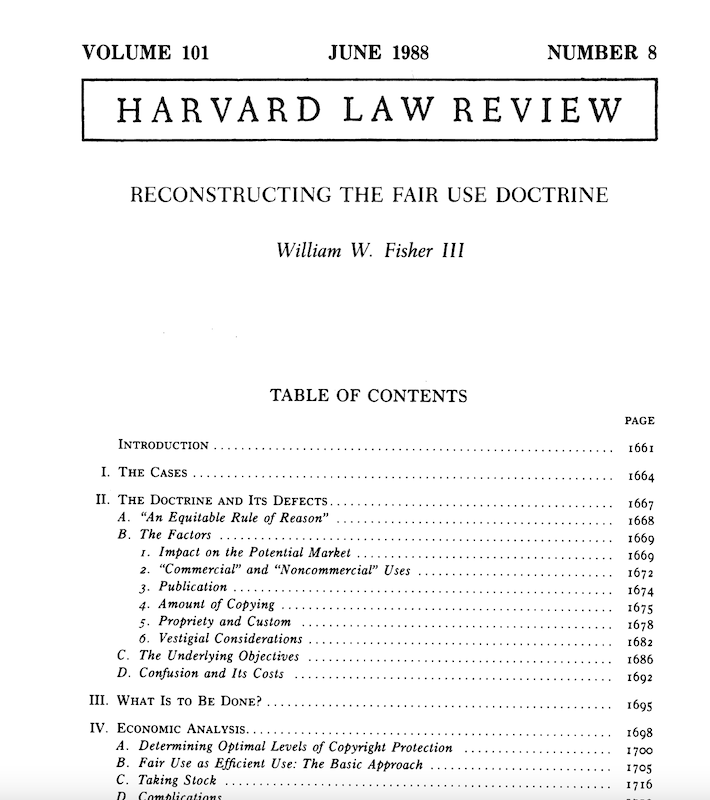
RE-CONSTRUCTING FAIR USE- WILLIAM FISHER (SUMMARY AND TAKEAWAY)

I am choosing to summarize and analyze one of the (in my opinion) most important pieces of Copyright theory and policy (some very prominent Professors here at Berkeley refer it to as their bible on anything copyright). I am putting this here for everyone to be able to contextualize the role of Fair use as a policy matter while thinking of copyright’s role, its trade-offs, and how to think about progress/ values and its role in it. Here is the full piece (highlighted): Link

Prof. Fisher, to begin with, recounts that fair use as an affirmative defense, distinct from an inquiry of infringement began in the mid-twentieth century, and was subsequently adopted in Section 107 of the Act of 1976. He recounts the logic given by Justice O’Conner of Market Impairment in Sony Betamax and argues that every case where the fair use defense is invoked will involve market harm, and so it is relevant to estimate the “magnitude” of market impairment by privileging certain uses, not the mere “existence” of market impairment. 

On Necessity, Prof. Fisher points out to be wary of the dangers inherent in its ambiguity. Sony and Harper v. Row discounted the necessity factor- however, J. O Conner in his analysis did say that copying essential to communicate facts may be privileged. 

Prof. Fisher points out J. O Conner’s discussion where he says the rights conferred by copyright are designed to assure contributors to the store of knowledge a fair return for their labor. Prof. Fisher criticizes this as showing an objective that is fundamentally different from social utility. He says that the notion J. O Conner embodies is that authors and inventors deserve a reward for labor irrespective of whether they would continue to work in the absence of this compensation. He criticizes this as being ambiguous- in terms of what exactly is a “fair” return for creative labor- how to balance it with the dissemination of output concerns, etc.  He argues fair use, in its (then) current practice to be aiming at “balancing” inconsistent claims derived from conventional, incommensurable premises- something which perpetuates difficulty, as against concreteness in analysis. 

He then goes on to choose premises- firstly relying on economic premises- he argues- that the objective of copyright law in general and the fair use doctrine, in particular, should be the efficient allocation of resources. Secondly, he argues, what he calls more of a utopian vision relying on cultural premises- stating that “copyright law has a significant effect on the shape of our culture and that a vision of the sort of culture we would like is a prerequisite to wise administration of the law.”

Coming to the doctrine, he says that if the package of entitlements created by the provisions of the copyright act other than 107 enabled creators of intellectual work to collect monopoly profits in greater than optimal amounts, a judge could use fair use to chip away at that package until reaching the most efficient combination. He argues that economic analysis helps us realize this, in spite of its important critiques of fostering complete market dependence.  He argues that the point of inducement through monetary incentives is to have more and better works, but efficiency gains from this inducement are only realized upon increased consumer satisfaction that results when readers have access to these more and better works. 

Prof. Fisher states that an efficient way of using the incentive access paradigm towards efficient allocation of resources through the fair use doctrine – is to analyze whether the production of “work” requires- or is affected by incentives or not. He firstly talks about special circumstances where the provision of incentives through the law has no role to play in the inducement of further production, given optimal earnings even without such legal protection is available. Here he says every use should be fair. On the other hand, he talks about works where even a single putatively infringing use would incur economic costs that exceed gains due to sensitivity to fluctuation in anticipated incomes and behavioral elasticity in respect thereof. In such a situation due to the inefficiency involved, it should be ruled unfair. Moving on from these special circumstances, he argues that In more complex situations, differentiating types of works for applying fair use creates some efficiency and some inefficiency as well. He says that copyright covers a variety of works from books to films, to factual works to fictional works, to computer software- the incentive interests/requirements on which are different. He thus argues that creating some difference in the nature of work in relation to their purported incentive requirement does make sense, but too many differences may lead to distortion where artists will assume the worth of their works legally and pursue or distort from pursuing a particular form in favor of the other. His solution is the following:

“To make an efficient choice, the judge should estimate three figures. First, he should determine how much of an efficiency gain, caused by differentiating the monetary incentives for creating different types of intellectual products, would result from moving from each level of specificity to the next. For any of a variety of reasons, the optimal combination of entitlements for musicals may be different from the optimal combination for other sorts of plays. Lumping them together would therefore result in a less-than-ideal system of incentives for playwrights of all sorts. The judge should ascertain how much less than ideal. Second, the judge should determine how much of an efficiency loss, caused by reducing playwrights’ ability to predict their incomes, would result from each subdivision. Suppose, for example, that differentiating musicals from other plays resulted in sharply different combinations of entitlements and income levels for writers of the two sorts of works, but left a substantial number of potential playwrights uncertain as to whether the plays they contemplated writing would ultimately be classified as musicals or non-musicals. The effect would be to sacrifice much of the efficiency gain described above by reducing the willingness of risk-averse playwrights to write works whose status was unclear. Third and finally, the judge should calculate how each additional differentiation would affect the number of cases in which the parties disputed the classification of the copyrighted work in question, and what the litigation costs generated by those controversies would be.”

Another theory that could relate to the nature of work factor, that Prof. Fisher furthers is that, when an art form is in its infancy, or just starting to grow in circulation, adjusting the compensation system so as to increase the number of artists engaged in developing it may increase quality and variety available to consumers- if that is what the legislature values. As opportunities for synergies of this sort diminish, the scope of protection can rather be reduced. 

Prof. Fisher, in his economic analysis, continues to focus on identifying the incentive/loss ratio by examining efficiency considerations upon every use on the incentive and its consequence on the overall allocation of resources and efficiency, as a tool to understand whether a use is fair or not. 

Moving on to his utopian vision, he uses J.S. Mill to argue that self-determination and the development of mental and moral faculties for a rich, diversified, and animating culture is the most important goal of copyright policy. He argues that cultural innovativeness- the key to diversity- would not just be tolerated by the government but rather nourished and rewarded. This is what he invokes to be his theory of protection of transformative works as fair uses. 

He argues that defining the optimality of incentives when calculating the incentive/loss ratio needs to accept the following analysis: The creators of art should be afforded better than average incomes (or greater freedom from drudgery) whenever, but ONLY whenever, such a policy would increase their output enough to yield a net improvement in the lives of non-artists. He argues fair use as limitations on the freedoms of some to advance the interests of others from the view of helping shape tastes and capacities that enable the formation of autonomous and socially determined preferences in lieu of a good life. 

His main argument for reformulating fair use is the following.:

Maximization of allocative efficiency can be achieved by arranging the set of activities putatively reserved to copyright owners by section io6 in order of their incentive/loss ratios, identifying the point in the series at which the benefits secured by holding out monetary incentives to talented persons exceed by the maximum amount the attendant monopoly losses, and declaring all uses above that point fair and all uses below it unfair.”

Coming to the factors: he argues that the transformative factor is important as it creates more opportunities for Americans to be actively involved in shaping their culture and socially shaping identities- thus enhancing abilities beyond the ability if all were mere passive consumers. 

Then he goes on to advocate for the value of the use- citing education as an example- and so he argues that acidities that facilitate education by enhancing access to information and argument on matters of public importance, or facilitate dissemination of education – they should be fair uses due to the value component involved- however, the degree of preferential treatment, according to fisher depends on how important (NECESSITY) to education is the use of that activity. 

Another value determinant he cites is cultural diversity- any usage that facilitates cultural diversity and faculties of choice and self-determination. He thus argues to deem fair – uses- that have the potential for more derivative works – given their impact on cultural diversity. (AK comment: I think he is conceptualizing derivative works in a broad way to include transformations in content, otherwise I don’t know how this would make sense given the meaning and message remains the same irrespective of the potential to have more derivative works). 

The next factor for him is Protecting the Creative Process: where he argues to disfavor things that undercut the artistic process- and provide artists and consumers maximum opportunities for engaging in the creative process. He uses this to analyze the “published” – “unpublished” dichotomy and argues for use of unpublished works to be unfair- given for him they hamper the confidence of the artist in his/her/their creative process. He says rather than deterring all unpublished works from being used, a more precise standard would be “disfavored unauthorized uses of materials the creators of which were still considering revising”. 

He also favors uses that equalize public access as ones that ought to be deemed to be fair. 

In conclusion of his utopian analysis he identifies that consistent application of the utopian analysis would require expansion of fair use to the point where creators would be left only with income to live on, or a just conception which would require that the expansion of fair use be only halted when further movement would leave creators substantially below the national average of income- given the law perpetuates this enablement. 

He finally argues that:

for the time being, it seems wisest to limit judges’ involvement in the compensation of artists to (i) the avoidance of superfluous income; (ii) the promotion of cultural diversity by favoring types of art for which popular demand currently is low; and (iii) providing artists (to the extent practicable) minimal levels of income.”

PROPOSAL:

Recognizing that his utopian vision is not going to tangibly turn in policy any time soon, he proposes a modest solution using factorial reform for better fair use to ensure a better deal than the one existing then: 

  1. Whether the creator considered the work finished.
  2. Definition of injury of harm.
    • Ascertain the “type of copyrighted use at issue” to ascertain incentives actually required in the said type, in terms of the incentive/loss ratio. This, however, should be carefully done narrowly as is consistent with preservation of the ability of authors to identify which camp they fall in. 
    • Conduct of the sort engaged by the defendant- commercial or not (although not a separate analysis but only a component of defining the harm caused to the creator if at all)
  3. Decide whether the harm above is substantial (reduce the quantity or quality of output by affecting incentives) or insubstantial. 
  4. If the above three tests fail to resolve the controversy- or there isn’t enough information to draw a conclusion out of the above three tests- be proposes the following factors to step into:
    • The magnitude of injury (the more serious harm to producers- the less willing the judge should be to deem it fair)
    • Creativity (the more the activity or use is creative, and transformative, the more the judge should deem it fair as they increase diversity)
    • Education (Fisher points out this is to be of relatively higher importance): use increases access to info or arguments (perspectives) on issues of public importance or facilitates efforts to make available to students resources to learn- the more the bend towards fair use. 
    • Price discrimination (the more use undermines the ability of the holder to engage in price discrimination, the weaker case of fair use- given price discrimination is good policy as it increases rewards and increases access. (Differential pricing strategies- which have lately been criticized due to administrative difficulties and parallel importation logics)

A PRELIMINARY THEORY OF FAIR USE THAT I AM BEGINNING TO CONCEPTUALISE:

The legislature values certain things (not in the commodity sense) that it seeks to ‘enable’ (a proxy for incentivizing, given it doesn’t really incentivize in my opinion- it ensures they are not de-incentivized)  so that people who produce these valuable outputs are not disincentivized from producing and shift to marginal sources of revenue, because well they aren’t able to survive and make enough money by doing these pursuits. The corollary of not enabling them would be such performances (a proxy for “creations” because I personally do not believe anyone can ever find out who created an expression) not existing in society, and these performances are valuable. So the legislature using the tool of the Copyright Act enables them by giving them a limited property-Esque right/ market power over their creations so that they can extract value out of it (social and economic). However, the legislature does recognize the constraints of giving such market power access to these valuable outputs- the very reason why they want these creativities to exist- the very reason they value it is so that people can experience it. 

So, to ensure that they protect interests that they value over/more than the enablement of creators- they create exemptions and limitations (and not exceptions) to this statute that provides enablement. Values like research, education, cultural diversity, etc are more important for the legislature than enabling the creation of works- and this “hierarchy of values needs to be understood”. Fair use is representative of this hierarchy of values. Fair use is not a defense in that understanding- it is in fact a tool to show which value is deemed to be more important and what sacrifices does enablement of creation has to go through to actually and tangibly support the achievement of the ultimate policy goal and value it seeks to instrumentally achieve – i.e., the existence of more and diverse works for people to understand, internalize and be exposed to. Fair use stems from this hierarchy of values that in a democracy the legislature prioritizes.

_______________________________________________

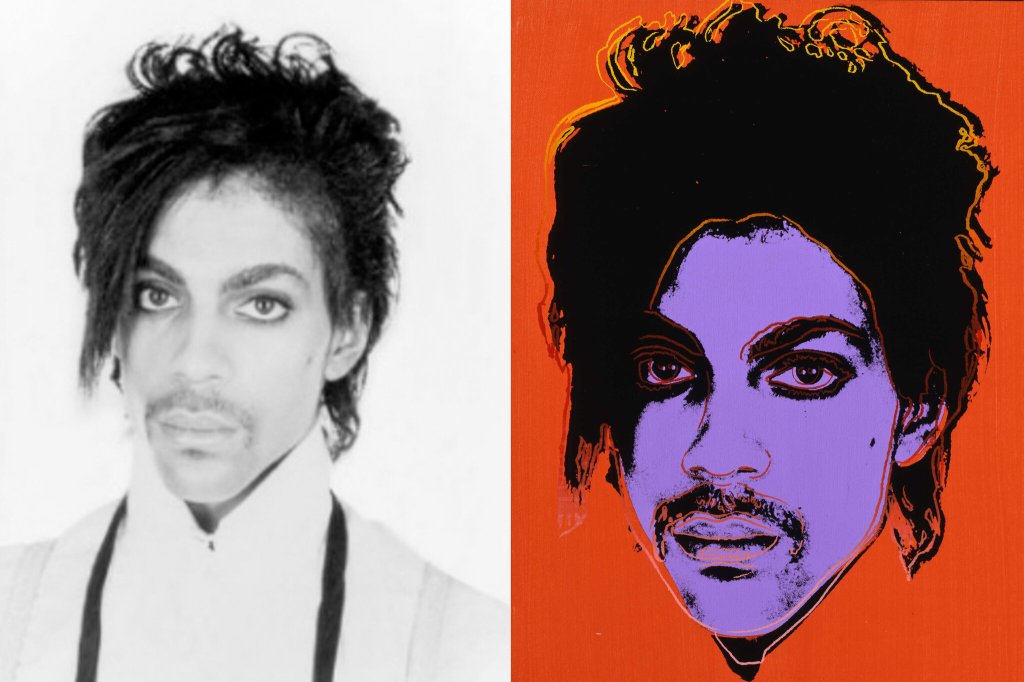
Andy Warhol Foundation v. Goldsmith – A misnomer of a debate!

In my opinion, the main debate in Andy Warhol Foundation v. Goldsmith, which was recently argued at the United States Supreme Court is-

“How to draw the line between the scope of the right to exclude the creation of derivative works, that copyright law confers upon the creator/owner, as against the purpose and character of use exemption to copyright infringement that is for users/downstream creators/people who seek access.”

The debate is riddled with delusions and misconceptions about the instrumental purpose of copyright law. Why?

The purpose and character of use exemption is often used to limit the scope of claims of copyright infringement and is considered to be applicable to all rights that are given to the owner of copyright (Re: Google v. Oracle (SC)). In Campbell, the Supreme Court devised the transformative purpose and character test to define the meaning of this exemption. It stated that if there is a transformed purpose, meaning, or message conveyed by the use of a work, the same would probably be exempted from infringement (upon balancing this with the other three factors of the fair use analysis). On the other hand, the right to make a derivative work, in its definition under §101 of the Copyright Act, states that a work based upon one or more preexisting works, such as a translation, musical arrangement, dramatization, fictionalization, motion picture version, sound recording, art reproduction, abridgment, condensation, or any other form in which a work may be recast, transformed, or adapted is a derivative work.

Seems like an oxymoron on the first blush, isn’t it? How can transformed uses be excludable and exempted from infringement at the same time?

Well, not really a conflict if we try to understand the concept behind (i) the right (the social relation or claims against others) that the derivative excludability confers, (ii) the instrumental purpose behind the purpose and character of use exemption, (iii) as well as their interaction with the reproduction right given to the owner.

As Talha Syed argues, the meaning of words in a statute is never given- whether plain, common or core, but is always rather a concept to further the social relation that the law seeks to instrumentally push. Talha argues- “We are not supposed to look for something out there by staring at the words, but rather think about our aims.” Just staring at words that may be identical but used in different contexts and concluding oxymoron-ish usage in lawmaking as a ground for an indeterminacy critique of the same, is a mistake and does not do much in terms of devising a solution. It is a mistake that forgets the need to contextualize every use of the word in a statute to be representative of a concept, which is never self-contained but relational and hence fluid- in terms of the context and aim it seeks to achieve, given the law is nothing but an instrumental tool to achieve a social goal and govern social relations. Reifying words keeps us confused throughout and keeps us thinking that law is indeterminate and is basically a character of what Libby Adler terms as an invitation to “lawyering 101”. Talha Syed argues that “To think it anything else—i.e., to think of it as some rules “out there,” with “words” having “given” meanings that must be divined (or destabilized)—is to seek to replace what is always, ultimately, a question of purposes and values with a pseudo-cognitive operation.”. We don’t need to be mystified by the words used in the statute seeming identical, and try to trace, mechanically, some perceivably authoritative sources which could result in such uses- and then try to understand what the word means in an effort to reduce its indeterminacy. This whole process completely forgets the core aim of the legal tool and analysis considering the same. It is just a tool to avoid any mental contact with the aim and purpose of the instrumental tool. This is what is happening in this case.

The Court, by trying to draw distinctions between the scope of the rights, focusing on what is the width of each of these competing claims- tracing levels of transformativeness – and thinking that anextension of the court-created transformative use criteria to alternate meaning or message would erode the transformation right given to the owner, because, well, at both places “transformation” is mentioned,is completely missing the point.

Let us go back to the purpose of Copyright law. Due to fairness and economic concerns, authors (who often assign these rights away) are, through a competing legal claim in the form of a property right, allowed to exclude people from using/accessing their work in the primary market as well as some secondary markets, so that they are able to extract optimal social value out of the same. The reason is not because it’s natural to them or because they used their mind and body and therefore others should not get to use it or free ride on it depriving originators of benefit. The reason is simple- we need to ensure these people get reasonably paid so that they are enabled to continue these creations because we as a society value these creations which help in subjective self-determination for a lot of us. Thus, we make a trade-off with access benefits. The fundamental reason for this is that we value such creations, and we want more of such meanings and messages which help our self-determination to be autonomously defined by exposure to many and variety.

This law is a tool to instrumentally achieve this goal. Every concept in this law, in its statutory framings, has to be remolded in light of it being a tool to achieve this particular goal. Focusing on identifying meanings of words within the tool, completely takes away any mental contact with this goal, assuming the said goal to be fulfilled by reading the words in a particular way anyway. No. That is fundamentally evasive of having any mental contact with the act of reasoning as to whether a particular interpretation even does anything to achieve the goal or not.

In light of the said purpose of copyright, let us look at this debate. The derivative right gives control to the author of the work over-exploitation of works in secondary markets which are in a different form. The concept of ‘form’ here has to be interpreted in light of the purpose of the law, to allow for protection only in secondary markets and not in the primary market- for which the right to reproduction already exists. And the illustrations in the provision clearly show the above concept as well: translation, dramatization, fictionalization, sound recording, abridgment etc. Apart from musical arrangements (which was heavily lobbied for, and I argue was mistakenly included within this elsewhere), there is rarely any change in the meaning and message of the original content that is represented in any of these forms that are illustrated. The content, meaning and message conveyed are essentially the same, the medium of representation being different. This coincides with the whole idea that copyright is only conferred upon original expression. By construing the scope of the secondary market to extend to forms of expression which although incorporate some of the primary content but convey a different meaning and message overall, in effect confers a right to exclude over by-products of the original work, which are not even original to the person to whom the right is actually conferred. What is the enablement for then? To prevent free-riding? I don’t see prevention of free riding beyond the original work (and by work, I mean the original meaning and message of the creator) being extended to any and every by-product, fulfilling any instrumental purpose of the law articulated above. It is just a moralistic claim with no basis, but rather an argument that- as I uttered a word from my mouth or used my hand to make a stroke on a canvas, so I get to exclude whoever uses it in whatever context. That has no instrumental role to play at all. In that case, let us extend market power to exclude on every act of imputing labor to include all by-products, even if the meaning and message of the by-product is fundamentally different and non-original to the person seeking the right. That just doesn’t make any sense. The whole point of giving an instrumental right is to show that we value such original creations- but then using the instrument to curb the ability of others to create more meanings and messages, is like pitting the instrument against the ultimate purpose of having the instrument in the first place. As Madhavi Sundar states- IP is a means to an end, not an end in itself.

Being cloaked by indeterminacy concerns of the law influences lobbies and power to drive the ultimate meaning of the legal tool. Due to concerns around indeterminacy, as against trying to interpret the law from the purpose it sought to achieve, the scope of the derivative rights have been read extremely broadly over time to include works, which although do not involve, conceptually, any “form” based changes, but rather incorporate prior content to portray an alternate meaning or message, unless the purpose of representation has been shown to be different. The logic extended is to expand excludability to all channels through which the public experienced the work, even if in fragments, embedded in a different meaning or message. It is plainly wrong to be doing this. It shows the power of the political economy in driving meanings of legal tools which are shrouded and critiqued only through the lens of indeterminacy, as the right holders will always be able to use their capital to hire the best lawyers to draw their side of the interpretation to be the better one before the judges- capitalizing around the somewhat “confusing” image of the law. It is just problematic and ignorant of drawing any mental contact with the ultimate purpose that the law seeks to achieve.

Derivative rights do not and are not supposed to include transformed uses even for the same expressive purpose, but only transformed forms of the same expression that is the original creation of the primary author. The interpretation of the use of the concept of ‘form’ with transformed within the definition has a limited meaning of an alternate medium of representation/ an alternate physical embodiment distinct from the medium of expression of the original work. Any different interpretation, pitting the scope of the derivative right against the transformative purpose and character exemption under the Copyright Act, seriously undermines the instrumental nature and goals of copyright and its first amendment concerns. It just makes the co-existence of the derivative works right, reproduction right, and the purpose and character of use exemption to copyright infringement, which are all present in the same statute, completely incoherent.

Coming to the purpose and character of use exemption, many argue that purpose and character only mean transformed purpose- that is if a work is initially meant to entertain, and the user uses it for informative purposes- well then it satisfies the first-factor enquiry. Such a limited reading, influenced by the use of transformed in the definition of the derivative right, again ignores that transformations also happen to show different meanings. These are inquiries of exemptions to infringement- with the goal being to ensure that the enablement value of copyright does not, curb access and downstream usage concerns, beyond its optimal purpose. It once again runs contrary to the instrumental purpose of the law and romanticizes the instrument beyond its optimal need instead. The goal of having a paintbrush is to paint a picture. It is not to keep staring at the paintbrush and appreciating its look and romanticizing it and just continuously increasing its value without really painting anything using it.

Once we get hold of this concept, the case is quite easy actually, especially to the extent that the cert. was issued by the SC- on the limited issue of transformativeness of usage. It is clearly transformative and does not impact any form-based secondary market of the original creator, in relation to her original work, so long as the meaning and message that comes out of the new picture is different for people who are in the art world.

Any time the meaning and message is transformed be it in the primary market or the secondary market, and it does not simply seek to substitute the original works’ markets by trying to replace it portraying the same expression/meaning or message in the eyes of the viewer (someone who can identify given conceptual art is complicated to interpret), it satisfies the first fair use inquiry. Period. Irrespective of the rights conferred to the owner- this is the reasonable balance that the Copyright Act seeks to draw to ensure that the enablement is optimal and not beyond it, considering its bilateral tradeoff with access and use concerns and the instrumental goal that copyright, as a legal tool, seeks to achieve.

Given the large-scale implications of this case on appropriation art, sampling artists, artists performing various kinds of ontologically “transformative” culture- it is important to internalize this and ignore this misnomer of a debate, which in a prolonged manner, through the tool of the cloak of indeterminacy, is continuing to existentially estrange many cultural meanings and messages (something which the society clearly values) from existence in the society- paradoxical to the goal which the law, where this supposed indeterminacy is perceived to be embedded, seeks to achieve. 

Alpana Roy on De-Colonizing Copyright and Cultural Policy

In this set of 4 posts- I shall be discussing my dilemmas from the Kacha Badam Controversy. The first post covered my thoughts on the delusion that this whole controversy has produced and the need to revamp its factual narrative. The second post covered my thoughts on the hard case that this factual narrative exposes- something I cannot really grapple with yet. The third post brainstormed thoughts on resolving this hard case. Finally, this fourth post will, in the backdrop of these three posts, discuss an amazing paper by Prof. Alpana Roy titled- “Copyright: a colonial doctrine in a post-colonial age” and how her thesis has an important role to play in figuring out/ or rather even further complicating this hard case.

PART-4

In this final post, I am discussing, Prof. Alpana Roy’s paper titled Copyright: A colonial doctrine in a post-colonial age, in the backdrop of the discussions we have had so far. I also had an opportunity of discussing this article in the Critical Interdisciplinary Perspectives to IP reading group hosted by Prof. Anjali Vats, Prof. David Jefferson, among others- which led to a lot of thoughts pushback, and questions. I shall try and put them out here This is also my expression of gratitude to all who turned up for the reading group.

Prof. Alpana Roy’s article, published in the Copyright Reporter in 26th Volume 4th Issue, in December 2008, discusses IP from a sharp post-colonial lens. It is a provocative piece of writing, to say the least.

Setting the stage, Roy clears the air on what colonialism implies and what constitutes de-colonial thinking. She clearly puts it forth that the socio-economic exploitation of the so called “periphery” or alternate, need not always be directly political or dominated by the military. It can also involve continued subordination through the exploitation of the political economy to adversely affect capabilities. She mentions the prevalence of colonial thought in law-making and how it pervades global norms, in sheer ignorance of alternate indigenous realities. This narrative somehow resembles the work of the amazing late Prof. Keith Aoki, on what he calls Neo-Colonialism, and in the context of IP states that- transnational IP system erode concepts of sovereignty and self-determination.

Putting the article in context, Roy turns to International IP Agreements and reflects on the role of these “multifaceted projects” or dominant narratives which primarily reflect/mirror particular moments in the history of Western cultural practice. She emphasizes the importance of this by projecting the dissonance of the norms in agreements like Berne, with nations outside the West. She asserts that Copyright remains a foreign concept in many cultures, and many societies take an extremely radical view on what constitutes property and can be the subject of individualistic private property. In this context, it is important to reflect on the “independent” v. “inter-dependent and inherently social conceptions of the self (the idea of a “family”)” which vary across societies – with the West bending towards the former and Asian societies towards the latter. The law, as it is in its current “global” framings, only accommodates the former, completely ignoring the latter.

She then goes on to talk about a few of these individual dissonant features: (i) print culture (ii) the idea of piracy as against copying and sharing as a sign of respect and recognition- and mentions how such norms being globalized are nothing but a symbol of a dominant narrative used to foster a “one-way traffic around the notion of desirable culture”- consequently moving towards cultural imperialism. It is at this point where she makes her most important argument about this whole system having a far deeper impact than the earlier forms of colonialism, imperialism, or simple tourism, as it tends/attempts to alter the source of the self.

Hereon, she gets into the hard case by discussing the example of “Return to innocence”, supposedly a Taiwanese tribal song, which was appropriated out of a performance by 30 indigenous Taiwanese performers who were invited to perform across Europe by the French Ministry of Culture. A significant portion of these songs was used by a German music entrepreneur and was then also recorded by Enigma- and sold as “his copyright”, without any due accreditation or financial compensation for the use of the said song. She primarily uses this example to first- expose the political economy of cultural practice, and thereafter and most importantly, the political economy of law on culture- and who gets to enforce and who doesn’t. This is important in the context of the debate on print vs. aural culture, as well as in the context of the argument that accesses to a platform to showcase determines who gets to ‘own’. What I am concerned about, in this example, is not the appropriation, but rather the possessive claim of Enigma over this output- dispossessing many others who could have been the actual originators of the expression and should have had the ability to use, build on, or get any financial remuneration in respect thereof. It is in this context that the appropriation is important to be addressed.

Roy uses the “Return of innocence” case to contend how indigenous works fail to fulfill individualistic notions of property rights and are dispossessed from their performers through dissonant norms. She uses this to show how western law, and its hegemonic transposition is highly inappropriate, results in fictitious commodification, and continues to perpetuate the idea of the historic “other” even in law and policymaking. She aligns with Rosemary Coombe who argues that neoliberal conceptions of copyright do not accommodate cultural differences that are difficult to be formulated in terms of a commodity, and are hence difficult to encompass within the conceptual frameworks of “modernity”.

Roy also refers to oral research outputs and argues that as soon as someone publishes all the oral research output they get copyright over it- dispossessing participants and researchers who contributed and undertook research orally but did not/could not really “fix the output in the printed/published form”. On this aspect of fixation, during the discussion with the reading group, Prof. Ann Bartow put forth an interesting question as to- how do rules of evidence work in aural societies? – Historically mapping the same could be an interesting analogy to look at while discussing the irrelevance of fixation norms in non-western societies.

Roy then moves on to how these western cultural norms were exported to colonies by European colonizers as a part of the package of colonization, most prominently in the 18th and the 19th Century. She states that pirating foreign work was still prevalent in free-er countries given the US only joined the Berne until 1989 and offered little protection. To foreign authors until then. Unfortunately, those who were colonized had little say in such policy for their own capability development (I discuss this aspect of IP Gradualism in detail in my paper here).

Roy then moves to the strongest part of her paper where she argues the relevance of printing technology and entrepreneurs in respect thereof in centralizing and transplanting these western norms abroad.  She talks about how printing was essential for the colonial and imperial projects of Europe as their empires could not have survived without the spread of propaganda, religious tacit, commercial documents, maps, charts, etc., among the natives. Here comes the relevance of copyright. She argues that as a form of communication- printing, unlike oral communication, has a tendency of universalizing ideas- and disseminating information through identical texts and making them truths by imposing them through “violent hierarchies” facilitated by the tool of colonialism and the Prospero complex it produces. She talks about how most of the so-called “universal truths” coincided with this enlightenment period of solitary creation and printing technology – that is basically the rise of print medium and subsequently the law of copyright. Importantly she reiterates that this exchange was not happening among “equals” but rather as an imposition in a colonial setup.

Upon political decolonization, Roy writes that there were some modest attempts at resisting western copyright by the Global South, in the context of the inability to translate and develop knowledge, however not to any structural yield. Thes prevailing norms have not only been normalized but have, through TRIPS, also been universally accepted (read: imposed), and are now a part of public international law.

Moving on to a consequential analysis of these norms, embedded with capitalism and the global political economy, Roy quotes Butalia, to argue that it is impossible to separate the world of Copyright law from the world of politics, as knowledge, culture, and access are inextricably linked with power, power is linked with money- and both of those are linked with history– something which cannot be repaired easily. In my opinion- this brings us back to the hard case and the relevance of reparative solutions to be intermingled with systemic change and to look at the same as complementary rather than as an either/or binary.

Roy finally concludes by referring to how copyright is nothing but a tool to merely further the trade and capitalist interests of western societies. However, a consequential corollary of this, which Roy misses in her analysis, is the impact of such a tool on identities and cultural estrangement- the “othering” of non-marketable culture. We might be celebrating Bhuban and his expression today, but that is only because he and many others like him, who do not fit in to this marketable system have been othered from cultural identity framing discourses and economic benefits in respect thereof, for a long, long time. As Macneil argues, we cannot subordinate the subsistence of society itself to the laws of the market, and the interest of the marketers, as it disenfranchises humans of the ability to direct the trajectories of their social institutions. We cannot, as a society afford to do this, as the same is nothing estranging identities.

To conclude these posts, the takeaway I seek to present is-  the need for scholarship, research and thought on –

How to ensure that identity interests of self-determination (including remunerative concerns), especially of those who have been denied the same for long, are retained-  without resorting to dissonant logics of property rights as tools of affirmative action?

Hope we have enough food for thought! Do reach out if anyone wishes to discuss any of this. I am available at 97akshatag@gmail.com


Part 1- here

Part 2- here

Part 3- here

Resolving the ‘Hard Case’? You can try the best you can!

In this set of 4 posts- I shall be discussing my dilemmas from the Kacha Badam Controversy. The first post covered my thoughts on the delusion that this whole controversy has produced and the need to revamp its factual narrative. The second post covered my thoughts on the hard case that this factual narrative exposes- something I cannot really grapple with yet. This third post brainstorms thoughts on resolving this ‘hard case’. And finally, the fourth post will, in the backdrop of these three posts, discuss an amazing paper by Prof. Alpana Roy titled- “Copyright: a colonial doctrine in a post-colonial age” and how her thesis has an important role to play in figuring out/ or rather even further complicating this hard case.

PART-3

In this post, I shall discuss thoughts on the hard case, and why it is really hard. I will also discuss my preliminary ideas on resolving its dilemmas. To put things into perspective-

Should we be celebrating Bhuban’s remunerative win (which supposedly is because of Copyright law) or should we be questioning the structural acceptance of a copyright system that is significantly dissonant from the ontological reality of cultural practice in India – a system that has merely been transposed from the west due to the state of law and the global political economy?


The hard case is really hard as one of the major issues that come with a structural challenge to the system- is its ignorance of the years of inequality and identity politics associated with cultural production. We can never crawl back to ground zero. The structure of copyright law, its commodifiability, and dissonance with alternate cultural practices has already produced a skew in visibility- which cannot be discounted. A structural challenge to the system would result in an unequal commons- resolving none of our equality concerns.

In other words, although by allowing sharing, derivation, and remixing to make it compliant with other ethnographic realities, a structural challenge to copyright’s individualistic norms, does help substitute individualistic possessiveness, however, it does little to narrow the privilege gap resulting from the prevailing system. Structurally challenging copyright norms may allow for wider cultural engagement- but they do little in remedying the lack of engagement or the skew in practice that is already persisting. Anyone who has, as a result of the prevailing system, attained a comparative advantage, continues to enjoy the same – given investment capabilities and the political economy of cultural practice. In line with this, how do we ensure that Bhuban gets his due remuneration to survive?

Proponents who believe in revamping the copyright system internally and allowing economic recognition of artists like Bhuban through prevailing norms- as a more practical solution, maybe right to the extent that it allows for these individuals to get recognition and helps balance out the inequalities to some extent.  These proponents also believe that property-like rights are the only retributive solution to the issues created by property-like exclusivities themselves. Madhavi Sundar and Anupam Chander convincingly argue, in their paper- The Romance of the Public Domain, that leaving these ignored cultural expressions in the public domain does not help satisfy societal ideals and rather perpetuates inequality by allowing those with the capability to misappropriate (not dispossess, but rather get a better benefit due to access privileges) to freely do it. It denies them a claim to self-determination. They, thus, argue for a property rights-based liability system (no control but an objectively defined fee on every use) to continue in favor of those who have been denied long-standing claims- to be able to re-project a scenario where we start from ground zero. For them, Bhuban getting this remunerative benefit would be a deal worth it from an overall welfarist perspective.

For me, this is something I continue to be unclear about, because fundamentally – using a property-rights-oriented solution to solve problems that are a result of the long-standing prominence of the same system- is paradoxical. As Amy Kapczynski argues, “why should we view a collective despot as an improvement over an individual despot?”

 I do agree that Prof. Sundar and Chander only endorse a liability model– where contours of exclusive possession and control do not strictly apply, and rather a fee is to be paid for every use However, even this, as a tool of affirmative action, does reify- principally the same tool of exclusivity. It also ignores how the idea of “originality” of a “work”– the genesis of a “mine” claim in the first place- is a myth- and a result of privileges of access (to showcase). This is applicable to both the claims of individuals and communities. One can never really prove that an expression is theirs and only theirs- and not a result/derivation of someone else’s. Once again- possession results in dispossession (often of the unknown).

Further, a liability rule, in my opinion, does not really address the main issue here- i.e., one of misappropriation of identities. Commodification has most definitely denied many non-commodifiable forms a claim to money- but most importantly it has estranged identities. The liability rules do not really help resolve that aspect.

Rosemary Coombe provides another interesting angle to this hard case in her paper- Ethnographic Explorations of Intellectual property– more so from an anthropological perspective. She maps arguments of the latter school of thought which say that even collective ownership dispossesses and reifies western liberal thoughts in culture impeding cultural engagement and ignoring ethnographic realities. She says that the whole idea of ownership in the binary of the individual and collective ought to be challenged from a hybridized perspective- and needs to be looked at by examining the actual reality of how culture is practiced, rather than requiring to mold cultural practices to fit in. She endorses the need for the decolonization of identities, as well as legal norms, by suggesting a more personhood-oriented solution to the aspect of reparations, as against one guarded within economical concerns- as was the case with the liability system. She argues for a system of benefit sharing to recognize the “cultural rights ” of people practicing alternate cultures rather than centering on a solution from an economic point of view. The idea is to endorse the personhood, identities, and development of these diasporic, hidden individuals and communities. Her focus is on ensuring that these identities are not dispossessed as against cultural outputs not being dispossessed. – given we can never be sure of what was the genesis of the cultural output in reality.

For me, as brewing thoughts, a few methods of resolving this hard case without resorting to a binary could include – primarily – decommodifying culture and making expressions inalienable, especially in favor of corporates who seek to capitalize and earn profits out of the most commodifiable and marketable identities/expressions. (see part 1) This potentially could resolve a huge hierarchical concern, at an institutional level, in respect of the ability to capitalize/market and showcase culture. However, I do agree that it does little on the aspect of the performer’s individual economic standing and capability to promote or be visible.

Another area that could be considered, as a part of future inquiry, could be getting rid of the idea of authorship of a work, and treating all expressions as performances- given we can never really figure out whether one is the “originator” of the content, but we can always associate the identity of the performer- with a particular performance. This avoids impeding downstream creation, especially in communities that depend on it, as well as ensures that if the performance, as a whole, is utilized as against merely the content within the performance (musical and literary “work” in current copyright framings), there is some remunerative benefit accruing to the previous performer for the associated identity thereto. So essentially, Bhuban cannot claim exclusivity over Kacha Badam, but if someone uses his performance of Kacha Badam substantially (Ann Bartow standard), he would have a remunerative claim (see here for a study on compensation systems) for the use of the cultural identity associated with his expression. This identity cannot be alienated from him in favor of any corporate entity. 

Coupled with this, maybe limiting this remunerative claim to only those performers who are a part of the “traditional knowledge”/ alternate culture herd- i.e., ones that have been denied a claim to be able to be visible for long, could serve the reparative goal sought by the primary school of thought. However, I have my doubts about the practicality and the acceptance of this, especially in light of the strong globally intuitive resistance to affirmative action policies in support of concerns of reparative equality, sometimes co-related to substantive equality.

Finally, another interesting area to build scholarly agendas on the side of equality in cultural policy and tools of affirmative action in respect thereof could be algorithmic support on the internet. By using tools of an affirmative bias in favor of performances/identities which have effectively been rendered invisible for the longest, a slow transformation could potentially take shape. Such cooperative responsibility from tech platforms could effectively help significantly revamp identity politics, and allow them to capitalize on scale benefits that come with it. As has been argued by Monson et al, it most definitely is technically possible to code algorithms that promote exposure to diverse content and highlight alternate perspectives- something which favorably happened in Bhuban’s case.

I do however acknowledge that these proposed solutions do not really resolve much, given hierarchies exist even within alternate contested identities. They do not have any sort of an enormous potential to resolve long-standing hierarchies which exist both due to copyright and beyond copyright concerns. But the intent of these posts is to have people engage in alternate cultural policy framings, without giving in to the binary of the internalist and structural critiques of the law in the context of this hard case. There is a need for social justice scholars to stop romanticizing either side of this hard case. In any case, we cannot afford to be celebrating the delusion produced by this Kacha Badam instance. 

In the next and the final post I shall, in the backdrop of this discussion, write my thoughts on Prof. Alpana Roy’s paper (more on the structural critiquing side) titled- Copyright: A colonial doctrine in a post-colonial age.


Part 1- here

Part 2-here

Part 4- here

“Kacha Badam” debate presents the Indian ‘Hard Case’?

In this set of 4 posts- I shall be discussing my dilemmas from the Kacha Badam Controversy. The first post covered my thoughts on the delusion that this whole controversy has produced and the need to revamp its factual narrative. This second post covers my thoughts on the hard case that this factual narrative exposes- something I cannot really grapple with yet. The third post shall brainstorm thoughts on resolving this hard case. And finally, the fourth post will, in the backdrop of these three posts, discuss an amazing paper by Prof. Alpana Roy titled- “Copyright: a colonial doctrine in a post-colonial age” and how her thesis has an important role to play in figuring out/ or rather even further complicating this hard case.

PART – 2

To put the idea of the hard case (not in the Dworkinian sense of “principle” but rather qua policy)  in context, I would refer to how I began thinking of it. While reading the wonderful Prof. Anjali Vats’s book- The color of creatorship, I came across an interesting narrative in the context of the Blurred Lines case in the US (Williams v. Bridgeport Music Inc. (2015)). What Vats mentions is that reading the Blurred Lines case is a complex negotiation in the backdrop of a legal system that consistently disenfranchises Black creators of the ability to come across as winners. The case was a historic instance, hailed by many, where, in a copyright infringement action, a Black creator was given a favorable judgment on infringement over, as Vats mentions, “white vultures” of the music industry. This was in a situation that was debatable from the lens of the infringement standards practiced in the US (given it involved ambient sounds). Now- there were two schools of thought that emerged after this case (both belonging to the larger roof of social justice scholars– however taking completely opposite stands on this issue):

The case was significantly hailed by a school of thought as a moment of reparation for black creators, who were significantly appropriated for a larger part of music history, without any sort of monetary compensation. It was an instance helping move toward a legal remedy for more than decades of appropriation of black artists. It was also appreciated as an instance that recognized the protectability of black musical practices.

HOWEVER

A set of critics of this judgment (the other school of thought) kept their focus on a rather structural argument concerning the colonial/western nature of Copyright policy, arguing that the said instance does nothing to repair concerns of equality and in effect reifies and attempts to normalize concepts outside black culture into black culture (in-contextual transposition). Hailing the judgment also estranges the fact that the verdict is extremely harmful to appropriative cultural practices like sampling, hip hop, reggaeton, etc. (mostly practiced by black musicians, or loosely non-western musicians). It reinforces racial capitalism, and a structural racial skew in legal interpretation, against normatively black practices which focus on re-use, and derivation rather than “original creation”. According to them, internalizing could never ever remedy/repair a copyright system that is racist to the core– and there was a need to structurally challenge it rather than supporting the expansion of the doctrine.

This brings us to the hard case.  Prof. Vats, in her book, presents this hard case in an interesting manner by writing as to how this situation was a seemingly forced choice for individuals invested in social justice outcomes out of this case and IP in general. It was either (i) embracing nostalgia and reparation for Gaye or (ii) a commitment to the musical innovation of hip hop (a non-western, non-white, non-individualistic art form dissonant with traditional principles of copyright law).

It was essentially a hard case to choose between “more” copyrights supporting the interests of black artists within the system of copyright law that exists, or a structural change in copyright according to actual epistemological realities or non-white cultures.

Using this, she turned to the de-colonial notion of creatorship and protection, outside the romanticism of commodification and the racial capitalism that it produces. She argues in her last chapter: “Advocating for intellectual property egalitarianism in a way that is legally and politically legible, requires pushing back against accepted IP doctrines, which conceal racial (and colonial) logics.” It is basically a debate between- internalizing possessive individualism (and looking for a solution within) v. structural questioning, which of course may not be a binary, but could end up eroding each other’s territories. We shall get more into this in Part-4.

Against this backdrop, the motion essentially is – Does the celebration of a black artist (Plaintiff) getting a judgment in their favor on copyright infringement, reflect a vantage point in the estrangement of cultural practices, norms and tendencies, through the neo-colonial tool that is western copyright?

Coming to the Kacha Badam issue, and the relevance of this backdrop therein:

I completely subscribe to and endorse the need to ensure that Copyright policy allows Bhuban to protect/recoup his remunerative interest in this performance, given his economic state/ standing, and the surprising visibility that has only been made possible due to the virality provoked by the long tail of the internet. Even record labels nowadays take their investment decisions depending on this viral tendency and potential. Prior to the internet, there was effectively a grand denial to creators/artists from remote villages in India to a claim to participate in visible culture and to be able to exploit them economically- especially due to the need to satisfy the aesthetic preferences of record companies before getting any visibility. I also agree that given folk artists have been denied such protection for the longest time, such remunerative benefit and commodification would help Bhuban do economically better, and will also recognize the copyrightability claims of such artists (I am still unsure as to whether we can categorize Bhuban’s performance as folk, but the song’s tonality does reflect folkish tendencies). I also understand the intuitional trigger and reparational thought in favor of Bhuban due to the long denial of visibility to such artists, his economic state, and the just desserts philosophy that comes with it.

I further subscribe to the fact that – those remixing and using Bhuban’s performance, attributing it to themselves, and in some cases also claiming copyrights over them (exclusivity over exploitation) to market using social media platforms/reels and other mediums, ought to pay license charges to Bhuban and attribute him- given the realistic state of the capitalistic society we live in. The possibility of remixers (who enjoy a better capability to capitalize or better access to visibility) using copyright to claim monopolies on their derived output- and earn money without paying any license fee to Bhuban, can never be discounted. The possibility of them misappropriating something linked to Bhuban’s identity can also never be discounted.

These are some extremely important real-world issues and do effectively endorse this thought of addressing the remunerative and reparative interests of Bhuban and such artists using Copyright law and its possessive individualism– as due compensation for the years of denial of economic compensation over such output and a lack of equal visibility.

But…..here comes the hard case.

A non-internalist/structural critique of this whole controversy would be-

Isn’t the compensating mechanism, mentioned above, normalizing a legal system of exclusivity and possessive individualism -over cultural expressions? Isn’t this a purely western normative ideal, against the norm of sharing – practiced widely in Indian folk cultures, forms of music, musical tendencies, and practices? How does it reflect as a consequence on the idea of imitative musical learning as a mode of pedagogy- which is extremely prevalent in indigenous and alternate musical practices? How does it also reflect on the romanticism of individualistic IP policy and its transposition on dissonant communitarian cultural practices/societies?

In India, indigenous cultural expressions have never really aligned with property-based exclusivities. In fact, to the contrary, there has been explicit resistance to recognizing this possessive individualism (see here, here, here,  here (accompanying note 16) and here), by practicing norms of anonymity while disseminating content, practicing imitation based learning as a core form of pedagogy (here, here, here and here) and by rather focussing on communitarian practice and performance of cultural expressions (here, here and here). For a general critique of the idea of possessive individualism – in the context of Indian culture and identity- see here (Chapter 8). Jaszi and Woodmansee have also, in detail, discussed the dissonance of individualistic norms of authorship and various cultures (which they refer to as “traditional” cultures, although I prefer- alternate cultures).  

The problem with internalizing copyright norms, which are premised on exclusive possession, is that it often relegates ontologically non-commodifiable/ non-individualistic/ community outputs and expressions, to the verge of cultural estrangement and diminishing. Expressions like folktales, ballads, chants, proses, alternate musical practices, religious musical expressions, Indian Classical and Carnatic music, etc., which involve aural transmission or are derivative and collective/communitarian creations do not fall within this commodifiable idea of a creation that is copyrighted and economically transacted in a market setup. This often results in cultural freezing. I, not for once, propose to say that the law should rather commodify such communitarian perspectives as well (as it has been doing in the case of traditional knowledge lately). I rather contend that this normative dissonance ought to be realized in the law and should be remedied by tailoring the law to foster these cultural practices rather than impede them by commodifying and altering their ontological nature in the first place. Transcribing western copyright norms, and in fact romanticizing them (its expansion and role) in cases of completely dissonant expressions, as in the case of Bhuban’s work, ignores the incompatibility of cultural expressions with core principles of western copyright norms- (i) fixation, (ii) individuated authorship, (iii) romanticism of originality and non-derivation (iv) exclusive possession, (v) author performer divide.  It also results in cultural alteration- merely for commercial advantage. In my opinion, such transposition of non-compliant norms takes the shape of a neo-colonial tool that does nothing but reflect the political economy of framing the law (in favor of western commercial interests by the neo-liberal tendencies of the western society). It also affects the political economy of culture and cultural practices. It shows a skew towards market fundamentalism, even in cases of cultures- which were never really supposed to be/ fit to be marketed in an industrial setup. We have to realize this and structurally challenge this.

Bhuban’s musical tone reflects a clear folk tonality, wherein it isn’t easy to assume originality, lest it shall devoid a majority of the members of a community, and dispossess them a claim to something that is normative to the community practice. Every possession results in dispossession. Even assuming the said musical work to be original, the social process of creation and the privilege of being able to access an audience can never be discounted. Romanticizing and transposing individualistic norms of this sort- denies many (who lack such access to showcase, get showcased, and receive) a participative claim to cultural exchange. Moreover, western copyright norms often seek justification on the idea of incentives- i.e., the assumption that unless such rights are granted- one might not be incentivized to create. Well, for starters, Bhuban had no idea he had these copyrights when he performed. The generalization of such a utilitarian conception, in cultural policy, dismisses the fact that for many – music is merely a source of communication and expression and not something which requires any incentive to be produced (some interesting scholarship on this facet here, here, here, here and here) However, this, of course, does not discount the fact that for many, who seek to practice music professionally and are not able to due to economic concerns forcing them to marginal sources of revenue (avenues which guarantee better economic condition), such incentives matter. What I seek to challenge is the generalization of these incentives as being the norm.

So, coming back,  how do we resolve this hard case? To be honest, I don’t know. But it may not be an either/or situation as it seems to be. We shall be looking at this in the next post.


Part- 1 – here.

Part 3- here.

Part 4- here.