A week to go for World IP Day. Last year, I posted a piece on this platform on why this ain’t no occasion to celebrate. I shall be reiterating the same here, albeit, in context.
In this set of 4 posts- I shall be discussing my dilemmas from the Kacha Badam Controversy. This first post covers my thoughts on the delusion that this whole controversy has produced and the need to revamp its factual narrative. The second post shall cover my thoughts on the hard case that this factual narrative exposes- something I cannot really grapple with yet. The third post brainstorms thoughts on resolving this hard case. And finally, the fourth post will, in the backdrop of these three posts, discuss an amazing paper by Prof. Alpana Roy titled- “Copyright: a colonial doctrine in a post-colonial age” and how her thesis has an important role to play in figuring out/ or rather even further complicating this hard case.
PART – 1
It has been a while since the Kacha Badam Controversy took shape. Readers from India would know what it entails, and in any case, this video does a good job at influencing thoughts about the whole debate. However, to put this issue in the context of its implications on cultural and copyright policy, here are the events that took place and how I see them (it might be an interesting hypo for Copyright classes):
A person Bhuban Badyakar, who earns his livelihood selling peanuts door to door, uses/sings a catchy musical tune to attract more consumers. The lyrics used along with his musical tune literally (in Hindi) says- “Kacha badam lelo” which when translated means “buy raw peanuts.” Some bystander in the village where he sells peanuts recorded him singing his catchy tune while selling peanuts, and posted it on social media websites over the internet (including YouTube). What followed is that the said video, including the “music and the lyrics” went viral on social media, and many people started to use, remix, recode, add dance moves, sing versions, and generate further content using it. The song became a viral sensation.
Upon being informed that, well, he could make money out of these uses and that others are making money out of recording and sharing his video, Bhuban reached out to the police in his village asking for his rightful musical dues.
Post this, a regional record label (Godhuli Bela Music), realizing the (i) virality of the video, (ii) economic state of the artist, and (iii) economic potential of aggressively exploiting an already viral work (under the scheme of the Indian Copyright Act), reached out to Bhuban for an assignment of all his rights in their favor, on the premise of a lump sum compensation of Rs. 3 Lakhs (around USD 3930). By this time, the song had already gone extremely viral and upon aggressive enforcement of copyrights, the amount of economic returns that could be garnered by Bhuban are a lot more than Rs. 3 Lakhs (no transformative use defense for non-personal uses of music in the Indian Copyright Act). However, this news of Bhuban even getting Rs. 3 lakhs (although at the cost of assigning away all his economic rights forever, without any scope of a termination of transfer existing in the Indian law) has been hailed by all saying – he got his rightful dues! Even the record label, after getting rights in a super-viral musical work assigned in its favor, put out a statement:
“The whole thought behind this project is to recognize and respect the original creator- Bhuban Badyakar”
As a consequence of this transfer, however, what has potentially been impeded is the ability of users/remixers/user-generated content creators to culturally interact with Bhuban’s work without paying a license fee to the record label (which being an investing business and not really someone who has created – would tend to exploit all money-making avenues in respect thereof). The prospect of royalties going back to Bhuban is also meek, given (i) the history of royalty disbursals in the case of Bollywood biggies (here, here, and here), let alone Bhuban, (ii) the actual state of royalty disbursal in India which amount to a mere 10-15% of the amounts earned by the assignee, and (iii) the interpretive question on the need of disbursing royalties when works are not incorporated in a film or a sound recording, in spite of a specific requirement under Section 19(3) of the Act for any assignment to compulsorily include “consideration and royalty”. However, the fact of the matter is that Bhuban is happy and famous and getting gigs– not because of the label- but because of the long tail of the internet. How does this reflect on copyright and cultural policy? (important reading here)
What comes into the foray from the above fact-view narrative is the delusion that the media has been making out of this incident, hailing it to be a huge win for Bhuban and the role of copyright policy in respect thereof (here and here). What it also brings out in perspective is the role of the existence of copyright law. What the tool of copyright law and its current framings in the Indian Act is doing at the moment- in this instance and many other instances- is benefitting no one else but a corporate entity.
Mind you- neither is the author getting their so-called– “rightful” dues – as was contemplated by the framers of the Act in their intent statement captured in the Rajya Sabha debates of 1955 and 2012 —nor are users, who seek to culturally interact, remix and produce transformative works for a wider variety of works for people to experience and for the broader cultural enrichment of the society (in terms of volume and diversity) getting to do the same- given a far greater potential of aggressive enforcement of copyrights by a corporate non-creating inventor, as against the actual author.
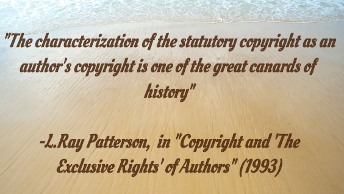
What is the point of having such a system? Is the law merely to benefit an investor, seeking to invest in already viral content, at the cost of the cultural enrichment of the society? No wonder the idea of Copyright, and its ideological symbolism of being hailed as an author’s prime tool, is nothing but one of the greatest canards of history.
I understand the argument that the author may be happy with whatever he has gotten, given Rs. 3 lakhs plus some meek royalties (if and when he gets that is) would be a huge sum for someone who used to sell peanuts + the amount of fame + ripple effect gigs, advertisements, etc. – but to me- that is exactly the problematic point:
If the author receives an amount “x” as the economic incentive to produce the work, in lieu of their copyrights, and they are happy with it (given the virality and prospects, etc.), what is the need for any further tax on the public to access the said work? Doesn’t the role of Copyright as a regulative policy end there? If there is no other recoupment for the author and the author is simultaneously happy, why more access fee in the name of either incentives or just desserts or whatever?
Especially considering the internet and its long tail, why is there for any need for a rate – x+y to be paid- where “y” merely goes to corporate investors seeking to make money out of aggressive enforcement of copyrights?
In my opinion, especially in the context of content that is already viral even before record labels/distributors/publishers step in, this additional amount “y” that is levied as a tax on users, is an unjustifiable deadweight loss and nothing else. The mere disbursal of a lump sum payment cannot be a ground to justify this deadweight loss as a desirable policy, given the undesirable tradeoff of a concurrent tax “y” and continued exclusivity in the hands of a corporate entity (non-creator). Maybe we need to figure out a way that this amount “x”, in Bhuban’s case Rs. 3,00,000, reaches out to him quickly from users directly- and maybe we need to figure out an efficient system in respect thereof- but allowing intermediation, assignments, and continued exclusivity (resulting in immeasurable further tax on users and downstream creators), just because a lump sum by an intermediary is easier- is not a ground to justify beyond incentive payments by users for access and use. It goes over and above the actual intent of copyright and is merely a problem of laze.
We ought to realize this and push for disintermediation in Copyright policy (banning assignments or alienation by authors in favor of corporates), especially in the era of the internet. But for disintermediation- we are gravely and adversely affecting cultural engagement, enrichment, and freedom- something which is paradoxical to the goal of copyright and cultural policy. In a copyright scheme where no transformative usage is recognized (unless it is for personal/private purposes, research purposes, or parodical/critical purposes), such change is all the more required to ensure that copyright incentives, which do not even go back to the author, do not freeze cultural engagementand democracy- or the ability of situated users to talk back and present their cultural narrative in an accommodative permissive cultural space.
This is FOR both the author and the user (aren’t they the same?), and only against a corporate investor- who ideally should really have no stake in Copyright policy, but unfortunately has the most. Who knows, as Oren Bracha argues– the history of IP (commodification of expressions (might actually be the history of capitalism, which is an unfortunate truth.
Note: This post, for a change, is in the context of a case law rendered by the Karnataka High Court in ANI Technologies Private Limited v. State of Karnataka holding Copyright infringement to be a Cognizable and Non-Bailable offense in Indian law. However, this post is much more than a legal comment on the interpretation resorted to by the High Court. Read on to find out more:
In a recent precedent from the Karnataka High Court, Copyright infringement involving an element of mens rea and qualifying within the contours of Section 63 of the Indian Copyright Act, 1957, has been held, once again, to be a cognizable and non-bailable offense. Legally, this judgment clearly goes to the teeth of the Delhi High Court’s (J. Bakhru’s) ruling in Anurag Sanghi v. State, where it was clearly held that these offenses have to be non-cognizable and bailable, even if one disagrees, due to the binding Supreme Court precedent in Avinash Bhosale v. Union of India(2007) 14 SCC 325 – where it was clearly held that “up to 3 years”, because of being inclusive of offenses which are punishable for less than 3 years, has to be read to be categorized in Item III of Part 2 of Schedule I to the CrPC. Any other interpretation would lead to a situation where even an offense where the punishment prescribed is less than 3 years, is rendered non-bailable which cannot be permissible as per the stipulation in the schedule. The Karnataka HC has clearly ignored this precedent, and its reliance by the Delhi HC in both Anurag Sanghi (supra) and GNCTD v. Naresh Kumar Garg, rendering the decision clearlyper incuriam, i.e., in ignorance of binding law. In any case, the offense of Copyright Infringement being raised to a level of being non-bailable, inspite of other offenses in part I of Schedule 1 of CrPC which are punishable for 3 years (sl. No. 181, 193) being bailable, clearly goes to the teeth of the rationale expended by the Karnataka HC. Further, in case of ambiguity in the statute (the Copyright Act does not specifically mention whether the offense is cognizable or not, and provides punishment up to 3 years, which is sort of a “no-man’s land” and a cause of confusion), the rule of lenity requires an interpretation in favour of the accused to be taken. Therefore, legally speaking the judgment is clearly flawed.
However, this post is not about that.
This post is about how this judgment is extremely unmindful and ignorant of the scheme and provisions of users’ rights, and limitations to copyright which are present within the Copyright Act itself. This post is about reiterating the fact that Copyright is not a natural monopoly, but rather a carefully constrained legal monopoly, which is not unconditional or a ground to curb liberty of citizens whatsoever.
Judgments holding Copyright infringement (whether conclusively determined by a Court of law or not) as a cognizable and non-bailable offense under Section 63 of the Act, have led to quite an uncertainty for those who seek to use Copyrighted works for uses that are protected and are recognized as limitations to copyright and fundamental to speech purposes, deterring them from resorting to practicing permitted speech, and in effect resulting in a chilling effect on culture. After all, the police, while arresting (and curbing liberties) cannot be expected to figure out what is permitted under Section 52 of the Act and what is not, right? How does the police figure out as to whether borderline uses/dealings are limitations to infringement- or infringement? Given that Courts have even held that even commercial uses can be termed as fair use (Super Cassettes v. Hamar Television), there is no reasonable way for Police to prima facie determine as to whether the alleged offense is one that is statutorily protected or not, with its genesis in other fundamental constitutional obligations (reiterated in Wiley v. IIM).
I ask myself (as colloquially used in courts!), can the liberty of an individual, practicing legitimate speech be statutorily curbed in spite of their being a chance that the speech is protected under the same very statute? What if the unlicensed use of copyrighted content by Ola Cabs in the said case before the Karnataka HC could have come within the domains of Section 52 of the Act? Could the police determine the same? Would arresting an individual, in spite of the possibility of the use being within the contours of Section 52 to be determined by the Court, be in any case justiciable?
In effect, in a country like India, with an indigenous culture that is primarily derivative, and dependent on existing inputs to develop further cultural outputs, as a mode of learning as well as a mode of cultural practice (be it qua musical works, the guru-shishya parampara, or many such works where transformative-ness and derivative usage are the core of cultural performance- similar to sampling in hip-hop cultures), more so in cases of religious cultural outputs (which are also infact protectable, shockingly), people who resort to doing the same may be arrested with their liberties being given less of a preference as compared to overarching proprietary claims which often rest with corporate entities which did not put in any “skill and judgment” to deserve such statutory incentives.
Could this ever be the intent of the law?
It is extremely essential for Courts in India to realize the “EQUAL EXISTANCE” of Section 52 in the same very Copyright Act. Yes- the same Act, provides for certain dealings and uses with the works, to be exempt from being termed as infringing, or as the Supreme Court of India has held– not reproductions that are infringing for the purposes of Section 51 of the Act. Unless and until, a Court of law/ judicial authority clearly comes to the conclusion, at least on a prima facie basis that the use/dealing which is infringing does not come within one of the limitations, arresting anybody or taking cognizance merely by a police officer (not a judicial authority) on the basis of an FIR, would be completely contrary to the purpose of the existence of Section 52 within the scheme of the Act. It is also important for Courts to realize that Copyright is a statutory monopoly conferred to someone who imputes their skill and judgment. As the Supreme Court has held, it is against the general course of our constitutional schema- which discourages monopolies. To regulate and “create a balance”, regulatory safeguards to this monopoly in the form of limitations have been prescribed under Section 52.
Merely because there is an economic loss to companies who now own these copyrights (due to assignments or employment contracts), possible infringements [without a clear legal determination of the same by a judicial court of law (at least a magistrate)] cannot, ever, be a ground to deny liberty and protection qua permitted speeches to people, especially when there is still a chance of penal consequences without there being a need to curb human liberties. Moreover, it is also important to realize that the companies which bank on copyright transfers as the genesis of their business models are in fact legally de-risked and are treated at a higher pedestal than any other business dealing in any other normal (or essential) commodity. This is merely because of their “investment” in products of skill and judgment, and not their creation of the same. Therefore, to have them cry out loud in the case of every ‘possible’ infringement, and to ask courts to arrest individuals committing acts, which may or may not be infringement (until determined by courts) can never be desirable policy.
Section 52 is an equal right/ freedom, and not something to be overlooked. In fact, it is the section that renders the Copyright Act constitutional, and in fact saves it from being vulnerable to unconstitutionality under the Indian Constitutional schema. Courts ought to be mindful of the same while dealing with cases of alleged infringement under the Copyright Act, 1957.
I am tired of hearing the phrase “balance”. I am tired of those who say that limitations to Copyright ought to be interpreted in a way that balances it with the interests of Copyright holders. I am tired of those who argue for limitations to be read narrowly in the name of “balance”. I am tired of those who argue for wider and broader IP rights and contest limitations by claiming that they must be applied in a “balanced” way, that they must be applied in only “certain special cases”. I am tired!
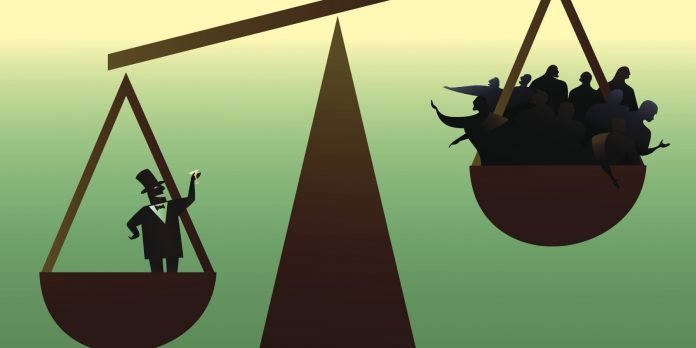
What is Balance? Balance is keeping scales aligned and symmetrical. Balance is ensuring that every conscious act, which is a step away from normative thoughts, practices etc., is regulated to the extent that it does not take a form of a tyrannical unconscious act. Balance is meant to ensure that things are conscious of tradeoffs – and every move played, in the game of chess, for a purpose (whatever that might be), is smart and not one which is erratic and unreasoned. It is a way of ensuring that even erratic moves do not affect the most fundamental, by safeguarding and keeping them in the realm of generic normalcy.
Well, Copyright is, in and by itself, abnormal. It is not intuitive or natural. It can never be. It is deemed “commodification” for a purpose – i.e., to serve the end of ensuring that creators do not shift to marginal sources of revenue that will economically help them survive better. It is an imbalance, in the norm of competitive markets. It is encouraging monopoly, as against the norm of discouraging clusters or market power. It is by itself an imbalance.
I often get riled up when copyright owners (with enormous aggregated market power through tools of assignment/contracting out these rights of creators), say that hey- please do not restrict our monopoly in the name of limitations like use/fair use/permitted dealings etc. “We deserve free markets.” “We contribute to the GDP.” “We make the economy.” I often get riled up when they call for narrow readings of limitations- touting them as “exceptions”, saying that well a balance must be struck that does not defeat the owners right to market and exploitation.
Copyright is by itself an interference in “free markets”. It is a monopoly statutorily conferred, in the backdrop of a constitution which discourages monopolies. How can businesses, which by their genesis run on a model that is an interference in free markets- want complete regulatory stagnation? How can they want their rights/ businesses to be treated like other businesses in the free markets?
The idea of “limiting” the exemptions from Copyright/ limitations to Copyright, or applying them narrowly, is something which we need to get rid of. Asking for balance within an imbalance is an oxymoron. These limitations ARE THE BALANCE. Reading them widely, or as strongly (sadly) as we read these rights IS THE BALANCE.
Copyright owners asking for free markets/ no regulation (by arguing that any regulation like limitations or compulsory licenses goes against free trade or right to property) is the biggest oxymoron ever- as the genesis of their claims is by itself a regulatory interference in the free market.
To conclude in a single line-
Reading limitations to Copyright narrowly, in the name of “Balance” is the genesis of systemic imbalance. Reading them broadly, or at least at a similar threshold as those rights , is what constitutes “Balance”.
IP Mosaic, last year i.e., in 2020, was special. It was the first time I attended an IP Conference, because a friend was incidentally presenting. It was then that I got to hear from a few of the most amazing critical Intellectual Property Scholars- people like Prof. Brian L. Frye, Prof. Anjali Vats, Prof. Betsy Rosenblatt, Prof. Carys Craig, Prof. Bita Amani, among many others. The conference was very influential for me, in the sense, it imbibed this new way to look at IP scholarship. Since, I have even had the pleasure of working on some projects with Prof. Brian Frye and Prof. Anjali Vats.
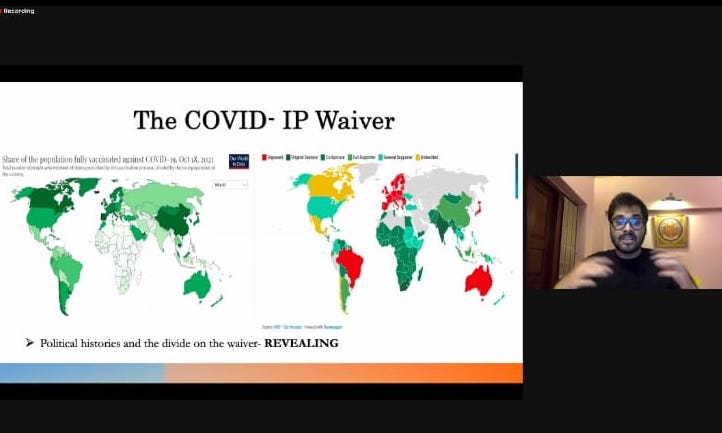
Yesterday, at the 7th IP Mosaic Conference 2021, titled- IP as protest, change and empowerment, hosted by the Institute for Intellectual Property and Social Justice, Washington DC, along with MH School of Law in the US, I finally got to present my upcoming paper (almost in the final stages) titled- “Waiving Windfalls: A socio-legal and contextual justification of a TRIPS Waiver during the COVID-19 pandemic”, in the panel titled “Patents and public health”. The panel included Prof. Muhammed Zaheer Abbas (inspiring scholarship), Prof. Mason Marks and of course the moderator Prof. Sharon Sandeen (@TradeSecretProf).
Coming to my paper, it is NOW uploaded on SSRN, however as a gist, the trigger of the paper was the Second Wave and my experiences during the devastating and frustrating situation in India. People running to Courts for oxygen, hospital beds (anyone who was in Delhi then, would completely relate to what I am referring to), a tab of Remdesivir or Tocilizumab, got me thinking – how did we even get here!
The paper goes on to specifically look at the contextual political history in terms of IP regimes, the “gradualism” or the transition period afforded to developing nations – and how our global trade mechanisms are completely unmindful of accommodating these political historical realities, which were not within the control of most of the nations, now struggling to serve the health needs and priorities of their domestic population. I go on to bat for the essence of a waiver provision in the WTO Agreement, and use historical instances where waivers have been granted, as well as the political histories of the countries batting for a waiver, as against those opposing it, to justify the fact that IT’S NOW OR NEVER.
The main theme and focus of the paper is on colonial de-linking of pharmaceutical trade and IP laws.
“De-Colonizing IP requires an alternate accent – where global trade ought to be looked at from the eyes of geo-historical attentiveness. The essence of distributive justice, especially in the grim situation that we face today, lies in realizing the importance of the historical context, i.e., this context of prolonged inability, not due to controllable forces or complacency or a lack of merit, but rather due to global acts of suppression, accounted for in real history.”
Anyway, for more, here is the abstract and the (highly textual) slides which I used in the presentation.
Here is the full paper- up for comments and opinions.
Alternatively, the slides can also be accessed here:
Today morning, I was called to my Alma Mater, Jindal Global Law School, (of course virtually) to talk about Music Sampling and its relation to Copyright. Prof. Vishwas H. Deviah (who was my Independent Research Project advisor at Jindal, as also for whom, I served as a Teaching Assistant during my final year) had invited me to address a lecture to the LLM and Undergraduate students who have taken up the elective -“Music and Copyrights”.
Although the method of pedagogy in terms of this course is supposed to primarily be formalistic, and case-law oriented, tracing the judicial interpretations of sampling, I decided that given this opportunity, and having recently read The Color of Creatorship by Prof. Anjali Vats, I would try and do something different, and focus more on an interdisciplinary approach towards this lecture.
Here is the drive link with the slides that I used for the lecture/presentation:
Broadly, I have tried to provoke a critical voice, against the normative idea which is taught in copyright lectures, especially here in India. I have tried and focussed on viewing and tracing the imperialistic nature of Copyright, and its adverse impact on normative non-white practices like sampling- by doing a historical overview of copyright policy, as well as of Hip-Hop as a form of music. I tried, through, this lecture to make a case for Copyright’s racist origins hidden, and invisible in the face of the law, until one gets into technicalities.
I have tried to break bubbles around the acceptability of copyright’s idea of windfall incentives. Also to show how knowledge development has been a result of widespread appropriation, which is now widely condemned, by the same erstwhile appropriating communities. I also tried to break the shackles of the ideas of Romantic Authorship, by normalising conceptions of “creative borrowing” as a core and intrinsic practice within music and art.
This is not really something which is ever taught in our copyright courses. The idea of writing this post is that we must try and include conflicting narratives and dissents to status quo policies like copyrights, to realise the societies and communities- it adversely affects, and to focus upon their lenses, who have been at the receiving end of these colonial impositions, which they sometimes do not even realise they have been subjected to.
As copyright scholars, it is our role to emphasise on this perspective as well, rather than merely focussing on internalising copyright policy, and focussing on intrinsic reforms within it.
Reading List/ Sources I referred to (even copied from) for the purpose of these slides:
The Color Of Creatorship, Anjali Vats (Stanford University Press)
Copyrights and Copywrongs, Siva Vaidyanathan (NYU Press)
Privilege and Property: Essays on the History of Copyright (Chapters- 3,4,6), by Mark Rose, Oren Bracha and Maurizio Borghi (Open Book Publishers)
Today is 26th April. The day, which is termed, every year as the “World IP day”, by the World Intellectual Property Organization. This is to celebrate and romanticise the concept of market exclusivities and the right to exclude. Exclusivities in culture, in knowledge, in information and consequently in pharmaceutical innovation.
This World IP day, I would like to pose a question – what has this romanticism led us to?
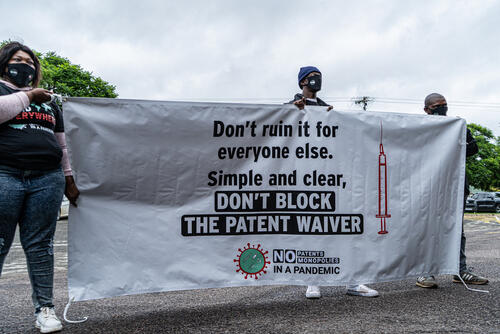
The deadly repercussions of internalising IP in terms of excludability/ the right to exclude- as the most viable form of incentives for innovative and creative production- are clearly visible to us today. COVID-19 has led to many pieces being written all around the world arguing to invoke compulsory licenses, to ensure technology transfer, to prevent trade secrecy, to maintain voluntary social solidarity towards resolving the crisis which we are facing. We are even looking at a TRIPS waiver, for an equitable access to not just drugs and technology- which can help a multitude of organizations develop drugs- but also to access research and R&D, which are the basic fulcrum of knowledge development, and are blocked by exclusivity rights- facilitated by IP ownership.
It is interesting to note, however, that IP was infact, paradoxically, developed to “encourage” learning, “stimulate” creativity, for scientific “progress”, and to help cover costs of innovation. Sadly so, it is now used as a lever to earn windfalls out of publicly funded creations, and derivative knowledge.
What is the point of such “progress”, when inspite of the availability of the end result (vaccine), it is practically left inaccessible, and primarily so due to the idea of exclusivities? What is the point of a “means to an end”, when the “means” itself hampers the realization of the “end”, to the extent of its desirable social utility? Propertizing knowledge and culture is dangerous.
IP was envisioned as a limited entitlement, and sadly one revolving around exclusivities being conferred to one who has the privilege of being the first mover – often dictated by “capability” and structural positions in the society, as also, years of appropriation of capability (ironically so) (see here). IP apparently is something used to “protect” (see here) the “creator”/ “innovator” against appropriation, but to be honest – IP infact amplifies the norm of historical appropriation, because this is what is the foundation of the capability involved in being the first mover.
We often think of IP as something which invokes the Blackstonian idea of “my creation = my sole and despotic dominion” (see here– pg. 1135-1136), and go on to equate it to tangible property (see here), conferring the right to exclude – that is the right to restrict access, unless the access-seeker budges into the terms which I impose for them to access “my” property/IP. But let’s think socially for once- what was the purpose of conferring this monopoly? Was it to empower the so called “creator” to an extent that they could demand access- seekers/dying patients- to put up sovereign assets, including military bases and federal bank reserves, as a collateral for access? Is this a fair tradeoff for innovative efficiency? If this is what IP permits and if this is the dialogue around power that it frames- I am sorry there is nothing, whatsoever, worth celebrating. It’s a dark day. IP and propertisation of knowledge – the greed it induces – the norm of excludability it fosters- is one of the reasons why there are more corpses to be cremated, than “ghee” which can be used to facilitate this cremation.
People say: But for IP protection, these companies would never have been incentivized to create the vaccines anyway. But for IP, artists would be dying. But for IP, we wouldn’t have any movies that we watch to relieve ourselves during these dark times. But for IP, my business and my brand can easily be appropriated and but for IP, anyone can steal anything that I do. “Thou shalt not steal” is what is the principled justification of the existence of IP and exclusive rights in essential resources today.
I have a few important and compelling questions/ observations for these people:
Who funded the research which was used by Bharat Biotech? (cough cough! ICMR- that’s my (taxpayers) money. Where is my vaccine? If not, BB show otherwise please? Where is the transparency?). See – here, here, here
IP specifically in health resources and knowledge resources is not like any other market-oriented exclusivity. Such exclusivities curb access to materials which are otherwise backed by Fundamental Constitutional Rights. There has to be limits to so-called “incentives” which IP provides, to the extent of ensuring effective access along with recoupment of costs. This statutorily conferred monopoly cannot be left to be realized on the whims and turns of the market- given its direct impact on access to fundamentally essential resources. Is there any proportionality/ transparency on this exclusivity? Has BB shown how much it spent on the development of the vaccine? Is there any data which justifies the extent of compensation it deserves? Or wait, is it correct to leave it to its market power, especially when what that directly leads to is “people dying”? What justifies the “limited right”? or is IP just here to bestow windfalls (as it has done in the past- making pharma industries and academic publishing industries a few of the most profitable industries in the world (See here and here)), and unless one budges into their demands, you better die? The IP system is murderous. Data Exclusivity is murderous. (See here and here , here and here.)
Is IP concerned about the actual structural inequalities that are persistent in our societies, the actual images of the people who are barely able to afford a meal today? Is it mindful of distributive realities? What kind of drugs are being developed due to IP? Rare diseases – NO, Diseases of the developing world- NO, Infections and conditions which do not affect the rich- NO, Obscure diseases which affect Tribals, Adivasis, due to their lifestyles- NO (here), but wait- Hair Transplant treatments? – YES. See here and here.
“Compulsory licenses” – Let us think about the number of times they even been used? Once in India in the last 51 years. Heard about Special 301 US report (here)? Compulsory Licenses as well as Article 31bis of TRIPS are just a farce, and let’s face it, that’s the truth- the amount of economic pressure that comes with the invocation of Compulsory licenses, due to structural global positions, almost makes it impossible to invoke this provision, rendering it practically almost theoretical, even during situations of such a pandemic. Anyway, even invoking such provisions barely help, due to trade secrecy, regulatory burdens, threats of trade sanctions on alternate industries, diplomatic pressures and gaps in know-how. See here, here, here and here.
Research Exceptions in Copyright law are theoretical provisions, because they need one to honor paywalls in the beginning itself- for purposes of access. If I don’t honor the paywall, and circumvent it, to access for researching and further building on knowledge- well the anti-circumvention police are after me. What is the purpose of the research exception? Nothing. It is practically useless, unless I pay Elsevier for access to the paywall protected article. See here. Is that conscientious to the knowledge and research development in the developing world? Or is IP basically a tool to widen the knowledge gap, and the capacity to access and use essential research thereto?
How will the book author earn? How would they make money? – Well copyrights are never with book authors firstly, due to transferability. So, the whole idea of “fruits of one’s labour” is another farce to cover up for interests of industries which want to capitalize on knowledge and earn without any limits, through a monopoly on these creations- facilitated by IP. They don’t care about humanity. Just profits. As William Patry once rightly said, Copyrights as authors rights is a fascinating story carved out by industrialists to put authors in the forefront, and ultimately use the narrative, through the almost hidden tool of transferability (it’s like those convincing ponzi schemes, with faint and minute disclaimers: “terms and conditions apply”). Copyrights as effective tools of remuneration and incentive for “authors” is the biggest canard in our history and we must realize it ASAP. (see here and here)
A comparison of the revenues earned by publishing houses (and even for academic publishing), is grossly disproportionate to what goes back to authors of these works. (An insightful report by Authors Alliance) The Academic Publishing industry earns a fortune, from all corners (See more here, here, and here), by exploiting these copyrights, which were intended to ensure reasonable revenue and control in favor of authors. For these publishers, it is their monopoly on visibility in the market that renders this possible. In fact, if one does not fulfill the requirements of what the publishers want to publish (including the narrative of information), it may not even get published. Authors are often at the mercy of publishers, who in fact exploit the rights of these authors, to earn the maximum amount of money for themselves. If Copyright is actually supposed to help authors recoup income through these rights, where is the income? Why are authors having a hard time making it, monetarily? (See here) Are such exclusivities desirable, at the cost of access to educational/ research papers/ knowledge resources/ resources which facilitate development of vaccines and healthcare? Is the tradeoff worth it?
Why would people make music? How do artists get remunerated if not for IP? Well, apart from the 1% superstars who conform to the homogenous mainstream music market, does any artist even make money out of copyrights? Realistically, few authors have made money through copyrights. Various studies and anecdotes have helped substantiate this over time. (See here, here (page 16), here, here, here). In fact, vaguely 10% of the revenue through copyrights, has been argued to be disseminated amongst 90% of the creators, with the rest in the hands of certain “superstars” (who make mainstream content) as well as these industries themselves, which are gold mines. Prof. Shamnad in a hard-hitting piece, which dates back to 2010, had emphasized upon this rhetoric, highlighting the plight of creators. What is the point of a system focusing on exclusivities which are transferable, as against direct remunerations to authors? (see here for a detailed post arguing disintermediation)
The idea of Copyright as incentives to create cultural works is indeed questionable. As Zimmerman recognises here:
“A raft of recent studies makes it quite clear that modern creators generally have little more realistic hope than Victorian poets of earning much in the way of remuneration for their acts of creation. The copyright “incentive” notwithstanding, it is more credible to understand their devotion to the production of expressive works more as a product of love than as a response to the promise of money, because they are unlikely ever to see much of the latter. A British survey, for example, found that few of that country’s writers could support themselves by their craft, with the result that most must regularly turn to other part- or full-time jobs to supply themselves with the income necessary to survive. This finding is consistent with those from similar studies in the United States and Canada”
There are many who have actually questioned the relevance of “exclusivities” as the reason for inducing cultural production, as well as an effective remunerative tool, even from a fruits of one’s labour approach. (see here, here, here, here, here, here and here). In fact, there are research outputs that show that copyright constraints creative autonomy, and fosters industrial conformity towards the marketable mainstream. (here,here, here and here). IP is a tool of coercion of agency and concentration into cultural homogeneity, as against democratic and representative discourse. It embraces difference within a homogenous bubble- not representative diversity. What justifies exclusivities then? Windfall incentives to invest? What about alternate- non access curbing- incentives?
What kind of creativity does copyright incentivize, if at all? Industrial mainstream creativity which is capable of generating the most amount of money for those who control distributive visibility. Basically, content which satisfies the aesthetic and cultural conceptions of those who are wealthy and can pay the most, and can make these copyright owners (transferees, by virtue of distributive edge) richer. It contributes to erasure of dialogues which do not belong/ or satisfy the aesthetic judgments of economically superior (often due to structural reasons) audiences who can generate maximum profits for creative industries. It results in erasure of non- urban, non-upper class, non- elite, non- upper caste, and non-racially skewed dialogues, which would make these upper classes uncomfortable. It fosters speech hierarchy which furthers the divide around privilege of capability. It levels creators belonging to communities which depend on borrowing as a normative practice as “lazy thieves” and labels them as imitators who lack the capacity of groundbreaking art, due to the derivative nature of their creative expressions, inspite of that being the norm. (look out for my upcoming paper titled Access to Culture Dialogues, dealing with this. Had presented it at WIPIP’ 21. Here are the slides).
IP is a shorthand for creating a white male knowledge citizenry that is completely ignorant of the knowledge and historical divide of capabilities, and appropriation thereto, as also the normative practice of borrowing and sharing involved in various cultural societies, where these norms are coerced. IP is racist. (see Anjali Vats- the color of creatorshipfor the last 2 bullets). It also privileges those with a capability of a first mover advantage due to structural considerations. It favors with those with better “natural” engines and provides them exclusive monopoly rights over exercise and use of that particular resource, estranging many. It does not favour the first creator (in copyrights, there is no way to ascertain whether the person claiming monopoly is actually the “first creator”), but rather the first “showcaser”, one with the ability and visibility. See also here, here, here and here. It favors and provides exclusivities to certain kinds of cultural practices that are individualistic, textual (as against aural), and non-derivative (supposedly, as a myth), ostracizing those who practice alternate cultures, economically.
The idea of the IP system as an entitlement, even for purposes of autonomy, “just” desserts, labour as also incentives, is a flawed belief– lest it should not have been transferable, it should have accounted for bargaining power, it should have been perpetual (which it isn’t and thank god for it – the statute of Anne was only a 10 year right (See here, but also here). IP was supposed to be a tool, to ensure that firms which invest in innovation and authors who create, are not “disincentivized” and forced to shift to marginal sources of revenue due to capitalistic forces in play. However, now, do we even need such incentives, or rather do we need such incentives which provide the power of excludability? A serious response to the same must be considerate of the magnitude of profits currently being earned by Pharma and publishing industries, and the extent to which alternative systems, which do not depend on access control, and exclusivities would corrode these profits. (For profitability in the Pharma Industry see here, here, here, here,here and here) It requires transparency in financial data, and requires conducive thought to the idea of health, education and culture, which are in effect commodified upon a model of excludability, being involved and them being fundamental to human existence. Are Patents and similar exclusivities the only drivers of innovation? See here
Before I am bombarded with opinions which blast me saying – “What is the alternative you suggest?” – I am no one to suggest alternatives. But there are people who have been studying this field and constantly foreseeing the problems with the IP system i.e., excludable monopoly over knowledge, culture and health resources, and have suggested some feasible alternatives. But, as I guess, they will never see the light of the day, because well of course they go against the idea of “staggering profits” and windfalls, which these industries have gotten accustomed to, even if that so at the cost of human lives. If you still however, wish to see the alternatives to the IP system- which do not involve the “Right to exclude”– see here, here, here, here, here.here, here, here, here and here.
I believe, it is time to look beyond internalizing exclusivities and excludable. It is time to look beyond the term “Property”. It is time to believe in alternatives- one’s that aren’t governed by whims and fancies, but rather are accountable towards their larger social goals they seek to promote. If this pandemic has taught us one thing- it is that we are all connected human beings- socially affected by and to some dependent on each other. We need to respect that and look beyond individualistic benefits and incentives.
Let’s look beyond sole concerns of economy and industrialization, which employ means that restrict fundamental human growth. As Amartya Sen says:
“Focusing on human freedoms contrasts with narrower views of development, such as identifying development with the growth of gross national product, or with the rise in personal incomes, or with industrialization, or with technological advance, or with social modernization. Growth of GNP or of individual incomes can, of course, be very important as means to expanding the freedoms enjoyed by the members of the society. But freedoms depend also on other determinants, such as social and economic arrangements (for example, facilities for education and health care) as well as political and civil rights (for example, the liberty to participate in public discussion and scrutiny).
With people dying, corpses repeatedly filling burial grounds, innovative capability being stifled due to exclusivities inspite of the availability of 5 developed vaccines owned (through patents and trade secrets and data exclusivities) by already billionaire industries, I must say, the IP system* is definitely partly to blame for the continuation of deaths.
Therefore, to conclude – Dare you celebrate today. If you choose to do so, you better know that the IP (excludability) system is complicit, and so are you!!
*focusing on industrial policy and excludabilities and justified by non- inclusive economic considerations which further the rich getting richer aphorism.
In this first post, I shall discuss the aim, vision and plan of action of this blog. I have pinned the contents of this post in the “About” section of this website.
Notes from an IP Theory enthusiast. This platform has a purpose. In our respective law school journeys, we have realised the importance of theoretical reading and appreciating academic work, but have always wondered about the great divide when it comes to the academic ideas we read and the actual legal practice on that subject. The purpose here is to dissect academia and showcase its essence and relevance in practice. This is a readers perspective, for our readers. This is just our understanding of the material discussed, and nothing beyond it. Do not trust us much (we are naive students after all!) however do read and join the discourse.
IP has been a subject area which has intuitively attracted both of us. We, as one could call it, are IP aficionados (not to mean that we are pro- Intellectual Property – we are conflicted on that). We LOVE reading and theorising around IP and delve into various philosophies in the context of how it affects the disciplines within IP. Besides this, we have also been lucky enough, while reading for pleasure, to indulge in the academic works of various renowned and developing IP scholars and professors from around the world, getting exposed to various thoughts and debates on the purpose of IP in the first place.
Through this platform, we aim to indulge our readers (hopefully students, academics, practitioners, judges and aficionados) into these academic readings and thoughts, and rethink the intuitive dialogue that runs around the areas of IP.
The blog offers the views of various legal theorists and philosophers and how we could use them while reading IP. An instance of the same would be our indulgence with Kant and his philosophy on “autonomy” with respect to copyright. Another could be our reading of Foucault and his piece on “Who is an Author”. We have a collection of a number of such theorists who we shall attempt to explore and allow many of our readers to contextualise their relevance in the current IP debates. We shall also be indulging with the works of various academics from various schools of thought in IP Policy. We aim to present these “hostile debates” and ruminate about how they matter while practicing and implementing IP.
Using this tool of academia, this blog shall also endeavour to examine the Indian Copyright Act, its legislative schema and the interpretations by the courts – to ponder upon whether they move towards the goal which IP was supposed to fulfil in the first place, or have they changed the goal in itself.
On this platform, we also present various other projects that we are working on together, as well as individually, for anyone who is interested to contribute and indulge in a discourse.
We do not have a staunch ideology and we are yet conflicted trying to decipher what we actually “should” be following and we hope this blog helps in that process.
WHAT WE DO NOT DO:
On this platform, we do not discuss case laws and general upcoming IP jurisprudence of the courts in India and Abroad. Although if tempted we may try to theoretically comment on them. However, that is not what we generally will do. We are extremely theoretical in our approach, to support normalising the use of theory in practice, rather than ruling it out as “too theoretical”. If you wish to check out our comments and analysis on case laws and related jurisprudence, we write for IPRMENT Law, and absolutely love it. You could also check out IPKat for international IP Jurisprudence.
Welcome to our immersive world of IP Theory and Academia. I hope we have a journey worth remembering!







 IP Musings