In India, there has been significant discourse lately surrounding copyright concerns in the development of Generative AI models, the most recent contribution being MEITY subcommittee’s Report on AI Governance in India, which declares that storing and copying works to create datasets for training foundation models constitutes infringement. Moreover, it isn’t protected under Section 52(1)(a)(i) of the Copyright Act.
While I have written extensively about these issues elsewhere, this piece focuses on what I believe is a fundamental misdirection in this debate—from both sides—whether it’s those claiming training-purpose usage is infringement or those arguing it constitutes “fair use.” Let us not even touch fair use. Training models using copyright works (including storing or making copies of them for training a model) is not infringement of any exclusionary right provided under Section 14, period.
The MEITY Sub-Committee’s broad conclusion that models infringe copyright holders’ exclusive rights simply by storing and making training copies of publicly available copyrighted works is deeply problematic. This stance, if accepted, would fundamentally overturn our understanding of copyright law. Here’s why:
Consider the implications of this statement. If the mere act of making and storing a copy constitutes copyright infringement, wouldn’t you be liable for printing or saving an article from my blog to read later? Could I legitimately sue you for that? If you showed it to someone else or uploaded oit n a public drive, then maybe, but otherwise could I?
The essence of copyright—whether it is reproduction, distribution, performance, or other rights—lies in the exclusive ability to express one’s original expression, translating to an ability/ or a right, to stop someone else from expressing one’s original expression. It is crucial to understand that toexpress is fundamentally a relative concept involving two human beings– the human “expresso” and the human “consumer” of that expression. Copyright claims, in respect of publicly available works, are only available, under law if one has substituted the position of the expressor (by becoming the expressor of someone else’s original expression)- not if someone is a mere consumer of the expression. This relative relation does not exist in AI training. It merely involves consumption of the expression of the original creation by the model to learn and train itself.
What’s missing from the current debate is a crucial understanding: copyright protects against unauthorized sharing of my work with others, potentially depriving me of credit or economic compensation that I could have gotten by sharing it with them myself. In simpler terms, while I cannot express your original expression without your permission, I can certainly consume your publicly available original expression without the same (maybe (or not?) barring paywall circumvention, which isn’t part of this current debate). The law focuses on unauthorized expression of original publicly available content—not its unauthorized consumption, as making content public already waives that claim.
This is why I struggle to understand how storing or copying for purposes that don’t involve sharing/expressing the original expression, or a substantial part thereof with third parties (what academics often call non-expressive, consumptive copying) could be considered infringement at all. This question needs to be addressed before we even enter the fair use debate, which only becomes relevant after establishing prima facie infringement. If such copying were illegal, simply printing publicly available web pages for one’s learning/consumption would constitute copyright infringement. If I store content for learning, which I might use to produce a potentially competing article, is that infringement? By this logic, academia (a commercial enterprise), which more often than not requires storing and printing publicly available articles for learning the ideas embedded within them, would equal to an enterprise built on infringement of copyright. Fortunately (and thank god for that!) that is not the case.
Developers of models aren’t exposing any humans to the expression of the inputted works—they’re creating an alternate expression. If this alternate expression substantially resembles the original expression used for learning, that will indeed constitute infringement, but that’s fundamentally different from claiming that storing and copying for model training purposes is inherently infringing.
In short – (i) no, copyright is not the answer for your existential crises, and (ii) it is a “scope of rights” issue, not concerning itself with a backend defense of fair use.
The sooner we understand this and get over copyright, the sooner we will look for other arenas that actually resolve the existential concerns.
Trademark policy is a tool to facilitate consumers to distinctly identify the source of goods or products that they like. Its goal is to ensure that a consumer who wants to specifically use product x is not confused or deceived into using product y, believing it to be from the same source and hence of the same value- be it aesthetic or functional, as product x. To fulfill this goal, law makers have deemed it fit to confer exclusionary rights in the use of such source identifying attributes– often affixed to the products- to those who provide these products. What are these source identifying attributes? The legislators seem to understand these attributes to include verbal and non-verbal identifiers.-n“any word, name, symbol, or device” or any combination of these tools of source identification that a provider may use in conjunction with their product to facilitate recognition- as being excludable.
The underlying purpose of this exclusionary right is to protect the interest of consumer in being able to firmly identify the source, and to protect the interest of the provider in being able to use such distinctive identifiers enabling consumers to identify the source. It logically flows from this that such exclusionary rights are only to be extended to those attributes that are primarily and specifically used for identifying the source of the product. However, by broadly interpreting the meaning of “symbol” and “device”,[1] courts have rendered even attributes that generally are not considered by consumers to identify source, as being source identifiers or performing a source identification function.[2] Courts have reasoned this on the basis of the capability of such attributes to have a source identification function,[3] without investigating into whether – when divorced from the word mark and/or the distinctive logo (that primarily have source-identifying functions)- these attributes are even considered by consumers while identifying source, or not.
The upshot? Exclusionary rights have been extended to even (i) attributes which- even when divorced from the word mark or the logo- almost never actually have a source identification function but are merely attractive design features with their own non-source identifying significance (and its own legal tool of enablement – copyright law or design law)[4]; (ii) attributes which sometimes form part of the product- thus allowing an exclusionary right over the product itself- a product which may have use significance, although not functional utility in its strict sense;[5] (iii) attributes which flow from the experience of the product – its sensory characteristics- aesthetic, auditory, olfactory.[6] These although, almost always are a subject of originality and creativity and sometimes even novelty, are rarely primarily performing a source identifying function, especially when used in conjunction with a word mark or a logo. Most of the time, the originality of their sensory expression is excludable through other forms of intellectual property – copyright law, design patent law etc.- however given trademark protection, at least theoretically is perpetual (although we have the genericide doctrine), providers would often love to double up these exclusionary rights by portraying these attributes to also be source identifying.
A further radical upshot, with potential to be dismissed as being a conspiracy theory- Almost all of visual and auditory copyrightable subject matter could potentially be overlapping with trademark law- thus providing double and perpetual exclusion of works which are socially valuable to be accessed and used. The way trade dress protection has expanded- it is not inconceivable that Taylor Swift seeks trade dress protection over her songs arguing that – Hey! Someone listening to my song will immediately identify that this song comes from me, or Banksy seeks trade dress protection arguing – Hey!Anyone who sees that art on the train would obviously know that it’s me who has done that. We all know this has nothing to do with the goals of trademark policy and why it exists.
Such analysis is not limited to product configuration but extends to product packaging too- where even when divorced from the wordmark and the logo, the packaging would mostly be attractive – and that would be its primary function as against source identification -which automatically flows from that attraction because we would want to know who produced this attractive packaging. But such secondary potential of source identification is possible with all subject matter of copyright law as well. I might like a song by Radiohead because of its sensory attributes, but I would then associate Thom Yorke’s voice with him as a byproduct of the attraction. This source identification function although does not seem to be the concern of Trademark law because it directly flows from the song (product configuration) or its amazing sound recording (product packaging), as against a specific attribute peculiarly intentioned to help a consumer identify source. That specific attribute is the concern of trademark law. Put another way, how much ever Thom Yorke wants to trademark his sound, because as soon as we hear it- we know it distinctively is Thom Yorke’s attractive voice, that is not the kind of source identification trademark law protects – by providing an exclusionary right over the product itself.
If at all trademark protection is to be extended to product packaging or product configuration as source identifiers, the relevant enquiry could be:
Divorced from verbal and logo- identifiers which primarily serve as source identifiers- does the consumer, almost inevitably, associate the sensory attribute to be source identifying, as against anything else?
Maybe in the absence of the logo and the word mark on the product packaging, I would have to rely on distinct design features or packaging color (product configuration or product packaging), but when the product already has specific source identifiers in the form of a word mark and/or a logo, associating any source identification function on the trade dress/ design- be it of the product or the packaging- is a leap, which, on an objective basis, average consumers would not rely on.
This is where secondary meaning comes at play. If there is a product which does not have a specifically dedicated source identifier but rather relies upon its product packaging or product configuration to perform an identification function, and the consumers realize this and rely upon the said attribute over time (hence secondary meaning), there could be enough of a claim to extend source identification to trade dress. But this is as rare as it gets, and this is why, as Glynn Lunney recognizes- the legislators did not envision this, specifically including “packaging” or “configuration of goods” in the definition of a trademark only in the secondary/supplementary register and not for purposes of the principal register.[7]
Thus, J. Breyer’s broad reading of “symbol and device” in Qualitex, to conclude – any and everything that could possibly, inspite of the existence/ or in the absence of a dedicated source identifier, be a source identifier – is overzealous interpretation- completely ignoring the purpose and the interest sought to be achieved by the tool of trademark policy. It, as Lemley and Dogan argue, is a tenuous presumption of consumer behavior.[8] Put concretely, in my opinion, it is not objectively reasonable to assume that inspite of the boldly written distinctive name- Reese, in its distinctive style, font and logo-like characteristics, the consumer would continue to rely on its orange-colored wrapper to identify its source. And even if the consumer unbelievably loves associating the color- orange with Reese- thus showing certain amount of secondary meaning, still- so long as primarily specific source identifiers in the form of the logo or the word mark exist, there is no reason to allow excluding some other chocolate manufacturer- with a different logo and word mark to use the color orange on its packaging.
There is thus a need, and a strong one, to get rid of the propertarian impulse that provokes an exclusionary right on packaging or product design or sensory features, in the presence of other and specifically dedicated source identifiers. An exclusionary right on such features in some cases could be the domain of copyright law and in some of patent law, but in none is it a concern of trademark law and policy. When these specifically dedicated source identifiers are not present, it is only then, as a policy matter, that it could be explored whether upon finding secondary meaning- product packaging or product configuration could be rendered excludable for the purposes of source identification, or not.
[1] In Two Pesos, the Supreme Court interpreted trademark protection to extend to the total image of the business, general appearance of the product/its exterior, the décor, the menu and collated it into a single test – distinctive total image and overall appearance. The Court noted that in §43(a) or in the definition of Trademark under §45, legislators have not differentiated between a trade dress and a trademark – and hence an inherent distinctiveness approach ought to be followed, as against a secondary meaning approach. The Court said that legislators have given no basis to differentiate between a trademark and a trade dress or to not include the latter as a subset of the former. It thus differed from the logic of the 2nd Circuit in Stormy Clime Ltd. v. Pro Group. This was applied to extend protection to the festive eating atmosphere and the interior and exterior design of a Mexican restaurant. As Glynn Lunney argues in The Trade Dress Emperor’s New Clothes: Why Trade Dress Does Not Belong on thePrincipal Register, 51 Hastings L.J. 1131 (2000) [Emperor’s New Clothes], the Court completely ignored the distinction between the definitions of trademark for the purposes of the principal register and the supplementary register. It was a conscious omission- conscious decision of the legislators according to Prof. Lunney, to not include trade dress for purposes of excludability through the principal register. Such excludability was wrongly first initiated by A.C. Daphne Roberts Leeds in Exparte Haig & Haig Ltd., 118 U.S.P.Q. (BNA) 229 (Comm’r Pat. 1958), and has since, according to him, begun to spiral out of control.
Even in Qualitex v. Jacobson, J. Breyer extends the meaning of symbol and device to include anything capable of carrying meaning. He logically supports this by referring to the registration and validity of shape marks, scent marks, sound marks etc. He accordingly posits if all of that is in scope, why would not the scope extend to color? Justice Breyer thus seems to, without any reasoning, accept the premise that shape marks, scent marks and sound marks are protectable. He assumes the authority of these registrations, without questioning whether they are within the scope of the interest sought to be furthered by the tool of trademark law or not- and on the basis of that presumption extends protection to colors.
[2] Graeme B. Dinwoodie, The Death of Ontology: A Teleological Approach to Trademark law, 84 Iowa L.Rev. 611, 621-622 (1999) [“Courts have protected as trade dress the design features of extensive range of products including kitchen appliances, sporting equipment, candies, bathroom fittings, sports cars, giant gumball machines, furniture, hardware items, fashion accessories, lamps and even golf holes.”] See also, Justice Breyer in Qualitex, where he states- “The courts and the Patent and Trademark Office have authorized for use as a mark a particular shape (of a Coca–Cola bottle), a particular sound (of NBC’s three chimes), and even particular scent (of plumeria blossoms on sewing thread). See, e.g., Registration No. 696,147 (Apr. 12, 1960); Registration Nos. 523,616 (Apr. 4, 1950) and 916,522 (July 13, 1971); In re Clarke, 17 U.S.P.Q.2d 1238, 1240 (TTAB 1990). If a shape, a sound, and a fragrance can act as symbols why, one might ask, can a color not do the same?”
[3] In Two Pesos, the Court prominently focused on capability of having a source identification function as against whether the attribute is generally considered to be performing a source identification function or not. The Court held any attribute that is an “inherently distinctive dress that is capable of identifying a particular source of the product” to be eligible to be excludable. Glynn Lunney argues against this in Emperor’s New Clothes, where he asserts- “First, the mere possibility that trade dress can serve a trademark function does not mean that a product feature or design is serving as a trademark in any given case. Yet, the recognition of trade dress as principal register subject matter encourages the assumption that some aspect of a product or its packaging claimed as trade dress is necessarily serving a trademark function. This assumption is unwarranted, particularly when a party claims a product’s features or configuration, rather than its packaging, as trade dress As the Restatement (Third) of Unfair Competition has recognized, consumers seldom perceive and rely on product configuration or product features as a source of information regarding the product, rather than as an aspect of the product itself.”
[4] In Christian Louboutin, the use of an aesthetic product or its aesthetic feature was protected. In Wallace, the use of the silverware, in case it was a part of a competitive market, would have been held to be excludable. In Qualitex, the particular product and its color feature was protected. In Best Cellar, the interior design of a wine cellar was held to be protectable, inspite of ambience being one of the core elements of the market of the product. Lemley and Buccafusco argue this to be an awkward overlap with Copyright law which is completely undesirable and comes with much more costs- and should be scrapped. See, Mark Lemley and Chris Buccafusco, Functionality Screens, 103(7) Virginia Law Review 1293, 1373 (2017).
[5] The decision in Wallace Int’l Silversmiths, Inc. v. Godinger Silver Art Co. clearly shows this – where the Court falls in what Richard Stallman calls intellectual property law’s seductive mirage- conflating the propertarian impulse associated with copyright law- with the extremely distinct purpose of trademark law. In Wallace, the Court rejects, what I believe to be the sound rationale of the 2nd Circuit in Pagliero to hold that “Under Pagliero, the commercial success of an aesthetic feature automatically destroys all of the originator’s trademark interest in it, notwithstanding the feature’s secondary meaning and the lack of any evidence that competitors cannot develop non-infringing, attractive patterns. By allowing the copying of an exact design without any evidence of market foreclosure, the Pagliero test discourages both originators and later competitors from developing pleasing designs.” This extremely significant portion of the Wallace decision shows how court is confused about the difference between the trademark and the copyright doctrine and its goals- and extrapolates copyright’s logic on a trademark issue. The court limits the doctrine of aesthetic functionality as a defense to only when market competition is being foreclosed- another logic that flows straight from the logic of the merger doctrine and the scenes a faire doctrine in copyright law- without understanding that most of these aesthetic feature are actually valuable for their attractiveness, and what the actual subject matter of trademark protection is, is the name or logo that accompanies it for the purpose of associating this attractiveness with the one who provides the attractive work. The court also relies on Illustration 6 of the Restatement which says- “A manufactures china. Among the products marketed by A is a set of china bearing a particular “overall” pattern covering the entire upper surface of each dish. Evidence indicates that aesthetic factors play an important role in the purchase of china, that A’s design is attractive to a significant number of consumers, and that the number of alternative patterns is virtually unlimited. In the absence of evidence indicating that similarly attractive “overall” patterns are unavailable to competing manufacturers, A’s pattern design is not functional under the rule stated in this Section.”- In my opinion- by adopting this rationale, the Restatement and the Court in Wallace has conflated the subject of copyright protection and its rationale supported by Clause 8 or the IP Clause of the Constitution, with the subject and object of trademark protection- which is completely distinct and is more of a source identification function with roots in the commerce clause. See also, Mark Lemley and Chris Buccafusco, Functionality Screens, 103(7) Virginia Law Review 1293, 1346-1347, 1373 (2017).
[6] Justice Breyer in Qualitex, where he states- “The courts and the Patent and Trademark Office have authorized for use as a mark a particular shape (of a Coca–Cola bottle), a particular sound (of NBC’s three chimes), and even particular scent (of plumeria blossoms on sewing thread). See, e.g., Registration No. 696,147 (Apr. 12, 1960); Registration Nos. 523,616 (Apr. 4, 1950) and 916,522 (July 13, 1971); In re Clarke, 17 U.S.P.Q.2d 1238, 1240 (TTAB 1990). If a shape, a sound, and a fragrance can act as symbols why, one might ask, can a color not do the same?”
Even J. Scalia in Wal Mart Stores, to avoid disagreeing with Two Pesos, teleologically finds (awkwardly- as noted later in Best Cellars Inc. v. Wine Made Simple) that “Two Pesos is inapposite to our holding here because the trade dress at issue, the decor of a restaurant, seems to us not to constitute product design. It was either product packaging—which, as we have discussed, normally is taken by the consumer to indicate origin—or else some tertium quid that is akin to product packaging and has no bearing on the present case.” It is unfathomable as to how the interior of the restaurant does not function as a product design – because in a restaurant, the product is not just the food and drinks but also the ambience- which significantly drives consumer choice and motive of visit.
[7] Glynn Lunney, Emperor’s New Clothes, supra notes 1 and 2.
[8] Stacey L. Dogan & Mark A. Lemley, Trademarks and Consumer Search Costs on the Internet, 41 HOUS. L. REV. 777, 777 (2004) (“[C]ourts have stretched trademark doctrine . . . based . . . not on the normative goals of trademark law, but on unexplored instincts and tenuous presumptions about consumer expectations and practices.”).
I did not end up posting anything on World IP Day this year. So here is a consolation for that. I am leaving all of you with a beautiful and provocative portion of the inimitable Prof. Talha Syed’s [my mentor, supervisor, and favorite law professor] speech at UC Berkeley as part of a debate (linked here). I hope you enjoy:
“For me, intellectual property rights—you have to begin with the basic idea that they are rights to exclude others from using a resource—information or knowledge or culture—which resource is intangible. And because it’s intangible, it’s nonrival, and because it’s nonrival, many people can use without anyone degrading anyone else’s use. So, it’s really unfortunate, unfair to restrict access on that. For me, the harm is that it restricts access to something which, once created, should be available to all because it does not derogate from anyone’s use that others share it. That’s the miracle of intangible resources.
Having said that, there are both fairness and incentive arguments for why the creator might be owed a decent return for the effort that went into creating something that’s socially valuable and that, if we don’t get that decent return, it might be that others will be discouraged from doing so, and we might get less innovation. That’s my basic, very modest framework. Access restrictions on intangible resources are a default bad idea But some way of generating those resources may be required through some legal policy to promote fairness and robust production and robust innovation.
What the ultimate principled basis of that is we could explore, and I’m happy to discuss. But it’s this mix of sort of basic ideas of wide access and fair returns that motivates my view that intellectual property rights, like some other innovation policy mechanism, should be evaluated in terms of how well they enable wide access and robust production and fair, equitable returns.
And on that, I’m not committed to intellectual property rights as being the best scheme or to how strong they should be. My own view is that current rights are, through the roof, way too strong. There’s a massive overreach. There’s a very clear, political economy story why that happens. It’s completely unfortunate, and it’s expanding to this day. And what’s happening on the internet with criminal enforcement and so forth makes it all even much worse.
So, on all that, we, I think, are not too far apart, although one could have various sort of modest disagreements. But where we disagree is sort of the foundational basis of our positions. And so, on this, I don’t have much time, so I’m going to just try to say a few things. So, Mr. Kinsella has what he claims is a sort of a libertarian, principled position based on natural rights arguments.
Now, to me, there’s a few problems with this.
First of all, it’s always puzzling to me why it’s called the libertarian position when it’s really the propertarian position. It’s not about freedom. It’s about property rights. Well, then say that. It’s a propertarian position. It’s not about an unvarnished, principled commitment to freedom. It’s about the guiding motif being something called property rights. Now, on the idea of property rights, I just want to say three things and see if I can get it in in this time.
First, of all, natural rights. I’ve never understood what people mean when they say natural rights. To me, rights are claims against others. Mr. Kinsella seems to agree. There are no rights on a desert island by yourself. Rights are claims against others. Rights are social relationships.
Now, the basis of those rights can be in various different kinds of arguments. Those are arguments. Calling them natural is just cheating. Where do they reside? They’re not your eyesight. Eyesight might be natural for some. To call something natural is a dishonest way of trying to get pre-modern warrant for a normative argument as quasi-non-normative. It is, in a word, bullshit.
There are rights, which we can respect based on reasons. We have to give reasons for those rights. When the reasons are given, they can be more or less persuasive. Calling them natural does nothing to the argument except try to convince you that it’s not a normative argument at all. It’s like a physical act. Well, there’s a chair there, don’t you know. Well, okay, good. But that doesn’t tell me about whether the chair is nice or not nice, pleasing or not pleasing, should be sat upon or not, whose chair is it, and so forth.
Those are normative arguments. Historically, until about 1700-1800s, normative arguments were couched in the language of time inmemorial, divinity, revelation, and so forth, or something called natural rights, which was a fusion of them, natural reason, according to Locke in the Second Treatise. Ultimately, natural reason is just reason, and I’m fine with arguments from reason. But putting this label “natural” on it as if it’s not any longer something human, something social, something historical, something normative, is a cheat, pure and simple. It is an attempt to deny the inescapable reality that rights are social relationships, which we have to argue about to determine which interests merit protection over which other interests.
I have no problem saying the argument should be grounded in something called right reason of the Second Treatise, but then you have to tell me what the premises and principles of that right reason are. So let me go to that second point in a moment.
On natural rights, I think the word “natural” has mental-blocking properties. The minute you say natural right, you’ve made it seem as if you’re making an argument of individuals outside of society. All rights are social, period, conceptually and institutionally. That’s just a truth. There’s nothing you can do about it except cry. But that’s what it is. All rights are social. Natural rights theorists have, for most of history, argued that natural rights can be justified in unilateral, individualist ways. Any time you get an argument that justifies someone’s rights in a unilateral, individualist way, without taking into account competing bilateral claims, it’s someone who doesn’t understand what a right is conceptually and institutionally. And that misunderstanding is facilitated by the rhetoric of natural, which has had, historically, that role. Second, “natural” also has the rhetorically loaded character of inviting you to believe that this is something you observe as an empirical claim rather than something that you argue for as a normative claim. The minute someone says, yeah, of course, all rights are social and normative and backed in normative reasons, we’re fine. Then the word “natural” plays no role. If you say, well, that’s what the word means, then my question is, well, why use the word “natural?” What does natural add except to say certain reasons do not depend on their recognition by certain contingent legislatures? Well, that I agree with. Of course, I absolutely agree that rights are not just the conventional positive legal rights that our legal system may or may not recognize. Of course, I agree we all have the right and obligation to be critical of the existing rights of a legal regime according to reflection and reason. Of course, that’s right. Anyone who doesn’t think that besides Bentham is crazy. But that’s a different view. The word “natural” doesn’t add anything.
On that second point, the idea that all rights are property rights strikes me as patently bizarre. Either it’s going to be tautologically true, because we’re going to empty the concept of property rights of any content and meaning, in which case what’s the point of the exercise? Or it’s going to be false because I don’t understand what it means to say that my interest in being able to express myself should be protected as a right against other people’s interests in not hearing what I say, and being able to violently stop myself from speaking.
Oh, well, that’s really a property interest because you’re using your vocal organs, and you own them. I don’t know what that means. I don’t know how that helps anything. I don’t know what that means except to illicitly try to reduce all human interests to the logic of the market. And that’s, to me, a very historically specific recent phenomenon, and when libertarians, or what I call propertarians, think it is somehow true from time immemorial, they’re just wrong.
There are no such arguments until very recently on the stage of history because the social form that those arguments track is very recent on the stage of history. Propertarian mindsets are the mental expression of people who live in capitalist societies. That’s fine, but that shouldn’t be then naturalized into some sort of trans-historical, human phenomenon through the gobbledygook of natural and blah, blah, blah. It just doesn’t make sense. It’s dishonest. It’s patently absurd. The argument should be made on their own terms, not with the implication of unhelpful metaphors, which try to hide the ball.
Last point. The rights of property that are being claimed as absolute and sacrosanct here are the rights in one’s body, self-ownership, and the rights in external resources based on first occupancy, fundamentally [then there’s contract and rectification]. But that’s a very strange argument, first occupancy. The first person who delimits or does something that no one else has done now has it. Locke never made that argument fully. He thought that that argument by itself was too thin a read, and he was right because, of course, by itself, that can’t be enough, just being there first.
What if you’re there first in a lot of places, and you don’t leave “enough and as good” for others? Well, there’s a problem. Locke understood that. The propertarian literature has struggled with this from the beginning. How do you deal with the in-built limit on property rights in external resources based on the “enough-and-is-good” proviso? There is a whole industry on talking about this. What does it mean to be born into an Earth that’s already been occupied and owned by everyone? What is all this about? And fundamentally, I can’t really argue against this at this time, I’m happy to argue it against it at length.
But I just want to leave you with an idea that, fundamentally, this whole mindset is a bizarre idea that humans are born fully form, self-autonomous beings at birth. They are not. They are born vulnerable, fragile, deeply dependent, social beings all the way down. Adults at some point in a market society come to resent this reality and deny it deeply by pretending something else is the case and then invent a series of fictional just-so stories which none of which have any grip for anyone who’s not already in the grip of the idea, the infantile desire to escape the reality of society and history and go back to some primordial, fictional story in which there are absolute rights, sacrosanct between self-governing sovereigns who relate to each other as pinball machines and can’t define their rights in any plausible way.
There is no such thing, period, as an absolute right because rights are social relations, and to have an absolute right would mean to have an interest protected against any other interest absolutely. And that is conceptually and institutionally not on the cards. Okay, I’ll stop.”
Hope you enjoyed it. All of this is of course “owned” by Prof. Syed. It is his “vocal organs” after all!
I am choosing to summarize and analyze one of the (in my opinion) most important pieces of Copyright theory and policy (some very prominent Professors here at Berkeley refer it to as their bible on anything copyright). I am putting this here for everyone to be able to contextualize the role of Fair use as a policy matter while thinking of copyright’s role, its trade-offs, and how to think about progress/ values and its role in it. Here is the full piece (highlighted): Link
Prof. Fisher, to begin with, recounts that fair use as an affirmative defense, distinct from an inquiry of infringement began in the mid-twentieth century, and was subsequently adopted in Section 107 of the Act of 1976. He recounts the logic given by Justice O’Conner of Market Impairment in Sony Betamax and argues that every case where the fair use defense is invoked will involve market harm, and so it is relevant to estimate the “magnitude” of market impairment by privileging certain uses, not the mere “existence” of market impairment.
On Necessity, Prof. Fisher points out to be wary of the dangers inherent in its ambiguity. Sony and Harperv. Row discounted the necessity factor- however, J. O Conner in his analysis did say that copying essential to communicate facts may be privileged.
Prof. Fisher points out J. O Conner’s discussion where he says the rights conferred by copyright are designed to assure contributors to the store of knowledge a fair return for their labor. Prof. Fisher criticizes this as showing an objective that is fundamentally different from social utility. He says that the notion J. O Conner embodies is that authors and inventors deserve a reward for labor irrespective of whether they would continue to work in the absence of this compensation. He criticizes this as being ambiguous- in terms of what exactly is a “fair” return for creative labor- how to balance it with the dissemination of output concerns, etc. He argues fair use, in its (then) current practice to be aiming at “balancing” inconsistent claims derived from conventional, incommensurable premises- something which perpetuates difficulty, as against concreteness in analysis.
He then goes on to choose premises- firstly relying on economic premises- he argues- that the objective of copyright law in general and the fair use doctrine, in particular, should be the efficient allocation of resources. Secondly, he argues, what he calls more of a utopian vision relying on cultural premises- stating that “copyright law has a significant effect on the shape of our culture and that a vision of the sort of culture we would like is a prerequisite to wise administration of the law.”
Coming to the doctrine, he says that if the package of entitlements created by the provisions of the copyright act other than 107 enabled creators of intellectual work to collect monopoly profits in greater than optimal amounts, a judge could use fair use to chip away at that package until reaching the most efficient combination. He argues that economic analysis helps us realize this, in spite of its important critiques of fostering complete market dependence. He argues that the point of inducement through monetary incentives is to have more and better works, but efficiency gains from this inducement are only realized upon increased consumer satisfaction that results when readers have access to these more and better works.
Prof. Fisher states that an efficient way of using the incentive access paradigm towards efficient allocation of resources through the fair use doctrine – is to analyze whether the production of “work” requires- or is affected by incentives or not. He firstly talks about special circumstances where the provision of incentives through the law has no role to play in the inducement of further production, given optimal earnings even without such legal protection is available. Here he says every use should be fair. On the other hand, he talks about works where even a single putatively infringing use would incur economic costs that exceed gains due to sensitivity to fluctuation in anticipated incomes and behavioral elasticity in respect thereof. In such a situation due to the inefficiency involved, it should be ruled unfair. Moving on from these special circumstances, he argues that In more complex situations, differentiating types of works for applying fair use creates some efficiency and some inefficiency as well. He says that copyright covers a variety of works from books to films, to factual works to fictional works, to computer software- the incentive interests/requirements on which are different. He thus argues that creating some difference in the nature of work in relation to their purported incentive requirement does make sense, but too many differences may lead to distortion where artists will assume the worth of their works legally and pursue or distort from pursuing a particular form in favor of the other. His solution is the following:
“To make an efficient choice, the judge should estimate three figures. First, he should determine how much of an efficiency gain, caused by differentiating the monetary incentives for creating different types of intellectual products, would result from moving from each level of specificity to the next. For any of a variety of reasons, the optimal combination of entitlements for musicals may be different from the optimal combination for other sorts of plays. Lumping them together would therefore result in a less-than-ideal system of incentives for playwrights of all sorts. The judge should ascertain how much less than ideal. Second, the judge should determine how much of an efficiency loss, caused by reducing playwrights’ ability to predict their incomes, would result from each subdivision. Suppose, for example, that differentiating musicals from other plays resulted in sharply different combinations of entitlements and income levels for writers of the two sorts of works, but left a substantial number of potential playwrights uncertain as to whether the plays they contemplated writing would ultimately be classified as musicals or non-musicals. The effect would be to sacrifice much of the efficiency gain described above by reducing the willingness of risk-averse playwrights to write works whose status was unclear. Third and finally, the judge should calculate how each additional differentiation would affect the number of cases in which the parties disputed the classification of the copyrighted work in question, and what the litigation costs generated by those controversies would be.”
Another theory that could relate to the nature of work factor, that Prof. Fisher furthers is that, when an art form is in its infancy, or just starting to grow in circulation, adjusting the compensation system so as to increase the number of artists engaged in developing it may increase quality and variety available to consumers- if that is what the legislature values. As opportunities for synergies of this sort diminish, the scope of protection can rather be reduced.
Prof. Fisher, in his economic analysis, continues to focus on identifying the incentive/loss ratio by examining efficiency considerations upon every use on the incentive and its consequence on the overall allocation of resources and efficiency, as a tool to understand whether a use is fair or not.
Moving on to his utopian vision, he uses J.S. Mill to argue that self-determination and the development of mental and moral faculties for a rich, diversified, and animating culture is the most important goal of copyright policy. He argues that cultural innovativeness- the key to diversity- would not just be tolerated by the government but rather nourished and rewarded. This is what he invokes to be his theory of protection of transformative works as fair uses.
He argues that defining the optimality of incentives when calculating the incentive/loss ratio needs to accept the following analysis: The creators of art should be afforded better than average incomes (or greater freedom from drudgery) whenever, but ONLY whenever, such a policy would increase their output enough to yield a net improvement in the lives of non-artists. He argues fair use as limitations on the freedoms of some to advance the interests of others from the view of helping shape tastes and capacities that enable the formation of autonomous and socially determined preferences in lieu of a good life.
His main argument for reformulating fair use is the following.:
“Maximization of allocative efficiency can be achieved by arranging the set of activities putatively reserved to copyright owners by section io6 in order of their incentive/loss ratios, identifying the point in the series at which the benefits secured by holding out monetary incentives to talented persons exceed by the maximum amount the attendant monopoly losses, and declaring all uses above that point fair and all uses below it unfair.”
Coming to the factors: he argues that the transformative factor is important as it creates more opportunities for Americans to be actively involved in shaping their culture and socially shaping identities- thus enhancing abilities beyond the ability if all were mere passive consumers.
Then he goes on to advocate for the value of the use- citing education as an example- and so he argues that acidities that facilitate education by enhancing access to information and argument on matters of public importance, or facilitate dissemination of education – they should be fair uses due to the value component involved- however, the degree of preferential treatment, according to fisher depends on how important (NECESSITY) to education is the use of that activity.
Another value determinant he cites is cultural diversity- any usage that facilitates cultural diversity and faculties of choice and self-determination. He thus argues to deem fair – uses- that have the potential for more derivative works – given their impact on cultural diversity. (AK comment: I think he is conceptualizing derivative works in a broad way to include transformations in content, otherwise I don’t know how this would make sense given the meaning and message remains the same irrespective of the potential to have more derivative works).
The next factor for him is Protecting the Creative Process: where he argues to disfavor things that undercut the artistic process- and provide artists and consumers maximum opportunities for engaging in the creative process. He uses this to analyze the “published” – “unpublished” dichotomy and argues for use of unpublished works to be unfair- given for him they hamper the confidence of the artist in his/her/their creative process. He says rather than deterring all unpublished works from being used, a more precise standard would be “disfavored unauthorized uses of materials the creators of which were still considering revising”.
He also favors uses that equalize public access as ones that ought to be deemed to be fair.
In conclusion of his utopian analysis he identifies that consistent application of the utopian analysis would require expansion of fair use to the point where creators would be left only with income to live on, or a just conception which would require that the expansion of fair use be only halted when further movement would leave creators substantially below the national average of income- given the law perpetuates this enablement.
He finally argues that:
“for the time being, it seems wisest to limit judges’ involvement in the compensation of artists to (i) the avoidance of superfluous income; (ii) the promotion of cultural diversity by favoring types of art for which popular demand currently is low; and (iii) providing artists (to the extent practicable) minimal levels of income.”
PROPOSAL:
Recognizing that his utopian vision is not going to tangibly turn in policy any time soon, he proposes a modest solution using factorial reform for better fair use to ensure a better deal than the one existing then:
Whether the creator considered the work finished.
Definition of injury of harm.
Ascertain the “type of copyrighted use at issue” to ascertain incentives actually required in the said type, in terms of the incentive/loss ratio. This, however, should be carefully done narrowly as is consistent with preservation of the ability of authors to identify which camp they fall in.
Conduct of the sort engaged by the defendant- commercial or not (although not a separate analysis but only a component of defining the harm caused to the creator if at all)
Decide whether the harm above is substantial (reduce the quantity or quality of output by affecting incentives) or insubstantial.
If the above three tests fail to resolve the controversy- or there isn’t enough information to draw a conclusion out of the above three tests- be proposes the following factors to step into:
The magnitude of injury (the more serious harm to producers- the less willing the judge should be to deem it fair)
Creativity (the more the activity or use is creative, and transformative, the more the judge should deem it fair as they increase diversity)
Education (Fisher points out this is to be of relatively higher importance): use increases access to info or arguments (perspectives) on issues of public importance or facilitates efforts to make available to students resources to learn- the more the bend towards fair use.
Price discrimination (the more use undermines the ability of the holder to engage in price discrimination, the weaker case of fair use- given price discrimination is good policy as it increases rewards and increases access. (Differential pricing strategies- which have lately been criticized due to administrative difficulties and parallel importation logics)
A PRELIMINARY THEORY OF FAIR USE THAT I AM BEGINNING TO CONCEPTUALISE:
The legislature values certain things (not in the commodity sense) that it seeks to ‘enable’ (a proxy for incentivizing, given it doesn’t really incentivize in my opinion- it ensures they are not de-incentivized) so that people who produce these valuable outputs are not disincentivized from producing and shift to marginal sources of revenue, because well they aren’t able to survive and make enough money by doing these pursuits. The corollary of not enabling them would be such performances (a proxy for “creations” because I personally do not believe anyone can ever find out who created an expression) not existing in society, and these performances are valuable. So the legislature using the tool of the Copyright Act enables them by giving them a limited property-Esque right/ market power over their creations so that they can extract value out of it (social and economic). However, the legislature does recognize the constraints of giving such market power access to these valuable outputs- the very reason why they want these creativities to exist- the very reason they value it is so that people can experience it.
So, to ensure that they protect interests that they value over/more than the enablement of creators- they create exemptions and limitations (and not exceptions) to this statute that provides enablement. Values like research, education, cultural diversity, etc are more important for the legislature than enabling the creation of works- and this “hierarchy of values needs to be understood”. Fair use is representative of this hierarchy of values. Fair use is not a defense in that understanding- it is in fact a tool to show which value is deemed to be more important and what sacrifices does enablement of creation has to go through to actually and tangibly support the achievement of the ultimate policy goal and value it seeks to instrumentally achieve – i.e., the existence of more and diverse works for people to understand, internalize and be exposed to. Fair use stems from this hierarchy of values that in a democracy the legislature prioritizes.
In this set of 4 posts- I shall be discussing my dilemmas from the Kacha Badam Controversy. The first post covered my thoughts on the delusion that this whole controversy has produced and the need to revamp its factual narrative. This second post covers my thoughts on the hard case that this factual narrative exposes- something I cannot really grapple with yet. The third post shall brainstorm thoughts on resolving this hard case. And finally, the fourth post will, in the backdrop of these three posts, discuss an amazing paper by Prof. Alpana Roy titled- “Copyright: a colonial doctrine in a post-colonial age” and how her thesis has an important role to play in figuring out/ or rather even further complicating this hard case.
PART – 2
To put the idea of the hard case (not in the Dworkinian sense of “principle” but rather qua policy) in context, I would refer to how I began thinking of it. While reading the wonderful Prof. Anjali Vats’s book- The color of creatorship, I came across an interesting narrative in the context of the Blurred Lines case in the US (Williams v. Bridgeport Music Inc. (2015)). What Vats mentions is that reading the Blurred Lines case is a complex negotiation in the backdrop of a legal system that consistently disenfranchises Black creators of the ability to come across as winners. The case was a historic instance, hailed by many, where, in a copyright infringement action, a Black creator was given a favorable judgment on infringement over, as Vats mentions, “white vultures” of the music industry. This was in a situation that was debatable from the lens of the infringement standards practiced in the US (given it involved ambient sounds). Now- there were two schools of thought that emerged after this case (both belonging to the larger roof of social justice scholars– however taking completely opposite stands on this issue):
The case was significantly hailed by a school of thought as a moment of reparation for black creators, who were significantly appropriated for a larger part of music history, without any sort of monetary compensation. It was an instance helping move toward a legal remedy for more than decades of appropriation of black artists. It was also appreciated as an instance that recognized the protectability of black musical practices.
HOWEVER
A set of critics of this judgment (the other school of thought) kept their focus on a rather structural argument concerning the colonial/western nature of Copyright policy, arguing that the said instance does nothing to repair concerns of equality and in effect reifies and attempts to normalize concepts outside black culture into black culture (in-contextual transposition). Hailing the judgment also estranges the fact that the verdict is extremely harmful to appropriative cultural practices like sampling, hip hop, reggaeton, etc. (mostly practiced by black musicians, or loosely non-western musicians). It reinforces racial capitalism, and a structural racial skew in legal interpretation, against normatively black practices which focus on re-use, and derivation rather than “original creation”. According to them, internalizing could never ever remedy/repair a copyright system that is racist to the core– and there was a need to structurally challenge it rather than supporting the expansion of the doctrine.
This brings us to the hard case. Prof. Vats, in her book, presents this hard case in an interesting manner by writing as to how this situation was a seemingly forced choice for individuals invested in social justice outcomes out of this case and IP in general. It was either (i) embracing nostalgia and reparation for Gaye or (ii) a commitment to the musical innovation of hip hop (a non-western, non-white, non-individualistic art form dissonant with traditional principles of copyright law).
It was essentially a hard case to choose between “more” copyrights supporting the interests of black artists within the system of copyright law that exists, or a structural change in copyright according to actual epistemological realities or non-white cultures.
Using this, she turned to the de-colonial notion of creatorship and protection, outside the romanticism of commodification and the racial capitalism that it produces. She argues in her last chapter: “Advocating for intellectual property egalitarianism in a way that is legally and politically legible, requires pushing back against accepted IP doctrines, which conceal racial (and colonial) logics.” It is basically a debate between- internalizing possessive individualism (and looking for a solution within) v. structural questioning, which of course may not be a binary, but could end up eroding each other’s territories. We shall get more into this in Part-4.
Against this backdrop, the motion essentially is – Does the celebration of a black artist (Plaintiff) getting a judgment in their favor on copyright infringement, reflect a vantage point in the estrangement of cultural practices, norms and tendencies, through the neo-colonial tool that is western copyright?
Coming to the Kacha Badam issue, and the relevance of this backdrop therein:
I completely subscribe to and endorse the need to ensure that Copyright policy allows Bhuban to protect/recoup his remunerative interest in this performance, given his economic state/ standing, and the surprising visibility that has only been made possible due to the virality provoked by the long tail of the internet. Even record labels nowadays take their investment decisions depending on this viral tendency and potential. Prior to the internet, there was effectively a grand denial to creators/artists from remote villages in India to a claim to participate in visible culture and to be able to exploit them economically- especially due to the need to satisfy the aesthetic preferences of record companies before getting any visibility. I also agree that given folk artists have been denied such protection for the longest time, such remunerative benefit and commodification would help Bhuban do economically better, and will also recognize the copyrightability claims of such artists (I am still unsure as to whether we can categorize Bhuban’s performance as folk, but the song’s tonality does reflect folkish tendencies). I also understand the intuitional trigger and reparational thought in favor of Bhuban due to the long denial of visibility to such artists, his economic state, and the just desserts philosophy that comes with it.
I further subscribe to the fact that – those remixing and using Bhuban’s performance, attributing it to themselves, and in some cases also claiming copyrights over them (exclusivity over exploitation) to market using social media platforms/reels and other mediums, ought to pay license charges to Bhuban and attribute him- given the realistic state of the capitalistic society we live in. The possibility of remixers (who enjoy a better capability to capitalize or better access to visibility) using copyright to claim monopolies on their derived output- and earn money without paying any license fee to Bhuban, can never be discounted. The possibility of them misappropriating something linked to Bhuban’s identity can also never be discounted.
These are some extremely important real-world issues and do effectively endorse this thought of addressing the remunerative and reparative interests of Bhuban and such artists using Copyright law and its possessive individualism– as due compensation for the years of denial of economic compensation over such output and a lack of equal visibility.
But…..here comes the hard case.
A non-internalist/structural critique of this whole controversy would be-
Isn’t the compensating mechanism, mentioned above, normalizing a legal system of exclusivity and possessive individualism -over cultural expressions? Isn’t this a purely western normative ideal, against the norm of sharing – practiced widely in Indian folk cultures, forms of music, musical tendencies, and practices? How does it reflect as a consequence on the idea of imitative musical learning as a mode of pedagogy- which is extremely prevalent in indigenous and alternate musical practices? How does it also reflect on the romanticism of individualistic IP policy and its transposition on dissonant communitarian cultural practices/societies?
In India, indigenous cultural expressions have never really aligned with property-based exclusivities. In fact, to the contrary, there has been explicit resistance to recognizing this possessive individualism (see here, here, here, here (accompanying note 16) and here), by practicing norms of anonymity while disseminating content, practicing imitation based learning as a core form of pedagogy (here, here, here and here) and by rather focussing on communitarian practice and performance of cultural expressions (here, here and here). For a general critique of the idea of possessive individualism – in the context of Indian culture and identity- see here (Chapter 8). Jaszi and Woodmansee have also, in detail, discussed the dissonance of individualistic norms of authorship and various cultures (which they refer to as “traditional” cultures, although I prefer- alternate cultures).
The problem with internalizing copyright norms, which are premised on exclusive possession, is that it often relegates ontologically non-commodifiable/ non-individualistic/ community outputs and expressions, to the verge of cultural estrangement and diminishing. Expressions like folktales, ballads, chants, proses, alternate musical practices, religious musical expressions, Indian Classical and Carnatic music, etc., which involve aural transmission or are derivative and collective/communitarian creations do not fall within this commodifiable idea of a creation that is copyrighted and economically transacted in a market setup. This often results in cultural freezing. I, not for once, propose to say that the law should rather commodify such communitarian perspectives as well (as it has been doing in the case of traditional knowledge lately). I rather contend that this normative dissonance ought to be realized in the law and should be remedied by tailoring the law to foster these cultural practices rather than impede them by commodifying and altering their ontological nature in the first place. Transcribing western copyright norms, and in fact romanticizing them (its expansion and role) in cases of completely dissonant expressions, as in the case of Bhuban’s work, ignores the incompatibility of cultural expressions with core principles of western copyright norms- (i) fixation, (ii) individuated authorship, (iii) romanticism of originality and non-derivation (iv) exclusive possession, (v) author performer divide. It also results in cultural alteration- merely for commercial advantage. In my opinion, such transposition of non-compliant norms takes the shape of a neo-colonial tool that does nothing but reflect the political economy of framing the law (in favor of western commercial interests by the neo-liberal tendencies of the western society). It also affects the political economy of culture and cultural practices. It shows a skew towards market fundamentalism, even in cases of cultures- which were never really supposed to be/ fit to be marketed in an industrial setup. We have to realize this and structurally challenge this.
Bhuban’s musical tone reflects a clear folk tonality, wherein it isn’t easy to assume originality, lest it shall devoid a majority of the members of a community, and dispossess them a claim to something that is normative to the community practice. Every possession results in dispossession. Even assuming the said musical work to be original, the social process of creation and the privilege of being able to access an audience can never be discounted. Romanticizing and transposing individualistic norms of this sort- denies many (who lack such access to showcase, get showcased, and receive) a participative claim to cultural exchange. Moreover, western copyright norms often seek justification on the idea of incentives- i.e., the assumption that unless such rights are granted- one might not be incentivized to create. Well, for starters, Bhuban had no idea he had these copyrights when he performed. The generalization of such a utilitarian conception, in cultural policy, dismisses the fact that for many – music is merely a source of communication and expression and not something which requires any incentive to be produced (some interesting scholarship on this facet here, here, here, here and here) However, this, of course, does not discount the fact that for many, who seek to practice music professionally and are not able to due to economic concerns forcing them to marginal sources of revenue (avenues which guarantee better economic condition), such incentives matter. What I seek to challenge is the generalization of these incentives as being the norm.
So, coming back, how do we resolve this hard case? To be honest, I don’t know. But it may not be an either/or situation as it seems to be. We shall be looking at this in the next post.
Note: This post, for a change, is in the context of a case law rendered by the Karnataka High Court in ANI Technologies Private Limited v. State of Karnataka holding Copyright infringement to be a Cognizable and Non-Bailable offense in Indian law. However, this post is much more than a legal comment on the interpretation resorted to by the High Court. Read on to find out more:
In a recent precedent from the Karnataka High Court, Copyright infringement involving an element of mens rea and qualifying within the contours of Section 63 of the Indian Copyright Act, 1957, has been held, once again, to be a cognizable and non-bailable offense. Legally, this judgment clearly goes to the teeth of the Delhi High Court’s (J. Bakhru’s) ruling in Anurag Sanghi v. State, where it was clearly held that these offenses have to be non-cognizable and bailable, even if one disagrees, due to the binding Supreme Court precedent in Avinash Bhosale v. Union of India(2007) 14 SCC 325 – where it was clearly held that “up to 3 years”, because of being inclusive of offenses which are punishable for less than 3 years, has to be read to be categorized in Item III of Part 2 of Schedule I to the CrPC. Any other interpretation would lead to a situation where even an offense where the punishment prescribed is less than 3 years, is rendered non-bailable which cannot be permissible as per the stipulation in the schedule. The Karnataka HC has clearly ignored this precedent, and its reliance by the Delhi HC in both Anurag Sanghi (supra) and GNCTD v. Naresh Kumar Garg, rendering the decision clearlyper incuriam, i.e., in ignorance of binding law. In any case, the offense of Copyright Infringement being raised to a level of being non-bailable, inspite of other offenses in part I of Schedule 1 of CrPC which are punishable for 3 years (sl. No. 181, 193) being bailable, clearly goes to the teeth of the rationale expended by the Karnataka HC. Further, in case of ambiguity in the statute (the Copyright Act does not specifically mention whether the offense is cognizable or not, and provides punishment up to 3 years, which is sort of a “no-man’s land” and a cause of confusion), the rule of lenity requires an interpretation in favour of the accused to be taken. Therefore, legally speaking the judgment is clearly flawed.
However, this post is not about that.
This post is about how this judgment is extremely unmindful and ignorant of the scheme and provisions of users’ rights, and limitations to copyright which are present within the Copyright Act itself. This post is about reiterating the fact that Copyright is not a natural monopoly, but rather a carefully constrained legal monopoly, which is not unconditional or a ground to curb liberty of citizens whatsoever.
Judgments holding Copyright infringement (whether conclusively determined by a Court of law or not) as a cognizable and non-bailable offense under Section 63 of the Act, have led to quite an uncertainty for those who seek to use Copyrighted works for uses that are protected and are recognized as limitations to copyright and fundamental to speech purposes, deterring them from resorting to practicing permitted speech, and in effect resulting in a chilling effect on culture. After all, the police, while arresting (and curbing liberties) cannot be expected to figure out what is permitted under Section 52 of the Act and what is not, right? How does the police figure out as to whether borderline uses/dealings are limitations to infringement- or infringement? Given that Courts have even held that even commercial uses can be termed as fair use (Super Cassettes v. Hamar Television), there is no reasonable way for Police to prima facie determine as to whether the alleged offense is one that is statutorily protected or not, with its genesis in other fundamental constitutional obligations (reiterated in Wiley v. IIM).
I ask myself (as colloquially used in courts!), can the liberty of an individual, practicing legitimate speech be statutorily curbed in spite of their being a chance that the speech is protected under the same very statute? What if the unlicensed use of copyrighted content by Ola Cabs in the said case before the Karnataka HC could have come within the domains of Section 52 of the Act? Could the police determine the same? Would arresting an individual, in spite of the possibility of the use being within the contours of Section 52 to be determined by the Court, be in any case justiciable?
In effect, in a country like India, with an indigenous culture that is primarily derivative, and dependent on existing inputs to develop further cultural outputs, as a mode of learning as well as a mode of cultural practice (be it qua musical works, the guru-shishya parampara, or many such works where transformative-ness and derivative usage are the core of cultural performance- similar to sampling in hip-hop cultures), more so in cases of religious cultural outputs (which are also infact protectable, shockingly), people who resort to doing the same may be arrested with their liberties being given less of a preference as compared to overarching proprietary claims which often rest with corporate entities which did not put in any “skill and judgment” to deserve such statutory incentives.
Could this ever be the intent of the law?
It is extremely essential for Courts in India to realize the “EQUAL EXISTANCE” of Section 52 in the same very Copyright Act. Yes- the same Act, provides for certain dealings and uses with the works, to be exempt from being termed as infringing, or as the Supreme Court of India has held– not reproductions that are infringing for the purposes of Section 51 of the Act. Unless and until, a Court of law/ judicial authority clearly comes to the conclusion, at least on a prima facie basis that the use/dealing which is infringing does not come within one of the limitations, arresting anybody or taking cognizance merely by a police officer (not a judicial authority) on the basis of an FIR, would be completely contrary to the purpose of the existence of Section 52 within the scheme of the Act. It is also important for Courts to realize that Copyright is a statutory monopoly conferred to someone who imputes their skill and judgment. As the Supreme Court has held, it is against the general course of our constitutional schema- which discourages monopolies. To regulate and “create a balance”, regulatory safeguards to this monopoly in the form of limitations have been prescribed under Section 52.
Merely because there is an economic loss to companies who now own these copyrights (due to assignments or employment contracts), possible infringements [without a clear legal determination of the same by a judicial court of law (at least a magistrate)] cannot, ever, be a ground to deny liberty and protection qua permitted speeches to people, especially when there is still a chance of penal consequences without there being a need to curb human liberties. Moreover, it is also important to realize that the companies which bank on copyright transfers as the genesis of their business models are in fact legally de-risked and are treated at a higher pedestal than any other business dealing in any other normal (or essential) commodity. This is merely because of their “investment” in products of skill and judgment, and not their creation of the same. Therefore, to have them cry out loud in the case of every ‘possible’ infringement, and to ask courts to arrest individuals committing acts, which may or may not be infringement (until determined by courts) can never be desirable policy.
Section 52 is an equal right/ freedom, and not something to be overlooked. In fact, it is the section that renders the Copyright Act constitutional, and in fact saves it from being vulnerable to unconstitutionality under the Indian Constitutional schema. Courts ought to be mindful of the same while dealing with cases of alleged infringement under the Copyright Act, 1957.
IP Mosaic, last year i.e., in 2020, was special. It was the first time I attended an IP Conference, because a friend was incidentally presenting. It was then that I got to hear from a few of the most amazing critical Intellectual Property Scholars- people like Prof. Brian L. Frye, Prof. Anjali Vats, Prof. Betsy Rosenblatt, Prof. Carys Craig, Prof. Bita Amani, among many others. The conference was very influential for me, in the sense, it imbibed this new way to look at IP scholarship. Since, I have even had the pleasure of working on some projects with Prof. Brian Frye and Prof. Anjali Vats.
Yesterday, at the 7th IP Mosaic Conference 2021, titled- IP as protest, change and empowerment, hosted by the Institute for Intellectual Property and Social Justice, Washington DC, along with MH School of Law in the US, I finally got to present my upcoming paper (almost in the final stages) titled- “Waiving Windfalls: A socio-legal and contextual justification of a TRIPS Waiver during the COVID-19 pandemic”, in the panel titled “Patents and public health”. The panel included Prof. Muhammed Zaheer Abbas (inspiring scholarship), Prof. Mason Marks and of course the moderator Prof. Sharon Sandeen (@TradeSecretProf).
Coming to my paper, it is NOW uploaded on SSRN, however as a gist, the trigger of the paper was the Second Wave and my experiences during the devastating and frustrating situation in India. People running to Courts for oxygen, hospital beds (anyone who was in Delhi then, would completely relate to what I am referring to), a tab of Remdesivir or Tocilizumab, got me thinking – how did we even get here!
The paper goes on to specifically look at the contextual political history in terms of IP regimes, the “gradualism” or the transition period afforded to developing nations – and how our global trade mechanisms are completely unmindful of accommodating these political historical realities, which were not within the control of most of the nations, now struggling to serve the health needs and priorities of their domestic population. I go on to bat for the essence of a waiver provision in the WTO Agreement, and use historical instances where waivers have been granted, as well as the political histories of the countries batting for a waiver, as against those opposing it, to justify the fact that IT’S NOW OR NEVER.
The main theme and focus of the paper is on colonial de-linking of pharmaceutical trade and IP laws.
“De-Colonizing IP requires an alternate accent – where global trade ought to be looked at from the eyes of geo-historical attentiveness. The essence of distributive justice, especially in the grim situation that we face today, lies in realizing the importance of the historical context, i.e., this context of prolonged inability, not due to controllable forces or complacency or a lack of merit, but rather due to global acts of suppression, accounted for in real history.”
Anyway, for more, here is the abstract and the (highly textual) slides which I used in the presentation.
Here is the full paper- up for comments and opinions.
Alternatively, the slides can also be accessed here:
Today is 26th April. The day, which is termed, every year as the “World IP day”, by the World Intellectual Property Organization. This is to celebrate and romanticise the concept of market exclusivities and the right to exclude. Exclusivities in culture, in knowledge, in information and consequently in pharmaceutical innovation.
This World IP day, I would like to pose a question – what has this romanticism led us to?
The deadly repercussions of internalising IP in terms of excludability/ the right to exclude- as the most viable form of incentives for innovative and creative production- are clearly visible to us today. COVID-19 has led to many pieces being written all around the world arguing to invoke compulsory licenses, to ensure technology transfer, to prevent trade secrecy, to maintain voluntary social solidarity towards resolving the crisis which we are facing. We are even looking at a TRIPS waiver, for an equitable access to not just drugs and technology- which can help a multitude of organizations develop drugs- but also to access research and R&D, which are the basic fulcrum of knowledge development, and are blocked by exclusivity rights- facilitated by IP ownership.
It is interesting to note, however, that IP was infact, paradoxically, developed to “encourage” learning, “stimulate” creativity, for scientific “progress”, and to help cover costs of innovation. Sadly so, it is now used as a lever to earn windfalls out of publicly funded creations, and derivative knowledge.
What is the point of such “progress”, when inspite of the availability of the end result (vaccine), it is practically left inaccessible, and primarily so due to the idea of exclusivities? What is the point of a “means to an end”, when the “means” itself hampers the realization of the “end”, to the extent of its desirable social utility? Propertizing knowledge and culture is dangerous.
IP was envisioned as a limited entitlement, and sadly one revolving around exclusivities being conferred to one who has the privilege of being the first mover – often dictated by “capability” and structural positions in the society, as also, years of appropriation of capability (ironically so) (see here). IP apparently is something used to “protect” (see here) the “creator”/ “innovator” against appropriation, but to be honest – IP infact amplifies the norm of historical appropriation, because this is what is the foundation of the capability involved in being the first mover.
We often think of IP as something which invokes the Blackstonian idea of “my creation = my sole and despotic dominion” (see here– pg. 1135-1136), and go on to equate it to tangible property (see here), conferring the right to exclude – that is the right to restrict access, unless the access-seeker budges into the terms which I impose for them to access “my” property/IP. But let’s think socially for once- what was the purpose of conferring this monopoly? Was it to empower the so called “creator” to an extent that they could demand access- seekers/dying patients- to put up sovereign assets, including military bases and federal bank reserves, as a collateral for access? Is this a fair tradeoff for innovative efficiency? If this is what IP permits and if this is the dialogue around power that it frames- I am sorry there is nothing, whatsoever, worth celebrating. It’s a dark day. IP and propertisation of knowledge – the greed it induces – the norm of excludability it fosters- is one of the reasons why there are more corpses to be cremated, than “ghee” which can be used to facilitate this cremation.
People say: But for IP protection, these companies would never have been incentivized to create the vaccines anyway. But for IP, artists would be dying. But for IP, we wouldn’t have any movies that we watch to relieve ourselves during these dark times. But for IP, my business and my brand can easily be appropriated and but for IP, anyone can steal anything that I do. “Thou shalt not steal” is what is the principled justification of the existence of IP and exclusive rights in essential resources today.
I have a few important and compelling questions/ observations for these people:
Who funded the research which was used by Bharat Biotech? (cough cough! ICMR- that’s my (taxpayers) money. Where is my vaccine? If not, BB show otherwise please? Where is the transparency?). See – here, here, here
IP specifically in health resources and knowledge resources is not like any other market-oriented exclusivity. Such exclusivities curb access to materials which are otherwise backed by Fundamental Constitutional Rights. There has to be limits to so-called “incentives” which IP provides, to the extent of ensuring effective access along with recoupment of costs. This statutorily conferred monopoly cannot be left to be realized on the whims and turns of the market- given its direct impact on access to fundamentally essential resources. Is there any proportionality/ transparency on this exclusivity? Has BB shown how much it spent on the development of the vaccine? Is there any data which justifies the extent of compensation it deserves? Or wait, is it correct to leave it to its market power, especially when what that directly leads to is “people dying”? What justifies the “limited right”? or is IP just here to bestow windfalls (as it has done in the past- making pharma industries and academic publishing industries a few of the most profitable industries in the world (See here and here)), and unless one budges into their demands, you better die? The IP system is murderous. Data Exclusivity is murderous. (See here and here , here and here.)
Is IP concerned about the actual structural inequalities that are persistent in our societies, the actual images of the people who are barely able to afford a meal today? Is it mindful of distributive realities? What kind of drugs are being developed due to IP? Rare diseases – NO, Diseases of the developing world- NO, Infections and conditions which do not affect the rich- NO, Obscure diseases which affect Tribals, Adivasis, due to their lifestyles- NO (here), but wait- Hair Transplant treatments? – YES. See here and here.
“Compulsory licenses” – Let us think about the number of times they even been used? Once in India in the last 51 years. Heard about Special 301 US report (here)? Compulsory Licenses as well as Article 31bis of TRIPS are just a farce, and let’s face it, that’s the truth- the amount of economic pressure that comes with the invocation of Compulsory licenses, due to structural global positions, almost makes it impossible to invoke this provision, rendering it practically almost theoretical, even during situations of such a pandemic. Anyway, even invoking such provisions barely help, due to trade secrecy, regulatory burdens, threats of trade sanctions on alternate industries, diplomatic pressures and gaps in know-how. See here, here, here and here.
Research Exceptions in Copyright law are theoretical provisions, because they need one to honor paywalls in the beginning itself- for purposes of access. If I don’t honor the paywall, and circumvent it, to access for researching and further building on knowledge- well the anti-circumvention police are after me. What is the purpose of the research exception? Nothing. It is practically useless, unless I pay Elsevier for access to the paywall protected article. See here. Is that conscientious to the knowledge and research development in the developing world? Or is IP basically a tool to widen the knowledge gap, and the capacity to access and use essential research thereto?
How will the book author earn? How would they make money? – Well copyrights are never with book authors firstly, due to transferability. So, the whole idea of “fruits of one’s labour” is another farce to cover up for interests of industries which want to capitalize on knowledge and earn without any limits, through a monopoly on these creations- facilitated by IP. They don’t care about humanity. Just profits. As William Patry once rightly said, Copyrights as authors rights is a fascinating story carved out by industrialists to put authors in the forefront, and ultimately use the narrative, through the almost hidden tool of transferability (it’s like those convincing ponzi schemes, with faint and minute disclaimers: “terms and conditions apply”). Copyrights as effective tools of remuneration and incentive for “authors” is the biggest canard in our history and we must realize it ASAP. (see here and here)
A comparison of the revenues earned by publishing houses (and even for academic publishing), is grossly disproportionate to what goes back to authors of these works. (An insightful report by Authors Alliance) The Academic Publishing industry earns a fortune, from all corners (See more here, here, and here), by exploiting these copyrights, which were intended to ensure reasonable revenue and control in favor of authors. For these publishers, it is their monopoly on visibility in the market that renders this possible. In fact, if one does not fulfill the requirements of what the publishers want to publish (including the narrative of information), it may not even get published. Authors are often at the mercy of publishers, who in fact exploit the rights of these authors, to earn the maximum amount of money for themselves. If Copyright is actually supposed to help authors recoup income through these rights, where is the income? Why are authors having a hard time making it, monetarily? (See here) Are such exclusivities desirable, at the cost of access to educational/ research papers/ knowledge resources/ resources which facilitate development of vaccines and healthcare? Is the tradeoff worth it?
Why would people make music? How do artists get remunerated if not for IP? Well, apart from the 1% superstars who conform to the homogenous mainstream music market, does any artist even make money out of copyrights? Realistically, few authors have made money through copyrights. Various studies and anecdotes have helped substantiate this over time. (See here, here (page 16), here, here, here). In fact, vaguely 10% of the revenue through copyrights, has been argued to be disseminated amongst 90% of the creators, with the rest in the hands of certain “superstars” (who make mainstream content) as well as these industries themselves, which are gold mines. Prof. Shamnad in a hard-hitting piece, which dates back to 2010, had emphasized upon this rhetoric, highlighting the plight of creators. What is the point of a system focusing on exclusivities which are transferable, as against direct remunerations to authors? (see here for a detailed post arguing disintermediation)
The idea of Copyright as incentives to create cultural works is indeed questionable. As Zimmerman recognises here:
“A raft of recent studies makes it quite clear that modern creators generally have little more realistic hope than Victorian poets of earning much in the way of remuneration for their acts of creation. The copyright “incentive” notwithstanding, it is more credible to understand their devotion to the production of expressive works more as a product of love than as a response to the promise of money, because they are unlikely ever to see much of the latter. A British survey, for example, found that few of that country’s writers could support themselves by their craft, with the result that most must regularly turn to other part- or full-time jobs to supply themselves with the income necessary to survive. This finding is consistent with those from similar studies in the United States and Canada”
There are many who have actually questioned the relevance of “exclusivities” as the reason for inducing cultural production, as well as an effective remunerative tool, even from a fruits of one’s labour approach. (see here, here, here, here, here, here and here). In fact, there are research outputs that show that copyright constraints creative autonomy, and fosters industrial conformity towards the marketable mainstream. (here,here, here and here). IP is a tool of coercion of agency and concentration into cultural homogeneity, as against democratic and representative discourse. It embraces difference within a homogenous bubble- not representative diversity. What justifies exclusivities then? Windfall incentives to invest? What about alternate- non access curbing- incentives?
What kind of creativity does copyright incentivize, if at all? Industrial mainstream creativity which is capable of generating the most amount of money for those who control distributive visibility. Basically, content which satisfies the aesthetic and cultural conceptions of those who are wealthy and can pay the most, and can make these copyright owners (transferees, by virtue of distributive edge) richer. It contributes to erasure of dialogues which do not belong/ or satisfy the aesthetic judgments of economically superior (often due to structural reasons) audiences who can generate maximum profits for creative industries. It results in erasure of non- urban, non-upper class, non- elite, non- upper caste, and non-racially skewed dialogues, which would make these upper classes uncomfortable. It fosters speech hierarchy which furthers the divide around privilege of capability. It levels creators belonging to communities which depend on borrowing as a normative practice as “lazy thieves” and labels them as imitators who lack the capacity of groundbreaking art, due to the derivative nature of their creative expressions, inspite of that being the norm. (look out for my upcoming paper titled Access to Culture Dialogues, dealing with this. Had presented it at WIPIP’ 21. Here are the slides).
IP is a shorthand for creating a white male knowledge citizenry that is completely ignorant of the knowledge and historical divide of capabilities, and appropriation thereto, as also the normative practice of borrowing and sharing involved in various cultural societies, where these norms are coerced. IP is racist. (see Anjali Vats- the color of creatorshipfor the last 2 bullets). It also privileges those with a capability of a first mover advantage due to structural considerations. It favors with those with better “natural” engines and provides them exclusive monopoly rights over exercise and use of that particular resource, estranging many. It does not favour the first creator (in copyrights, there is no way to ascertain whether the person claiming monopoly is actually the “first creator”), but rather the first “showcaser”, one with the ability and visibility. See also here, here, here and here. It favors and provides exclusivities to certain kinds of cultural practices that are individualistic, textual (as against aural), and non-derivative (supposedly, as a myth), ostracizing those who practice alternate cultures, economically.
The idea of the IP system as an entitlement, even for purposes of autonomy, “just” desserts, labour as also incentives, is a flawed belief– lest it should not have been transferable, it should have accounted for bargaining power, it should have been perpetual (which it isn’t and thank god for it – the statute of Anne was only a 10 year right (See here, but also here). IP was supposed to be a tool, to ensure that firms which invest in innovation and authors who create, are not “disincentivized” and forced to shift to marginal sources of revenue due to capitalistic forces in play. However, now, do we even need such incentives, or rather do we need such incentives which provide the power of excludability? A serious response to the same must be considerate of the magnitude of profits currently being earned by Pharma and publishing industries, and the extent to which alternative systems, which do not depend on access control, and exclusivities would corrode these profits. (For profitability in the Pharma Industry see here, here, here, here,here and here) It requires transparency in financial data, and requires conducive thought to the idea of health, education and culture, which are in effect commodified upon a model of excludability, being involved and them being fundamental to human existence. Are Patents and similar exclusivities the only drivers of innovation? See here
Before I am bombarded with opinions which blast me saying – “What is the alternative you suggest?” – I am no one to suggest alternatives. But there are people who have been studying this field and constantly foreseeing the problems with the IP system i.e., excludable monopoly over knowledge, culture and health resources, and have suggested some feasible alternatives. But, as I guess, they will never see the light of the day, because well of course they go against the idea of “staggering profits” and windfalls, which these industries have gotten accustomed to, even if that so at the cost of human lives. If you still however, wish to see the alternatives to the IP system- which do not involve the “Right to exclude”– see here, here, here, here, here.here, here, here, here and here.
I believe, it is time to look beyond internalizing exclusivities and excludable. It is time to look beyond the term “Property”. It is time to believe in alternatives- one’s that aren’t governed by whims and fancies, but rather are accountable towards their larger social goals they seek to promote. If this pandemic has taught us one thing- it is that we are all connected human beings- socially affected by and to some dependent on each other. We need to respect that and look beyond individualistic benefits and incentives.
Let’s look beyond sole concerns of economy and industrialization, which employ means that restrict fundamental human growth. As Amartya Sen says:
“Focusing on human freedoms contrasts with narrower views of development, such as identifying development with the growth of gross national product, or with the rise in personal incomes, or with industrialization, or with technological advance, or with social modernization. Growth of GNP or of individual incomes can, of course, be very important as means to expanding the freedoms enjoyed by the members of the society. But freedoms depend also on other determinants, such as social and economic arrangements (for example, facilities for education and health care) as well as political and civil rights (for example, the liberty to participate in public discussion and scrutiny).
With people dying, corpses repeatedly filling burial grounds, innovative capability being stifled due to exclusivities inspite of the availability of 5 developed vaccines owned (through patents and trade secrets and data exclusivities) by already billionaire industries, I must say, the IP system* is definitely partly to blame for the continuation of deaths.
Therefore, to conclude – Dare you celebrate today. If you choose to do so, you better know that the IP (excludability) system is complicit, and so are you!!
*focusing on industrial policy and excludabilities and justified by non- inclusive economic considerations which further the rich getting richer aphorism.




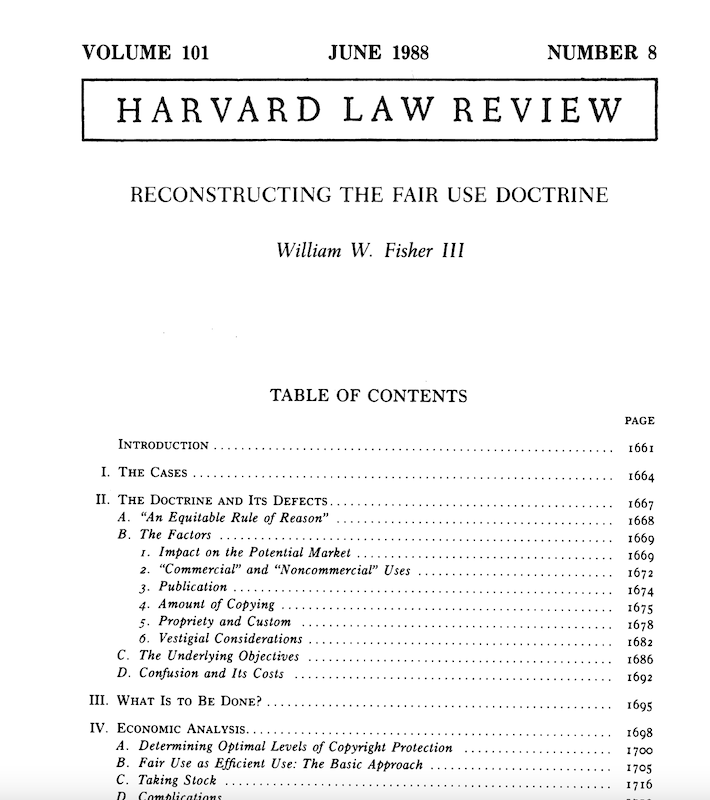



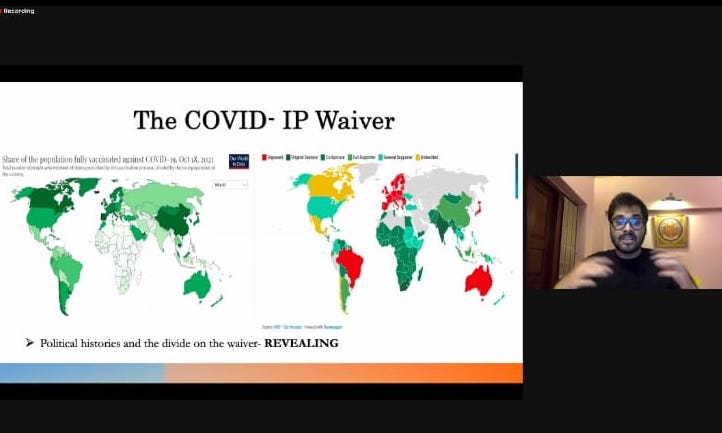

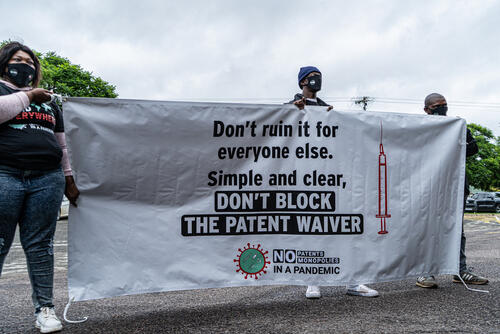


 IP Musings