
A Critique of the Dilution Doctrine in Trademark law

In Dilution Redefined for the Year 2002, the author Jerre B. Swann, Sr., defends the doctrine of Dilution in Trademark law- which protects marks with a reputation across all kinds of products i.e., irrespective of whether the infringer uses the reputed mark in the context of distinct product classes or not- by invoking marketing theories of clarity, clutter, and cognition. His main claims are, first, based on the personhood relation of a proprietor to a mark, condemning any unauthorized use as leeching, given reputation in a mark is like the face of a person- something which is inherently theirs and no one else’s. Second, by shifting focus on the consumer, he argues that distinct and reputable marks enter the consumer’s mind and make them singularly think of a particular thing- the referent that is sold. According to him, out-of-context use of the said mark by someone else who is not its first appropriator erodes the singularity associated with the mark in respect of the information sought to be conveyed. He uses this to argue that singularity retains immediate cognitive responses, and the more number of propositions that come to be related to a signifier or its concept, the lesser the possibility of an immediate cognitive response to the mark. Although the author acknowledges that initially there was criticism of this approach as it seemed to overlap with Copyright law, he shrugs it off by arguing that the ultimate goal of Dilution is to protect mental informational associations/ what he calls “sensations”, of consumers in relation to a brand and its reputation, blindsiding its property-esque characteristics, and enmeshing it with the purpose of protecting consumers from sensation-al, deception.

I criticize the arguments of the author, first, from a semiotic perspective, and second, from the perspective of purposive goals of Trademark law and inherent limits that its doctrine sets on its property-esque character- limits that are often evaporated by the Dilution or the Well-Known mark doctrine, making it incompatible with free expression. I also argue free riding to be a misconceived premise- as what the author refers to as free riding only represents a positive externality that does not cause any harm to the owner of the mark in its context.

First, the author argues that modern Trademarks “convey, among a multitude of other messages- personality, purpose, performance, preparation, properties, price, position, and panache.” The author also postulates his five-step Dilution formula, arguing that the owner of a unique and reputed marketing symbol should be entitled to prevent impairment of its communicative clarity of association by anyone else using a similar symbol. The author refers to this as singularity, arguing the signal value of a mark- word or symbol- to cognitively be linked to its singular association.

What the author misses is the emptiness of these claims when divorced from the particular product i.e., the particular context in which the mark or symbol is specifically being communicated. The singularity of association is expressly rejected not only within the legal substance of the Trademark doctrine but also in social semiotic theory developed by Ferdinand de Saussure as interpreted by Talha Syed and applied in his critique of legal formalism.

Trademark law, itself, rejects this theory of symbols having only singular meanings/associations across all products. The use of the word or symbol “apple” as an apple (as we know) does not erode the possibility of someone using Apple in the context of electronics. If I go to a grocery store and ask for an apple, the store coordinator would not give me an Apple device, and if I go to an electronic store and ask for an apple, the store coordinator would not bring me an apple to eat. Importantly, if I go to an automobile store and ask for an apple, the store owner would be very confused and would not know what to do. Allowing this to happen, Trademark law implicitly rejects this notion of singularity. Further, Trademark law’s prevention of the use of descriptive terms (i.e., symbols already associated with certain products in language) is only applicable in respect of the product it is generally supposed to describe. It does not extend to marketers of other products, lest Apple would never have been allowed to Trademark its word in the context of electronic devices. This shows how Trademark policy, implicitly, dismisses any notion of singularity in the context of a word or its use as a mark.

In any case, when divorced from the context of use, words have no fixed meanings. The context in fact constitutes or generates the associated meaning. Words are merely labels for concepts that have a relational purpose in a particular context. Talha Syed, while interpreting Saussure shows this using the instance of the “Stop” sign, where he argues that neither the signifier nor the sign matters. It is the signified in a relevant context, that evokes association or helps us make sense of what is being communicated. When a “Stop” sign appears for the pedestrian, it does not mean that the pedestrian is supposed to literally stop. It signifies or communicates a concept that is understood in a particular context – the context of the pedestrian walking on a road where cars also move- the concept that- hey pedestrian! you are now advised to see around you for traffic signals and accordingly cross the road. Thus, divorced from context, words have no specific meaning that is signified and are empty labels with no communicative function. Trademark use, essentially, involves similar functional use- i.e., communicating to the user- the particular source of a particular product that is present around other similar products. It thus generates continuous conceptual association of sources in the minds of the consumer in respect of those products, or a family of similar products. There is no presumptuous communicative association that automatically arises across multiple kinds of products. The same word/symbol could signify a different concept forged in a different context – i.e., in relation to a completely different product. This is exactly the reason why cross-class, or cross-product usage of similar marks is allowed in Trademark law around the world.

The context in which communicative association is curated outdoes this logic of singularity and lays the Dilution doctrine at odds with the other features of Trademark law. Trademark law provides rights to exclude to those who coin distinctive associational signifiers to communicate to the consumer that it is their product, however, while doing this- these signifiers automatically become a part of the discursive sphere- vulnerable to be forged in an alternate context. Trademark law allows these exclusions if uses are in the same communicative context – that is in the context of the same product, or similar kinds of products (what is often referred to as the same class of products through the NICE classification system). However, as shown above, if used in a different context, distinct meanings of the same words could be forged to communicate or signify a distinct concept or association. The Dilution doctrine however changes this and extends protection to cross-class/cross-product usage if the mark is reputed, denuding the ability to communicate or forge a separate association using a word/symbol/mark. A criticism of this approach comes back to the apple example- which shows how human minds gradually associate a separate message with a word/symbol in a distinct context. When Apple would have started using the word in the context of electronics, such an association might have initially been awkward. However, the alternate semiotic message to be conveyed gets gradually fixated in a distinct context through constant continuous use. No one who goes to an Apple store or a grocery store, anymore, misassociates these two products which are linguistically communicated using the same word/symbol/signifier. Dilution doctrine erodes this gradual possibility of a word having multiple communicative associations, and misrepresents it by creating the delusion of singularity – something at odds with free speech and communication. Why? Exactly for the reason that provoked skepticism when the Dilution doctrine was first adopted- extending copyright-like rights to exclude over words/symbols/signifiers, to appropriate revenues from every channel that would expose coined terms to the public. And why Trademark law? One of the reasons is the perpetual nature of Trademark excludability.

Trademark law does not aim to incentivize/enable the production of new words. Copyright law, which focuses on the enablement of creative expressions, does not extend rights to exclude to words by themselves considering them building blocks of expression. How do we then justify the argument of the author where he says- for Dilution a symbol need not just be distinctive in respect of the product, but also vis-à-vis other marks? This theory- endorsing competitive edge for coining distinctive symbols- would only seem justifiable if the social interest that the law sought to protect was the enablement of the production of distinctive marks or words. On the contrary, the only reason why the law seems to provide rights to exclude to owners of distinctive marks is to ensure consumers have constant associations of words with certain products in the context of their use. Extending them to all kinds of possible products, in respect of which the mark is not even being used, would be to curb the use of language, and exclude the use of words or signifiers from representing or communicating alternate ideas in alternate contexts- something which Copyright law expressly promotes by rejecting rights to exclude over words. Isn’t Dilution in Trademark law, and Copyright law thus, in fact, at odds, as against merely overlapping?

In any case, treating Trademark excludability as property rights over coined words would extend the kind of protection which Article I Cl. 8 of the US Constitution envisions. However, the perpetuity of Trademark excludability runs at odds with the limiting clause of Art. I Cl. 8. Even if Trademark law is considered a part of this clause (although the same is expressly rejected in The Trademark Cases), limiting the excludability of the coined word to use in the context of the product it represents is this inherent limit– to ensure it does not impede communicative interests associated with signifiers. Similarly, genericide is an inherent limit on the time of protection to a mark, as the interest sought to be protected is consumer confusion/deception (and not enablement or creation of new words). The Abercrombie spectrum further represents this- a mark that is distinctive gets stronger and thus longer protection, in the sense, it’s stronger only because the possibility of its generic association is least, to begin with until it travels and becomes integrated within general linguistic use out of the context in which it was protected. However, once a mark attains a substantial reputation for Dilution to kick in (i) it is already substantially integrated within the language for expressive concerns to begin, and (ii) a consumer being confused by someone using it – is less significant a consequence for the proprietor as against a consumer being voluntarily diverted.

This brings me to the last leg of the critique- free riding, which focuses on diversion by use of the mark, as against confusion. A justification for protection against free-riding is that it creates a negative externality for the Trademark owner by derailing a potential source of income or the possibility of an expanded market. However, a mere possibility of expansion of the market or a potential association of a reputed mark, without creating any confusion, cannot, in my opinion, be a legitimate interest when competed with the interest of using reputed and popular words/symbols that have communicative or semiotic functions. The same is not a viable interest (especially in the case of a reputed mark that already has a significant source of income) to erode semiotic functions of the integrated word/symbol and limit it to a unitary meaning in all contexts. From Hugo Grotius (an early natural law theorist) to Mark Lemley (a recent law and economics theorist), all acknowledge that an interest to use things that are otherwise excluded, without demeaning any legitimate interest of the excluder, is a positive externality and is socially permissible. Thus, in my opinion, the use of Louis Vuitton to sell groceries, although awkward in the beginning, would in no way harm the bag seller in the current time (they may argue that the potential to expand is hurt, but Trademark law should only concern with actual use, not probable use) and would promote a legitimate speech interest of generating alternate associations and forging alternate meanings.

Taking this argument further to the “Rolex” example in Trademarks Unplugged by Alex Kozinski, any seller of the premium watch- Rolex would not be legitimately hurt by a so-called counterfeiter selling cheap watches with the label Rolex on the street, as neither would a consumer of the fake be a potential market of the initial owner nor would there be any associational loss (as no reasonable Rolex customer would be confused or would associate it with the rich person’s Rolex).

The only loss to the proprietor of the reputed mark here is what I refer to as the possible propertarian moral loss. To elaborate, the only interests of the proprietor that are hurt are- (i) third-party associational interests (but that is not a consumer), and (ii) most importantly in the panache of the mark’s associated product, generated by keeping supply low and prices high. However, whether this is a legitimate interest, is debatable. In my opinion, an interest that enhances societal hierarchies inconsiderate of distributive capabilities is not a legitimate interest when competing with the communicative interest of using the word Rolex in a way that does not confuse or deceive consumers (not third parties) about the origin of the associated product sold under that label. An assumption that it is a natural right to protect this interest in maintaining panache through its property-esque formulation is ignorant of the limits that it faces considering competing communicative and socially re-equalizing effects of alternate concurrent use of the expression.
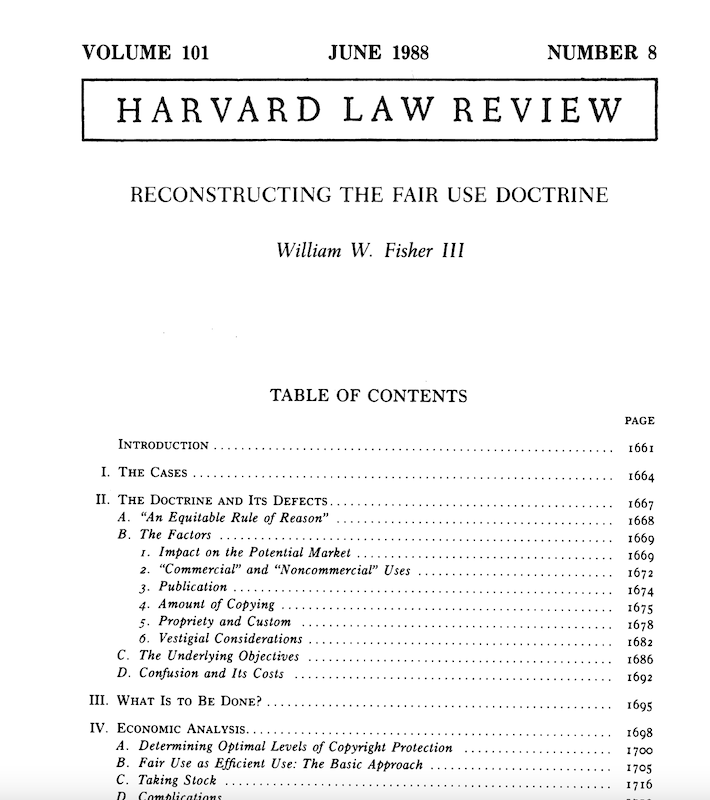

RE-CONSTRUCTING FAIR USE- WILLIAM FISHER (SUMMARY AND TAKEAWAY)

I am choosing to summarize and analyze one of the (in my opinion) most important pieces of Copyright theory and policy (some very prominent Professors here at Berkeley refer it to as their bible on anything copyright). I am putting this here for everyone to be able to contextualize the role of Fair use as a policy matter while thinking of copyright’s role, its trade-offs, and how to think about progress/ values and its role in it. Here is the full piece (highlighted): Link

Prof. Fisher, to begin with, recounts that fair use as an affirmative defense, distinct from an inquiry of infringement began in the mid-twentieth century, and was subsequently adopted in Section 107 of the Act of 1976. He recounts the logic given by Justice O’Conner of Market Impairment in Sony Betamax and argues that every case where the fair use defense is invoked will involve market harm, and so it is relevant to estimate the “magnitude” of market impairment by privileging certain uses, not the mere “existence” of market impairment. 

On Necessity, Prof. Fisher points out to be wary of the dangers inherent in its ambiguity. Sony and Harper v. Row discounted the necessity factor- however, J. O Conner in his analysis did say that copying essential to communicate facts may be privileged. 

Prof. Fisher points out J. O Conner’s discussion where he says the rights conferred by copyright are designed to assure contributors to the store of knowledge a fair return for their labor. Prof. Fisher criticizes this as showing an objective that is fundamentally different from social utility. He says that the notion J. O Conner embodies is that authors and inventors deserve a reward for labor irrespective of whether they would continue to work in the absence of this compensation. He criticizes this as being ambiguous- in terms of what exactly is a “fair” return for creative labor- how to balance it with the dissemination of output concerns, etc.  He argues fair use, in its (then) current practice to be aiming at “balancing” inconsistent claims derived from conventional, incommensurable premises- something which perpetuates difficulty, as against concreteness in analysis. 

He then goes on to choose premises- firstly relying on economic premises- he argues- that the objective of copyright law in general and the fair use doctrine, in particular, should be the efficient allocation of resources. Secondly, he argues, what he calls more of a utopian vision relying on cultural premises- stating that “copyright law has a significant effect on the shape of our culture and that a vision of the sort of culture we would like is a prerequisite to wise administration of the law.”

Coming to the doctrine, he says that if the package of entitlements created by the provisions of the copyright act other than 107 enabled creators of intellectual work to collect monopoly profits in greater than optimal amounts, a judge could use fair use to chip away at that package until reaching the most efficient combination. He argues that economic analysis helps us realize this, in spite of its important critiques of fostering complete market dependence.  He argues that the point of inducement through monetary incentives is to have more and better works, but efficiency gains from this inducement are only realized upon increased consumer satisfaction that results when readers have access to these more and better works. 

Prof. Fisher states that an efficient way of using the incentive access paradigm towards efficient allocation of resources through the fair use doctrine – is to analyze whether the production of “work” requires- or is affected by incentives or not. He firstly talks about special circumstances where the provision of incentives through the law has no role to play in the inducement of further production, given optimal earnings even without such legal protection is available. Here he says every use should be fair. On the other hand, he talks about works where even a single putatively infringing use would incur economic costs that exceed gains due to sensitivity to fluctuation in anticipated incomes and behavioral elasticity in respect thereof. In such a situation due to the inefficiency involved, it should be ruled unfair. Moving on from these special circumstances, he argues that In more complex situations, differentiating types of works for applying fair use creates some efficiency and some inefficiency as well. He says that copyright covers a variety of works from books to films, to factual works to fictional works, to computer software- the incentive interests/requirements on which are different. He thus argues that creating some difference in the nature of work in relation to their purported incentive requirement does make sense, but too many differences may lead to distortion where artists will assume the worth of their works legally and pursue or distort from pursuing a particular form in favor of the other. His solution is the following:

“To make an efficient choice, the judge should estimate three figures. First, he should determine how much of an efficiency gain, caused by differentiating the monetary incentives for creating different types of intellectual products, would result from moving from each level of specificity to the next. For any of a variety of reasons, the optimal combination of entitlements for musicals may be different from the optimal combination for other sorts of plays. Lumping them together would therefore result in a less-than-ideal system of incentives for playwrights of all sorts. The judge should ascertain how much less than ideal. Second, the judge should determine how much of an efficiency loss, caused by reducing playwrights’ ability to predict their incomes, would result from each subdivision. Suppose, for example, that differentiating musicals from other plays resulted in sharply different combinations of entitlements and income levels for writers of the two sorts of works, but left a substantial number of potential playwrights uncertain as to whether the plays they contemplated writing would ultimately be classified as musicals or non-musicals. The effect would be to sacrifice much of the efficiency gain described above by reducing the willingness of risk-averse playwrights to write works whose status was unclear. Third and finally, the judge should calculate how each additional differentiation would affect the number of cases in which the parties disputed the classification of the copyrighted work in question, and what the litigation costs generated by those controversies would be.”

Another theory that could relate to the nature of work factor, that Prof. Fisher furthers is that, when an art form is in its infancy, or just starting to grow in circulation, adjusting the compensation system so as to increase the number of artists engaged in developing it may increase quality and variety available to consumers- if that is what the legislature values. As opportunities for synergies of this sort diminish, the scope of protection can rather be reduced. 

Prof. Fisher, in his economic analysis, continues to focus on identifying the incentive/loss ratio by examining efficiency considerations upon every use on the incentive and its consequence on the overall allocation of resources and efficiency, as a tool to understand whether a use is fair or not. 

Moving on to his utopian vision, he uses J.S. Mill to argue that self-determination and the development of mental and moral faculties for a rich, diversified, and animating culture is the most important goal of copyright policy. He argues that cultural innovativeness- the key to diversity- would not just be tolerated by the government but rather nourished and rewarded. This is what he invokes to be his theory of protection of transformative works as fair uses. 

He argues that defining the optimality of incentives when calculating the incentive/loss ratio needs to accept the following analysis: The creators of art should be afforded better than average incomes (or greater freedom from drudgery) whenever, but ONLY whenever, such a policy would increase their output enough to yield a net improvement in the lives of non-artists. He argues fair use as limitations on the freedoms of some to advance the interests of others from the view of helping shape tastes and capacities that enable the formation of autonomous and socially determined preferences in lieu of a good life. 

His main argument for reformulating fair use is the following.:

Maximization of allocative efficiency can be achieved by arranging the set of activities putatively reserved to copyright owners by section io6 in order of their incentive/loss ratios, identifying the point in the series at which the benefits secured by holding out monetary incentives to talented persons exceed by the maximum amount the attendant monopoly losses, and declaring all uses above that point fair and all uses below it unfair.”

Coming to the factors: he argues that the transformative factor is important as it creates more opportunities for Americans to be actively involved in shaping their culture and socially shaping identities- thus enhancing abilities beyond the ability if all were mere passive consumers. 

Then he goes on to advocate for the value of the use- citing education as an example- and so he argues that acidities that facilitate education by enhancing access to information and argument on matters of public importance, or facilitate dissemination of education – they should be fair uses due to the value component involved- however, the degree of preferential treatment, according to fisher depends on how important (NECESSITY) to education is the use of that activity. 

Another value determinant he cites is cultural diversity- any usage that facilitates cultural diversity and faculties of choice and self-determination. He thus argues to deem fair – uses- that have the potential for more derivative works – given their impact on cultural diversity. (AK comment: I think he is conceptualizing derivative works in a broad way to include transformations in content, otherwise I don’t know how this would make sense given the meaning and message remains the same irrespective of the potential to have more derivative works). 

The next factor for him is Protecting the Creative Process: where he argues to disfavor things that undercut the artistic process- and provide artists and consumers maximum opportunities for engaging in the creative process. He uses this to analyze the “published” – “unpublished” dichotomy and argues for use of unpublished works to be unfair- given for him they hamper the confidence of the artist in his/her/their creative process. He says rather than deterring all unpublished works from being used, a more precise standard would be “disfavored unauthorized uses of materials the creators of which were still considering revising”. 

He also favors uses that equalize public access as ones that ought to be deemed to be fair. 

In conclusion of his utopian analysis he identifies that consistent application of the utopian analysis would require expansion of fair use to the point where creators would be left only with income to live on, or a just conception which would require that the expansion of fair use be only halted when further movement would leave creators substantially below the national average of income- given the law perpetuates this enablement. 

He finally argues that:

for the time being, it seems wisest to limit judges’ involvement in the compensation of artists to (i) the avoidance of superfluous income; (ii) the promotion of cultural diversity by favoring types of art for which popular demand currently is low; and (iii) providing artists (to the extent practicable) minimal levels of income.”

PROPOSAL:

Recognizing that his utopian vision is not going to tangibly turn in policy any time soon, he proposes a modest solution using factorial reform for better fair use to ensure a better deal than the one existing then: 

  1. Whether the creator considered the work finished.
  2. Definition of injury of harm.
    • Ascertain the “type of copyrighted use at issue” to ascertain incentives actually required in the said type, in terms of the incentive/loss ratio. This, however, should be carefully done narrowly as is consistent with preservation of the ability of authors to identify which camp they fall in. 
    • Conduct of the sort engaged by the defendant- commercial or not (although not a separate analysis but only a component of defining the harm caused to the creator if at all)
  3. Decide whether the harm above is substantial (reduce the quantity or quality of output by affecting incentives) or insubstantial. 
  4. If the above three tests fail to resolve the controversy- or there isn’t enough information to draw a conclusion out of the above three tests- be proposes the following factors to step into:
    • The magnitude of injury (the more serious harm to producers- the less willing the judge should be to deem it fair)
    • Creativity (the more the activity or use is creative, and transformative, the more the judge should deem it fair as they increase diversity)
    • Education (Fisher points out this is to be of relatively higher importance): use increases access to info or arguments (perspectives) on issues of public importance or facilitates efforts to make available to students resources to learn- the more the bend towards fair use. 
    • Price discrimination (the more use undermines the ability of the holder to engage in price discrimination, the weaker case of fair use- given price discrimination is good policy as it increases rewards and increases access. (Differential pricing strategies- which have lately been criticized due to administrative difficulties and parallel importation logics)

A PRELIMINARY THEORY OF FAIR USE THAT I AM BEGINNING TO CONCEPTUALISE:

The legislature values certain things (not in the commodity sense) that it seeks to ‘enable’ (a proxy for incentivizing, given it doesn’t really incentivize in my opinion- it ensures they are not de-incentivized)  so that people who produce these valuable outputs are not disincentivized from producing and shift to marginal sources of revenue, because well they aren’t able to survive and make enough money by doing these pursuits. The corollary of not enabling them would be such performances (a proxy for “creations” because I personally do not believe anyone can ever find out who created an expression) not existing in society, and these performances are valuable. So the legislature using the tool of the Copyright Act enables them by giving them a limited property-Esque right/ market power over their creations so that they can extract value out of it (social and economic). However, the legislature does recognize the constraints of giving such market power access to these valuable outputs- the very reason why they want these creativities to exist- the very reason they value it is so that people can experience it. 

So, to ensure that they protect interests that they value over/more than the enablement of creators- they create exemptions and limitations (and not exceptions) to this statute that provides enablement. Values like research, education, cultural diversity, etc are more important for the legislature than enabling the creation of works- and this “hierarchy of values needs to be understood”. Fair use is representative of this hierarchy of values. Fair use is not a defense in that understanding- it is in fact a tool to show which value is deemed to be more important and what sacrifices does enablement of creation has to go through to actually and tangibly support the achievement of the ultimate policy goal and value it seeks to instrumentally achieve – i.e., the existence of more and diverse works for people to understand, internalize and be exposed to. Fair use stems from this hierarchy of values that in a democracy the legislature prioritizes.

_______________________________________________

Alpana Roy on De-Colonizing Copyright and Cultural Policy

In this set of 4 posts- I shall be discussing my dilemmas from the Kacha Badam Controversy. The first post covered my thoughts on the delusion that this whole controversy has produced and the need to revamp its factual narrative. The second post covered my thoughts on the hard case that this factual narrative exposes- something I cannot really grapple with yet. The third post brainstormed thoughts on resolving this hard case. Finally, this fourth post will, in the backdrop of these three posts, discuss an amazing paper by Prof. Alpana Roy titled- “Copyright: a colonial doctrine in a post-colonial age” and how her thesis has an important role to play in figuring out/ or rather even further complicating this hard case.

PART-4

In this final post, I am discussing, Prof. Alpana Roy’s paper titled Copyright: A colonial doctrine in a post-colonial age, in the backdrop of the discussions we have had so far. I also had an opportunity of discussing this article in the Critical Interdisciplinary Perspectives to IP reading group hosted by Prof. Anjali Vats, Prof. David Jefferson, among others- which led to a lot of thoughts pushback, and questions. I shall try and put them out here This is also my expression of gratitude to all who turned up for the reading group.

Prof. Alpana Roy’s article, published in the Copyright Reporter in 26th Volume 4th Issue, in December 2008, discusses IP from a sharp post-colonial lens. It is a provocative piece of writing, to say the least.

Setting the stage, Roy clears the air on what colonialism implies and what constitutes de-colonial thinking. She clearly puts it forth that the socio-economic exploitation of the so called “periphery” or alternate, need not always be directly political or dominated by the military. It can also involve continued subordination through the exploitation of the political economy to adversely affect capabilities. She mentions the prevalence of colonial thought in law-making and how it pervades global norms, in sheer ignorance of alternate indigenous realities. This narrative somehow resembles the work of the amazing late Prof. Keith Aoki, on what he calls Neo-Colonialism, and in the context of IP states that- transnational IP system erode concepts of sovereignty and self-determination.

Putting the article in context, Roy turns to International IP Agreements and reflects on the role of these “multifaceted projects” or dominant narratives which primarily reflect/mirror particular moments in the history of Western cultural practice. She emphasizes the importance of this by projecting the dissonance of the norms in agreements like Berne, with nations outside the West. She asserts that Copyright remains a foreign concept in many cultures, and many societies take an extremely radical view on what constitutes property and can be the subject of individualistic private property. In this context, it is important to reflect on the “independent” v. “inter-dependent and inherently social conceptions of the self (the idea of a “family”)” which vary across societies – with the West bending towards the former and Asian societies towards the latter. The law, as it is in its current “global” framings, only accommodates the former, completely ignoring the latter.

She then goes on to talk about a few of these individual dissonant features: (i) print culture (ii) the idea of piracy as against copying and sharing as a sign of respect and recognition- and mentions how such norms being globalized are nothing but a symbol of a dominant narrative used to foster a “one-way traffic around the notion of desirable culture”- consequently moving towards cultural imperialism. It is at this point where she makes her most important argument about this whole system having a far deeper impact than the earlier forms of colonialism, imperialism, or simple tourism, as it tends/attempts to alter the source of the self.

Hereon, she gets into the hard case by discussing the example of “Return to innocence”, supposedly a Taiwanese tribal song, which was appropriated out of a performance by 30 indigenous Taiwanese performers who were invited to perform across Europe by the French Ministry of Culture. A significant portion of these songs was used by a German music entrepreneur and was then also recorded by Enigma- and sold as “his copyright”, without any due accreditation or financial compensation for the use of the said song. She primarily uses this example to first- expose the political economy of cultural practice, and thereafter and most importantly, the political economy of law on culture- and who gets to enforce and who doesn’t. This is important in the context of the debate on print vs. aural culture, as well as in the context of the argument that accesses to a platform to showcase determines who gets to ‘own’. What I am concerned about, in this example, is not the appropriation, but rather the possessive claim of Enigma over this output- dispossessing many others who could have been the actual originators of the expression and should have had the ability to use, build on, or get any financial remuneration in respect thereof. It is in this context that the appropriation is important to be addressed.

Roy uses the “Return of innocence” case to contend how indigenous works fail to fulfill individualistic notions of property rights and are dispossessed from their performers through dissonant norms. She uses this to show how western law, and its hegemonic transposition is highly inappropriate, results in fictitious commodification, and continues to perpetuate the idea of the historic “other” even in law and policymaking. She aligns with Rosemary Coombe who argues that neoliberal conceptions of copyright do not accommodate cultural differences that are difficult to be formulated in terms of a commodity, and are hence difficult to encompass within the conceptual frameworks of “modernity”.

Roy also refers to oral research outputs and argues that as soon as someone publishes all the oral research output they get copyright over it- dispossessing participants and researchers who contributed and undertook research orally but did not/could not really “fix the output in the printed/published form”. On this aspect of fixation, during the discussion with the reading group, Prof. Ann Bartow put forth an interesting question as to- how do rules of evidence work in aural societies? – Historically mapping the same could be an interesting analogy to look at while discussing the irrelevance of fixation norms in non-western societies.

Roy then moves on to how these western cultural norms were exported to colonies by European colonizers as a part of the package of colonization, most prominently in the 18th and the 19th Century. She states that pirating foreign work was still prevalent in free-er countries given the US only joined the Berne until 1989 and offered little protection. To foreign authors until then. Unfortunately, those who were colonized had little say in such policy for their own capability development (I discuss this aspect of IP Gradualism in detail in my paper here).

Roy then moves to the strongest part of her paper where she argues the relevance of printing technology and entrepreneurs in respect thereof in centralizing and transplanting these western norms abroad.  She talks about how printing was essential for the colonial and imperial projects of Europe as their empires could not have survived without the spread of propaganda, religious tacit, commercial documents, maps, charts, etc., among the natives. Here comes the relevance of copyright. She argues that as a form of communication- printing, unlike oral communication, has a tendency of universalizing ideas- and disseminating information through identical texts and making them truths by imposing them through “violent hierarchies” facilitated by the tool of colonialism and the Prospero complex it produces. She talks about how most of the so-called “universal truths” coincided with this enlightenment period of solitary creation and printing technology – that is basically the rise of print medium and subsequently the law of copyright. Importantly she reiterates that this exchange was not happening among “equals” but rather as an imposition in a colonial setup.

Upon political decolonization, Roy writes that there were some modest attempts at resisting western copyright by the Global South, in the context of the inability to translate and develop knowledge, however not to any structural yield. Thes prevailing norms have not only been normalized but have, through TRIPS, also been universally accepted (read: imposed), and are now a part of public international law.

Moving on to a consequential analysis of these norms, embedded with capitalism and the global political economy, Roy quotes Butalia, to argue that it is impossible to separate the world of Copyright law from the world of politics, as knowledge, culture, and access are inextricably linked with power, power is linked with money- and both of those are linked with history– something which cannot be repaired easily. In my opinion- this brings us back to the hard case and the relevance of reparative solutions to be intermingled with systemic change and to look at the same as complementary rather than as an either/or binary.

Roy finally concludes by referring to how copyright is nothing but a tool to merely further the trade and capitalist interests of western societies. However, a consequential corollary of this, which Roy misses in her analysis, is the impact of such a tool on identities and cultural estrangement- the “othering” of non-marketable culture. We might be celebrating Bhuban and his expression today, but that is only because he and many others like him, who do not fit in to this marketable system have been othered from cultural identity framing discourses and economic benefits in respect thereof, for a long, long time. As Macneil argues, we cannot subordinate the subsistence of society itself to the laws of the market, and the interest of the marketers, as it disenfranchises humans of the ability to direct the trajectories of their social institutions. We cannot, as a society afford to do this, as the same is nothing estranging identities.

To conclude these posts, the takeaway I seek to present is-  the need for scholarship, research and thought on –

How to ensure that identity interests of self-determination (including remunerative concerns), especially of those who have been denied the same for long, are retained-  without resorting to dissonant logics of property rights as tools of affirmative action?

Hope we have enough food for thought! Do reach out if anyone wishes to discuss any of this. I am available at 97akshatag@gmail.com


Part 1- here

Part 2- here

Part 3- here

Resolving the ‘Hard Case’? You can try the best you can!

In this set of 4 posts- I shall be discussing my dilemmas from the Kacha Badam Controversy. The first post covered my thoughts on the delusion that this whole controversy has produced and the need to revamp its factual narrative. The second post covered my thoughts on the hard case that this factual narrative exposes- something I cannot really grapple with yet. This third post brainstorms thoughts on resolving this ‘hard case’. And finally, the fourth post will, in the backdrop of these three posts, discuss an amazing paper by Prof. Alpana Roy titled- “Copyright: a colonial doctrine in a post-colonial age” and how her thesis has an important role to play in figuring out/ or rather even further complicating this hard case.

PART-3

In this post, I shall discuss thoughts on the hard case, and why it is really hard. I will also discuss my preliminary ideas on resolving its dilemmas. To put things into perspective-

Should we be celebrating Bhuban’s remunerative win (which supposedly is because of Copyright law) or should we be questioning the structural acceptance of a copyright system that is significantly dissonant from the ontological reality of cultural practice in India – a system that has merely been transposed from the west due to the state of law and the global political economy?


The hard case is really hard as one of the major issues that come with a structural challenge to the system- is its ignorance of the years of inequality and identity politics associated with cultural production. We can never crawl back to ground zero. The structure of copyright law, its commodifiability, and dissonance with alternate cultural practices has already produced a skew in visibility- which cannot be discounted. A structural challenge to the system would result in an unequal commons- resolving none of our equality concerns.

In other words, although by allowing sharing, derivation, and remixing to make it compliant with other ethnographic realities, a structural challenge to copyright’s individualistic norms, does help substitute individualistic possessiveness, however, it does little to narrow the privilege gap resulting from the prevailing system. Structurally challenging copyright norms may allow for wider cultural engagement- but they do little in remedying the lack of engagement or the skew in practice that is already persisting. Anyone who has, as a result of the prevailing system, attained a comparative advantage, continues to enjoy the same – given investment capabilities and the political economy of cultural practice. In line with this, how do we ensure that Bhuban gets his due remuneration to survive?

Proponents who believe in revamping the copyright system internally and allowing economic recognition of artists like Bhuban through prevailing norms- as a more practical solution, maybe right to the extent that it allows for these individuals to get recognition and helps balance out the inequalities to some extent.  These proponents also believe that property-like rights are the only retributive solution to the issues created by property-like exclusivities themselves. Madhavi Sundar and Anupam Chander convincingly argue, in their paper- The Romance of the Public Domain, that leaving these ignored cultural expressions in the public domain does not help satisfy societal ideals and rather perpetuates inequality by allowing those with the capability to misappropriate (not dispossess, but rather get a better benefit due to access privileges) to freely do it. It denies them a claim to self-determination. They, thus, argue for a property rights-based liability system (no control but an objectively defined fee on every use) to continue in favor of those who have been denied long-standing claims- to be able to re-project a scenario where we start from ground zero. For them, Bhuban getting this remunerative benefit would be a deal worth it from an overall welfarist perspective.

For me, this is something I continue to be unclear about, because fundamentally – using a property-rights-oriented solution to solve problems that are a result of the long-standing prominence of the same system- is paradoxical. As Amy Kapczynski argues, “why should we view a collective despot as an improvement over an individual despot?”

 I do agree that Prof. Sundar and Chander only endorse a liability model– where contours of exclusive possession and control do not strictly apply, and rather a fee is to be paid for every use However, even this, as a tool of affirmative action, does reify- principally the same tool of exclusivity. It also ignores how the idea of “originality” of a “work”– the genesis of a “mine” claim in the first place- is a myth- and a result of privileges of access (to showcase). This is applicable to both the claims of individuals and communities. One can never really prove that an expression is theirs and only theirs- and not a result/derivation of someone else’s. Once again- possession results in dispossession (often of the unknown).

Further, a liability rule, in my opinion, does not really address the main issue here- i.e., one of misappropriation of identities. Commodification has most definitely denied many non-commodifiable forms a claim to money- but most importantly it has estranged identities. The liability rules do not really help resolve that aspect.

Rosemary Coombe provides another interesting angle to this hard case in her paper- Ethnographic Explorations of Intellectual property– more so from an anthropological perspective. She maps arguments of the latter school of thought which say that even collective ownership dispossesses and reifies western liberal thoughts in culture impeding cultural engagement and ignoring ethnographic realities. She says that the whole idea of ownership in the binary of the individual and collective ought to be challenged from a hybridized perspective- and needs to be looked at by examining the actual reality of how culture is practiced, rather than requiring to mold cultural practices to fit in. She endorses the need for the decolonization of identities, as well as legal norms, by suggesting a more personhood-oriented solution to the aspect of reparations, as against one guarded within economical concerns- as was the case with the liability system. She argues for a system of benefit sharing to recognize the “cultural rights ” of people practicing alternate cultures rather than centering on a solution from an economic point of view. The idea is to endorse the personhood, identities, and development of these diasporic, hidden individuals and communities. Her focus is on ensuring that these identities are not dispossessed as against cultural outputs not being dispossessed. – given we can never be sure of what was the genesis of the cultural output in reality.

For me, as brewing thoughts, a few methods of resolving this hard case without resorting to a binary could include – primarily – decommodifying culture and making expressions inalienable, especially in favor of corporates who seek to capitalize and earn profits out of the most commodifiable and marketable identities/expressions. (see part 1) This potentially could resolve a huge hierarchical concern, at an institutional level, in respect of the ability to capitalize/market and showcase culture. However, I do agree that it does little on the aspect of the performer’s individual economic standing and capability to promote or be visible.

Another area that could be considered, as a part of future inquiry, could be getting rid of the idea of authorship of a work, and treating all expressions as performances- given we can never really figure out whether one is the “originator” of the content, but we can always associate the identity of the performer- with a particular performance. This avoids impeding downstream creation, especially in communities that depend on it, as well as ensures that if the performance, as a whole, is utilized as against merely the content within the performance (musical and literary “work” in current copyright framings), there is some remunerative benefit accruing to the previous performer for the associated identity thereto. So essentially, Bhuban cannot claim exclusivity over Kacha Badam, but if someone uses his performance of Kacha Badam substantially (Ann Bartow standard), he would have a remunerative claim (see here for a study on compensation systems) for the use of the cultural identity associated with his expression. This identity cannot be alienated from him in favor of any corporate entity. 

Coupled with this, maybe limiting this remunerative claim to only those performers who are a part of the “traditional knowledge”/ alternate culture herd- i.e., ones that have been denied a claim to be able to be visible for long, could serve the reparative goal sought by the primary school of thought. However, I have my doubts about the practicality and the acceptance of this, especially in light of the strong globally intuitive resistance to affirmative action policies in support of concerns of reparative equality, sometimes co-related to substantive equality.

Finally, another interesting area to build scholarly agendas on the side of equality in cultural policy and tools of affirmative action in respect thereof could be algorithmic support on the internet. By using tools of an affirmative bias in favor of performances/identities which have effectively been rendered invisible for the longest, a slow transformation could potentially take shape. Such cooperative responsibility from tech platforms could effectively help significantly revamp identity politics, and allow them to capitalize on scale benefits that come with it. As has been argued by Monson et al, it most definitely is technically possible to code algorithms that promote exposure to diverse content and highlight alternate perspectives- something which favorably happened in Bhuban’s case.

I do however acknowledge that these proposed solutions do not really resolve much, given hierarchies exist even within alternate contested identities. They do not have any sort of an enormous potential to resolve long-standing hierarchies which exist both due to copyright and beyond copyright concerns. But the intent of these posts is to have people engage in alternate cultural policy framings, without giving in to the binary of the internalist and structural critiques of the law in the context of this hard case. There is a need for social justice scholars to stop romanticizing either side of this hard case. In any case, we cannot afford to be celebrating the delusion produced by this Kacha Badam instance. 

In the next and the final post I shall, in the backdrop of this discussion, write my thoughts on Prof. Alpana Roy’s paper (more on the structural critiquing side) titled- Copyright: A colonial doctrine in a post-colonial age.


Part 1- here

Part 2-here

Part 4- here

“Kacha Badam” debate presents the Indian ‘Hard Case’?

In this set of 4 posts- I shall be discussing my dilemmas from the Kacha Badam Controversy. The first post covered my thoughts on the delusion that this whole controversy has produced and the need to revamp its factual narrative. This second post covers my thoughts on the hard case that this factual narrative exposes- something I cannot really grapple with yet. The third post shall brainstorm thoughts on resolving this hard case. And finally, the fourth post will, in the backdrop of these three posts, discuss an amazing paper by Prof. Alpana Roy titled- “Copyright: a colonial doctrine in a post-colonial age” and how her thesis has an important role to play in figuring out/ or rather even further complicating this hard case.

PART – 2

To put the idea of the hard case (not in the Dworkinian sense of “principle” but rather qua policy)  in context, I would refer to how I began thinking of it. While reading the wonderful Prof. Anjali Vats’s book- The color of creatorship, I came across an interesting narrative in the context of the Blurred Lines case in the US (Williams v. Bridgeport Music Inc. (2015)). What Vats mentions is that reading the Blurred Lines case is a complex negotiation in the backdrop of a legal system that consistently disenfranchises Black creators of the ability to come across as winners. The case was a historic instance, hailed by many, where, in a copyright infringement action, a Black creator was given a favorable judgment on infringement over, as Vats mentions, “white vultures” of the music industry. This was in a situation that was debatable from the lens of the infringement standards practiced in the US (given it involved ambient sounds). Now- there were two schools of thought that emerged after this case (both belonging to the larger roof of social justice scholars– however taking completely opposite stands on this issue):

The case was significantly hailed by a school of thought as a moment of reparation for black creators, who were significantly appropriated for a larger part of music history, without any sort of monetary compensation. It was an instance helping move toward a legal remedy for more than decades of appropriation of black artists. It was also appreciated as an instance that recognized the protectability of black musical practices.

HOWEVER

A set of critics of this judgment (the other school of thought) kept their focus on a rather structural argument concerning the colonial/western nature of Copyright policy, arguing that the said instance does nothing to repair concerns of equality and in effect reifies and attempts to normalize concepts outside black culture into black culture (in-contextual transposition). Hailing the judgment also estranges the fact that the verdict is extremely harmful to appropriative cultural practices like sampling, hip hop, reggaeton, etc. (mostly practiced by black musicians, or loosely non-western musicians). It reinforces racial capitalism, and a structural racial skew in legal interpretation, against normatively black practices which focus on re-use, and derivation rather than “original creation”. According to them, internalizing could never ever remedy/repair a copyright system that is racist to the core– and there was a need to structurally challenge it rather than supporting the expansion of the doctrine.

This brings us to the hard case.  Prof. Vats, in her book, presents this hard case in an interesting manner by writing as to how this situation was a seemingly forced choice for individuals invested in social justice outcomes out of this case and IP in general. It was either (i) embracing nostalgia and reparation for Gaye or (ii) a commitment to the musical innovation of hip hop (a non-western, non-white, non-individualistic art form dissonant with traditional principles of copyright law).

It was essentially a hard case to choose between “more” copyrights supporting the interests of black artists within the system of copyright law that exists, or a structural change in copyright according to actual epistemological realities or non-white cultures.

Using this, she turned to the de-colonial notion of creatorship and protection, outside the romanticism of commodification and the racial capitalism that it produces. She argues in her last chapter: “Advocating for intellectual property egalitarianism in a way that is legally and politically legible, requires pushing back against accepted IP doctrines, which conceal racial (and colonial) logics.” It is basically a debate between- internalizing possessive individualism (and looking for a solution within) v. structural questioning, which of course may not be a binary, but could end up eroding each other’s territories. We shall get more into this in Part-4.

Against this backdrop, the motion essentially is – Does the celebration of a black artist (Plaintiff) getting a judgment in their favor on copyright infringement, reflect a vantage point in the estrangement of cultural practices, norms and tendencies, through the neo-colonial tool that is western copyright?

Coming to the Kacha Badam issue, and the relevance of this backdrop therein:

I completely subscribe to and endorse the need to ensure that Copyright policy allows Bhuban to protect/recoup his remunerative interest in this performance, given his economic state/ standing, and the surprising visibility that has only been made possible due to the virality provoked by the long tail of the internet. Even record labels nowadays take their investment decisions depending on this viral tendency and potential. Prior to the internet, there was effectively a grand denial to creators/artists from remote villages in India to a claim to participate in visible culture and to be able to exploit them economically- especially due to the need to satisfy the aesthetic preferences of record companies before getting any visibility. I also agree that given folk artists have been denied such protection for the longest time, such remunerative benefit and commodification would help Bhuban do economically better, and will also recognize the copyrightability claims of such artists (I am still unsure as to whether we can categorize Bhuban’s performance as folk, but the song’s tonality does reflect folkish tendencies). I also understand the intuitional trigger and reparational thought in favor of Bhuban due to the long denial of visibility to such artists, his economic state, and the just desserts philosophy that comes with it.

I further subscribe to the fact that – those remixing and using Bhuban’s performance, attributing it to themselves, and in some cases also claiming copyrights over them (exclusivity over exploitation) to market using social media platforms/reels and other mediums, ought to pay license charges to Bhuban and attribute him- given the realistic state of the capitalistic society we live in. The possibility of remixers (who enjoy a better capability to capitalize or better access to visibility) using copyright to claim monopolies on their derived output- and earn money without paying any license fee to Bhuban, can never be discounted. The possibility of them misappropriating something linked to Bhuban’s identity can also never be discounted.

These are some extremely important real-world issues and do effectively endorse this thought of addressing the remunerative and reparative interests of Bhuban and such artists using Copyright law and its possessive individualism– as due compensation for the years of denial of economic compensation over such output and a lack of equal visibility.

But…..here comes the hard case.

A non-internalist/structural critique of this whole controversy would be-

Isn’t the compensating mechanism, mentioned above, normalizing a legal system of exclusivity and possessive individualism -over cultural expressions? Isn’t this a purely western normative ideal, against the norm of sharing – practiced widely in Indian folk cultures, forms of music, musical tendencies, and practices? How does it reflect as a consequence on the idea of imitative musical learning as a mode of pedagogy- which is extremely prevalent in indigenous and alternate musical practices? How does it also reflect on the romanticism of individualistic IP policy and its transposition on dissonant communitarian cultural practices/societies?

In India, indigenous cultural expressions have never really aligned with property-based exclusivities. In fact, to the contrary, there has been explicit resistance to recognizing this possessive individualism (see here, here, here,  here (accompanying note 16) and here), by practicing norms of anonymity while disseminating content, practicing imitation based learning as a core form of pedagogy (here, here, here and here) and by rather focussing on communitarian practice and performance of cultural expressions (here, here and here). For a general critique of the idea of possessive individualism – in the context of Indian culture and identity- see here (Chapter 8). Jaszi and Woodmansee have also, in detail, discussed the dissonance of individualistic norms of authorship and various cultures (which they refer to as “traditional” cultures, although I prefer- alternate cultures).  

The problem with internalizing copyright norms, which are premised on exclusive possession, is that it often relegates ontologically non-commodifiable/ non-individualistic/ community outputs and expressions, to the verge of cultural estrangement and diminishing. Expressions like folktales, ballads, chants, proses, alternate musical practices, religious musical expressions, Indian Classical and Carnatic music, etc., which involve aural transmission or are derivative and collective/communitarian creations do not fall within this commodifiable idea of a creation that is copyrighted and economically transacted in a market setup. This often results in cultural freezing. I, not for once, propose to say that the law should rather commodify such communitarian perspectives as well (as it has been doing in the case of traditional knowledge lately). I rather contend that this normative dissonance ought to be realized in the law and should be remedied by tailoring the law to foster these cultural practices rather than impede them by commodifying and altering their ontological nature in the first place. Transcribing western copyright norms, and in fact romanticizing them (its expansion and role) in cases of completely dissonant expressions, as in the case of Bhuban’s work, ignores the incompatibility of cultural expressions with core principles of western copyright norms- (i) fixation, (ii) individuated authorship, (iii) romanticism of originality and non-derivation (iv) exclusive possession, (v) author performer divide.  It also results in cultural alteration- merely for commercial advantage. In my opinion, such transposition of non-compliant norms takes the shape of a neo-colonial tool that does nothing but reflect the political economy of framing the law (in favor of western commercial interests by the neo-liberal tendencies of the western society). It also affects the political economy of culture and cultural practices. It shows a skew towards market fundamentalism, even in cases of cultures- which were never really supposed to be/ fit to be marketed in an industrial setup. We have to realize this and structurally challenge this.

Bhuban’s musical tone reflects a clear folk tonality, wherein it isn’t easy to assume originality, lest it shall devoid a majority of the members of a community, and dispossess them a claim to something that is normative to the community practice. Every possession results in dispossession. Even assuming the said musical work to be original, the social process of creation and the privilege of being able to access an audience can never be discounted. Romanticizing and transposing individualistic norms of this sort- denies many (who lack such access to showcase, get showcased, and receive) a participative claim to cultural exchange. Moreover, western copyright norms often seek justification on the idea of incentives- i.e., the assumption that unless such rights are granted- one might not be incentivized to create. Well, for starters, Bhuban had no idea he had these copyrights when he performed. The generalization of such a utilitarian conception, in cultural policy, dismisses the fact that for many – music is merely a source of communication and expression and not something which requires any incentive to be produced (some interesting scholarship on this facet here, here, here, here and here) However, this, of course, does not discount the fact that for many, who seek to practice music professionally and are not able to due to economic concerns forcing them to marginal sources of revenue (avenues which guarantee better economic condition), such incentives matter. What I seek to challenge is the generalization of these incentives as being the norm.

So, coming back,  how do we resolve this hard case? To be honest, I don’t know. But it may not be an either/or situation as it seems to be. We shall be looking at this in the next post.


Part- 1 – here.

Part 3- here.

Part 4- here.

Clearing out delusions from the “Kacha Badam” controversy:

A week to go for World IP Day. Last year, I posted a piece on this platform on why this ain’t no occasion to celebrate. I shall be reiterating the same here, albeit, in context.

In this set of 4 posts- I shall be discussing my dilemmas from the Kacha Badam Controversy. This first post covers my thoughts on the delusion that this whole controversy has produced and the need to revamp its factual narrative. The second post shall cover my thoughts on the hard case that this factual narrative exposes- something I cannot really grapple with yet. The third post brainstorms thoughts on resolving this hard case. And finally, the fourth post will, in the backdrop of these three posts, discuss an amazing paper by Prof. Alpana Roy titled- “Copyright: a colonial doctrine in a post-colonial age” and how her thesis has an important role to play in figuring out/ or rather even further complicating this hard case.

PART – 1

It has been a while since the Kacha Badam Controversy took shape. Readers from India would know what it entails, and in any case, this video does a good job at influencing thoughts about the whole debate. However, to put this issue in the context of its implications on cultural and copyright policy, here are the events that took place and how I see them (it might be an interesting hypo for Copyright classes):


A person Bhuban Badyakar, who earns his livelihood selling peanuts door to door, uses/sings a catchy musical tune to attract more consumers. The lyrics used along with his musical tune literally (in Hindi) says- “Kacha badam lelo” which when translated means “buy raw peanuts.” Some bystander in the village where he sells peanuts recorded him singing his catchy tune while selling peanuts, and posted it on social media websites over the internet (including YouTube). What followed is that the said video, including the “music and the lyrics” went viral on social media, and many people started to use, remix, recode, add dance moves, sing versions, and generate further content using it. The song became a viral sensation.

Upon being informed that, well, he could make money out of these uses and that others are making money out of recording and sharing his video, Bhuban reached out to the police in his village asking for his rightful musical dues.

Post this, a regional record label (Godhuli Bela Music), realizing the (i) virality of the video, (ii) economic state of the artist, and (iii) economic potential of aggressively exploiting an already viral work (under the scheme of the Indian Copyright Act), reached out to Bhuban for an assignment of all his rights in their favor, on the premise of a lump sum compensation of Rs. 3 Lakhs (around USD 3930). By this time, the song had already gone extremely viral and upon aggressive enforcement of copyrights, the amount of economic returns that could be garnered by Bhuban are a lot more than Rs. 3 Lakhs (no transformative use defense for non-personal uses of music in the Indian Copyright Act). However, this news of Bhuban even getting Rs. 3 lakhs (although at the cost of assigning away all his economic rights forever, without any scope of a termination of transfer existing in the Indian law) has been hailed by all saying – he got his rightful dues! Even the record label, after getting rights in a super-viral musical work assigned in its favor, put out a statement:

“The whole thought behind this project is to recognize and respect the original creator- Bhuban Badyakar”

As a consequence of this transfer, however, what has potentially been impeded is the ability of users/remixers/user-generated content creators to culturally interact with Bhuban’s work without paying a license fee to the record label (which being an investing business and not really someone who has created – would tend to exploit all money-making avenues in respect thereof). The prospect of royalties going back to Bhuban is also meek, given (i) the history of royalty disbursals in the case of Bollywood biggies (here, here, and here), let alone Bhuban, (ii) the actual state of royalty disbursal in India which amount to a mere 10-15% of the amounts earned by the assignee, and (iii) the interpretive question on the need of disbursing royalties when works are not incorporated in a film or a sound recording, in spite of a specific requirement under Section 19(3) of the Act for any assignment to compulsorily include “consideration and royalty”. However, the fact of the matter is that Bhuban is happy and famous and getting gigs– not because of the label- but because of the long tail of the internet. How does this reflect on copyright and cultural policy? (important reading here)


What comes into the foray from the above fact-view narrative is the delusion that the media has been making out of this incident, hailing it to be a huge win for Bhuban and the role of copyright policy in respect thereof (here and here). What it also brings out in perspective is the role of the existence of copyright law. What the tool of copyright law and its current framings in the Indian Act is doing at the moment- in this instance and many other instances- is benefitting no one else but a corporate entity.

Mind you- neither is the author getting their so-called– “rightful” dues – as was contemplated by the framers of the Act in their intent statement captured in the Rajya Sabha debates of 1955 and 2012 —nor are users, who seek to culturally interact, remix and produce transformative works for a wider variety of works for people to experience and for the broader cultural enrichment of the society (in terms of volume and diversity) getting to do the same- given a far greater potential of aggressive enforcement of copyrights by a corporate non-creating inventor, as against the actual author.

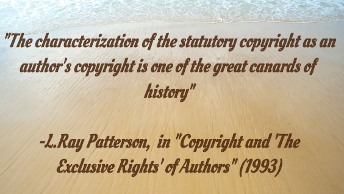
What is the point of having such a system? Is the law merely to benefit an investor, seeking to invest in already viral content, at the cost of the cultural enrichment of the society? No wonder the idea of Copyright, and its ideological symbolism of being hailed as an author’s prime tool, is nothing but one of the greatest canards of history.

I understand the argument that the author may be happy with whatever he has gotten, given Rs. 3 lakhs plus some meek royalties (if and when he gets that is) would be a huge sum for someone who used to sell peanuts + the amount of fame + ripple effect gigs, advertisements, etc. – but to me- that is exactly the problematic point:

If the author receives an amount “x” as the economic incentive to produce the work, in lieu of their copyrights, and they are happy with it (given the virality and prospects, etc.), what is the need for any further tax on the public to access the said work? Doesn’t the role of Copyright as a regulative policy end there? If there is no other recoupment for the author and the author is simultaneously happy, why more access fee in the name of either incentives or just desserts or whatever?

Especially considering the internet and its long tail, why is there for any need for a rate – x+y to be paid- where “y” merely goes to corporate investors seeking to make money out of aggressive enforcement of copyrights?

In my opinion, especially in the context of content that is already viral even before record labels/distributors/publishers step in, this additional amount “y” that is levied as a tax on users, is an unjustifiable deadweight loss and nothing else. The mere disbursal of a lump sum payment cannot be a ground to justify this deadweight loss as a desirable policy, given the undesirable tradeoff of a concurrent tax “y” and continued exclusivity in the hands of a corporate entity (non-creator). Maybe we need to figure out a way that this amount “x”, in Bhuban’s case Rs. 3,00,000, reaches out to him quickly from users directly- and maybe we need to figure out an efficient system in respect thereof- but allowing intermediation, assignments, and continued exclusivity (resulting in immeasurable further tax on users and downstream creators), just because a lump sum by an intermediary is easier- is not a ground to justify beyond incentive payments by users for access and use. It goes over and above the actual intent of copyright and is merely a problem of laze.

We ought to realize this and push for disintermediation in Copyright policy (banning assignments or alienation by authors in favor of corporates), especially in the era of the internet. But for disintermediation- we are gravely and adversely affecting cultural engagement, enrichment, and freedom- something which is paradoxical to the goal of copyright and cultural policy. In a copyright scheme where no transformative usage is recognized (unless it is for personal/private purposes, research purposes, or parodical/critical purposes), such change is all the more required to ensure that copyright incentives, which do not even go back to the author, do not freeze cultural engagement and democracy- or the ability of situated users to talk back and present their cultural narrative in an accommodative permissive cultural space.

This is FOR both the author and the user (aren’t they the same?), and only against a corporate investor- who ideally should really have no stake in Copyright policy, but unfortunately has the most. Who knows, as Oren Bracha argues– the history of IP (commodification of expressions (might actually be the history of capitalism, which is an unfortunate truth.

Part 2- On the hard case here.

Part 3- Resolving the hard case here.

Part 4- Alpana Roy on Decolonizing IP here.

In the name of Balance!

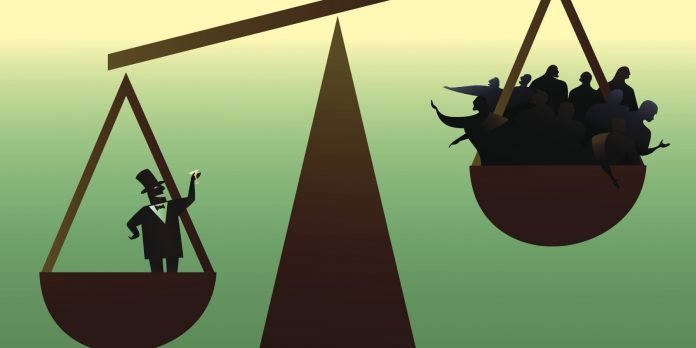
I am tired of hearing the phrase “balance”. I am tired of those who say that limitations to Copyright ought to be interpreted in a way that balances it with the interests of Copyright holders. I am tired of those who argue for limitations to be read narrowly in the name of “balance”. I am tired of those who argue for wider and broader IP rights and contest limitations by claiming that they must be applied in a “balanced” way, that they must be applied in only “certain special cases”. I am tired!

What is Balance? Balance is keeping scales aligned and symmetrical. Balance is ensuring that every conscious act, which is a step away from normative thoughts, practices etc., is regulated to the extent that it does not take a form of a tyrannical unconscious act. Balance is meant to ensure that things are conscious of tradeoffs – and every move played, in the game of chess, for a purpose (whatever that might be), is smart and not one which is erratic and unreasoned. It is a way of ensuring that even erratic moves do not affect the most fundamental, by safeguarding and keeping them in the realm of generic normalcy.

Well, Copyright is, in and by itself, abnormal. It is not intuitive or natural. It can never be. It is deemed “commodification” for a purpose – i.e., to serve the end of ensuring that creators do not shift to marginal sources of revenue that will economically help them survive better. It is an imbalance, in the norm of competitive markets. It is encouraging monopoly, as against the norm of discouraging clusters or market power. It is by itself an imbalance.

I often get riled up when copyright owners (with enormous aggregated market power through tools of assignment/contracting out these rights of creators), say that hey- please do not restrict our monopoly in the name of limitations like use/fair use/permitted dealings etc. “We deserve free markets.” “We contribute to the GDP.” “We make the economy.” I often get riled up when they call for narrow readings of limitations- touting them as “exceptions”, saying that well a balance must be struck that does not defeat the owners right to market and exploitation.

Copyright is by itself an interference in “free markets”. It is a monopoly statutorily conferred, in the backdrop of a constitution which discourages monopolies. How can businesses, which by their genesis run on a model that is an interference in free markets- want complete regulatory stagnation? How can they want their rights/ businesses to be treated like other businesses in the free markets?

The idea of “limiting” the exemptions from Copyright/ limitations to Copyright, or applying them narrowly, is something which we need to get rid of. Asking for balance within an imbalance is an oxymoron. These limitations ARE THE BALANCE. Reading them widely, or as strongly (sadly) as we read these rights IS THE BALANCE.

Copyright owners asking for free markets/ no regulation (by arguing that any regulation like limitations or compulsory licenses goes against free trade or right to property) is the biggest oxymoron ever- as the genesis of their claims is by itself a regulatory interference in the free market.

To conclude in a single line-

Reading limitations to Copyright narrowly, in the name of “Balance” is the genesis of systemic imbalance. Reading them broadly, or at least at a similar threshold as those rights , is what constitutes “Balance”.

WAIVING WINDFALLS @ IP MOSAIC’2021

IP Mosaic, last year i.e., in 2020, was special. It was the first time I attended an IP Conference, because a friend was incidentally presenting. It was then that I got to hear from a few of the most amazing critical Intellectual Property Scholars- people like Prof. Brian L. Frye, Prof. Anjali Vats, Prof. Betsy Rosenblatt, Prof. Carys Craig, Prof. Bita Amani, among many others. The conference was very influential for me, in the sense, it imbibed this new way to look at IP scholarship. Since, I have even had the pleasure of working on some projects with Prof. Brian Frye and Prof. Anjali Vats.

Yesterday, at the 7th IP Mosaic Conference 2021, titled- IP as protest, change and empowerment, hosted by the Institute for Intellectual Property and Social Justice, Washington DC, along with MH School of Law in the US, I finally got to present my upcoming paper (almost in the final stages) titled- “Waiving Windfalls: A socio-legal and contextual justification of a TRIPS Waiver during the COVID-19 pandemic”, in the panel titled “Patents and public health”. The panel included Prof. Muhammed Zaheer Abbas (inspiring scholarship), Prof. Mason Marks and of course the moderator Prof. Sharon Sandeen (@TradeSecretProf).

Coming to my paper, it is NOW uploaded on SSRN, however as a gist, the trigger of the paper was the Second Wave and my experiences during the devastating and frustrating situation in India. People running to Courts for oxygen, hospital beds (anyone who was in Delhi then, would completely relate to what I am referring to), a tab of Remdesivir or Tocilizumab, got me thinking – how did we even get here!

The paper goes on to specifically look at the contextual political history in terms of IP regimes, the “gradualism” or the transition period afforded to developing nations – and how our global trade mechanisms are completely unmindful of accommodating these political historical realities, which were not within the control of most of the nations, now struggling to serve the health needs and priorities of their domestic population. I go on to bat for the essence of a waiver provision in the WTO Agreement, and use historical instances where waivers have been granted, as well as the political histories of the countries batting for a waiver, as against those opposing it, to justify the fact that IT’S NOW OR NEVER.

The main theme and focus of the paper is on colonial de-linking of pharmaceutical trade and IP laws.

“De-Colonizing IP requires an alternate accent – where global trade ought to be looked at from the eyes of geo-historical attentiveness. The essence of distributive justice, especially in the grim situation that we face today, lies in realizing the importance of the historical context, i.e., this context of prolonged inability, not due to controllable forces or complacency or a lack of merit, but rather due to global acts of suppression, accounted for in real history.”

Anyway, for more, here is the abstract and the (highly textual) slides which I used in the presentation.

Here is the full paper- up for comments and opinions.

Alternatively, the slides can also be accessed here:

Thanks a lot to IIPSJ and Prof. Sharon Sandeen for this opportunity. The paper will be out on SSRN very soon.

“Discursive” Copyright?

Today morning, I was called to my Alma Mater, Jindal Global Law School, (of course virtually) to talk about Music Sampling and its relation to Copyright. Prof. Vishwas H. Deviah (who was my Independent Research Project advisor at Jindal, as also for whom, I served as a Teaching Assistant during my final year) had invited me to address a lecture to the LLM and Undergraduate students who have taken up the elective -“Music and Copyrights”.

Although the method of pedagogy in terms of this course is supposed to primarily be formalistic, and case-law oriented, tracing the judicial interpretations of sampling, I decided that given this opportunity, and having recently read The Color of Creatorship by Prof. Anjali Vats, I would try and do something different, and focus more on an interdisciplinary approach towards this lecture.

Here is the drive link with the slides that I used for the lecture/presentation:

https://drive.google.com/drive/folders/1gBvpnX4XeHbhv31QnA5NLnlmm6vK3tvl?usp=sharing

ALTERNATIVELY:

Broadly, I have tried to provoke a critical voice, against the normative idea which is taught in copyright lectures, especially here in India. I have tried and focussed on viewing and tracing the imperialistic nature of Copyright, and its adverse impact on normative non-white practices like sampling- by doing a historical overview of copyright policy, as well as of Hip-Hop as a form of music. I tried, through, this lecture to make a case for Copyright’s racist origins hidden, and invisible in the face of the law, until one gets into technicalities.

I have tried to break bubbles around the acceptability of copyright’s idea of windfall incentives. Also to show how knowledge development has been a result of widespread appropriation, which is now widely condemned, by the same erstwhile appropriating communities. I also tried to break the shackles of the ideas of Romantic Authorship, by normalising conceptions of “creative borrowing” as a core and intrinsic practice within music and art.

This is not really something which is ever taught in our copyright courses. The idea of writing this post is that we must try and include conflicting narratives and dissents to status quo policies like copyrights, to realise the societies and communities- it adversely affects, and to focus upon their lenses, who have been at the receiving end of these colonial impositions, which they sometimes do not even realise they have been subjected to.

As copyright scholars, it is our role to emphasise on this perspective as well, rather than merely focussing on internalising copyright policy, and focussing on intrinsic reforms within it.

Reading List/ Sources I referred to (even copied from) for the purpose of these slides:

  1. The Color Of Creatorship, Anjali Vats (Stanford University Press)
  2. Copyrights and Copywrongs, Siva Vaidyanathan (NYU Press)
  3. Privilege and Property: Essays on the History of Copyright (Chapters- 3,4,6), by Mark Rose, Oren Bracha and Maurizio Borghi (Open Book Publishers)
  4. Locke’s 1694 Memorandum (And More incomplete Copyright histographies), Justin Hughes (Cardozo AELJ)
  5. Primary Sources on Copyright, http://www.copyrighthistory.org/cam/
  6. Digital Sampling and Cultural Inequality, David Hesmonhalgh (The Open University UK)
  7. Sampling, Looping and Mashin…Oh My: Hip Hop music is scatching more than the surface of Copyright, Tonya M. Evans
  8. Copyright, Communication and Culture, Towards a Relational Theory of Copyright law, Carys Craig (Osgoode Digital Commons)
  9. Copyright, Culture & (and) Black Music: A legacy of Unequal Protection, K.J.Greene (Hastings CELJ)
  10. Copyright, Translations and relations between the British and India in Nineteenth and Early Twentieth Century, Lionel Bently (Chicago-Kent law review)
  11. Cultural Environmentalism and Beyond, James Boyle
  12. Intellectual Property and the intersection of Race and Gender, Lady Sings the Blues, K.J. Greene (Journal of Gender, Social Policy and Law)
  13. Critical Race Theory, Signifyin’, and Cultural Ownership, Richard L. Schur (in Parodies of Ownership
  14. On the Author Effect, Contemporary Copyright and Collective Creativity, Peter Jaszi
  15. Gandhi and Copyright Pragmatism, Shyamkrishna Balganesh
  16. Creativity and Culture in Copyright theory, Julie Cohen
  17. Digital Sampling: A Cultural Perspective, Henry Self
  18. From Mozart to Hip Hop: The Impact of Bridgeport v. Dimension Films on Musical Creativity, Lauren Brandes, (UCLA Entertainment Law Rev)
  19. Social Justice and Copyrights Excess, Betsy Rosenblatt (Texas AnM Journal of IP Law)
  20. Everyone is a superhero: The Cultural Theory of Mary Sue- Fan Fiction as Fair Use, Madhavi Sundar and Anupam Chander (California Law Review)
  21. Why Copyright law needs music lessons, Carys Craig (Osgoode Hall Law School)
  22. Fair Use and the Future of Art, Amy Alder (NYU School of Law)
  23. Hungry Translations: Relearning the world through Radical Vulnerability, Richa Nagar
  24. Free to be You and Me? Copyright and Constraint, Rebecca Tusnet, Harvard Law Review Forum
  25. Who Watches the Plagiarism Police, Brian Frye and Akshat Agrawal, (The Contemporary Law Forum)
  26. Is a Plot/Theme Copyrightable, Lets end the Controversy and Conflict, Part 2, Akshat Agrawal (IPRMENTLAW)