RE-CONSTRUCTING FAIR USE- WILLIAM FISHER (SUMMARY AND TAKEAWAY)

I am choosing to summarize and analyze one of the (in my opinion) most important pieces of Copyright theory and policy (some very prominent Professors here at Berkeley refer it to as their bible on anything copyright). I am putting this here for everyone to be able to contextualize the role of Fair use as a policy matter while thinking of copyright’s role, its trade-offs, and how to think about progress/ values and its role in it. Here is the full piece (highlighted): Link

Prof. Fisher, to begin with, recounts that fair use as an affirmative defense, distinct from an inquiry of infringement began in the mid-twentieth century, and was subsequently adopted in Section 107 of the Act of 1976. He recounts the logic given by Justice O’Conner of Market Impairment in Sony Betamax and argues that every case where the fair use defense is invoked will involve market harm, and so it is relevant to estimate the “magnitude” of market impairment by privileging certain uses, not the mere “existence” of market impairment. 

On Necessity, Prof. Fisher points out to be wary of the dangers inherent in its ambiguity. Sony and Harper v. Row discounted the necessity factor- however, J. O Conner in his analysis did say that copying essential to communicate facts may be privileged. 

Prof. Fisher points out J. O Conner’s discussion where he says the rights conferred by copyright are designed to assure contributors to the store of knowledge a fair return for their labor. Prof. Fisher criticizes this as showing an objective that is fundamentally different from social utility. He says that the notion J. O Conner embodies is that authors and inventors deserve a reward for labor irrespective of whether they would continue to work in the absence of this compensation. He criticizes this as being ambiguous- in terms of what exactly is a “fair” return for creative labor- how to balance it with the dissemination of output concerns, etc.  He argues fair use, in its (then) current practice to be aiming at “balancing” inconsistent claims derived from conventional, incommensurable premises- something which perpetuates difficulty, as against concreteness in analysis. 

He then goes on to choose premises- firstly relying on economic premises- he argues- that the objective of copyright law in general and the fair use doctrine, in particular, should be the efficient allocation of resources. Secondly, he argues, what he calls more of a utopian vision relying on cultural premises- stating that “copyright law has a significant effect on the shape of our culture and that a vision of the sort of culture we would like is a prerequisite to wise administration of the law.”

Coming to the doctrine, he says that if the package of entitlements created by the provisions of the copyright act other than 107 enabled creators of intellectual work to collect monopoly profits in greater than optimal amounts, a judge could use fair use to chip away at that package until reaching the most efficient combination. He argues that economic analysis helps us realize this, in spite of its important critiques of fostering complete market dependence.  He argues that the point of inducement through monetary incentives is to have more and better works, but efficiency gains from this inducement are only realized upon increased consumer satisfaction that results when readers have access to these more and better works. 

Prof. Fisher states that an efficient way of using the incentive access paradigm towards efficient allocation of resources through the fair use doctrine – is to analyze whether the production of “work” requires- or is affected by incentives or not. He firstly talks about special circumstances where the provision of incentives through the law has no role to play in the inducement of further production, given optimal earnings even without such legal protection is available. Here he says every use should be fair. On the other hand, he talks about works where even a single putatively infringing use would incur economic costs that exceed gains due to sensitivity to fluctuation in anticipated incomes and behavioral elasticity in respect thereof. In such a situation due to the inefficiency involved, it should be ruled unfair. Moving on from these special circumstances, he argues that In more complex situations, differentiating types of works for applying fair use creates some efficiency and some inefficiency as well. He says that copyright covers a variety of works from books to films, to factual works to fictional works, to computer software- the incentive interests/requirements on which are different. He thus argues that creating some difference in the nature of work in relation to their purported incentive requirement does make sense, but too many differences may lead to distortion where artists will assume the worth of their works legally and pursue or distort from pursuing a particular form in favor of the other. His solution is the following:

“To make an efficient choice, the judge should estimate three figures. First, he should determine how much of an efficiency gain, caused by differentiating the monetary incentives for creating different types of intellectual products, would result from moving from each level of specificity to the next. For any of a variety of reasons, the optimal combination of entitlements for musicals may be different from the optimal combination for other sorts of plays. Lumping them together would therefore result in a less-than-ideal system of incentives for playwrights of all sorts. The judge should ascertain how much less than ideal. Second, the judge should determine how much of an efficiency loss, caused by reducing playwrights’ ability to predict their incomes, would result from each subdivision. Suppose, for example, that differentiating musicals from other plays resulted in sharply different combinations of entitlements and income levels for writers of the two sorts of works, but left a substantial number of potential playwrights uncertain as to whether the plays they contemplated writing would ultimately be classified as musicals or non-musicals. The effect would be to sacrifice much of the efficiency gain described above by reducing the willingness of risk-averse playwrights to write works whose status was unclear. Third and finally, the judge should calculate how each additional differentiation would affect the number of cases in which the parties disputed the classification of the copyrighted work in question, and what the litigation costs generated by those controversies would be.”

Another theory that could relate to the nature of work factor, that Prof. Fisher furthers is that, when an art form is in its infancy, or just starting to grow in circulation, adjusting the compensation system so as to increase the number of artists engaged in developing it may increase quality and variety available to consumers- if that is what the legislature values. As opportunities for synergies of this sort diminish, the scope of protection can rather be reduced. 

Prof. Fisher, in his economic analysis, continues to focus on identifying the incentive/loss ratio by examining efficiency considerations upon every use on the incentive and its consequence on the overall allocation of resources and efficiency, as a tool to understand whether a use is fair or not. 

Moving on to his utopian vision, he uses J.S. Mill to argue that self-determination and the development of mental and moral faculties for a rich, diversified, and animating culture is the most important goal of copyright policy. He argues that cultural innovativeness- the key to diversity- would not just be tolerated by the government but rather nourished and rewarded. This is what he invokes to be his theory of protection of transformative works as fair uses. 

He argues that defining the optimality of incentives when calculating the incentive/loss ratio needs to accept the following analysis: The creators of art should be afforded better than average incomes (or greater freedom from drudgery) whenever, but ONLY whenever, such a policy would increase their output enough to yield a net improvement in the lives of non-artists. He argues fair use as limitations on the freedoms of some to advance the interests of others from the view of helping shape tastes and capacities that enable the formation of autonomous and socially determined preferences in lieu of a good life. 

His main argument for reformulating fair use is the following.:

Maximization of allocative efficiency can be achieved by arranging the set of activities putatively reserved to copyright owners by section io6 in order of their incentive/loss ratios, identifying the point in the series at which the benefits secured by holding out monetary incentives to talented persons exceed by the maximum amount the attendant monopoly losses, and declaring all uses above that point fair and all uses below it unfair.”

Coming to the factors: he argues that the transformative factor is important as it creates more opportunities for Americans to be actively involved in shaping their culture and socially shaping identities- thus enhancing abilities beyond the ability if all were mere passive consumers. 

Then he goes on to advocate for the value of the use- citing education as an example- and so he argues that acidities that facilitate education by enhancing access to information and argument on matters of public importance, or facilitate dissemination of education – they should be fair uses due to the value component involved- however, the degree of preferential treatment, according to fisher depends on how important (NECESSITY) to education is the use of that activity. 

Another value determinant he cites is cultural diversity- any usage that facilitates cultural diversity and faculties of choice and self-determination. He thus argues to deem fair – uses- that have the potential for more derivative works – given their impact on cultural diversity. (AK comment: I think he is conceptualizing derivative works in a broad way to include transformations in content, otherwise I don’t know how this would make sense given the meaning and message remains the same irrespective of the potential to have more derivative works). 

The next factor for him is Protecting the Creative Process: where he argues to disfavor things that undercut the artistic process- and provide artists and consumers maximum opportunities for engaging in the creative process. He uses this to analyze the “published” – “unpublished” dichotomy and argues for use of unpublished works to be unfair- given for him they hamper the confidence of the artist in his/her/their creative process. He says rather than deterring all unpublished works from being used, a more precise standard would be “disfavored unauthorized uses of materials the creators of which were still considering revising”. 

He also favors uses that equalize public access as ones that ought to be deemed to be fair. 

In conclusion of his utopian analysis he identifies that consistent application of the utopian analysis would require expansion of fair use to the point where creators would be left only with income to live on, or a just conception which would require that the expansion of fair use be only halted when further movement would leave creators substantially below the national average of income- given the law perpetuates this enablement. 

He finally argues that:

for the time being, it seems wisest to limit judges’ involvement in the compensation of artists to (i) the avoidance of superfluous income; (ii) the promotion of cultural diversity by favoring types of art for which popular demand currently is low; and (iii) providing artists (to the extent practicable) minimal levels of income.”

PROPOSAL:

Recognizing that his utopian vision is not going to tangibly turn in policy any time soon, he proposes a modest solution using factorial reform for better fair use to ensure a better deal than the one existing then: 

  1. Whether the creator considered the work finished.
  2. Definition of injury of harm.
    • Ascertain the “type of copyrighted use at issue” to ascertain incentives actually required in the said type, in terms of the incentive/loss ratio. This, however, should be carefully done narrowly as is consistent with preservation of the ability of authors to identify which camp they fall in. 
    • Conduct of the sort engaged by the defendant- commercial or not (although not a separate analysis but only a component of defining the harm caused to the creator if at all)
  3. Decide whether the harm above is substantial (reduce the quantity or quality of output by affecting incentives) or insubstantial. 
  4. If the above three tests fail to resolve the controversy- or there isn’t enough information to draw a conclusion out of the above three tests- be proposes the following factors to step into:
    • The magnitude of injury (the more serious harm to producers- the less willing the judge should be to deem it fair)
    • Creativity (the more the activity or use is creative, and transformative, the more the judge should deem it fair as they increase diversity)
    • Education (Fisher points out this is to be of relatively higher importance): use increases access to info or arguments (perspectives) on issues of public importance or facilitates efforts to make available to students resources to learn- the more the bend towards fair use. 
    • Price discrimination (the more use undermines the ability of the holder to engage in price discrimination, the weaker case of fair use- given price discrimination is good policy as it increases rewards and increases access. (Differential pricing strategies- which have lately been criticized due to administrative difficulties and parallel importation logics)

A PRELIMINARY THEORY OF FAIR USE THAT I AM BEGINNING TO CONCEPTUALISE:

The legislature values certain things (not in the commodity sense) that it seeks to ‘enable’ (a proxy for incentivizing, given it doesn’t really incentivize in my opinion- it ensures they are not de-incentivized)  so that people who produce these valuable outputs are not disincentivized from producing and shift to marginal sources of revenue, because well they aren’t able to survive and make enough money by doing these pursuits. The corollary of not enabling them would be such performances (a proxy for “creations” because I personally do not believe anyone can ever find out who created an expression) not existing in society, and these performances are valuable. So the legislature using the tool of the Copyright Act enables them by giving them a limited property-Esque right/ market power over their creations so that they can extract value out of it (social and economic). However, the legislature does recognize the constraints of giving such market power access to these valuable outputs- the very reason why they want these creativities to exist- the very reason they value it is so that people can experience it. 

So, to ensure that they protect interests that they value over/more than the enablement of creators- they create exemptions and limitations (and not exceptions) to this statute that provides enablement. Values like research, education, cultural diversity, etc are more important for the legislature than enabling the creation of works- and this “hierarchy of values needs to be understood”. Fair use is representative of this hierarchy of values. Fair use is not a defense in that understanding- it is in fact a tool to show which value is deemed to be more important and what sacrifices does enablement of creation has to go through to actually and tangibly support the achievement of the ultimate policy goal and value it seeks to instrumentally achieve – i.e., the existence of more and diverse works for people to understand, internalize and be exposed to. Fair use stems from this hierarchy of values that in a democracy the legislature prioritizes.

_______________________________________________
Andy Warhol Foundation v. Goldsmith – A misnomer of a debate!

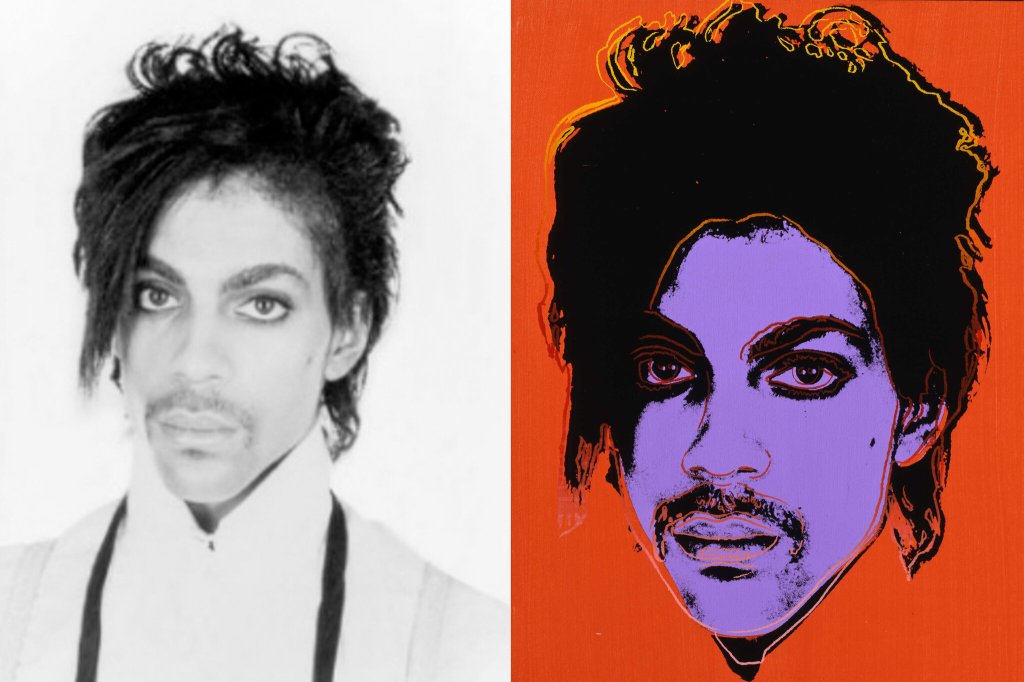
In my opinion, the main debate in Andy Warhol Foundation v. Goldsmith, which was recently argued at the United States Supreme Court is-

“How to draw the line between the scope of the right to exclude the creation of derivative works, that copyright law confers upon the creator/owner, as against the purpose and character of use exemption to copyright infringement that is for users/downstream creators/people who seek access.”

The debate is riddled with delusions and misconceptions about the instrumental purpose of copyright law. Why?

The purpose and character of use exemption is often used to limit the scope of claims of copyright infringement and is considered to be applicable to all rights that are given to the owner of copyright (Re: Google v. Oracle (SC)). In Campbell, the Supreme Court devised the transformative purpose and character test to define the meaning of this exemption. It stated that if there is a transformed purpose, meaning, or message conveyed by the use of a work, the same would probably be exempted from infringement (upon balancing this with the other three factors of the fair use analysis). On the other hand, the right to make a derivative work, in its definition under §101 of the Copyright Act, states that a work based upon one or more preexisting works, such as a translation, musical arrangement, dramatization, fictionalization, motion picture version, sound recording, art reproduction, abridgment, condensation, or any other form in which a work may be recast, transformed, or adapted is a derivative work.

Seems like an oxymoron on the first blush, isn’t it? How can transformed uses be excludable and exempted from infringement at the same time?

Well, not really a conflict if we try to understand the concept behind (i) the right (the social relation or claims against others) that the derivative excludability confers, (ii) the instrumental purpose behind the purpose and character of use exemption, (iii) as well as their interaction with the reproduction right given to the owner.

As Talha Syed argues, the meaning of words in a statute is never given- whether plain, common or core, but is always rather a concept to further the social relation that the law seeks to instrumentally push. Talha argues- “We are not supposed to look for something out there by staring at the words, but rather think about our aims.” Just staring at words that may be identical but used in different contexts and concluding oxymoron-ish usage in lawmaking as a ground for an indeterminacy critique of the same, is a mistake and does not do much in terms of devising a solution. It is a mistake that forgets the need to contextualize every use of the word in a statute to be representative of a concept, which is never self-contained but relational and hence fluid- in terms of the context and aim it seeks to achieve, given the law is nothing but an instrumental tool to achieve a social goal and govern social relations. Reifying words keeps us confused throughout and keeps us thinking that law is indeterminate and is basically a character of what Libby Adler terms as an invitation to “lawyering 101”. Talha Syed argues that “To think it anything else—i.e., to think of it as some rules “out there,” with “words” having “given” meanings that must be divined (or destabilized)—is to seek to replace what is always, ultimately, a question of purposes and values with a pseudo-cognitive operation.”. We don’t need to be mystified by the words used in the statute seeming identical, and try to trace, mechanically, some perceivably authoritative sources which could result in such uses- and then try to understand what the word means in an effort to reduce its indeterminacy. This whole process completely forgets the core aim of the legal tool and analysis considering the same. It is just a tool to avoid any mental contact with the aim and purpose of the instrumental tool. This is what is happening in this case.

The Court, by trying to draw distinctions between the scope of the rights, focusing on what is the width of each of these competing claims- tracing levels of transformativeness – and thinking that anextension of the court-created transformative use criteria to alternate meaning or message would erode the transformation right given to the owner, because, well, at both places “transformation” is mentioned,is completely missing the point.

Let us go back to the purpose of Copyright law. Due to fairness and economic concerns, authors (who often assign these rights away) are, through a competing legal claim in the form of a property right, allowed to exclude people from using/accessing their work in the primary market as well as some secondary markets, so that they are able to extract optimal social value out of the same. The reason is not because it’s natural to them or because they used their mind and body and therefore others should not get to use it or free ride on it depriving originators of benefit. The reason is simple- we need to ensure these people get reasonably paid so that they are enabled to continue these creations because we as a society value these creations which help in subjective self-determination for a lot of us. Thus, we make a trade-off with access benefits. The fundamental reason for this is that we value such creations, and we want more of such meanings and messages which help our self-determination to be autonomously defined by exposure to many and variety.

This law is a tool to instrumentally achieve this goal. Every concept in this law, in its statutory framings, has to be remolded in light of it being a tool to achieve this particular goal. Focusing on identifying meanings of words within the tool, completely takes away any mental contact with this goal, assuming the said goal to be fulfilled by reading the words in a particular way anyway. No. That is fundamentally evasive of having any mental contact with the act of reasoning as to whether a particular interpretation even does anything to achieve the goal or not.

In light of the said purpose of copyright, let us look at this debate. The derivative right gives control to the author of the work over-exploitation of works in secondary markets which are in a different form. The concept of ‘form’ here has to be interpreted in light of the purpose of the law, to allow for protection only in secondary markets and not in the primary market- for which the right to reproduction already exists. And the illustrations in the provision clearly show the above concept as well: translation, dramatization, fictionalization, sound recording, abridgment etc. Apart from musical arrangements (which was heavily lobbied for, and I argue was mistakenly included within this elsewhere), there is rarely any change in the meaning and message of the original content that is represented in any of these forms that are illustrated. The content, meaning and message conveyed are essentially the same, the medium of representation being different. This coincides with the whole idea that copyright is only conferred upon original expression. By construing the scope of the secondary market to extend to forms of expression which although incorporate some of the primary content but convey a different meaning and message overall, in effect confers a right to exclude over by-products of the original work, which are not even original to the person to whom the right is actually conferred. What is the enablement for then? To prevent free-riding? I don’t see prevention of free riding beyond the original work (and by work, I mean the original meaning and message of the creator) being extended to any and every by-product, fulfilling any instrumental purpose of the law articulated above. It is just a moralistic claim with no basis, but rather an argument that- as I uttered a word from my mouth or used my hand to make a stroke on a canvas, so I get to exclude whoever uses it in whatever context. That has no instrumental role to play at all. In that case, let us extend market power to exclude on every act of imputing labor to include all by-products, even if the meaning and message of the by-product is fundamentally different and non-original to the person seeking the right. That just doesn’t make any sense. The whole point of giving an instrumental right is to show that we value such original creations- but then using the instrument to curb the ability of others to create more meanings and messages, is like pitting the instrument against the ultimate purpose of having the instrument in the first place. As Madhavi Sundar states- IP is a means to an end, not an end in itself.

Being cloaked by indeterminacy concerns of the law influences lobbies and power to drive the ultimate meaning of the legal tool. Due to concerns around indeterminacy, as against trying to interpret the law from the purpose it sought to achieve, the scope of the derivative rights have been read extremely broadly over time to include works, which although do not involve, conceptually, any “form” based changes, but rather incorporate prior content to portray an alternate meaning or message, unless the purpose of representation has been shown to be different. The logic extended is to expand excludability to all channels through which the public experienced the work, even if in fragments, embedded in a different meaning or message. It is plainly wrong to be doing this. It shows the power of the political economy in driving meanings of legal tools which are shrouded and critiqued only through the lens of indeterminacy, as the right holders will always be able to use their capital to hire the best lawyers to draw their side of the interpretation to be the better one before the judges- capitalizing around the somewhat “confusing” image of the law. It is just problematic and ignorant of drawing any mental contact with the ultimate purpose that the law seeks to achieve.

Derivative rights do not and are not supposed to include transformed uses even for the same expressive purpose, but only transformed forms of the same expression that is the original creation of the primary author. The interpretation of the use of the concept of ‘form’ with transformed within the definition has a limited meaning of an alternate medium of representation/ an alternate physical embodiment distinct from the medium of expression of the original work. Any different interpretation, pitting the scope of the derivative right against the transformative purpose and character exemption under the Copyright Act, seriously undermines the instrumental nature and goals of copyright and its first amendment concerns. It just makes the co-existence of the derivative works right, reproduction right, and the purpose and character of use exemption to copyright infringement, which are all present in the same statute, completely incoherent.

Coming to the purpose and character of use exemption, many argue that purpose and character only mean transformed purpose- that is if a work is initially meant to entertain, and the user uses it for informative purposes- well then it satisfies the first-factor enquiry. Such a limited reading, influenced by the use of transformed in the definition of the derivative right, again ignores that transformations also happen to show different meanings. These are inquiries of exemptions to infringement- with the goal being to ensure that the enablement value of copyright does not, curb access and downstream usage concerns, beyond its optimal purpose. It once again runs contrary to the instrumental purpose of the law and romanticizes the instrument beyond its optimal need instead. The goal of having a paintbrush is to paint a picture. It is not to keep staring at the paintbrush and appreciating its look and romanticizing it and just continuously increasing its value without really painting anything using it.

Once we get hold of this concept, the case is quite easy actually, especially to the extent that the cert. was issued by the SC- on the limited issue of transformativeness of usage. It is clearly transformative and does not impact any form-based secondary market of the original creator, in relation to her original work, so long as the meaning and message that comes out of the new picture is different for people who are in the art world.

Any time the meaning and message is transformed be it in the primary market or the secondary market, and it does not simply seek to substitute the original works’ markets by trying to replace it portraying the same expression/meaning or message in the eyes of the viewer (someone who can identify given conceptual art is complicated to interpret), it satisfies the first fair use inquiry. Period. Irrespective of the rights conferred to the owner- this is the reasonable balance that the Copyright Act seeks to draw to ensure that the enablement is optimal and not beyond it, considering its bilateral tradeoff with access and use concerns and the instrumental goal that copyright, as a legal tool, seeks to achieve.

Given the large-scale implications of this case on appropriation art, sampling artists, artists performing various kinds of ontologically “transformative” culture- it is important to internalize this and ignore this misnomer of a debate, which in a prolonged manner, through the tool of the cloak of indeterminacy, is continuing to existentially estrange many cultural meanings and messages (something which the society clearly values) from existence in the society- paradoxical to the goal which the law, where this supposed indeterminacy is perceived to be embedded, seeks to achieve. 

Alpana Roy on De-Colonizing Copyright and Cultural Policy

In this set of 4 posts- I shall be discussing my dilemmas from the Kacha Badam Controversy. The first post covered my thoughts on the delusion that this whole controversy has produced and the need to revamp its factual narrative. The second post covered my thoughts on the hard case that this factual narrative exposes- something I cannot really grapple with yet. The third post brainstormed thoughts on resolving this hard case. Finally, this fourth post will, in the backdrop of these three posts, discuss an amazing paper by Prof. Alpana Roy titled- “Copyright: a colonial doctrine in a post-colonial age” and how her thesis has an important role to play in figuring out/ or rather even further complicating this hard case.

PART-4

In this final post, I am discussing, Prof. Alpana Roy’s paper titled Copyright: A colonial doctrine in a post-colonial age, in the backdrop of the discussions we have had so far. I also had an opportunity of discussing this article in the Critical Interdisciplinary Perspectives to IP reading group hosted by Prof. Anjali Vats, Prof. David Jefferson, among others- which led to a lot of thoughts pushback, and questions. I shall try and put them out here This is also my expression of gratitude to all who turned up for the reading group.

Prof. Alpana Roy’s article, published in the Copyright Reporter in 26th Volume 4th Issue, in December 2008, discusses IP from a sharp post-colonial lens. It is a provocative piece of writing, to say the least.

Setting the stage, Roy clears the air on what colonialism implies and what constitutes de-colonial thinking. She clearly puts it forth that the socio-economic exploitation of the so called “periphery” or alternate, need not always be directly political or dominated by the military. It can also involve continued subordination through the exploitation of the political economy to adversely affect capabilities. She mentions the prevalence of colonial thought in law-making and how it pervades global norms, in sheer ignorance of alternate indigenous realities. This narrative somehow resembles the work of the amazing late Prof. Keith Aoki, on what he calls Neo-Colonialism, and in the context of IP states that- transnational IP system erode concepts of sovereignty and self-determination.

Putting the article in context, Roy turns to International IP Agreements and reflects on the role of these “multifaceted projects” or dominant narratives which primarily reflect/mirror particular moments in the history of Western cultural practice. She emphasizes the importance of this by projecting the dissonance of the norms in agreements like Berne, with nations outside the West. She asserts that Copyright remains a foreign concept in many cultures, and many societies take an extremely radical view on what constitutes property and can be the subject of individualistic private property. In this context, it is important to reflect on the “independent” v. “inter-dependent and inherently social conceptions of the self (the idea of a “family”)” which vary across societies – with the West bending towards the former and Asian societies towards the latter. The law, as it is in its current “global” framings, only accommodates the former, completely ignoring the latter.

She then goes on to talk about a few of these individual dissonant features: (i) print culture (ii) the idea of piracy as against copying and sharing as a sign of respect and recognition- and mentions how such norms being globalized are nothing but a symbol of a dominant narrative used to foster a “one-way traffic around the notion of desirable culture”- consequently moving towards cultural imperialism. It is at this point where she makes her most important argument about this whole system having a far deeper impact than the earlier forms of colonialism, imperialism, or simple tourism, as it tends/attempts to alter the source of the self.

Hereon, she gets into the hard case by discussing the example of “Return to innocence”, supposedly a Taiwanese tribal song, which was appropriated out of a performance by 30 indigenous Taiwanese performers who were invited to perform across Europe by the French Ministry of Culture. A significant portion of these songs was used by a German music entrepreneur and was then also recorded by Enigma- and sold as “his copyright”, without any due accreditation or financial compensation for the use of the said song. She primarily uses this example to first- expose the political economy of cultural practice, and thereafter and most importantly, the political economy of law on culture- and who gets to enforce and who doesn’t. This is important in the context of the debate on print vs. aural culture, as well as in the context of the argument that accesses to a platform to showcase determines who gets to ‘own’. What I am concerned about, in this example, is not the appropriation, but rather the possessive claim of Enigma over this output- dispossessing many others who could have been the actual originators of the expression and should have had the ability to use, build on, or get any financial remuneration in respect thereof. It is in this context that the appropriation is important to be addressed.

Roy uses the “Return of innocence” case to contend how indigenous works fail to fulfill individualistic notions of property rights and are dispossessed from their performers through dissonant norms. She uses this to show how western law, and its hegemonic transposition is highly inappropriate, results in fictitious commodification, and continues to perpetuate the idea of the historic “other” even in law and policymaking. She aligns with Rosemary Coombe who argues that neoliberal conceptions of copyright do not accommodate cultural differences that are difficult to be formulated in terms of a commodity, and are hence difficult to encompass within the conceptual frameworks of “modernity”.

Roy also refers to oral research outputs and argues that as soon as someone publishes all the oral research output they get copyright over it- dispossessing participants and researchers who contributed and undertook research orally but did not/could not really “fix the output in the printed/published form”. On this aspect of fixation, during the discussion with the reading group, Prof. Ann Bartow put forth an interesting question as to- how do rules of evidence work in aural societies? – Historically mapping the same could be an interesting analogy to look at while discussing the irrelevance of fixation norms in non-western societies.

Roy then moves on to how these western cultural norms were exported to colonies by European colonizers as a part of the package of colonization, most prominently in the 18th and the 19th Century. She states that pirating foreign work was still prevalent in free-er countries given the US only joined the Berne until 1989 and offered little protection. To foreign authors until then. Unfortunately, those who were colonized had little say in such policy for their own capability development (I discuss this aspect of IP Gradualism in detail in my paper here).

Roy then moves to the strongest part of her paper where she argues the relevance of printing technology and entrepreneurs in respect thereof in centralizing and transplanting these western norms abroad.  She talks about how printing was essential for the colonial and imperial projects of Europe as their empires could not have survived without the spread of propaganda, religious tacit, commercial documents, maps, charts, etc., among the natives. Here comes the relevance of copyright. She argues that as a form of communication- printing, unlike oral communication, has a tendency of universalizing ideas- and disseminating information through identical texts and making them truths by imposing them through “violent hierarchies” facilitated by the tool of colonialism and the Prospero complex it produces. She talks about how most of the so-called “universal truths” coincided with this enlightenment period of solitary creation and printing technology – that is basically the rise of print medium and subsequently the law of copyright. Importantly she reiterates that this exchange was not happening among “equals” but rather as an imposition in a colonial setup.

Upon political decolonization, Roy writes that there were some modest attempts at resisting western copyright by the Global South, in the context of the inability to translate and develop knowledge, however not to any structural yield. Thes prevailing norms have not only been normalized but have, through TRIPS, also been universally accepted (read: imposed), and are now a part of public international law.

Moving on to a consequential analysis of these norms, embedded with capitalism and the global political economy, Roy quotes Butalia, to argue that it is impossible to separate the world of Copyright law from the world of politics, as knowledge, culture, and access are inextricably linked with power, power is linked with money- and both of those are linked with history– something which cannot be repaired easily. In my opinion- this brings us back to the hard case and the relevance of reparative solutions to be intermingled with systemic change and to look at the same as complementary rather than as an either/or binary.

Roy finally concludes by referring to how copyright is nothing but a tool to merely further the trade and capitalist interests of western societies. However, a consequential corollary of this, which Roy misses in her analysis, is the impact of such a tool on identities and cultural estrangement- the “othering” of non-marketable culture. We might be celebrating Bhuban and his expression today, but that is only because he and many others like him, who do not fit in to this marketable system have been othered from cultural identity framing discourses and economic benefits in respect thereof, for a long, long time. As Macneil argues, we cannot subordinate the subsistence of society itself to the laws of the market, and the interest of the marketers, as it disenfranchises humans of the ability to direct the trajectories of their social institutions. We cannot, as a society afford to do this, as the same is nothing estranging identities.

To conclude these posts, the takeaway I seek to present is-  the need for scholarship, research and thought on –

How to ensure that identity interests of self-determination (including remunerative concerns), especially of those who have been denied the same for long, are retained-  without resorting to dissonant logics of property rights as tools of affirmative action?

Hope we have enough food for thought! Do reach out if anyone wishes to discuss any of this. I am available at 97akshatag@gmail.com


Part 1- here

Part 2- here

Part 3- here

Resolving the ‘Hard Case’? You can try the best you can!

In this set of 4 posts- I shall be discussing my dilemmas from the Kacha Badam Controversy. The first post covered my thoughts on the delusion that this whole controversy has produced and the need to revamp its factual narrative. The second post covered my thoughts on the hard case that this factual narrative exposes- something I cannot really grapple with yet. This third post brainstorms thoughts on resolving this ‘hard case’. And finally, the fourth post will, in the backdrop of these three posts, discuss an amazing paper by Prof. Alpana Roy titled- “Copyright: a colonial doctrine in a post-colonial age” and how her thesis has an important role to play in figuring out/ or rather even further complicating this hard case.

PART-3

In this post, I shall discuss thoughts on the hard case, and why it is really hard. I will also discuss my preliminary ideas on resolving its dilemmas. To put things into perspective-

Should we be celebrating Bhuban’s remunerative win (which supposedly is because of Copyright law) or should we be questioning the structural acceptance of a copyright system that is significantly dissonant from the ontological reality of cultural practice in India – a system that has merely been transposed from the west due to the state of law and the global political economy?


The hard case is really hard as one of the major issues that come with a structural challenge to the system- is its ignorance of the years of inequality and identity politics associated with cultural production. We can never crawl back to ground zero. The structure of copyright law, its commodifiability, and dissonance with alternate cultural practices has already produced a skew in visibility- which cannot be discounted. A structural challenge to the system would result in an unequal commons- resolving none of our equality concerns.

In other words, although by allowing sharing, derivation, and remixing to make it compliant with other ethnographic realities, a structural challenge to copyright’s individualistic norms, does help substitute individualistic possessiveness, however, it does little to narrow the privilege gap resulting from the prevailing system. Structurally challenging copyright norms may allow for wider cultural engagement- but they do little in remedying the lack of engagement or the skew in practice that is already persisting. Anyone who has, as a result of the prevailing system, attained a comparative advantage, continues to enjoy the same – given investment capabilities and the political economy of cultural practice. In line with this, how do we ensure that Bhuban gets his due remuneration to survive?

Proponents who believe in revamping the copyright system internally and allowing economic recognition of artists like Bhuban through prevailing norms- as a more practical solution, maybe right to the extent that it allows for these individuals to get recognition and helps balance out the inequalities to some extent.  These proponents also believe that property-like rights are the only retributive solution to the issues created by property-like exclusivities themselves. Madhavi Sundar and Anupam Chander convincingly argue, in their paper- The Romance of the Public Domain, that leaving these ignored cultural expressions in the public domain does not help satisfy societal ideals and rather perpetuates inequality by allowing those with the capability to misappropriate (not dispossess, but rather get a better benefit due to access privileges) to freely do it. It denies them a claim to self-determination. They, thus, argue for a property rights-based liability system (no control but an objectively defined fee on every use) to continue in favor of those who have been denied long-standing claims- to be able to re-project a scenario where we start from ground zero. For them, Bhuban getting this remunerative benefit would be a deal worth it from an overall welfarist perspective.

For me, this is something I continue to be unclear about, because fundamentally – using a property-rights-oriented solution to solve problems that are a result of the long-standing prominence of the same system- is paradoxical. As Amy Kapczynski argues, “why should we view a collective despot as an improvement over an individual despot?”

 I do agree that Prof. Sundar and Chander only endorse a liability model– where contours of exclusive possession and control do not strictly apply, and rather a fee is to be paid for every use However, even this, as a tool of affirmative action, does reify- principally the same tool of exclusivity. It also ignores how the idea of “originality” of a “work”– the genesis of a “mine” claim in the first place- is a myth- and a result of privileges of access (to showcase). This is applicable to both the claims of individuals and communities. One can never really prove that an expression is theirs and only theirs- and not a result/derivation of someone else’s. Once again- possession results in dispossession (often of the unknown).

Further, a liability rule, in my opinion, does not really address the main issue here- i.e., one of misappropriation of identities. Commodification has most definitely denied many non-commodifiable forms a claim to money- but most importantly it has estranged identities. The liability rules do not really help resolve that aspect.

Rosemary Coombe provides another interesting angle to this hard case in her paper- Ethnographic Explorations of Intellectual property– more so from an anthropological perspective. She maps arguments of the latter school of thought which say that even collective ownership dispossesses and reifies western liberal thoughts in culture impeding cultural engagement and ignoring ethnographic realities. She says that the whole idea of ownership in the binary of the individual and collective ought to be challenged from a hybridized perspective- and needs to be looked at by examining the actual reality of how culture is practiced, rather than requiring to mold cultural practices to fit in. She endorses the need for the decolonization of identities, as well as legal norms, by suggesting a more personhood-oriented solution to the aspect of reparations, as against one guarded within economical concerns- as was the case with the liability system. She argues for a system of benefit sharing to recognize the “cultural rights ” of people practicing alternate cultures rather than centering on a solution from an economic point of view. The idea is to endorse the personhood, identities, and development of these diasporic, hidden individuals and communities. Her focus is on ensuring that these identities are not dispossessed as against cultural outputs not being dispossessed. – given we can never be sure of what was the genesis of the cultural output in reality.

For me, as brewing thoughts, a few methods of resolving this hard case without resorting to a binary could include – primarily – decommodifying culture and making expressions inalienable, especially in favor of corporates who seek to capitalize and earn profits out of the most commodifiable and marketable identities/expressions. (see part 1) This potentially could resolve a huge hierarchical concern, at an institutional level, in respect of the ability to capitalize/market and showcase culture. However, I do agree that it does little on the aspect of the performer’s individual economic standing and capability to promote or be visible.

Another area that could be considered, as a part of future inquiry, could be getting rid of the idea of authorship of a work, and treating all expressions as performances- given we can never really figure out whether one is the “originator” of the content, but we can always associate the identity of the performer- with a particular performance. This avoids impeding downstream creation, especially in communities that depend on it, as well as ensures that if the performance, as a whole, is utilized as against merely the content within the performance (musical and literary “work” in current copyright framings), there is some remunerative benefit accruing to the previous performer for the associated identity thereto. So essentially, Bhuban cannot claim exclusivity over Kacha Badam, but if someone uses his performance of Kacha Badam substantially (Ann Bartow standard), he would have a remunerative claim (see here for a study on compensation systems) for the use of the cultural identity associated with his expression. This identity cannot be alienated from him in favor of any corporate entity. 

Coupled with this, maybe limiting this remunerative claim to only those performers who are a part of the “traditional knowledge”/ alternate culture herd- i.e., ones that have been denied a claim to be able to be visible for long, could serve the reparative goal sought by the primary school of thought. However, I have my doubts about the practicality and the acceptance of this, especially in light of the strong globally intuitive resistance to affirmative action policies in support of concerns of reparative equality, sometimes co-related to substantive equality.

Finally, another interesting area to build scholarly agendas on the side of equality in cultural policy and tools of affirmative action in respect thereof could be algorithmic support on the internet. By using tools of an affirmative bias in favor of performances/identities which have effectively been rendered invisible for the longest, a slow transformation could potentially take shape. Such cooperative responsibility from tech platforms could effectively help significantly revamp identity politics, and allow them to capitalize on scale benefits that come with it. As has been argued by Monson et al, it most definitely is technically possible to code algorithms that promote exposure to diverse content and highlight alternate perspectives- something which favorably happened in Bhuban’s case.

I do however acknowledge that these proposed solutions do not really resolve much, given hierarchies exist even within alternate contested identities. They do not have any sort of an enormous potential to resolve long-standing hierarchies which exist both due to copyright and beyond copyright concerns. But the intent of these posts is to have people engage in alternate cultural policy framings, without giving in to the binary of the internalist and structural critiques of the law in the context of this hard case. There is a need for social justice scholars to stop romanticizing either side of this hard case. In any case, we cannot afford to be celebrating the delusion produced by this Kacha Badam instance. 

In the next and the final post I shall, in the backdrop of this discussion, write my thoughts on Prof. Alpana Roy’s paper (more on the structural critiquing side) titled- Copyright: A colonial doctrine in a post-colonial age.


Part 1- here

Part 2-here

Part 4- here

“Kacha Badam” debate presents the Indian ‘Hard Case’?

In this set of 4 posts- I shall be discussing my dilemmas from the Kacha Badam Controversy. The first post covered my thoughts on the delusion that this whole controversy has produced and the need to revamp its factual narrative. This second post covers my thoughts on the hard case that this factual narrative exposes- something I cannot really grapple with yet. The third post shall brainstorm thoughts on resolving this hard case. And finally, the fourth post will, in the backdrop of these three posts, discuss an amazing paper by Prof. Alpana Roy titled- “Copyright: a colonial doctrine in a post-colonial age” and how her thesis has an important role to play in figuring out/ or rather even further complicating this hard case.

PART – 2

To put the idea of the hard case (not in the Dworkinian sense of “principle” but rather qua policy)  in context, I would refer to how I began thinking of it. While reading the wonderful Prof. Anjali Vats’s book- The color of creatorship, I came across an interesting narrative in the context of the Blurred Lines case in the US (Williams v. Bridgeport Music Inc. (2015)). What Vats mentions is that reading the Blurred Lines case is a complex negotiation in the backdrop of a legal system that consistently disenfranchises Black creators of the ability to come across as winners. The case was a historic instance, hailed by many, where, in a copyright infringement action, a Black creator was given a favorable judgment on infringement over, as Vats mentions, “white vultures” of the music industry. This was in a situation that was debatable from the lens of the infringement standards practiced in the US (given it involved ambient sounds). Now- there were two schools of thought that emerged after this case (both belonging to the larger roof of social justice scholars– however taking completely opposite stands on this issue):

The case was significantly hailed by a school of thought as a moment of reparation for black creators, who were significantly appropriated for a larger part of music history, without any sort of monetary compensation. It was an instance helping move toward a legal remedy for more than decades of appropriation of black artists. It was also appreciated as an instance that recognized the protectability of black musical practices.

HOWEVER

A set of critics of this judgment (the other school of thought) kept their focus on a rather structural argument concerning the colonial/western nature of Copyright policy, arguing that the said instance does nothing to repair concerns of equality and in effect reifies and attempts to normalize concepts outside black culture into black culture (in-contextual transposition). Hailing the judgment also estranges the fact that the verdict is extremely harmful to appropriative cultural practices like sampling, hip hop, reggaeton, etc. (mostly practiced by black musicians, or loosely non-western musicians). It reinforces racial capitalism, and a structural racial skew in legal interpretation, against normatively black practices which focus on re-use, and derivation rather than “original creation”. According to them, internalizing could never ever remedy/repair a copyright system that is racist to the core– and there was a need to structurally challenge it rather than supporting the expansion of the doctrine.

This brings us to the hard case.  Prof. Vats, in her book, presents this hard case in an interesting manner by writing as to how this situation was a seemingly forced choice for individuals invested in social justice outcomes out of this case and IP in general. It was either (i) embracing nostalgia and reparation for Gaye or (ii) a commitment to the musical innovation of hip hop (a non-western, non-white, non-individualistic art form dissonant with traditional principles of copyright law).

It was essentially a hard case to choose between “more” copyrights supporting the interests of black artists within the system of copyright law that exists, or a structural change in copyright according to actual epistemological realities or non-white cultures.

Using this, she turned to the de-colonial notion of creatorship and protection, outside the romanticism of commodification and the racial capitalism that it produces. She argues in her last chapter: “Advocating for intellectual property egalitarianism in a way that is legally and politically legible, requires pushing back against accepted IP doctrines, which conceal racial (and colonial) logics.” It is basically a debate between- internalizing possessive individualism (and looking for a solution within) v. structural questioning, which of course may not be a binary, but could end up eroding each other’s territories. We shall get more into this in Part-4.

Against this backdrop, the motion essentially is – Does the celebration of a black artist (Plaintiff) getting a judgment in their favor on copyright infringement, reflect a vantage point in the estrangement of cultural practices, norms and tendencies, through the neo-colonial tool that is western copyright?

Coming to the Kacha Badam issue, and the relevance of this backdrop therein:

I completely subscribe to and endorse the need to ensure that Copyright policy allows Bhuban to protect/recoup his remunerative interest in this performance, given his economic state/ standing, and the surprising visibility that has only been made possible due to the virality provoked by the long tail of the internet. Even record labels nowadays take their investment decisions depending on this viral tendency and potential. Prior to the internet, there was effectively a grand denial to creators/artists from remote villages in India to a claim to participate in visible culture and to be able to exploit them economically- especially due to the need to satisfy the aesthetic preferences of record companies before getting any visibility. I also agree that given folk artists have been denied such protection for the longest time, such remunerative benefit and commodification would help Bhuban do economically better, and will also recognize the copyrightability claims of such artists (I am still unsure as to whether we can categorize Bhuban’s performance as folk, but the song’s tonality does reflect folkish tendencies). I also understand the intuitional trigger and reparational thought in favor of Bhuban due to the long denial of visibility to such artists, his economic state, and the just desserts philosophy that comes with it.

I further subscribe to the fact that – those remixing and using Bhuban’s performance, attributing it to themselves, and in some cases also claiming copyrights over them (exclusivity over exploitation) to market using social media platforms/reels and other mediums, ought to pay license charges to Bhuban and attribute him- given the realistic state of the capitalistic society we live in. The possibility of remixers (who enjoy a better capability to capitalize or better access to visibility) using copyright to claim monopolies on their derived output- and earn money without paying any license fee to Bhuban, can never be discounted. The possibility of them misappropriating something linked to Bhuban’s identity can also never be discounted.

These are some extremely important real-world issues and do effectively endorse this thought of addressing the remunerative and reparative interests of Bhuban and such artists using Copyright law and its possessive individualism– as due compensation for the years of denial of economic compensation over such output and a lack of equal visibility.

But…..here comes the hard case.

A non-internalist/structural critique of this whole controversy would be-

Isn’t the compensating mechanism, mentioned above, normalizing a legal system of exclusivity and possessive individualism -over cultural expressions? Isn’t this a purely western normative ideal, against the norm of sharing – practiced widely in Indian folk cultures, forms of music, musical tendencies, and practices? How does it reflect as a consequence on the idea of imitative musical learning as a mode of pedagogy- which is extremely prevalent in indigenous and alternate musical practices? How does it also reflect on the romanticism of individualistic IP policy and its transposition on dissonant communitarian cultural practices/societies?

In India, indigenous cultural expressions have never really aligned with property-based exclusivities. In fact, to the contrary, there has been explicit resistance to recognizing this possessive individualism (see here, here, here,  here (accompanying note 16) and here), by practicing norms of anonymity while disseminating content, practicing imitation based learning as a core form of pedagogy (here, here, here and here) and by rather focussing on communitarian practice and performance of cultural expressions (here, here and here). For a general critique of the idea of possessive individualism – in the context of Indian culture and identity- see here (Chapter 8). Jaszi and Woodmansee have also, in detail, discussed the dissonance of individualistic norms of authorship and various cultures (which they refer to as “traditional” cultures, although I prefer- alternate cultures).  

The problem with internalizing copyright norms, which are premised on exclusive possession, is that it often relegates ontologically non-commodifiable/ non-individualistic/ community outputs and expressions, to the verge of cultural estrangement and diminishing. Expressions like folktales, ballads, chants, proses, alternate musical practices, religious musical expressions, Indian Classical and Carnatic music, etc., which involve aural transmission or are derivative and collective/communitarian creations do not fall within this commodifiable idea of a creation that is copyrighted and economically transacted in a market setup. This often results in cultural freezing. I, not for once, propose to say that the law should rather commodify such communitarian perspectives as well (as it has been doing in the case of traditional knowledge lately). I rather contend that this normative dissonance ought to be realized in the law and should be remedied by tailoring the law to foster these cultural practices rather than impede them by commodifying and altering their ontological nature in the first place. Transcribing western copyright norms, and in fact romanticizing them (its expansion and role) in cases of completely dissonant expressions, as in the case of Bhuban’s work, ignores the incompatibility of cultural expressions with core principles of western copyright norms- (i) fixation, (ii) individuated authorship, (iii) romanticism of originality and non-derivation (iv) exclusive possession, (v) author performer divide.  It also results in cultural alteration- merely for commercial advantage. In my opinion, such transposition of non-compliant norms takes the shape of a neo-colonial tool that does nothing but reflect the political economy of framing the law (in favor of western commercial interests by the neo-liberal tendencies of the western society). It also affects the political economy of culture and cultural practices. It shows a skew towards market fundamentalism, even in cases of cultures- which were never really supposed to be/ fit to be marketed in an industrial setup. We have to realize this and structurally challenge this.

Bhuban’s musical tone reflects a clear folk tonality, wherein it isn’t easy to assume originality, lest it shall devoid a majority of the members of a community, and dispossess them a claim to something that is normative to the community practice. Every possession results in dispossession. Even assuming the said musical work to be original, the social process of creation and the privilege of being able to access an audience can never be discounted. Romanticizing and transposing individualistic norms of this sort- denies many (who lack such access to showcase, get showcased, and receive) a participative claim to cultural exchange. Moreover, western copyright norms often seek justification on the idea of incentives- i.e., the assumption that unless such rights are granted- one might not be incentivized to create. Well, for starters, Bhuban had no idea he had these copyrights when he performed. The generalization of such a utilitarian conception, in cultural policy, dismisses the fact that for many – music is merely a source of communication and expression and not something which requires any incentive to be produced (some interesting scholarship on this facet here, here, here, here and here) However, this, of course, does not discount the fact that for many, who seek to practice music professionally and are not able to due to economic concerns forcing them to marginal sources of revenue (avenues which guarantee better economic condition), such incentives matter. What I seek to challenge is the generalization of these incentives as being the norm.

So, coming back,  how do we resolve this hard case? To be honest, I don’t know. But it may not be an either/or situation as it seems to be. We shall be looking at this in the next post.


Part- 1 – here.

Part 3- here.

Part 4- here.

Clearing out delusions from the “Kacha Badam” controversy:

A week to go for World IP Day. Last year, I posted a piece on this platform on why this ain’t no occasion to celebrate. I shall be reiterating the same here, albeit, in context.

In this set of 4 posts- I shall be discussing my dilemmas from the Kacha Badam Controversy. This first post covers my thoughts on the delusion that this whole controversy has produced and the need to revamp its factual narrative. The second post shall cover my thoughts on the hard case that this factual narrative exposes- something I cannot really grapple with yet. The third post brainstorms thoughts on resolving this hard case. And finally, the fourth post will, in the backdrop of these three posts, discuss an amazing paper by Prof. Alpana Roy titled- “Copyright: a colonial doctrine in a post-colonial age” and how her thesis has an important role to play in figuring out/ or rather even further complicating this hard case.

PART – 1

It has been a while since the Kacha Badam Controversy took shape. Readers from India would know what it entails, and in any case, this video does a good job at influencing thoughts about the whole debate. However, to put this issue in the context of its implications on cultural and copyright policy, here are the events that took place and how I see them (it might be an interesting hypo for Copyright classes):


A person Bhuban Badyakar, who earns his livelihood selling peanuts door to door, uses/sings a catchy musical tune to attract more consumers. The lyrics used along with his musical tune literally (in Hindi) says- “Kacha badam lelo” which when translated means “buy raw peanuts.” Some bystander in the village where he sells peanuts recorded him singing his catchy tune while selling peanuts, and posted it on social media websites over the internet (including YouTube). What followed is that the said video, including the “music and the lyrics” went viral on social media, and many people started to use, remix, recode, add dance moves, sing versions, and generate further content using it. The song became a viral sensation.

Upon being informed that, well, he could make money out of these uses and that others are making money out of recording and sharing his video, Bhuban reached out to the police in his village asking for his rightful musical dues.

Post this, a regional record label (Godhuli Bela Music), realizing the (i) virality of the video, (ii) economic state of the artist, and (iii) economic potential of aggressively exploiting an already viral work (under the scheme of the Indian Copyright Act), reached out to Bhuban for an assignment of all his rights in their favor, on the premise of a lump sum compensation of Rs. 3 Lakhs (around USD 3930). By this time, the song had already gone extremely viral and upon aggressive enforcement of copyrights, the amount of economic returns that could be garnered by Bhuban are a lot more than Rs. 3 Lakhs (no transformative use defense for non-personal uses of music in the Indian Copyright Act). However, this news of Bhuban even getting Rs. 3 lakhs (although at the cost of assigning away all his economic rights forever, without any scope of a termination of transfer existing in the Indian law) has been hailed by all saying – he got his rightful dues! Even the record label, after getting rights in a super-viral musical work assigned in its favor, put out a statement:

“The whole thought behind this project is to recognize and respect the original creator- Bhuban Badyakar”

As a consequence of this transfer, however, what has potentially been impeded is the ability of users/remixers/user-generated content creators to culturally interact with Bhuban’s work without paying a license fee to the record label (which being an investing business and not really someone who has created – would tend to exploit all money-making avenues in respect thereof). The prospect of royalties going back to Bhuban is also meek, given (i) the history of royalty disbursals in the case of Bollywood biggies (here, here, and here), let alone Bhuban, (ii) the actual state of royalty disbursal in India which amount to a mere 10-15% of the amounts earned by the assignee, and (iii) the interpretive question on the need of disbursing royalties when works are not incorporated in a film or a sound recording, in spite of a specific requirement under Section 19(3) of the Act for any assignment to compulsorily include “consideration and royalty”. However, the fact of the matter is that Bhuban is happy and famous and getting gigs– not because of the label- but because of the long tail of the internet. How does this reflect on copyright and cultural policy? (important reading here)


What comes into the foray from the above fact-view narrative is the delusion that the media has been making out of this incident, hailing it to be a huge win for Bhuban and the role of copyright policy in respect thereof (here and here). What it also brings out in perspective is the role of the existence of copyright law. What the tool of copyright law and its current framings in the Indian Act is doing at the moment- in this instance and many other instances- is benefitting no one else but a corporate entity.

Mind you- neither is the author getting their so-called– “rightful” dues – as was contemplated by the framers of the Act in their intent statement captured in the Rajya Sabha debates of 1955 and 2012 —nor are users, who seek to culturally interact, remix and produce transformative works for a wider variety of works for people to experience and for the broader cultural enrichment of the society (in terms of volume and diversity) getting to do the same- given a far greater potential of aggressive enforcement of copyrights by a corporate non-creating inventor, as against the actual author.

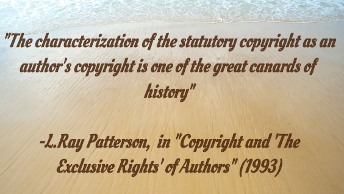
What is the point of having such a system? Is the law merely to benefit an investor, seeking to invest in already viral content, at the cost of the cultural enrichment of the society? No wonder the idea of Copyright, and its ideological symbolism of being hailed as an author’s prime tool, is nothing but one of the greatest canards of history.

I understand the argument that the author may be happy with whatever he has gotten, given Rs. 3 lakhs plus some meek royalties (if and when he gets that is) would be a huge sum for someone who used to sell peanuts + the amount of fame + ripple effect gigs, advertisements, etc. – but to me- that is exactly the problematic point:

If the author receives an amount “x” as the economic incentive to produce the work, in lieu of their copyrights, and they are happy with it (given the virality and prospects, etc.), what is the need for any further tax on the public to access the said work? Doesn’t the role of Copyright as a regulative policy end there? If there is no other recoupment for the author and the author is simultaneously happy, why more access fee in the name of either incentives or just desserts or whatever?

Especially considering the internet and its long tail, why is there for any need for a rate – x+y to be paid- where “y” merely goes to corporate investors seeking to make money out of aggressive enforcement of copyrights?

In my opinion, especially in the context of content that is already viral even before record labels/distributors/publishers step in, this additional amount “y” that is levied as a tax on users, is an unjustifiable deadweight loss and nothing else. The mere disbursal of a lump sum payment cannot be a ground to justify this deadweight loss as a desirable policy, given the undesirable tradeoff of a concurrent tax “y” and continued exclusivity in the hands of a corporate entity (non-creator). Maybe we need to figure out a way that this amount “x”, in Bhuban’s case Rs. 3,00,000, reaches out to him quickly from users directly- and maybe we need to figure out an efficient system in respect thereof- but allowing intermediation, assignments, and continued exclusivity (resulting in immeasurable further tax on users and downstream creators), just because a lump sum by an intermediary is easier- is not a ground to justify beyond incentive payments by users for access and use. It goes over and above the actual intent of copyright and is merely a problem of laze.

We ought to realize this and push for disintermediation in Copyright policy (banning assignments or alienation by authors in favor of corporates), especially in the era of the internet. But for disintermediation- we are gravely and adversely affecting cultural engagement, enrichment, and freedom- something which is paradoxical to the goal of copyright and cultural policy. In a copyright scheme where no transformative usage is recognized (unless it is for personal/private purposes, research purposes, or parodical/critical purposes), such change is all the more required to ensure that copyright incentives, which do not even go back to the author, do not freeze cultural engagement and democracy- or the ability of situated users to talk back and present their cultural narrative in an accommodative permissive cultural space.

This is FOR both the author and the user (aren’t they the same?), and only against a corporate investor- who ideally should really have no stake in Copyright policy, but unfortunately has the most. Who knows, as Oren Bracha argues– the history of IP (commodification of expressions (might actually be the history of capitalism, which is an unfortunate truth.

Part 2- On the hard case here.

Part 3- Resolving the hard case here.

Part 4- Alpana Roy on Decolonizing IP here.

World IP Day : DARE You Celebrate!

Today is 26th April. The day, which is termed, every year as the “World IP day”, by the World Intellectual Property Organization. This is to celebrate and romanticise the concept of market exclusivities and the right to exclude. Exclusivities in culture, in knowledge, in information and consequently in pharmaceutical innovation.

This World IP day, I would like to pose a question – what has this romanticism led us to?

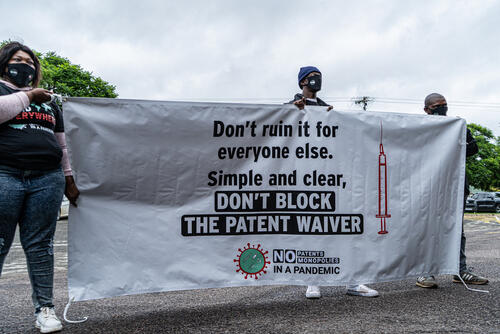
The deadly repercussions of internalising IP in terms of excludability/ the right to exclude- as the most viable form of incentives for innovative and creative production- are clearly visible to us today.  COVID-19 has led to many pieces being written all around the world arguing to invoke compulsory licenses, to ensure technology transfer, to prevent trade secrecy, to maintain voluntary social solidarity towards resolving the crisis which we are facing. We are even looking at a TRIPS waiver, for an equitable access to not just drugs and technology- which can help a multitude of organizations develop drugs- but also to access research and R&D, which are the basic fulcrum of knowledge development, and are blocked by exclusivity rights- facilitated by IP ownership.

It is interesting to note, however, that IP was infact, paradoxically, developed to “encourage” learning, “stimulate” creativity, for scientific “progress”, and to help cover costs of innovation. Sadly so, it is now used as a lever to earn windfalls out of publicly funded creations, and derivative knowledge.

What is the point of such “progress”, when inspite of the availability of the end result (vaccine), it is practically left inaccessible, and primarily so due to the idea of exclusivities? What is the point of a “means to an end”, when the “means” itself hampers the realization of the “end”, to the extent of its desirable social utility? Propertizing knowledge and culture is dangerous.

IP was envisioned as a limited entitlement, and sadly one revolving around exclusivities being conferred to one who has the privilege of being the first mover – often dictated by “capability” and structural positions in the society, as also, years of appropriation of capability (ironically so) (see here). IP apparently is something used to “protect” (see here) the “creator”/ “innovator” against appropriation, but to be honest –  IP infact amplifies the norm of historical appropriation, because this is what is the foundation of the capability involved in being the first mover.

We often think of IP as something which invokes the Blackstonian idea of “my creation = my sole and despotic dominion” (see here– pg. 1135-1136), and go on to equate it to tangible property (see here), conferring the right to exclude – that is the right to restrict access, unless the access-seeker budges into the terms which I impose for them to access “my” property/IP. But let’s think socially for once- what was the purpose of conferring this monopoly? Was it to empower the so called “creator” to an extent that they could demand access- seekers/dying patients- to put up sovereign assets, including military bases and federal bank reserves, as a collateral for access? Is this a fair tradeoff for innovative efficiency? If this is what IP permits and if this is the dialogue around power that it frames- I am sorry there is nothing, whatsoever, worth celebrating. It’s a dark day. IP and propertisation of knowledge – the greed it induces – the norm of excludability it fosters- is one of the reasons why there are more corpses to be cremated, than “ghee” which can be used to facilitate this cremation.

People say: But for IP protection, these companies would never have been incentivized to create the vaccines anyway. But for IP, artists would be dying. But for IP, we wouldn’t have any movies that we watch to relieve ourselves during these dark times. But for IP, my business and my brand can easily be appropriated and but for IP, anyone can steal anything that I do. “Thou shalt not steal” is what is the principled justification of the existence of IP and exclusive rights in essential resources today.

I have a few important and compelling questions/ observations for these people:


  • Who funded the research which was used by Bharat Biotech? (cough cough! ICMR- that’s my (taxpayers) money. Where is my vaccine? If not, BB show otherwise please? Where is the transparency?). See – here, here, here

  • IP specifically in health resources and knowledge resources is not like any other market-oriented exclusivity. Such exclusivities curb access to materials which are otherwise backed by Fundamental Constitutional Rights. There has to be limits to so-called “incentives” which IP provides, to the extent of ensuring effective access along with recoupment of costs. This statutorily conferred monopoly cannot be left to be realized on the whims and turns of the market- given its direct impact on access to fundamentally essential resources. Is there any proportionality/ transparency on this exclusivity? Has BB shown how much it spent on the development of the vaccine?  Is there any data which justifies the extent of compensation it deserves? Or wait, is it correct to leave it to its market power, especially when what that directly leads to is “people dying”? What justifies the “limited right”? or is IP just here to bestow windfalls (as it has done in the past- making pharma industries and academic publishing industries a few of the most profitable industries in the world (See here and here)), and unless one budges into their demands, you better die? The IP system is murderous. Data Exclusivity is murderous. (See here and here , here and here.)
  • Is IP concerned about the actual structural inequalities that are persistent in our societies, the actual images of the people who are barely able to afford a meal today? Is it mindful of distributive realities? What kind of drugs are being developed due to IP? Rare diseases – NO, Diseases of the developing world- NO, Infections and conditions which do not affect the rich- NO, Obscure diseases which affect Tribals, Adivasis, due to their lifestyles- NO (here), but wait- Hair Transplant treatments? – YES. See here and here.
  • “Compulsory licenses” – Let us think about the number of times they even been used? Once in India in the last 51 years. Heard about Special 301 US report (here)? Compulsory Licenses as well as Article 31bis of TRIPS are just a farce, and let’s face it, that’s the truth- the amount of economic pressure that comes with the invocation of Compulsory licenses, due to structural global positions, almost makes it impossible to invoke this provision, rendering it practically almost theoretical, even during situations of such a pandemic. Anyway, even invoking such provisions barely help, due to trade secrecy, regulatory burdens, threats of trade sanctions on alternate industries, diplomatic pressures and gaps in know-how. See here, here, here and here.
  • Research Exceptions in Copyright law are theoretical provisions, because they need one to honor paywalls in the beginning itself- for purposes of access. If I don’t honor the paywall, and circumvent it, to access for researching and further building on knowledge- well the anti-circumvention police are after me. What is the purpose of the research exception? Nothing. It is practically useless, unless I pay Elsevier for access to the paywall protected article. See here. Is that conscientious to the knowledge and research development in the developing world?  Or is IP basically a tool to widen the knowledge gap, and the capacity to access and use essential research thereto?
  • How will the book author earn? How would they make money? – Well copyrights are never with book authors firstly, due to transferability. So, the whole idea of “fruits of one’s labour” is another farce to cover up for interests of industries which want to capitalize on knowledge and earn without any limits, through a monopoly on these creations- facilitated by IP. They don’t care about humanity. Just profits. As William Patry once rightly said, Copyrights as authors rights is a fascinating story carved out by industrialists to put authors in the forefront, and ultimately use the narrative, through the almost hidden tool of transferability  (it’s like those convincing ponzi schemes, with faint and minute disclaimers: “terms and conditions apply”). Copyrights as effective tools of remuneration and incentive for “authors” is the biggest canard in our history and we must realize it ASAP. (see here and here)
  • A comparison of the revenues earned by publishing houses (and even for academic publishing), is grossly disproportionate to what goes back to authors of these works. (An insightful report by Authors Alliance) The Academic Publishing industry earns a fortune, from all corners (See more here, here, and here), by exploiting these copyrights, which were intended to ensure reasonable revenue and control in favor of authors. For these publishers, it is their monopoly on visibility in the market that renders this possible. In fact, if one does not fulfill the requirements of what the publishers want to publish (including the narrative of information), it may not even get published. Authors are often at the mercy of publishers, who in fact exploit the rights of these authors, to earn the maximum amount of money for themselves. If Copyright is actually supposed to help authors recoup income through these rights, where is the income? Why are authors having a hard time making it, monetarily? (See here) Are such exclusivities desirable, at the cost of access to educational/ research papers/ knowledge resources/ resources which facilitate development of vaccines and healthcare? Is the tradeoff worth it?
  • Why would people make music? How do artists get remunerated if not for IP? Well, apart from the 1% superstars who conform to the homogenous mainstream music market, does any artist even make money out of copyrights?  Realistically, few authors have made money through copyrights. Various studies and anecdotes have helped substantiate this over time. (See here, here (page 16), here, here, here). In fact, vaguely 10% of the revenue through copyrights, has been argued to be disseminated amongst 90% of the creators, with the rest in the hands of certain “superstars” (who make mainstream content) as well as these industries themselves, which are  gold mines.  Prof. Shamnad in a hard-hitting piece, which dates back to 2010, had emphasized upon this rhetoric, highlighting the plight of creators. What is the point of a system focusing on exclusivities which are transferable, as against direct remunerations to authors? (see here for a detailed post arguing disintermediation)
  • The idea of Copyright as incentives to create cultural works is indeed questionable. As Zimmerman recognises here:

“A raft of recent studies makes it quite clear that modern creators generally have little more realistic hope than Victorian poets of earning much in the way of remuneration for their acts of creation. The copyright “incentive” notwithstanding, it is more credible to understand their devotion to the production of expressive works more as a product of love than as a response to the promise of money, because they are unlikely ever to see much of the latter. A British survey, for example, found that few of that country’s writers could support themselves by their craft, with the result that most must regularly turn to other part- or full-time jobs to supply themselves with the income necessary to survive.  This finding is consistent with those from similar studies in the United States and Canada”

There are many who have actually questioned the relevance of “exclusivities” as the reason for inducing cultural production, as well as an effective remunerative tool, even from a fruits of one’s labour approach. (see here, here, here, here, here, here and here). In fact, there are research outputs that show that copyright constraints creative autonomy, and fosters industrial conformity towards the marketable mainstream. (here, here, here and here). IP is a tool of coercion of agency and concentration into cultural homogeneity, as against democratic and representative discourse. It embraces difference within a homogenous bubble- not representative diversity. What justifies exclusivities then? Windfall incentives to invest? What about alternate- non access curbing- incentives?

  • What kind of creativity does copyright incentivize, if at all? Industrial mainstream creativity which is capable of generating the most amount of money for those who control distributive visibility. Basically, content which satisfies the aesthetic and cultural conceptions of those who are wealthy and can pay the most, and can make these copyright owners (transferees, by virtue of distributive edge) richer. It contributes to erasure of dialogues which do not belong/ or satisfy the aesthetic judgments of economically superior (often due to structural reasons) audiences who can generate maximum profits for creative industries. It results in erasure of non- urban, non-upper class, non- elite, non- upper caste, and non-racially skewed dialogues, which would make these upper classes uncomfortable. It fosters speech hierarchy which furthers the divide around privilege of capability. It levels creators belonging to communities which depend on borrowing as a normative practice as “lazy thieves” and labels them as imitators who lack the capacity of groundbreaking art, due to the derivative nature of their creative expressions, inspite of that being the norm. (look out for my upcoming paper titled Access to Culture Dialogues, dealing with this. Had presented it at WIPIP’ 21. Here are the slides).
    • IP is a shorthand for creating a white male knowledge citizenry that is completely ignorant of the knowledge and historical divide of capabilities, and appropriation thereto, as also the normative practice of borrowing and sharing involved in various cultural societies, where these norms are coerced. IP is racist. (see Anjali Vats- the color of creatorship for the last 2 bullets). It also privileges those with a capability of a first mover advantage due to structural considerations. It favors with those with better “natural” engines and provides them exclusive monopoly rights over exercise and use of that particular resource, estranging many. It does not favour the first creator (in copyrights, there is no way to ascertain whether the person claiming monopoly is actually the “first creator”), but rather the first “showcaser”, one with the ability and visibility.  See also here, here, here and here. It favors and provides exclusivities to certain kinds of cultural practices that are individualistic, textual (as against aural), and non-derivative (supposedly, as a myth), ostracizing those who practice alternate cultures, economically.

    The idea of the IP system as an entitlement, even for purposes of autonomy, “just” desserts, labour as also incentives, is a flawed belief– lest it should not have been transferable, it should have accounted for bargaining power, it should have been perpetual (which it isn’t and thank god for it – the statute of Anne was only a 10 year right (See here, but also here). IP was supposed to be a tool, to ensure that firms which invest in innovation and authors who create, are not “disincentivized” and forced to shift to marginal sources of revenue due to capitalistic forces in play. However, now, do we even need such incentives, or rather do we need such incentives which provide the power of excludability? A serious response to the same must be considerate of the magnitude of profits currently being earned by Pharma and publishing industries, and the extent to which alternative systems, which do not depend on access control, and exclusivities would corrode these profits. (For profitability in the Pharma Industry see here, here, here, here, here and here) It requires transparency in financial data, and requires conducive thought to the idea of health, education and culture, which are in effect commodified upon a model of excludability, being involved and them being fundamental to human existence. Are Patents and similar exclusivities the only drivers of innovation? See here

    Before I am bombarded with opinions which blast me saying – “What is the alternative you suggest?” – I am no one to suggest alternatives. But there are people who have been studying this field and constantly foreseeing the problems with the IP system i.e., excludable monopoly over knowledge, culture and health resources, and have suggested some feasible alternatives. But, as I guess, they will never see the light of the day, because well of course they go against the idea of “staggering profits” and windfalls, which these industries have gotten accustomed to, even if that so at the cost of human lives. If you still however, wish to see the alternatives to the IP system- which do not involve the “Right to exclude”– see  here, here, here, here, here. here, here, here, here and here.

    I believe, it is time to look beyond internalizing exclusivities and excludable. It is time to look beyond the term “Property”. It is time to believe in alternatives- one’s that aren’t governed by whims and fancies, but rather are accountable towards their larger social goals they seek to promote. If this pandemic has taught us one thing-  it is that we are all connected human beings- socially affected by and to some dependent on each other. We need to respect that and look beyond individualistic benefits and incentives.

    Let’s look beyond sole concerns of economy and industrialization, which employ means that restrict fundamental human growth. As Amartya Sen says:

    “Focusing on human freedoms contrasts with narrower views of development, such as identifying development with the growth of gross national product, or with the rise in personal incomes, or with industrialization, or with technological advance, or with social modernization. Growth of GNP or of individual incomes can, of course, be very important as means to expanding the freedoms enjoyed by the members of the society. But freedoms depend also on other determinants, such as social and economic arrangements (for example, facilities for education and health care) as well as political and civil rights (for example, the liberty to participate in public discussion and scrutiny).

    With people dying, corpses repeatedly filling burial grounds, innovative capability being stifled due to exclusivities inspite of the availability of 5 developed vaccines owned (through patents and trade secrets and data exclusivities) by already billionaire industries, I must say, the IP system* is definitely partly to blame for the continuation of deaths.

    Therefore, to conclude – Dare you celebrate today. If you choose to do so, you better know that the IP (excludability) system is complicit, and so are you!!

    *focusing on industrial policy and excludabilities and justified by non- inclusive economic considerations which further the rich getting richer aphorism.