
A few months—or perhaps years—ago, I heard a story of a monk, perhaps in one of Osho’s talks, who had recently returned to my mind, making me wonder once again what time truly is, and how deeply it shapes our legal imagination. So the story goes like that:
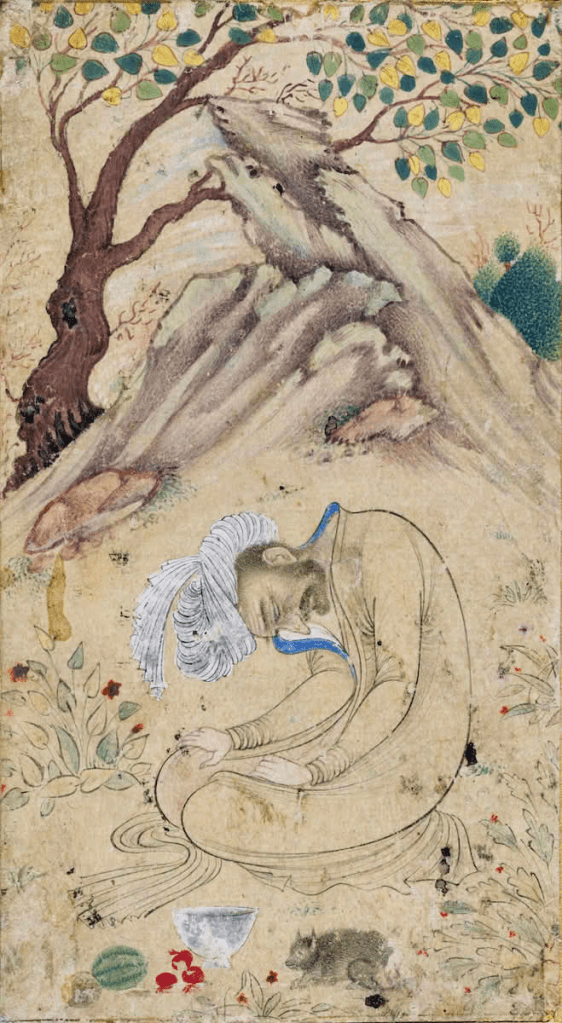
A Zen monk was working in the garden, digging the earth.
A visitor asked, “What are you doing?”
The monk replied, “I am digging.”
The visitor pressed further, “I can see that you’re digging, but who is digging?”
The monk paused, smiled, and said:
“There is no one digging—there is only digging.”
Or, as another version puts it:
“I am the very act of digging.”
Lately, I’ve been tussling with this idea of time. An endlessly exciting concept, as it is. Its meanings and non-meanings spill across disciplines: science, philosophy, psychology, and religion. And yet, my own small mind keeps returning to it through what I know better—intellectual property law.
People often speak of those rare moments when time seems to cease. Yes, those moments of immersion, of pure flow. As Professor Shamnad Basheer once wrote, in a very creative piece where I first encountered this idea of “flow,” creation arguably happens in such a state. Put simply, when we write, paint, compose, or lose ourselves in love, time seems to stop. The past and future fall away. Only the act remains. As this twitter/X user named Keshavchan defined it so nicely, “flow state. that scene in f1 when Brad was flying. in whiplash, when miles teller was one with drums. when time slows down and you are operating at a frequency beyond thought. You are no longer making something, you are simply the conduit through which it comes into being”
Put otherwise, one can understand flow as a psychological and even a phenomenological state: a becoming in which the self dissolves into the act, where the actor and the act become one, just as the monk in the story became the digging. As G. N. Devy beautifully writes in A Crisis Within, reflecting on Buddhist thought:
“Abhinavagupta postulated that ‘the knowledge of Truth is just another name for the knowledge of the Self’. For him, all experience and all dramatic sentiments were justified in their ability to evoke the experience of that which is ‘permanent nature’, the ‘sthayibhava’ of ‘moksha’. Knowledge for him was, thus, ‘realizing’ and not a (or the) ‘realization’.”
Devy offers several examples suggesting that systems of knowledge production and governance in ancient India rested on epistemic foundations quite distinct from those we take for granted today—particularly from the proprietary logic that underpins modern notions of copyright.
Returning to the idea of flow, one could say that it unfolds in a space outside measurable time. Something that mystics and metaphysicians might call kairos (qualitative, lived time) rather than chronos (quantitative, historical time). It is in this moment that the “I” which owns, measures, or names wonderfully withers away, leaving only the act itself.
But once the work is produced, fixed, and transformed into “information”—or a fount of information—it re-enters chronos. It becomes subject to laws, such as copyright laws, data laws, and other systems of record and recognition, which can be seen, exchanged, owned, copied, and thus legislated. Here, copyright becomes a technology of knowledge governance, through which the timeless flow of creation is arrested and put back into a temporal, property-bearing form. And here, dear reader, in this very domain of time, the work becomes an event: authored and evenutated by someone, made at a particular moment, and protected for a ‘duration’. After all, this, this very realm of time makes governance possible. Doesn’t it?
And hither I wonder, and only wonder (with no critique of law or anything like that) … how do we reconcile or even re-imagine these two experiences of time? On one side, creation ‘arguably’ arises from a space (?) where time does not exist. This is a personal experience. On the other hand, it must exist in time to be seen, shared, or even acknowledged. What does this passage look like? I, for sure, don’t know. And perhaps I may even be wrong to speak of space while questioning the boundaries of time. What thou says?
As Kant would have it, time, along with space, is an a priori condition of experience. We cannot think or feel without it. Love, grief, or joy, all actions unfold in duration. Every action/doing occurs across time, beginning somewhere and ending somewhere. Or, should I believe what Shri Krisha in the Bagavad Gita said, “अंतः अस्ति प्रारंभः/Antah Asti Prarambh”, i.e., meaning “The End is the Beginning”. I am tempted to second him.
And yet, I would say, the act of creation, like meditation, or perhaps love, if it may, momentarily frees us from time. The two are inseparable: we need time to recognise what it means to be timeless. No? Or, creation is not an escape from time, but a play with it. A tango between the eternal and the temporal, between pure becoming and fixed being, if you will.
Maybe.
Okay, time to be back in the realm of time… See you again 😉
Thanks to Sahana Simha for her comments on the draft.

 IP Musings
Interestingly read sir. However, purely from an academic perspective. You can also delve into the idea of how time is just a construct of space. It is oddly amusing that which is plan our lives accordingly flows differently at different points in space. Telling us that we are not that important. Scary yet relaxing. Personally, this idea has helped me get through things. Maybe it would work for you as well.