
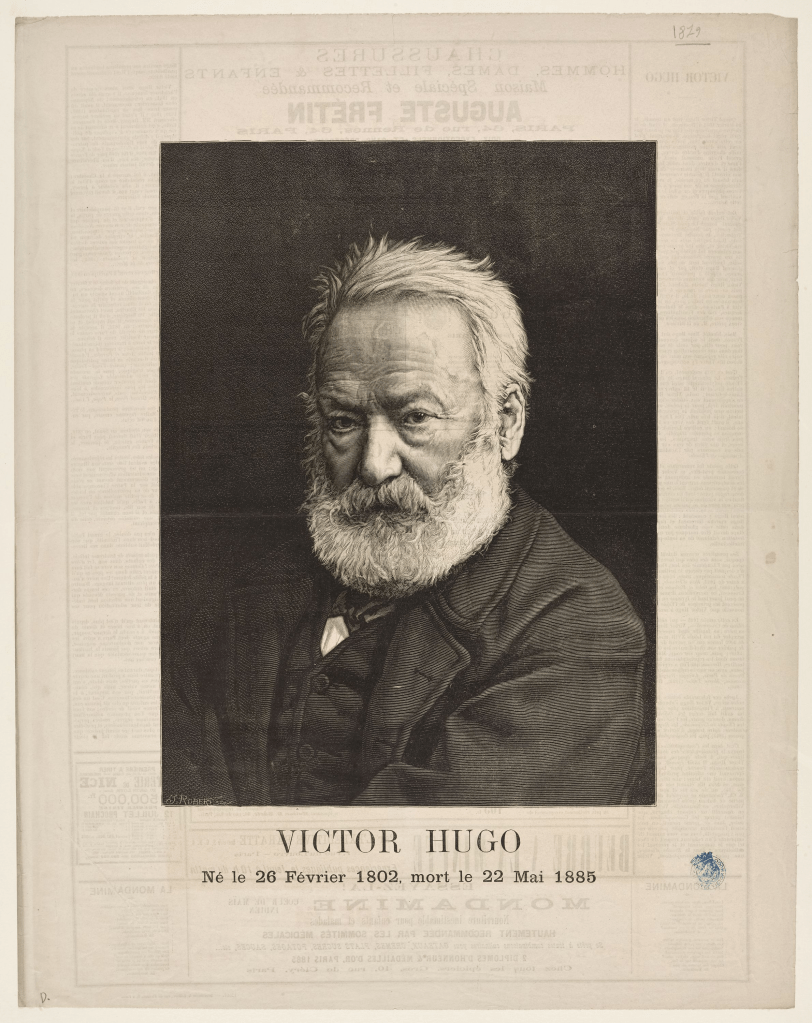
This is the second speech delivered on 21st June 1878, in which Hugo explains his case for a system that focuses more on society and less on the heirs of authors. Though he finds the interest of heirs just as respectable and worth keeping in mind.
Disclaimer – The following text is an English translation of a French original. The translation was performed using DeepL. Although I have made the best of my efforts to maintain the accuracy of the source material. I would suggest you check the original source in Pataille, J., ed. Annales de la Propriété Industrielle, Artistique et Littéraire. Vol. 25. Paris, 1880. Available through Gallica, the digital archive of the Bibliothèque nationale de France. If you don’t find the document, let me know. I will share a copy with you.
Here we go:
Discours de M. Victor Hugo , président du Congrés .(Séance solennelle d’ouverture du 17 juin.)
Since you wish to know my opinion, gentlemen, I shall tell you.
This, moreover, is merely a conversation.
Gentlemen, in this serious matter of literary property, there are two entities involved: the author and society. I use the word entity for brevity; they are like two distinct persons. These two persons, these two entities, know what they are doing and what they want; only they know this.
In a moment, we will address the question of a third party, the heir.
As for me, I have no hesitation in saying that the most absolute, the most complete right belongs to these two entities: the author, who is the first entity, and society, which is the second.
The author knows what he is doing.
Society knows what it wants.
The author gives the book, society accepts it or does not accept it. The fate of the book is decided by society.
The heir does not make the book; he cannot have the rights of the author.
The heir does not create success; he cannot have the rights of society.
I would find it difficult to see Congress recognising any value in the will of the heir.
Let us not take false starting points.
The author knows what he is doing; society knows what it is doing; the heir does not. He is neutral and passive.
Let us first examine the conflicting rights of these two entities: the author who creates the book, and the company that accepts or rejects this creation.
The author obviously has an absolute right over his work; this right is complete. It goes very far, because it extends to destruction . But let us be clear about this destruction . Before publication, the author has an indisputable and unlimited right. Imagine a man like Dante, Molière, Shakespeare. Imagine him at the
moment when he has just finished a great work. His manuscript is there, in front of him; imagine that he has the whim to throw it into the fire, no one can stop him. Shakespeare can destroy Hamlet; Molière, Tartuffe; Dante, Inferno.
But as soon as the work is published, the author is no longer its master. It is then that the other character takes hold of it, call it what you will: the human mind, the public domain, society. It is this character who says: I am here, I take this work, I do with it what I believe I should do, I, the human spirit; I possess it, it is mine from now on. And may my honourable friend Mr. de Molinari allow me to say this to him, the work no longer belongs to the author himself. He can no longer remove anything from it; or else, upon his death, everything reappears. His will can do nothing about it. Voltaire, from the depths of his grave, would like to suppress La Pucelle; Mr. Dupanloup would publish it.
The man who is speaking to you at this moment began as a Catholic and a monarchist. He suffered the consequences of an aristocratic and clerical education. Was he refused permission to republish
works from his childhood? No. (Bravo! Bravo!)
I wanted to mark my starting point. I wanted to be able to say: This is where I started and this is where I ended up.
I said this in exile: I started from a happy position and rose to the misfortune that is the consequence of duty fulfilled, of conscience obeyed. (Applause.) I do not want to erase the early years of my life.
But I go much further, I say: It is not up to the author to make a deletion in his work once he has published it. He can make a correction of style, he cannot make a deletion of conscience. Why? Because the other character, the public, has taken possession of his work.
I have sometimes written harsh words, which I later I would have liked, out of a feeling of leniency, to erase . It happened to me one day… I can tell you this, to condemn the name of a very guilty man; and I certainly did well to condemn that name. This man had a son. That son met a heroic end, he died for his country . So I exercised my right and forbade that name from being spoken in the theatres of Paris, where the plays I have just mentioned were read publicly. But it was not in my power to erase the disgraced name from the work; the heroism of the son could not erase the fault of the father. (Bravo.)
I would like to do so, but I cannot. If I could, I would have done so.
You see, then, how much the public, human conscience, human intelligence, the human spirit, that other character who is present alongside the author, has an absolute right that cannot be infringed upon.
All the author can do is write faithfully. As for me, I have peace and serenity of conscience. That is enough for me. (Applause.)
All that the author can do is write faithfully. As for me, I have All the author can do is write honestly. As for me, I have peace and serenity of conscience. That is enough for me. (Applause.)
Let us do our duty and leave it to the future to judge. Once the author dead, the author gone, his work belongs only to his memory, which will either wither or glorify it. (That’s very true! Very good!)
I declare that if I had to choose between the writer’s right and the right of the public domain, I would choose the right of the public domain. Above all, we are men of devotion and sacrifice. We
must work for everyone before working for ourselves.
That said, there is a third character, a third entity in which I take the deepest interest: the heir, the child. This raises the very delicate, very curious, very interesting question of heredity and the form it should take.
I ask your permission to quickly submit to you, from this new point of view, the ideas that seem to me to result from my careful examination of this question.
What is a book?
The author knows. He wrote it.
Society knows. It reads it.
The heir does not know. It is none of his business.
Joseph de Maistre, Voltaire’s heir, would not have the right to say: I know about it.
The heir has no right to make a deletion, to remove a line. He has no right to delay for a minute or to diminish by one copy the publication of his ancestor’s work. (Bravo! Bravo! Very good!)
He has only one right: to live off the inheritance that his ancestor has bequeathed to him.
Gentlemen, I say this quite clearly. I consider all forms of current legislation that constitute the right of the heir for a limited period of time to be detestable. They grant him complete authority that they have no right to give him, and they grant him the right of publication for a limited time, which is a useless part. They grant him complete authority that they have no right to give him, and they grant him the right of publication for a limited time, which is a useless part. The law is very easily circumvented.
The heir, in my opinion, has only one right, I repeat: to live off the work of his ascendant; this right is sacred, and it would certainly not be easy to make me disinherit our children and grandchildren . We work first for all men, then for our children .
But what we firmly want is for the right of publication to remain absolute and entirely in the public domain. It is the right of human intelligence
That is why, many years ago – I am one of those who sadly have to go back a long way in their memories – I proposed a very simple mechanism which seemed to me, and still seems to me, to have the advantage of reconciling all the rights of the three parties involved: the author, the public domain and the heir. Here is the system: when the author dies, their book belongs to the public domain; anyone can publish it immediately, with complete freedom, because I am in favour of freedom. Under what conditions? I will tell you.
There is an article in our laws that has no penalty, which means it has been violated very often. It is an article that requires all publishers, before publishing a work, to make a declaration to the bookshop management, at the Ministry of the Interior, covering the following points:
1st point: What is the book that he is going to publish?
2nd point: Who is the printer?
3rd point: What will be the format?
4th point: What is the name of the author?
This is where the declaration required by law ends. I would like to see two other pieces of information added, which I will tell you about.
The publisher would be required to declare the cost price for each copy of the book he intends to publish and the price at which he intends to sell it. Between these two prices, in this interval, is included the publisher’s profit.
That being the case, you have certain data: the number of copies, the cost price and the selling price, and you can, in the simplest way possible, assess the profit.
Here, I will be told: You are establishing the publisher’s profit on the basis of a simple declaration and without knowing whether he will sell his edition. No, I want the law to be absolutely fair. I even want it to lean more towards the public domain than towards the heirs. So I say to you: the publisher will only be required to account for the profit he has made when he comes to file a new declaration. Then we say to him: You have sold the first edition, and since you want to publish a second one, you owe the heirs their royalties. This right, gentlemen , do not forget, must be very moderate, for the heir’s right must never be an obstacle to the right of the public domain, an obstacle to the distribution of books. I would ask for only a royalty of five or ten per cent on the profit made .
No objection possible. The publisher cannot find onerous a condition that applies to profits already earned and is so moderate; for if he has earned a thousand pounds, he is only asked for a hundred pounds and is left with nine hundred pounds. You can see how advantageous to him is the law that I propose and that I would like to see passed.
I repeat that this is simply a conversation. We are all seeking to enlighten one another. I have studied this question extensively in the interests of enlightenment and freedom. I look for objections and I confess that I cannot find any. I see all objections to the old system crumbling; everything that has been said about the good or bad will of an heir, about a bishop confiscating Voltaire, has been excellently said, it was true in the old system, but in mine it vanishes.
The heir exists only as a stakeholder, levying a very small royalty on the proceeds of his ancestor’s work. Except for the concessions made and stipulated by the author during his lifetime, contracts that are binding, except for these reservations, the publisher may publish the work in as many copies as he sees fit, in the format he pleases; he makes his declaration, he pays the royalty and that is all there is to it.
Here, one objection is that our law has a loophole. There are legal experts in this assembly; they know that there is no statute of limitations without penalty; however, the statute of limitations relating to the declaration has no penalty. The publisher makes the declaration required of him by law, if he wishes to do so. This leads to a great deal of fraud, the perpetrators of which are now victims. The law should attach a penalty to this obligation .
I would like the legal experts to indicate this themselves. It seems to me that a false declaration made by a publisher could be likened to forgery of a public or private document. A penalty is therefore necessary; in my opinion, it is only on this condition that we will be able to use the system that I have the honour of explaining to you, and which I proposed many years ago.
This system has been taken up with great loyalty and competence by a distinguished publisher whom I regret not seeing here, Mr Hetzel; he has published an excellent paper on this subject.
In my opinion, such a law would be useful. I certainly do not have the opinion of the very distinguished writers who are listening to me, but it would be very useful if, in their resolutions, they would take into account what I have had the honour of telling them:
1º There are only two parties with a genuine interest: the writer and society;
2º The interests of the heir, although very respectable, must come second.
The interests of the heir must be safeguarded, but under conditions so moderate that, in no case, do these interests take precedence over the interests of society.
You have seen all the objections collapse. You have heard my words. I do not wish to influence your decision, and I do not want to know to what extent you will agree with the advice I am giving you.
I believe that your decision will be a good one.
I am sure that the future belongs to the solution I have proposed to you.
If you do not accept it, the future is patient, it has time, it will wait.
(Prolonged applause. – The assembly votes unanimously to have this speech printed.)

 IP Musings
3 thoughts on “Speech two: Victor Hugo’s Speech of 21 June 1878 at Paris Congess”