
A week to go for World IP Day. Last year, I posted a piece on this platform on why this ain’t no occasion to celebrate. I shall be reiterating the same here, albeit, in context.
In this set of 4 posts- I shall be discussing my dilemmas from the Kacha Badam Controversy. This first post covers my thoughts on the delusion that this whole controversy has produced and the need to revamp its factual narrative. The second post shall cover my thoughts on the hard case that this factual narrative exposes- something I cannot really grapple with yet. The third post brainstorms thoughts on resolving this hard case. And finally, the fourth post will, in the backdrop of these three posts, discuss an amazing paper by Prof. Alpana Roy titled- “Copyright: a colonial doctrine in a post-colonial age” and how her thesis has an important role to play in figuring out/ or rather even further complicating this hard case.
PART – 1
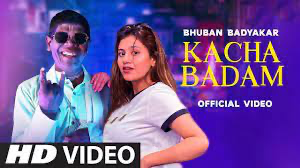
It has been a while since the Kacha Badam Controversy took shape. Readers from India would know what it entails, and in any case, this video does a good job at influencing thoughts about the whole debate. However, to put this issue in the context of its implications on cultural and copyright policy, here are the events that took place and how I see them (it might be an interesting hypo for Copyright classes):
A person Bhuban Badyakar, who earns his livelihood selling peanuts door to door, uses/sings a catchy musical tune to attract more consumers. The lyrics used along with his musical tune literally (in Hindi) says- “Kacha badam lelo” which when translated means “buy raw peanuts.” Some bystander in the village where he sells peanuts recorded him singing his catchy tune while selling peanuts, and posted it on social media websites over the internet (including YouTube). What followed is that the said video, including the “music and the lyrics” went viral on social media, and many people started to use, remix, recode, add dance moves, sing versions, and generate further content using it. The song became a viral sensation.
Upon being informed that, well, he could make money out of these uses and that others are making money out of recording and sharing his video, Bhuban reached out to the police in his village asking for his rightful musical dues.
Post this, a regional record label (Godhuli Bela Music), realizing the (i) virality of the video, (ii) economic state of the artist, and (iii) economic potential of aggressively exploiting an already viral work (under the scheme of the Indian Copyright Act), reached out to Bhuban for an assignment of all his rights in their favor, on the premise of a lump sum compensation of Rs. 3 Lakhs (around USD 3930). By this time, the song had already gone extremely viral and upon aggressive enforcement of copyrights, the amount of economic returns that could be garnered by Bhuban are a lot more than Rs. 3 Lakhs (no transformative use defense for non-personal uses of music in the Indian Copyright Act). However, this news of Bhuban even getting Rs. 3 lakhs (although at the cost of assigning away all his economic rights forever, without any scope of a termination of transfer existing in the Indian law) has been hailed by all saying – he got his rightful dues! Even the record label, after getting rights in a super-viral musical work assigned in its favor, put out a statement:
“The whole thought behind this project is to recognize and respect the original creator- Bhuban Badyakar”
As a consequence of this transfer, however, what has potentially been impeded is the ability of users/remixers/user-generated content creators to culturally interact with Bhuban’s work without paying a license fee to the record label (which being an investing business and not really someone who has created – would tend to exploit all money-making avenues in respect thereof). The prospect of royalties going back to Bhuban is also meek, given (i) the history of royalty disbursals in the case of Bollywood biggies (here, here, and here), let alone Bhuban, (ii) the actual state of royalty disbursal in India which amount to a mere 10-15% of the amounts earned by the assignee, and (iii) the interpretive question on the need of disbursing royalties when works are not incorporated in a film or a sound recording, in spite of a specific requirement under Section 19(3) of the Act for any assignment to compulsorily include “consideration and royalty”. However, the fact of the matter is that Bhuban is happy and famous and getting gigs– not because of the label- but because of the long tail of the internet. How does this reflect on copyright and cultural policy? (important reading here)
What comes into the foray from the above fact-view narrative is the delusion that the media has been making out of this incident, hailing it to be a huge win for Bhuban and the role of copyright policy in respect thereof (here and here). What it also brings out in perspective is the role of the existence of copyright law. What the tool of copyright law and its current framings in the Indian Act is doing at the moment- in this instance and many other instances- is benefitting no one else but a corporate entity.
Mind you- neither is the author getting their so-called– “rightful” dues – as was contemplated by the framers of the Act in their intent statement captured in the Rajya Sabha debates of 1955 and 2012 —nor are users, who seek to culturally interact, remix and produce transformative works for a wider variety of works for people to experience and for the broader cultural enrichment of the society (in terms of volume and diversity) getting to do the same- given a far greater potential of aggressive enforcement of copyrights by a corporate non-creating inventor, as against the actual author.
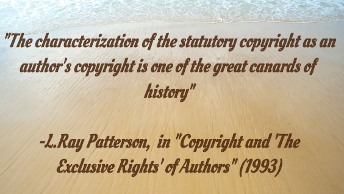
What is the point of having such a system? Is the law merely to benefit an investor, seeking to invest in already viral content, at the cost of the cultural enrichment of the society? No wonder the idea of Copyright, and its ideological symbolism of being hailed as an author’s prime tool, is nothing but one of the greatest canards of history.
I understand the argument that the author may be happy with whatever he has gotten, given Rs. 3 lakhs plus some meek royalties (if and when he gets that is) would be a huge sum for someone who used to sell peanuts + the amount of fame + ripple effect gigs, advertisements, etc. – but to me- that is exactly the problematic point:
If the author receives an amount “x” as the economic incentive to produce the work, in lieu of their copyrights, and they are happy with it (given the virality and prospects, etc.), what is the need for any further tax on the public to access the said work? Doesn’t the role of Copyright as a regulative policy end there? If there is no other recoupment for the author and the author is simultaneously happy, why more access fee in the name of either incentives or just desserts or whatever?
Especially considering the internet and its long tail, why is there for any need for a rate – x+y to be paid- where “y” merely goes to corporate investors seeking to make money out of aggressive enforcement of copyrights?
In my opinion, especially in the context of content that is already viral even before record labels/distributors/publishers step in, this additional amount “y” that is levied as a tax on users, is an unjustifiable deadweight loss and nothing else. The mere disbursal of a lump sum payment cannot be a ground to justify this deadweight loss as a desirable policy, given the undesirable tradeoff of a concurrent tax “y” and continued exclusivity in the hands of a corporate entity (non-creator). Maybe we need to figure out a way that this amount “x”, in Bhuban’s case Rs. 3,00,000, reaches out to him quickly from users directly- and maybe we need to figure out an efficient system in respect thereof- but allowing intermediation, assignments, and continued exclusivity (resulting in immeasurable further tax on users and downstream creators), just because a lump sum by an intermediary is easier- is not a ground to justify beyond incentive payments by users for access and use. It goes over and above the actual intent of copyright and is merely a problem of laze.
We ought to realize this and push for disintermediation in Copyright policy (banning assignments or alienation by authors in favor of corporates), especially in the era of the internet. But for disintermediation- we are gravely and adversely affecting cultural engagement, enrichment, and freedom- something which is paradoxical to the goal of copyright and cultural policy. In a copyright scheme where no transformative usage is recognized (unless it is for personal/private purposes, research purposes, or parodical/critical purposes), such change is all the more required to ensure that copyright incentives, which do not even go back to the author, do not freeze cultural engagement and democracy- or the ability of situated users to talk back and present their cultural narrative in an accommodative permissive cultural space.
This is FOR both the author and the user (aren’t they the same?), and only against a corporate investor- who ideally should really have no stake in Copyright policy, but unfortunately has the most. Who knows, as Oren Bracha argues– the history of IP (commodification of expressions (might actually be the history of capitalism, which is an unfortunate truth.
Part 2- On the hard case here.
Part 3- Resolving the hard case here.
Part 4- Alpana Roy on Decolonizing IP here.
 IP Musings
3 thoughts on “Clearing out delusions from the “Kacha Badam” controversy:”