Alpana Roy on De-Colonizing Copyright and Cultural Policy

In this set of 4 posts- I shall be discussing my dilemmas from the Kacha Badam Controversy. The first post covered my thoughts on the delusion that this whole controversy has produced and the need to revamp its factual narrative. The second post covered my thoughts on the hard case that this factual narrative exposes- something I cannot really grapple with yet. The third post brainstormed thoughts on resolving this hard case. Finally, this fourth post will, in the backdrop of these three posts, discuss an amazing paper by Prof. Alpana Roy titled- “Copyright: a colonial doctrine in a post-colonial age” and how her thesis has an important role to play in figuring out/ or rather even further complicating this hard case.
PART-4

In this final post, I am discussing, Prof. Alpana Roy’s paper titled Copyright: A colonial doctrine in a post-colonial age, in the backdrop of the discussions we have had so far. I also had an opportunity of discussing this article in the Critical Interdisciplinary Perspectives to IP reading group hosted by Prof. Anjali Vats, Prof. David Jefferson, among others- which led to a lot of thoughts pushback, and questions. I shall try and put them out here This is also my expression of gratitude to all who turned up for the reading group.

Prof. Alpana Roy’s article, published in the Copyright Reporter in 26th Volume 4th Issue, in December 2008, discusses IP from a sharp post-colonial lens. It is a provocative piece of writing, to say the least.

Setting the stage, Roy clears the air on what colonialism implies and what constitutes de-colonial thinking. She clearly puts it forth that the socio-economic exploitation of the so called “periphery” or alternate, need not always be directly political or dominated by the military. It can also involve continued subordination through the exploitation of the political economy to adversely affect capabilities. She mentions the prevalence of colonial thought in law-making and how it pervades global norms, in sheer ignorance of alternate indigenous realities. This narrative somehow resembles the work of the amazing late Prof. Keith Aoki, on what he calls Neo-Colonialism, and in the context of IP states that- transnational IP system erode concepts of sovereignty and self-determination.

Putting the article in context, Roy turns to International IP Agreements and reflects on the role of these “multifaceted projects” or dominant narratives which primarily reflect/mirror particular moments in the history of Western cultural practice. She emphasizes the importance of this by projecting the dissonance of the norms in agreements like Berne, with nations outside the West. She asserts that Copyright remains a foreign concept in many cultures, and many societies take an extremely radical view on what constitutes property and can be the subject of individualistic private property. In this context, it is important to reflect on the “independent” v. “inter-dependent and inherently social conceptions of the self (the idea of a “family”)” which vary across societies – with the West bending towards the former and Asian societies towards the latter. The law, as it is in its current “global” framings, only accommodates the former, completely ignoring the latter.

She then goes on to talk about a few of these individual dissonant features: (i) print culture (ii) the idea of piracy as against copying and sharing as a sign of respect and recognition- and mentions how such norms being globalized are nothing but a symbol of a dominant narrative used to foster a “one-way traffic around the notion of desirable culture”- consequently moving towards cultural imperialism. It is at this point where she makes her most important argument about this whole system having a far deeper impact than the earlier forms of colonialism, imperialism, or simple tourism, as it tends/attempts to alter the source of the self.

Hereon, she gets into the hard case by discussing the example of “Return to innocence”, supposedly a Taiwanese tribal song, which was appropriated out of a performance by 30 indigenous Taiwanese performers who were invited to perform across Europe by the French Ministry of Culture. A significant portion of these songs was used by a German music entrepreneur and was then also recorded by Enigma- and sold as “his copyright”, without any due accreditation or financial compensation for the use of the said song. She primarily uses this example to first- expose the political economy of cultural practice, and thereafter and most importantly, the political economy of law on culture- and who gets to enforce and who doesn’t. This is important in the context of the debate on print vs. aural culture, as well as in the context of the argument that accesses to a platform to showcase determines who gets to ‘own’. What I am concerned about, in this example, is not the appropriation, but rather the possessive claim of Enigma over this output- dispossessing many others who could have been the actual originators of the expression and should have had the ability to use, build on, or get any financial remuneration in respect thereof. It is in this context that the appropriation is important to be addressed.

Roy uses the “Return of innocence” case to contend how indigenous works fail to fulfill individualistic notions of property rights and are dispossessed from their performers through dissonant norms. She uses this to show how western law, and its hegemonic transposition is highly inappropriate, results in fictitious commodification, and continues to perpetuate the idea of the historic “other” even in law and policymaking. She aligns with Rosemary Coombe who argues that neoliberal conceptions of copyright do not accommodate cultural differences that are difficult to be formulated in terms of a commodity, and are hence difficult to encompass within the conceptual frameworks of “modernity”.

Roy also refers to oral research outputs and argues that as soon as someone publishes all the oral research output they get copyright over it- dispossessing participants and researchers who contributed and undertook research orally but did not/could not really “fix the output in the printed/published form”. On this aspect of fixation, during the discussion with the reading group, Prof. Ann Bartow put forth an interesting question as to- how do rules of evidence work in aural societies? – Historically mapping the same could be an interesting analogy to look at while discussing the irrelevance of fixation norms in non-western societies.

Roy then moves on to how these western cultural norms were exported to colonies by European colonizers as a part of the package of colonization, most prominently in the 18th and the 19th Century. She states that pirating foreign work was still prevalent in free-er countries given the US only joined the Berne until 1989 and offered little protection. To foreign authors until then. Unfortunately, those who were colonized had little say in such policy for their own capability development (I discuss this aspect of IP Gradualism in detail in my paper here).

Roy then moves to the strongest part of her paper where she argues the relevance of printing technology and entrepreneurs in respect thereof in centralizing and transplanting these western norms abroad.  She talks about how printing was essential for the colonial and imperial projects of Europe as their empires could not have survived without the spread of propaganda, religious tacit, commercial documents, maps, charts, etc., among the natives. Here comes the relevance of copyright. She argues that as a form of communication- printing, unlike oral communication, has a tendency of universalizing ideas- and disseminating information through identical texts and making them truths by imposing them through “violent hierarchies” facilitated by the tool of colonialism and the Prospero complex it produces. She talks about how most of the so-called “universal truths” coincided with this enlightenment period of solitary creation and printing technology – that is basically the rise of print medium and subsequently the law of copyright. Importantly she reiterates that this exchange was not happening among “equals” but rather as an imposition in a colonial setup.

Upon political decolonization, Roy writes that there were some modest attempts at resisting western copyright by the Global South, in the context of the inability to translate and develop knowledge, however not to any structural yield. Thes prevailing norms have not only been normalized but have, through TRIPS, also been universally accepted (read: imposed), and are now a part of public international law.

Moving on to a consequential analysis of these norms, embedded with capitalism and the global political economy, Roy quotes Butalia, to argue that it is impossible to separate the world of Copyright law from the world of politics, as knowledge, culture, and access are inextricably linked with power, power is linked with money- and both of those are linked with history– something which cannot be repaired easily. In my opinion- this brings us back to the hard case and the relevance of reparative solutions to be intermingled with systemic change and to look at the same as complementary rather than as an either/or binary.

Roy finally concludes by referring to how copyright is nothing but a tool to merely further the trade and capitalist interests of western societies. However, a consequential corollary of this, which Roy misses in her analysis, is the impact of such a tool on identities and cultural estrangement- the “othering” of non-marketable culture. We might be celebrating Bhuban and his expression today, but that is only because he and many others like him, who do not fit in to this marketable system have been othered from cultural identity framing discourses and economic benefits in respect thereof, for a long, long time. As Macneil argues, we cannot subordinate the subsistence of society itself to the laws of the market, and the interest of the marketers, as it disenfranchises humans of the ability to direct the trajectories of their social institutions. We cannot, as a society afford to do this, as the same is nothing estranging identities.

To conclude these posts, the takeaway I seek to present is-  the need for scholarship, research and thought on –

How to ensure that identity interests of self-determination (including remunerative concerns), especially of those who have been denied the same for long, are retained-  without resorting to dissonant logics of property rights as tools of affirmative action?

Hope we have enough food for thought! Do reach out if anyone wishes to discuss any of this. I am available at 97akshatag@gmail.com


Part 1- here

Part 2- here

Part 3- here

Resolving the ‘Hard Case’? You can try the best you can!

In this set of 4 posts- I shall be discussing my dilemmas from the Kacha Badam Controversy. The first post covered my thoughts on the delusion that this whole controversy has produced and the need to revamp its factual narrative. The second post covered my thoughts on the hard case that this factual narrative exposes- something I cannot really grapple with yet. This third post brainstorms thoughts on resolving this ‘hard case’. And finally, the fourth post will, in the backdrop of these three posts, discuss an amazing paper by Prof. Alpana Roy titled- “Copyright: a colonial doctrine in a post-colonial age” and how her thesis has an important role to play in figuring out/ or rather even further complicating this hard case.

PART-3

In this post, I shall discuss thoughts on the hard case, and why it is really hard. I will also discuss my preliminary ideas on resolving its dilemmas. To put things into perspective-

Should we be celebrating Bhuban’s remunerative win (which supposedly is because of Copyright law) or should we be questioning the structural acceptance of a copyright system that is significantly dissonant from the ontological reality of cultural practice in India – a system that has merely been transposed from the west due to the state of law and the global political economy?


The hard case is really hard as one of the major issues that come with a structural challenge to the system- is its ignorance of the years of inequality and identity politics associated with cultural production. We can never crawl back to ground zero. The structure of copyright law, its commodifiability, and dissonance with alternate cultural practices has already produced a skew in visibility- which cannot be discounted. A structural challenge to the system would result in an unequal commons- resolving none of our equality concerns.

In other words, although by allowing sharing, derivation, and remixing to make it compliant with other ethnographic realities, a structural challenge to copyright’s individualistic norms, does help substitute individualistic possessiveness, however, it does little to narrow the privilege gap resulting from the prevailing system. Structurally challenging copyright norms may allow for wider cultural engagement- but they do little in remedying the lack of engagement or the skew in practice that is already persisting. Anyone who has, as a result of the prevailing system, attained a comparative advantage, continues to enjoy the same – given investment capabilities and the political economy of cultural practice. In line with this, how do we ensure that Bhuban gets his due remuneration to survive?

Proponents who believe in revamping the copyright system internally and allowing economic recognition of artists like Bhuban through prevailing norms- as a more practical solution, maybe right to the extent that it allows for these individuals to get recognition and helps balance out the inequalities to some extent.  These proponents also believe that property-like rights are the only retributive solution to the issues created by property-like exclusivities themselves. Madhavi Sundar and Anupam Chander convincingly argue, in their paper- The Romance of the Public Domain, that leaving these ignored cultural expressions in the public domain does not help satisfy societal ideals and rather perpetuates inequality by allowing those with the capability to misappropriate (not dispossess, but rather get a better benefit due to access privileges) to freely do it. It denies them a claim to self-determination. They, thus, argue for a property rights-based liability system (no control but an objectively defined fee on every use) to continue in favor of those who have been denied long-standing claims- to be able to re-project a scenario where we start from ground zero. For them, Bhuban getting this remunerative benefit would be a deal worth it from an overall welfarist perspective.

For me, this is something I continue to be unclear about, because fundamentally – using a property-rights-oriented solution to solve problems that are a result of the long-standing prominence of the same system- is paradoxical. As Amy Kapczynski argues, “why should we view a collective despot as an improvement over an individual despot?”

 I do agree that Prof. Sundar and Chander only endorse a liability model– where contours of exclusive possession and control do not strictly apply, and rather a fee is to be paid for every use However, even this, as a tool of affirmative action, does reify- principally the same tool of exclusivity. It also ignores how the idea of “originality” of a “work”– the genesis of a “mine” claim in the first place- is a myth- and a result of privileges of access (to showcase). This is applicable to both the claims of individuals and communities. One can never really prove that an expression is theirs and only theirs- and not a result/derivation of someone else’s. Once again- possession results in dispossession (often of the unknown).

Further, a liability rule, in my opinion, does not really address the main issue here- i.e., one of misappropriation of identities. Commodification has most definitely denied many non-commodifiable forms a claim to money- but most importantly it has estranged identities. The liability rules do not really help resolve that aspect.

Rosemary Coombe provides another interesting angle to this hard case in her paper- Ethnographic Explorations of Intellectual property– more so from an anthropological perspective. She maps arguments of the latter school of thought which say that even collective ownership dispossesses and reifies western liberal thoughts in culture impeding cultural engagement and ignoring ethnographic realities. She says that the whole idea of ownership in the binary of the individual and collective ought to be challenged from a hybridized perspective- and needs to be looked at by examining the actual reality of how culture is practiced, rather than requiring to mold cultural practices to fit in. She endorses the need for the decolonization of identities, as well as legal norms, by suggesting a more personhood-oriented solution to the aspect of reparations, as against one guarded within economical concerns- as was the case with the liability system. She argues for a system of benefit sharing to recognize the “cultural rights ” of people practicing alternate cultures rather than centering on a solution from an economic point of view. The idea is to endorse the personhood, identities, and development of these diasporic, hidden individuals and communities. Her focus is on ensuring that these identities are not dispossessed as against cultural outputs not being dispossessed. – given we can never be sure of what was the genesis of the cultural output in reality.

For me, as brewing thoughts, a few methods of resolving this hard case without resorting to a binary could include – primarily – decommodifying culture and making expressions inalienable, especially in favor of corporates who seek to capitalize and earn profits out of the most commodifiable and marketable identities/expressions. (see part 1) This potentially could resolve a huge hierarchical concern, at an institutional level, in respect of the ability to capitalize/market and showcase culture. However, I do agree that it does little on the aspect of the performer’s individual economic standing and capability to promote or be visible.

Another area that could be considered, as a part of future inquiry, could be getting rid of the idea of authorship of a work, and treating all expressions as performances- given we can never really figure out whether one is the “originator” of the content, but we can always associate the identity of the performer- with a particular performance. This avoids impeding downstream creation, especially in communities that depend on it, as well as ensures that if the performance, as a whole, is utilized as against merely the content within the performance (musical and literary “work” in current copyright framings), there is some remunerative benefit accruing to the previous performer for the associated identity thereto. So essentially, Bhuban cannot claim exclusivity over Kacha Badam, but if someone uses his performance of Kacha Badam substantially (Ann Bartow standard), he would have a remunerative claim (see here for a study on compensation systems) for the use of the cultural identity associated with his expression. This identity cannot be alienated from him in favor of any corporate entity. 

Coupled with this, maybe limiting this remunerative claim to only those performers who are a part of the “traditional knowledge”/ alternate culture herd- i.e., ones that have been denied a claim to be able to be visible for long, could serve the reparative goal sought by the primary school of thought. However, I have my doubts about the practicality and the acceptance of this, especially in light of the strong globally intuitive resistance to affirmative action policies in support of concerns of reparative equality, sometimes co-related to substantive equality.

Finally, another interesting area to build scholarly agendas on the side of equality in cultural policy and tools of affirmative action in respect thereof could be algorithmic support on the internet. By using tools of an affirmative bias in favor of performances/identities which have effectively been rendered invisible for the longest, a slow transformation could potentially take shape. Such cooperative responsibility from tech platforms could effectively help significantly revamp identity politics, and allow them to capitalize on scale benefits that come with it. As has been argued by Monson et al, it most definitely is technically possible to code algorithms that promote exposure to diverse content and highlight alternate perspectives- something which favorably happened in Bhuban’s case.

I do however acknowledge that these proposed solutions do not really resolve much, given hierarchies exist even within alternate contested identities. They do not have any sort of an enormous potential to resolve long-standing hierarchies which exist both due to copyright and beyond copyright concerns. But the intent of these posts is to have people engage in alternate cultural policy framings, without giving in to the binary of the internalist and structural critiques of the law in the context of this hard case. There is a need for social justice scholars to stop romanticizing either side of this hard case. In any case, we cannot afford to be celebrating the delusion produced by this Kacha Badam instance. 

In the next and the final post I shall, in the backdrop of this discussion, write my thoughts on Prof. Alpana Roy’s paper (more on the structural critiquing side) titled- Copyright: A colonial doctrine in a post-colonial age.


Part 1- here

Part 2-here

Part 4- here

“Kacha Badam” debate presents the Indian ‘Hard Case’?

In this set of 4 posts- I shall be discussing my dilemmas from the Kacha Badam Controversy. The first post covered my thoughts on the delusion that this whole controversy has produced and the need to revamp its factual narrative. This second post covers my thoughts on the hard case that this factual narrative exposes- something I cannot really grapple with yet. The third post shall brainstorm thoughts on resolving this hard case. And finally, the fourth post will, in the backdrop of these three posts, discuss an amazing paper by Prof. Alpana Roy titled- “Copyright: a colonial doctrine in a post-colonial age” and how her thesis has an important role to play in figuring out/ or rather even further complicating this hard case.

PART – 2

To put the idea of the hard case (not in the Dworkinian sense of “principle” but rather qua policy)  in context, I would refer to how I began thinking of it. While reading the wonderful Prof. Anjali Vats’s book- The color of creatorship, I came across an interesting narrative in the context of the Blurred Lines case in the US (Williams v. Bridgeport Music Inc. (2015)). What Vats mentions is that reading the Blurred Lines case is a complex negotiation in the backdrop of a legal system that consistently disenfranchises Black creators of the ability to come across as winners. The case was a historic instance, hailed by many, where, in a copyright infringement action, a Black creator was given a favorable judgment on infringement over, as Vats mentions, “white vultures” of the music industry. This was in a situation that was debatable from the lens of the infringement standards practiced in the US (given it involved ambient sounds). Now- there were two schools of thought that emerged after this case (both belonging to the larger roof of social justice scholars– however taking completely opposite stands on this issue):

The case was significantly hailed by a school of thought as a moment of reparation for black creators, who were significantly appropriated for a larger part of music history, without any sort of monetary compensation. It was an instance helping move toward a legal remedy for more than decades of appropriation of black artists. It was also appreciated as an instance that recognized the protectability of black musical practices.

HOWEVER

A set of critics of this judgment (the other school of thought) kept their focus on a rather structural argument concerning the colonial/western nature of Copyright policy, arguing that the said instance does nothing to repair concerns of equality and in effect reifies and attempts to normalize concepts outside black culture into black culture (in-contextual transposition). Hailing the judgment also estranges the fact that the verdict is extremely harmful to appropriative cultural practices like sampling, hip hop, reggaeton, etc. (mostly practiced by black musicians, or loosely non-western musicians). It reinforces racial capitalism, and a structural racial skew in legal interpretation, against normatively black practices which focus on re-use, and derivation rather than “original creation”. According to them, internalizing could never ever remedy/repair a copyright system that is racist to the core– and there was a need to structurally challenge it rather than supporting the expansion of the doctrine.

This brings us to the hard case.  Prof. Vats, in her book, presents this hard case in an interesting manner by writing as to how this situation was a seemingly forced choice for individuals invested in social justice outcomes out of this case and IP in general. It was either (i) embracing nostalgia and reparation for Gaye or (ii) a commitment to the musical innovation of hip hop (a non-western, non-white, non-individualistic art form dissonant with traditional principles of copyright law).

It was essentially a hard case to choose between “more” copyrights supporting the interests of black artists within the system of copyright law that exists, or a structural change in copyright according to actual epistemological realities or non-white cultures.

Using this, she turned to the de-colonial notion of creatorship and protection, outside the romanticism of commodification and the racial capitalism that it produces. She argues in her last chapter: “Advocating for intellectual property egalitarianism in a way that is legally and politically legible, requires pushing back against accepted IP doctrines, which conceal racial (and colonial) logics.” It is basically a debate between- internalizing possessive individualism (and looking for a solution within) v. structural questioning, which of course may not be a binary, but could end up eroding each other’s territories. We shall get more into this in Part-4.

Against this backdrop, the motion essentially is – Does the celebration of a black artist (Plaintiff) getting a judgment in their favor on copyright infringement, reflect a vantage point in the estrangement of cultural practices, norms and tendencies, through the neo-colonial tool that is western copyright?

Coming to the Kacha Badam issue, and the relevance of this backdrop therein:

I completely subscribe to and endorse the need to ensure that Copyright policy allows Bhuban to protect/recoup his remunerative interest in this performance, given his economic state/ standing, and the surprising visibility that has only been made possible due to the virality provoked by the long tail of the internet. Even record labels nowadays take their investment decisions depending on this viral tendency and potential. Prior to the internet, there was effectively a grand denial to creators/artists from remote villages in India to a claim to participate in visible culture and to be able to exploit them economically- especially due to the need to satisfy the aesthetic preferences of record companies before getting any visibility. I also agree that given folk artists have been denied such protection for the longest time, such remunerative benefit and commodification would help Bhuban do economically better, and will also recognize the copyrightability claims of such artists (I am still unsure as to whether we can categorize Bhuban’s performance as folk, but the song’s tonality does reflect folkish tendencies). I also understand the intuitional trigger and reparational thought in favor of Bhuban due to the long denial of visibility to such artists, his economic state, and the just desserts philosophy that comes with it.

I further subscribe to the fact that – those remixing and using Bhuban’s performance, attributing it to themselves, and in some cases also claiming copyrights over them (exclusivity over exploitation) to market using social media platforms/reels and other mediums, ought to pay license charges to Bhuban and attribute him- given the realistic state of the capitalistic society we live in. The possibility of remixers (who enjoy a better capability to capitalize or better access to visibility) using copyright to claim monopolies on their derived output- and earn money without paying any license fee to Bhuban, can never be discounted. The possibility of them misappropriating something linked to Bhuban’s identity can also never be discounted.

These are some extremely important real-world issues and do effectively endorse this thought of addressing the remunerative and reparative interests of Bhuban and such artists using Copyright law and its possessive individualism– as due compensation for the years of denial of economic compensation over such output and a lack of equal visibility.

But…..here comes the hard case.

A non-internalist/structural critique of this whole controversy would be-

Isn’t the compensating mechanism, mentioned above, normalizing a legal system of exclusivity and possessive individualism -over cultural expressions? Isn’t this a purely western normative ideal, against the norm of sharing – practiced widely in Indian folk cultures, forms of music, musical tendencies, and practices? How does it reflect as a consequence on the idea of imitative musical learning as a mode of pedagogy- which is extremely prevalent in indigenous and alternate musical practices? How does it also reflect on the romanticism of individualistic IP policy and its transposition on dissonant communitarian cultural practices/societies?

In India, indigenous cultural expressions have never really aligned with property-based exclusivities. In fact, to the contrary, there has been explicit resistance to recognizing this possessive individualism (see here, here, here,  here (accompanying note 16) and here), by practicing norms of anonymity while disseminating content, practicing imitation based learning as a core form of pedagogy (here, here, here and here) and by rather focussing on communitarian practice and performance of cultural expressions (here, here and here). For a general critique of the idea of possessive individualism – in the context of Indian culture and identity- see here (Chapter 8). Jaszi and Woodmansee have also, in detail, discussed the dissonance of individualistic norms of authorship and various cultures (which they refer to as “traditional” cultures, although I prefer- alternate cultures).  

The problem with internalizing copyright norms, which are premised on exclusive possession, is that it often relegates ontologically non-commodifiable/ non-individualistic/ community outputs and expressions, to the verge of cultural estrangement and diminishing. Expressions like folktales, ballads, chants, proses, alternate musical practices, religious musical expressions, Indian Classical and Carnatic music, etc., which involve aural transmission or are derivative and collective/communitarian creations do not fall within this commodifiable idea of a creation that is copyrighted and economically transacted in a market setup. This often results in cultural freezing. I, not for once, propose to say that the law should rather commodify such communitarian perspectives as well (as it has been doing in the case of traditional knowledge lately). I rather contend that this normative dissonance ought to be realized in the law and should be remedied by tailoring the law to foster these cultural practices rather than impede them by commodifying and altering their ontological nature in the first place. Transcribing western copyright norms, and in fact romanticizing them (its expansion and role) in cases of completely dissonant expressions, as in the case of Bhuban’s work, ignores the incompatibility of cultural expressions with core principles of western copyright norms- (i) fixation, (ii) individuated authorship, (iii) romanticism of originality and non-derivation (iv) exclusive possession, (v) author performer divide.  It also results in cultural alteration- merely for commercial advantage. In my opinion, such transposition of non-compliant norms takes the shape of a neo-colonial tool that does nothing but reflect the political economy of framing the law (in favor of western commercial interests by the neo-liberal tendencies of the western society). It also affects the political economy of culture and cultural practices. It shows a skew towards market fundamentalism, even in cases of cultures- which were never really supposed to be/ fit to be marketed in an industrial setup. We have to realize this and structurally challenge this.

Bhuban’s musical tone reflects a clear folk tonality, wherein it isn’t easy to assume originality, lest it shall devoid a majority of the members of a community, and dispossess them a claim to something that is normative to the community practice. Every possession results in dispossession. Even assuming the said musical work to be original, the social process of creation and the privilege of being able to access an audience can never be discounted. Romanticizing and transposing individualistic norms of this sort- denies many (who lack such access to showcase, get showcased, and receive) a participative claim to cultural exchange. Moreover, western copyright norms often seek justification on the idea of incentives- i.e., the assumption that unless such rights are granted- one might not be incentivized to create. Well, for starters, Bhuban had no idea he had these copyrights when he performed. The generalization of such a utilitarian conception, in cultural policy, dismisses the fact that for many – music is merely a source of communication and expression and not something which requires any incentive to be produced (some interesting scholarship on this facet here, here, here, here and here) However, this, of course, does not discount the fact that for many, who seek to practice music professionally and are not able to due to economic concerns forcing them to marginal sources of revenue (avenues which guarantee better economic condition), such incentives matter. What I seek to challenge is the generalization of these incentives as being the norm.

So, coming back,  how do we resolve this hard case? To be honest, I don’t know. But it may not be an either/or situation as it seems to be. We shall be looking at this in the next post.


Part- 1 – here.

Part 3- here.

Part 4- here.

Clearing out delusions from the “Kacha Badam” controversy:

A week to go for World IP Day. Last year, I posted a piece on this platform on why this ain’t no occasion to celebrate. I shall be reiterating the same here, albeit, in context.

In this set of 4 posts- I shall be discussing my dilemmas from the Kacha Badam Controversy. This first post covers my thoughts on the delusion that this whole controversy has produced and the need to revamp its factual narrative. The second post shall cover my thoughts on the hard case that this factual narrative exposes- something I cannot really grapple with yet. The third post brainstorms thoughts on resolving this hard case. And finally, the fourth post will, in the backdrop of these three posts, discuss an amazing paper by Prof. Alpana Roy titled- “Copyright: a colonial doctrine in a post-colonial age” and how her thesis has an important role to play in figuring out/ or rather even further complicating this hard case.

PART – 1

It has been a while since the Kacha Badam Controversy took shape. Readers from India would know what it entails, and in any case, this video does a good job at influencing thoughts about the whole debate. However, to put this issue in the context of its implications on cultural and copyright policy, here are the events that took place and how I see them (it might be an interesting hypo for Copyright classes):


A person Bhuban Badyakar, who earns his livelihood selling peanuts door to door, uses/sings a catchy musical tune to attract more consumers. The lyrics used along with his musical tune literally (in Hindi) says- “Kacha badam lelo” which when translated means “buy raw peanuts.” Some bystander in the village where he sells peanuts recorded him singing his catchy tune while selling peanuts, and posted it on social media websites over the internet (including YouTube). What followed is that the said video, including the “music and the lyrics” went viral on social media, and many people started to use, remix, recode, add dance moves, sing versions, and generate further content using it. The song became a viral sensation.

Upon being informed that, well, he could make money out of these uses and that others are making money out of recording and sharing his video, Bhuban reached out to the police in his village asking for his rightful musical dues.

Post this, a regional record label (Godhuli Bela Music), realizing the (i) virality of the video, (ii) economic state of the artist, and (iii) economic potential of aggressively exploiting an already viral work (under the scheme of the Indian Copyright Act), reached out to Bhuban for an assignment of all his rights in their favor, on the premise of a lump sum compensation of Rs. 3 Lakhs (around USD 3930). By this time, the song had already gone extremely viral and upon aggressive enforcement of copyrights, the amount of economic returns that could be garnered by Bhuban are a lot more than Rs. 3 Lakhs (no transformative use defense for non-personal uses of music in the Indian Copyright Act). However, this news of Bhuban even getting Rs. 3 lakhs (although at the cost of assigning away all his economic rights forever, without any scope of a termination of transfer existing in the Indian law) has been hailed by all saying – he got his rightful dues! Even the record label, after getting rights in a super-viral musical work assigned in its favor, put out a statement:

“The whole thought behind this project is to recognize and respect the original creator- Bhuban Badyakar”

As a consequence of this transfer, however, what has potentially been impeded is the ability of users/remixers/user-generated content creators to culturally interact with Bhuban’s work without paying a license fee to the record label (which being an investing business and not really someone who has created – would tend to exploit all money-making avenues in respect thereof). The prospect of royalties going back to Bhuban is also meek, given (i) the history of royalty disbursals in the case of Bollywood biggies (here, here, and here), let alone Bhuban, (ii) the actual state of royalty disbursal in India which amount to a mere 10-15% of the amounts earned by the assignee, and (iii) the interpretive question on the need of disbursing royalties when works are not incorporated in a film or a sound recording, in spite of a specific requirement under Section 19(3) of the Act for any assignment to compulsorily include “consideration and royalty”. However, the fact of the matter is that Bhuban is happy and famous and getting gigs– not because of the label- but because of the long tail of the internet. How does this reflect on copyright and cultural policy? (important reading here)


What comes into the foray from the above fact-view narrative is the delusion that the media has been making out of this incident, hailing it to be a huge win for Bhuban and the role of copyright policy in respect thereof (here and here). What it also brings out in perspective is the role of the existence of copyright law. What the tool of copyright law and its current framings in the Indian Act is doing at the moment- in this instance and many other instances- is benefitting no one else but a corporate entity.

Mind you- neither is the author getting their so-called– “rightful” dues – as was contemplated by the framers of the Act in their intent statement captured in the Rajya Sabha debates of 1955 and 2012 —nor are users, who seek to culturally interact, remix and produce transformative works for a wider variety of works for people to experience and for the broader cultural enrichment of the society (in terms of volume and diversity) getting to do the same- given a far greater potential of aggressive enforcement of copyrights by a corporate non-creating inventor, as against the actual author.

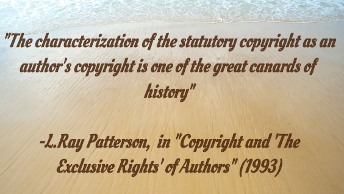
What is the point of having such a system? Is the law merely to benefit an investor, seeking to invest in already viral content, at the cost of the cultural enrichment of the society? No wonder the idea of Copyright, and its ideological symbolism of being hailed as an author’s prime tool, is nothing but one of the greatest canards of history.

I understand the argument that the author may be happy with whatever he has gotten, given Rs. 3 lakhs plus some meek royalties (if and when he gets that is) would be a huge sum for someone who used to sell peanuts + the amount of fame + ripple effect gigs, advertisements, etc. – but to me- that is exactly the problematic point:

If the author receives an amount “x” as the economic incentive to produce the work, in lieu of their copyrights, and they are happy with it (given the virality and prospects, etc.), what is the need for any further tax on the public to access the said work? Doesn’t the role of Copyright as a regulative policy end there? If there is no other recoupment for the author and the author is simultaneously happy, why more access fee in the name of either incentives or just desserts or whatever?

Especially considering the internet and its long tail, why is there for any need for a rate – x+y to be paid- where “y” merely goes to corporate investors seeking to make money out of aggressive enforcement of copyrights?

In my opinion, especially in the context of content that is already viral even before record labels/distributors/publishers step in, this additional amount “y” that is levied as a tax on users, is an unjustifiable deadweight loss and nothing else. The mere disbursal of a lump sum payment cannot be a ground to justify this deadweight loss as a desirable policy, given the undesirable tradeoff of a concurrent tax “y” and continued exclusivity in the hands of a corporate entity (non-creator). Maybe we need to figure out a way that this amount “x”, in Bhuban’s case Rs. 3,00,000, reaches out to him quickly from users directly- and maybe we need to figure out an efficient system in respect thereof- but allowing intermediation, assignments, and continued exclusivity (resulting in immeasurable further tax on users and downstream creators), just because a lump sum by an intermediary is easier- is not a ground to justify beyond incentive payments by users for access and use. It goes over and above the actual intent of copyright and is merely a problem of laze.

We ought to realize this and push for disintermediation in Copyright policy (banning assignments or alienation by authors in favor of corporates), especially in the era of the internet. But for disintermediation- we are gravely and adversely affecting cultural engagement, enrichment, and freedom- something which is paradoxical to the goal of copyright and cultural policy. In a copyright scheme where no transformative usage is recognized (unless it is for personal/private purposes, research purposes, or parodical/critical purposes), such change is all the more required to ensure that copyright incentives, which do not even go back to the author, do not freeze cultural engagement and democracy- or the ability of situated users to talk back and present their cultural narrative in an accommodative permissive cultural space.

This is FOR both the author and the user (aren’t they the same?), and only against a corporate investor- who ideally should really have no stake in Copyright policy, but unfortunately has the most. Who knows, as Oren Bracha argues– the history of IP (commodification of expressions (might actually be the history of capitalism, which is an unfortunate truth.

Part 2- On the hard case here.

Part 3- Resolving the hard case here.

Part 4- Alpana Roy on Decolonizing IP here.