
IP Mosaic, last year i.e., in 2020, was special. It was the first time I attended an IP Conference, because a friend was incidentally presenting. It was then that I got to hear from a few of the most amazing critical Intellectual Property Scholars- people like Prof. Brian L. Frye, Prof. Anjali Vats, Prof. Betsy Rosenblatt, Prof. Carys Craig, Prof. Bita Amani, among many others. The conference was very influential for me, in the sense, it imbibed this new way to look at IP scholarship. Since, I have even had the pleasure of working on some projects with Prof. Brian Frye and Prof. Anjali Vats.
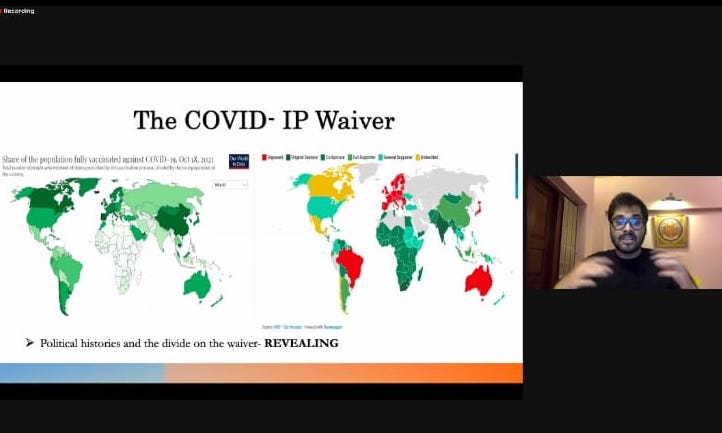
Yesterday, at the 7th IP Mosaic Conference 2021, titled- IP as protest, change and empowerment, hosted by the Institute for Intellectual Property and Social Justice, Washington DC, along with MH School of Law in the US, I finally got to present my upcoming paper (almost in the final stages) titled- “Waiving Windfalls: A socio-legal and contextual justification of a TRIPS Waiver during the COVID-19 pandemic”, in the panel titled “Patents and public health”. The panel included Prof. Muhammed Zaheer Abbas (inspiring scholarship), Prof. Mason Marks and of course the moderator Prof. Sharon Sandeen (@TradeSecretProf).
Coming to my paper, it is NOW uploaded on SSRN, however as a gist, the trigger of the paper was the Second Wave and my experiences during the devastating and frustrating situation in India. People running to Courts for oxygen, hospital beds (anyone who was in Delhi then, would completely relate to what I am referring to), a tab of Remdesivir or Tocilizumab, got me thinking – how did we even get here!
The paper goes on to specifically look at the contextual political history in terms of IP regimes, the “gradualism” or the transition period afforded to developing nations – and how our global trade mechanisms are completely unmindful of accommodating these political historical realities, which were not within the control of most of the nations, now struggling to serve the health needs and priorities of their domestic population. I go on to bat for the essence of a waiver provision in the WTO Agreement, and use historical instances where waivers have been granted, as well as the political histories of the countries batting for a waiver, as against those opposing it, to justify the fact that IT’S NOW OR NEVER.
The main theme and focus of the paper is on colonial de-linking of pharmaceutical trade and IP laws.
“De-Colonizing IP requires an alternate accent – where global trade ought to be looked at from the eyes of geo-historical attentiveness. The essence of distributive justice, especially in the grim situation that we face today, lies in realizing the importance of the historical context, i.e., this context of prolonged inability, not due to controllable forces or complacency or a lack of merit, but rather due to global acts of suppression, accounted for in real history.”
Anyway, for more, here is the abstract and the (highly textual) slides which I used in the presentation.
Here is the full paper- up for comments and opinions.
Alternatively, the slides can also be accessed here:
Thanks a lot to IIPSJ and Prof. Sharon Sandeen for this opportunity. The paper will be out on SSRN very soon.
 IP Musings